

SMR Data Center Power, Deep Fission $40 M IPO, 18.5 GW LOIs, and 2 Competitor IPOs (2021 to 2026)
Industry Risks: SMRs Pivot to Data Centers as Utility Projects Stall
The Small Modular Reactor (SMR) market has pivoted from pursuing large, complex utility-scale grid projects to targeting a more commercially agile segment: behind-the-meter power for AI data centers. This shift is a direct response to the slow progress and high-profile cancellations in the utility sector, contrasted with the acute and immediate power demand from hyperscalers that cannot be met by an already constrained grid. Developers now prioritize a standardized, factory-built product model aimed at private industrial customers who are willing to underwrite first-of-a-kind deployment risks to secure reliable, carbon-free power.
- Between 2021 and 2024, the primary commercial model for advanced nuclear focused on utility power purchase agreements, exemplified by Nu Scale Power’s Carbon Free Power Project (CFPP) in Idaho. The cancellation of this project in late 2023 due to escalating costs exposed the financial fragility of the utility-led model.
- Starting in 2025, a new model gained traction, with developers like Deep Fission, NANO Nuclear, and X-energy structuring their commercial strategy around providing direct power to data centers. This bypasses utility procurement processes and long grid interconnection queues, which can exceed a decade.
- Deep Fission’s June 2026 IPO, explicitly for funding reactors for data centers, validated this strategic pivot. Just after its IPO, the company announced it had signed non-binding Letters of Intent (LOIs) for a potential 18.5 GW of generation capacity with data center operators and industrial parks, signaling strong market pull.
- This customer segment requires a different product: smaller microreactors (1-20 MWe) or small reactors (up to 300 MWe) that can be deployed modularly on-site, contrasting with the larger designs previously intended for grid sale. The demand from tech giants like Microsoft and Google provides a concentrated and well-capitalized customer base that did not exist for the utility model.
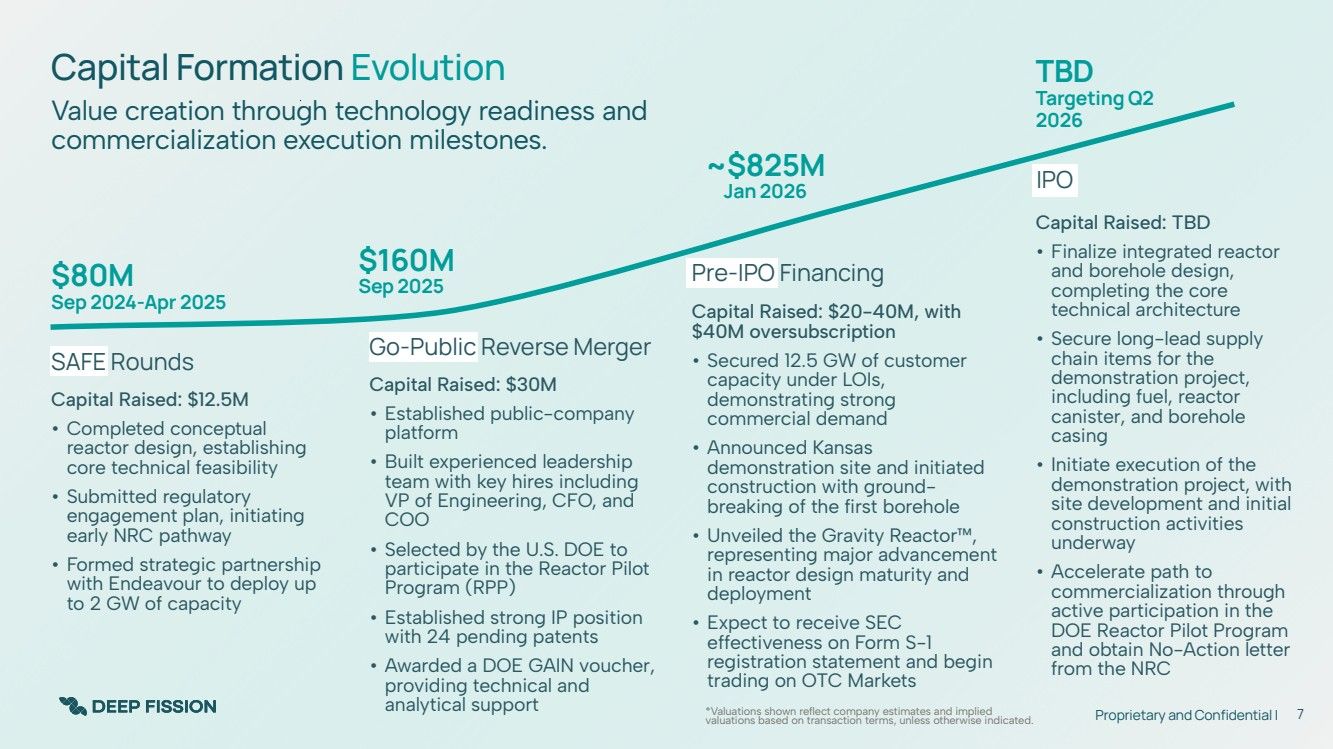
Deep Fission Nears Q2 2026 IPO with $825M Pre-IPO Valuation & 12.5 GW Customer LOIs
Deep Fission is rapidly advancing towards a Q2 2026 IPO, having secured an ~$825M pre-IPO valuation in January 2026. This significant capital formation is bolstered by securing 12.5 GW of customer capacity under LOIs and a strategic partnership with Endeavour for 2 GW of micro-reactor deployment.
Micro-Reactors Poised for Critical Infrastructure Deployment by 2026
The successful capital raises and significant customer commitments underscore robust market demand and investor confidence in Deep Fission’s micro-reactor technology. This progression, including regulatory engagement and a demonstration project, validates micro-reactors as a scalable, behind-the-meter power solution critical for energy-intensive applications like data centers.
Deep Fission Eyes $200M Capital for Subsurface SMR Deployment by 2025
Deep Fission seeks $200 million in capital by 2025 to deploy its first commercial subsurface SMR. Despite a 2025 net loss of $61.0 million and a ~$1.08 million monthly cash burn, its modular 15 MWe reactor capacity is specifically designed for incremental scaling to support hyperscale data centers, leveraging proven PWR technology.
(Source: EIA Gives Update on Small Modular and Microreactors)
Investment Analysis: Deep Fission IPO Signals High-Risk, High-Reward Market
Public market financing has emerged as the primary vehicle for funding the capital-intensive path to SMR commercialization, but investor sentiment is tempered with significant execution risk. While the successful IPOs of several nuclear developers confirm market appetite, the wide gap between initial valuation targets and final capital raised, as seen with Deep Fission, shows that investors are pricing in the immense regulatory, construction, and timeline risks inherent to nuclear projects. The capital raised is a fraction of what is needed for full-scale deployment, positioning these IPOs as a bridge to major regulatory and commercial milestones rather than full project financing.
- Deep Fission’s IPO in June 2026 provided a clear barometer of investor sentiment. The company initially targeted raising over $150 million at a $1.66 billion valuation but ultimately secured only $40 million, a 73% reduction from its goal.
- This contrasts with the April 2026 IPO of X-energy, which successfully raised $1 billion, demonstrating that investors differentiate based on technology maturity, regulatory progress, and existing commercial agreements.
- The purpose of this capital is not for widespread manufacturing but for “first-of-a-kind-engineering” (FOAKE), completing detailed designs required for regulatory review by the U.S. Nuclear Regulatory Commission (NRC), and securing the supply chain for the initial reactor.
- This funding stage is an execution play, moving beyond the venture-backed “thesis validation” stage. The modest amount raised by Deep Fission leaves no room for error and heightens the importance of securing federal grants or a strategic anchor customer to de-risk the path to commercial operation.
Partnership Data: From MOUs to Firm Contracts
The primary signal of commercial traction in the behind-the-meter nuclear market is the conversion of non-binding agreements into firm, bankable offtake contracts. In 2026, the industry is dominated by Memorandums of Understanding (MOUs) and Letters of Intent (LOIs), which demonstrate significant customer interest but carry no financial commitment. These agreements are a necessary first step to show regulators and investors a clear path to market, but the sector’s credibility hinges on translating this pipeline into binding projects with major data center operators.
- In June 2024, Deep Fission announced it had secured non-binding LOIs for 18.5 GW of potential capacity from data center operators and industrial clients. This large figure is an indicator of market size and interest, not a guaranteed order book.
- In May 2026, NANO Nuclear signed a strategic MOU with server manufacturer Supermicro to develop and market a standardized microreactor power solution for data centers. This alliance aims to create a pre-integrated “power-plus-compute” offering, simplifying procurement for customers.
- The next critical milestone for the sector will be the announcement of a binding, long-term Power Purchase Agreement (PPA) with a hyperscale data center operator like Microsoft, Google, or a large colocation provider. Such an agreement would provide the financial certainty needed to unlock project financing for the first commercial reactors.
Table: SMR Data Center Agreements in 2026
| Company & Partner(s) | Time Frame | Details and Strategic Purpose | Source |
|---|---|---|---|
| Deep Fission & Data Center/Industrial Park Operators | Jun 2026 | Announced non-binding Letters of Intent (LOIs) for a potential 18.5 GW of generation capacity. This serves as a key signal of market demand used to attract post-IPO investors and support regulatory applications. | Interesting Engineering |
| NANO Nuclear & Supermicro | May 2026 | Signed a strategic Memorandum of Understanding (MOU) to jointly design and market a standardized microreactor power solution for Supermicro’s global customer base, aiming to create an integrated product. | Nasdaq |

Deep Fission Nears IPO with $825M Valuation & 12.5 GW LOIs
Deep Fission is rapidly advancing towards a Q2 2026 IPO, having achieved an estimated ~$825M valuation by Jan 2026. The company boasts significant commercial traction, with 12.5 GW of customer capacity secured under LOIs, demonstrating strong demand for its micro-reactor technology. Preparations include an S-1 filing and OTC Market trading, supported by 24 pending patents and DOE program participation.
12.5 GW LOIs Validate Distributed Nuclear for Critical Loads
Deep Fission’s 12.5 GW of customer capacity under LOIs highlights significant market validation for distributed micro-reactor technology, especially for high-demand applications like data centers. This signals a strategic shift towards energy independence and resilience for critical infrastructure, reducing reliance on aging grids and unlocking new opportunities in high-power compute.
Deep Fission SMRs Target Data Centers with Subsurface, Modular Power
Deep Fission’s 15 MWe modular subsurface SMRs are designed to provide behind-the-meter power for hyperscale data centers by 2025. This strategy aims to deliver secure, localized power, reducing reliance on grid infrastructure and addressing growing energy demands from compute-intensive operations.
Geographic Focus: United States as the Epicenter for Nuclear-Powered Data Centers
The United States is the undisputed center of the emerging market for nuclear-powered data centers. This is driven by the unique convergence of the world’s largest AI and cloud computing industry, a sophisticated venture capital and public market ecosystem willing to fund deep-tech, and a federal regulatory body actively reforming its processes to accelerate advanced reactor licensing. While international interest exists, all significant commercial and financial activity is currently concentrated in the U.S.
- Prior to 2024, SMR development was a global effort with notable projects proposed in Canada, the UK, and Europe, primarily for grid applications. However, these programs have been slower to materialize compared to the recent U.S. acceleration.
- The concentration of hyperscale data centers in specific U.S. regions, particularly Virginia, Ohio, and Texas, creates dense pockets of power demand that are overwhelming local grids. This makes these states prime targets for SMR deployment.
- The U.S. Nuclear Regulatory Commission (NRC) is a key enabler. Its work on a new, streamlined licensing framework under Part 53, finalized in July 2026, is specifically designed for advanced reactors and aims to reduce review timelines from years to months, a critical factor for market viability.
- Federal financial incentives from the Inflation Reduction Act (IRA), providing clean energy tax credits for nuclear power, further solidify the U.S. as the most attractive market for developers like Deep Fission and their investors.
Technology Maturity: Commercially Unproven Despite Decades of Development
The application of SMRs for behind-the-meter data center power is pre-commercial, with no operational deployments to date. While the fundamental nuclear fission principles are mature, the specific innovations being pursued, such as Deep Fission’s underground deployment or advanced fuel types, have yet to be built and licensed for commercial use. The industry is currently in a critical validation phase, where the primary objective is to complete the first-of-a-kind (FOAK) engineering, navigate the NRC licensing process, and build the first commercial unit to prove the economic and operational model.
- From 2021-2024, technology maturity was measured by progress in research, development, and government-funded demonstrations. The focus was on proving reactor physics and safety cases in laboratory or test environments.
- Since 2025, the metric for maturity has shifted to commercial and regulatory execution. Key milestones now include the submission of licensing applications to the NRC, securing capital through public offerings, and establishing a manufacturing supply chain for components like fuel and pressure vessels.
- Deep Fission’s technology, which proposes placing a reactor a mile underground, introduces novel engineering and safety arguments that must be validated through the NRC’s rigorous review process. Its success depends entirely on regulatory approval, which remains a multi-year risk.
- The supply chain for critical components, particularly High-Assay Low-Enriched Uranium (HALEU) fuel, remains a significant bottleneck. While companies like Centrus and Orano are building domestic capacity with government support, fuel availability is a key dependency for all advanced reactor developers.
Scenario Modelling: Deep Fission’s Path to Commercial Viability
The most critical factor for Deep Fission and its competitors in the next 12-24 months is converting market interest into a bankable commercial project. Success is not guaranteed by a downsized IPO or a large pipeline of non-binding LOIs. The key signal to watch is the announcement of a binding, long-term power purchase agreement with a creditworthy hyperscale customer. Without this, the company will struggle to secure the much larger project financing required to build its first reactor.
- If Deep Fission successfully converts one of its 18.5 GW of LOIs into a firm contract with a major data center operator, then watch for the company to immediately seek a combination of federal loan guarantees and a larger follow-on equity or debt offering to fund construction.
- The primary signal to monitor is the company’s progress with the U.S. Nuclear Regulatory Commission. Submitting a formal license application would be a major de-risking event, providing investors with a clear timeline and technical validation.
- An alternative scenario is that data center operators, wary of the long timelines and risks of nuclear, opt for more immediate solutions. The rapid deployment of on-site gas-fired power plants or large-scale battery projects from firms like Tesla could satisfy near-term demand, pushing out the adoption timeline for nuclear solutions and making it harder for developers to secure their first customers.
The questions your competitors are already asking
This report covers one angle of small modular reactor commercialization. The questions that matter most depend on your work.
- List of nuclear companies for data center power
- Data center nuclear reactor construction timelines
- US government approval process for small nuclear reactors
- Cost comparison of data center power sources
This report does not answer these. Enki Brief Pro does.
Your question, your angle, your framework. SWOT, PESTL, scenario modelling. The same niche depth, built around the decision your work actually depends on.
