

EU Refined Product Supply Chains, 3.2% Inflation, 75% Jet Fuel Import Cut, and Emergency Reserve Releases (2025 to 2026)
EU Supply Chain Risk, 14% Global Refining Share, and Import Dependency (2025 to 2026)
Europe’s long-term decline in domestic refining capacity has created a critical vulnerability, directly exposed by the 2026 geopolitical shock, which shifted the primary market risk from price management to preventing physical supply shortages.
- Between 2021 and 2024, the strategic focus for Europe’s downstream sector was on decarbonization and managing post-pandemic demand recovery, with refinery closures often framed as progress toward climate goals. The risk of this shrinking capacity was largely a theoretical, long-term concern.
- The 2025-2026 period has abruptly changed this. The geopolitical conflict disrupting the Strait of Hormuz has turned the theoretical risk into an acute crisis. The continent’s reliance on imported refined products, a consequence of its share of global refining capacity falling from 22% in 2000 to 14% today, is now its primary economic security weakness.
- The immediate commercial impact is the tangible threat of fuel shortages, particularly for diesel and jet fuel. The crisis has cut an estimated 75% of Europe’s jet fuel imports from the Middle East, a shortfall of approximately 300, 000 barrels per day that cannot be easily replaced.
- This supply-side crisis has triggered demand destruction at the consumer level, as record-high prices force drivers to cut fuel consumption. The situation is also accelerating the search for alternatives, notably boosting sales of used electric vehicles as a hedge against fossil fuel volatility.
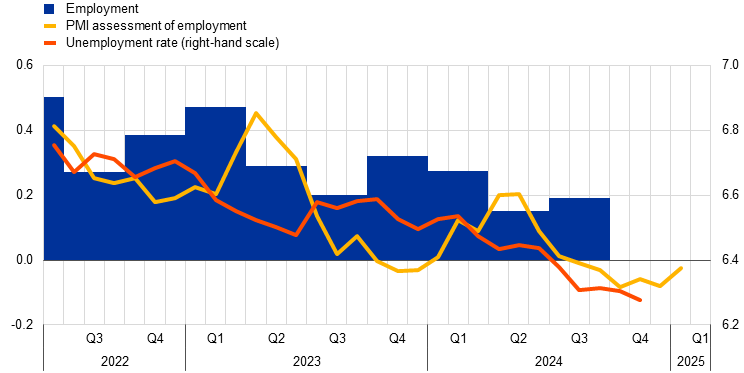
Economic Indicators Show Declining Trends in 2025
The section discusses the EU’s supply chain risks and import dependency for 2025-2026. This chart visually corroborates the theme by showing declining economic indicators in 2025, illustrating the tangible negative consequences of these structural vulnerabilities leading into the crisis period.
(Source: European Central Bank – European Union)
EU Growth Forecasts Slashed: 0.2% Growth Predicted by Allianz Amid 3.2% Inflation
The energy price shock has triggered significant downward revisions to Eurozone economic growth forecasts, pushing the region toward a stagflationary environment of high inflation and near-zero growth.
- The European Commission officially cut its 2026 economic growth forecast for the EU, citing the energy shock from the Strait of Hormuz crisis as the primary factor eroding both consumer and business confidence.
- Germany, Europe’s largest economy, is now projected to expand by a mere 0.6% in 2026, struggling to gain momentum after years of recession and weak growth, further weighing on the bloc’s overall performance.
- Private sector forecasts are even more pessimistic. Allianz Research predicts the Eurozone could fall into a technical recession, with annual growth potentially as low as +0.2% for 2026 under a stagflationary scenario.
- International bodies have echoed these concerns. The IMF warned in April 2026 that while its baseline forecast for Euro Area inflation was 2.6%, a deeper shock could push the figure significantly higher and severely curtail economic activity.

Energy Shock Drives Euro Area Inflation to 3.2%
The match is a direct confirmation of the section’s headline. The section explicitly states a predicted inflation rate of 3.2% for the EU, and the chart’s headline confirms this exact figure for the Euro Area, attributing it to an energy shock.
(Source: Stock Market Update – Substack)
Table: Eurozone Economic and Inflation Forecasts (2026)
| Metric | Forecast Provider | Date | Value | Source |
|---|---|---|---|---|
| Eurozone Economic Growth | Allianz Research | Mar 2026 | +0.2% | Allianz.com |
| Eurozone Economic Growth | European Commission | May 2026 | Downgraded | Euronews |
| Eurozone HICP Inflation | IMF | Apr 2026 | 2.6% (with upside risk) | TRT World |
| Eurozone HICP Inflation (May) | Eurostat (reported) | Jun 2026 | 3.2% | Mena FN |

Eurozone Business Activity Contracts in Early 2026
The section refers to a table of economic forecasts for 2026. This chart visualizes a key component of such forecasts, showing a contraction in Eurozone business activity in early 2026, a primary indicator of economic health.
(Source: Stock Market Update – Substack)
Emergency Alliances: US Supplants Middle East as Key EU Fuel Supplier Amid Hormuz Crisis
In response to the supply crisis, European nations have activated coordinated emergency reserve releases while the United States has emerged as a critical alternative supplier, fundamentally reorienting transatlantic energy trade flows.
- The European Union activated an emergency jet fuel release framework to stabilize supply, with countries including Ireland, Spain, Germany, Italy, and France participating in a coordinated release from their strategic reserves. As of the latest reading, these reserves stood at a collective 108.6 million tonnes.
- The United States has stepped in to fill a critical supply gap, particularly for jet fuel. U.S. jet fuel exports to Europe reached 131, 000 barrels per day in April 2026, making it a crucial swing supplier and mitigating the worst effects of the Middle East disruption.
- This ability to pivot exports highlights the dynamic nature of the US energy market, which is simultaneously grappling with its own domestic challenges, such as integrating massive new electricity demand from AI data centers in regions like Virginia.
- The crisis has exposed the deep vulnerabilities tied to specific geopolitical chokepoints. The disruption in the Strait of Hormuz, which handles a significant portion of global energy trade, has forced a rapid and painful re-evaluation of supply chain resilience across the EU.

US Inflation Remains Elevated at 3.3% in 2026
As the section describes the US becoming a key fuel supplier to the EU, this chart provides essential economic context on the new partner. Elevated inflation in the US is a relevant factor that would influence its export capacity and pricing during the crisis.
(Source: Reddit)
Table: Coordinated Supply Responses to the 2026 EU Energy Crisis
| Partner / Action | Time Frame | Details and Strategic Purpose | Source |
|---|---|---|---|
| EU Member States (Ireland, Spain, Germany, Italy, France, etc.) | Apr 2026 | Coordinated release of jet fuel from strategic emergency reserves to prevent widespread flight cancellations and stabilize the aviation market. | Travel And Tour World |
| United States Exports to Europe | Apr 2026 | Acted as a key alternative supplier, exporting 131, 000 barrels per day of jet fuel to Europe to help offset the loss of Middle Eastern supplies. | S&P Global |

Eurozone Inflation Trends Show Post-Spike Moderation
The section discusses coordinated responses to the 2026 energy crisis. This chart illustrates the potential positive outcome of such policy actions, showing inflation trends moderating after an initial crisis-driven spike.
(Source: eaccny)
European Fuel Price Disparity: German and Dutch Drivers Face Over €2.00/Litre
The impact of the energy shock is unevenly distributed across Europe, with countries heavily reliant on road transport and possessing high fuel taxes, like Germany and the Netherlands, experiencing the most severe price hikes and consumer pressure.
- In March 2026, Dutch drivers faced the highest petrol prices in Europe at an average of €2.17 per litre, with Germany close behind at €2.08 per litre. These prices directly reflect the combination of the crude oil surge and high national excise duties.
- By contrast, prices in other member states like Spain remained comparatively lower at €1.53 per litre as of June 2026, though still representing a significant burden on consumers. The UK saw average petrol prices reach 144 pence per litre (approximately €1.68) in late March 2026.
- This price disparity is largely explained by national tax policies. Taxes account for 50-60% of the final retail fuel price in many European countries, amplifying the impact of wholesale price spikes on consumers and businesses.

European Fuel Prices Surge Amid Energy Crisis
This is a direct and clear match. The section focuses on the high cost of fuel for consumers in Europe, and the chart’s headline perfectly encapsulates this by stating that European fuel prices are surging due to the energy crisis.
(Source: WSJ)
EU Refining Infrastructure: Decades of Decline Expose 2026 Commercial-Scale Shortfalls
The 2026 crisis validates that Europe’s downstream refining and import infrastructure, despite being a mature technology, has reached a state of strategic deficit, rendering it unable to absorb significant geopolitical supply shocks.
- In the 2021–2024 period, the narrative surrounding European refining was dominated by decarbonization. Refinery closures and conversions to biofuel production were viewed as necessary steps in the energy transition, with little strategic focus on the resilience of the remaining fossil fuel supply chain.
- The 2025-2026 energy shock has validated the commercial-scale risk of this strategy. With domestic refining capacity diminished, Europe lacks the buffer to absorb major disruptions to refined product imports, making it highly vulnerable to price volatility and physical shortages.
- The decline of the EU’s share of global refining capacity from 22% to 14% since 2000, while Asia’s share grew from 26% to 36%, is the key validation point of this long-term structural weakness.
- The crisis is now forcing a strategic re-evaluation where energy security and infrastructure resilience are being prioritized alongside decarbonization, shifting the focus from managed decline to securing a baseline of domestic production capability.
Scenario Modelling: A Prolonged Hormuz Closure Could Push Diesel to $300/bbl
The critical variable for the European economy in the year ahead is the duration and severity of the Strait of Hormuz disruption; a prolonged closure would escalate the current crisis into a full-blown economic recession driven by extreme energy prices and rationing.
- If this happens: A sustained closure of the Strait of Hormuz, a chokepoint for global energy trade, would trigger a severe global supply shock. Watch this: Projections from analysts like Wood Mackenzie indicate that in such a scenario, prices for refined products like diesel and jet fuel could surge towards $300/bbl by the end of the year.
- This could be happening if: European governments move beyond strategic reserve releases and begin implementing fuel rationing for consumers or businesses. Widespread, sustained flight cancellations due to a physical lack of jet fuel, rather than price, would be a definitive signal of this severe outcome.
- Watch this: The European Central Bank (ECB) would face an impossible dilemma. It would be under immense pressure to raise interest rates to combat soaring inflation while the economy simultaneously plunges into a deep, energy-induced recession, a classic stagflation trap.
- This could be happening if: The sales growth of used and new EVs, already rising, accelerates dramatically. A sustained fuel crisis would shift the EV from a discretionary purchase to an economic necessity for maintaining personal and commercial mobility, fundamentally altering the vehicle market.
The questions your competitors are already asking
This report covers one angle of the downstream energy supply crisis in Europe. The questions that matter most depend on your work.
- What is the status of emergency strategic petroleum reserve releases in key EU member states?
- What is the outlook for EV adoption in Europe through 2026, and how is the fuel crisis impacting the new vs. used market?
- What are the supply opportunities for US and Asian refiners to fill Europe’s 300,000 bpd jet fuel shortfall?
This report does not answer these. Enki Brief Pro does.
Your question, your angle, your framework. SWOT, PESTL, scenario modelling. The same niche depth, built around the decision your work actually depends on.
