

Qatar Energy Solar Strategy, 2 GW Samsung Agreement, 875 MW Commissioned, and 2 Major Projects Online (2025)
875 MW Online, Qatar Energy Centralized Solar Adoption
Qatar Energy’s 2025 strategy materializes its long-term plan, prioritizing the deployment of large-scale, centralized solar projects to build a foundational renewable grid, a significant acceleration from the planning and initial construction phases of the 2021-2024 period.
- The commissioning of two large-scale solar projects with a combined capacity of 875 MW in April 2025 marked a pivotal shift from ambition to operational reality. This contrasts with the prior period, which was largely defined by the construction of the foundational 800 MW Siraj 1 plant.
- The agreement with Samsung in September 2025 to construct the massive 2, 000 MW (2 GW) Dukhan solar plant confirms a strategic decision to focus on utility-scale assets first. This approach allows for faster capacity deployment and economies of scale, establishing a stable grid backbone before tackling the more complex integration of distributed generation like rooftop solar.
- This solar expansion is directly funded by record revenues from Qatar Energy‘s core liquefied natural gas (LNG) business. The continued investment in the North Field expansion projects provides the financial engine to de-risk these capital-intensive, multi-billion dollar renewable energy ventures.
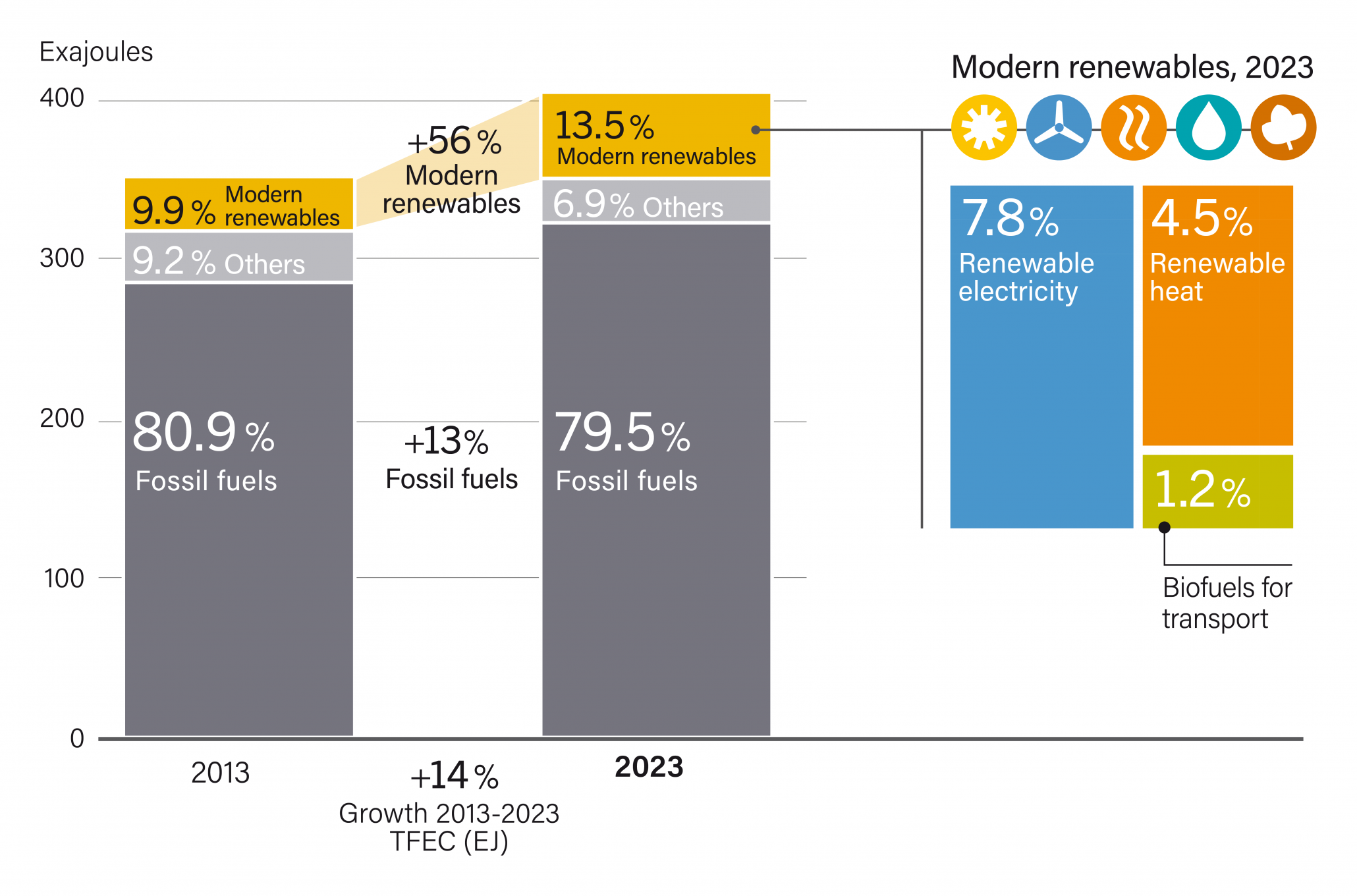
Modern Renewables Share in Energy Mix Grows
The commissioning of 875 MW of solar power represents a key milestone, directly contributing to the increasing share of modern renewables in Qatar’s energy mix as visualized in the chart.
(Source: REN21)
Qatar Energy $7 B Regional Investment and 2 GW Dukhan Solar Plant (2025)
In 2025, Qatar Energy’s investment strategy is characterized by using profits from its core hydrocarbon business to fund multi-billion dollar domestic solar infrastructure and diversify its international asset portfolio.
- The primary domestic investment is the commitment to the 2 GW Dukhan solar plant. While the exact capital expenditure was not disclosed, projects of this magnitude represent a multi-billion dollar investment set to double the nation’s solar capacity to over 4 GW.
- Internationally, the Golden Pass LNG export project in Texas, where Qatar Energy is a majority stakeholder, is scheduled to begin production by the end of 2025. This represents a major overseas investment to geographically diversify its LNG production and export capabilities.
- The involvement of Qatari company UCC Holding in a consortium making a landmark US$7 billion investment in Syria’s energy sector highlights the nation’s broader strategy of using its financial strength for regional influence, complementing Qatar Energy‘s direct project investments.

Qatar Solar Market to Reach $1.8B by 2031
The $7 billion regional investment, including the development of the 2 GW Dukhan solar plant, is a primary catalyst for the solar market’s projected expansion to $1.8 billion by 2031.
(Source: Verified Market Research)
Table: Qatar Energy Strategic Investments (2025)
| Partner / Project | Time Frame | Details and Strategic Purpose | Source |
|---|---|---|---|
| Dukhan Solar Power Plant | Sep 2025 | Agreement signed with Samsung for a 2, 000 MW plant. This project is a cornerstone of the national strategy to reach over 4 GW of solar capacity and reduce domestic gas consumption. | Qatar Renewable Energy Market Growth, Share & Forecast 2025-2033 |
| Golden Pass LNG Project | May 2025 | The LNG export project in the United States is set to begin production by the end of 2025, diversifying Qatar Energy‘s asset portfolio and capturing opportunities in the North American market. | Qatar Energy’s LNG Project in USA to Start Production by End of 2025 |
| North Field Expansion Project | May 2025 | Continued investment in the massive gas expansion projects that will boost Qatar’s LNG production capacity to 126 million metric tons per annum, providing the primary revenue stream for renewable investments. | LNG output from Qatar Energy’s North Field expansion to start in … |

Qatar’s Massive Gas Spending Shown
This chart offers a macro view of the significant capital allocated to gas projects, which is a cornerstone of Qatar Energy’s strategic investments detailed in the accompanying table.
(Source: Al Jazeera Centre for Studies)
Partnership Analysis, Qatar Energy Samsung and Total Energies Deals
Qatar Energy’s 2025 partnerships reinforce its dual strategy, securing technical expertise for massive renewable projects through agreements with firms like Samsung, while locking in long-term hydrocarbon revenue with partners like Shell and India’s GSPC.
- The development agreement with Samsung for the 2 GW Dukhan solar plant is the year’s most significant renewable partnership, securing a world-class engineering, procurement, and construction partner to execute its flagship solar project.
- The company continues to leverage its existing joint venture consortium with partners including Total Energies and Marubeni for developing large-scale solar. This model, where Qatar Energy holds a majority stake, allows it to maintain strategic control while benefiting from partner expertise.
- A landmark 25-year condensate supply agreement was signed with Shell, ensuring a reliable, long-term offtake for products from the North Field expansion and solidifying a relationship with a key international oil company.
- A collaboration with General Electric aims to develop a comprehensive roadmap for carbon capture, a critical component for decarbonizing its LNG facilities and creating the infrastructure for a future blue hydrogen economy.

Qatar’s LNG Export Destinations and Timelines
Partnerships with international majors like TotalEnergies and the shipbuilding capacity from deals with Samsung directly impact Qatar’s ability to serve a diverse portfolio of LNG export destinations, as shown in the chart.
(Source: ScienceDirect.com)
Table: Qatar Energy Key Partnerships (2025)
| Partner / Project | Time Frame | Details and Strategic Purpose | Source |
|---|---|---|---|
| Samsung | Sep 2025 | Development agreement for the 2, 000 MW Dukhan solar power plant, securing a key construction partner for doubling Qatar’s solar generation capacity. | Qatar Renewable Energy Market Growth, Share & Forecast 2025-2033 |
| Gujarat State Petroleum Corporation (GSPC) | Oct 2025 | A 17-year LNG supply agreement to provide up to 1 million tons per annum to India, securing a long-term customer for its expanding LNG production. | Qatar Energy signs 17-year LNG supply agreement with India’s GSPC |
| Shell International | Apr 2025 | A major 25-year condensate supply agreement, ensuring a long-term, reliable offtake for the condensate produced from Qatar’s North Field expansion projects. | Qatar Energy and Shell sign a landmark 25-year condensate supply … |
| Total Energies, Basrah Oil Company | Feb 2025 | Holds a 25% stake in the Gas Growth Integrated Project in Iraq, a multi-energy project that includes a solar power plant, demonstrating its strategy of participating in integrated energy projects abroad. | GGIP: A Multi-Energy Project to Support Iraq Towards Its Energy … |

QatarEnergy’s Long-Term LNG Contract Volumes to 2054
The vast and stable long-term LNG contract volumes, extending to mid-century, are the direct result of agreements with the key partners listed in the accompanying table, securing future revenue streams.
(Source: Center on Global Energy Policy – Columbia University)
Qatar vs. USA, Qatar Energy Domestic and International Focus
In 2025, Qatar Energy’s geographic focus is sharply divided between massive domestic investments in solar and LNG infrastructure within Qatar and strategic international LNG asset expansion, primarily in the United States.
- Domestic activity is concentrated entirely on large-scale projects within Qatar. The commissioning of 875 MW of solar capacity and the initiation of the 2 GW Dukhan project demonstrate a clear priority to build out the nation’s internal renewable energy generation and reduce its own carbon intensity.
- The primary international focus in 2025 is the United States, where the Golden Pass LNG project in Texas is set to begin production by the end of the year. This marks a significant milestone in diversifying Qatar Energy‘s production base outside of the Middle East.
- Compared to the 2021-2024 period, which was characterized by extensive planning for the North Field expansion, 2025 is an execution year. Billions of dollars are being deployed to construct the physical assets that were planned, both at home and abroad.
- The partnership in Iraq’s Gas Growth Integrated Project (GGIP), which combines gas recovery with a solar plant, represents a template for future international ventures, where Qatar Energy can export its expertise in integrated energy systems.
4 GW Target, Qatar Energy Utility-Scale Solar Maturity
In 2025, Qatar Energy’s strategy confirms that utility-scale solar technology is commercially mature and ready for mass deployment, while distributed solar remains a future goal pending the establishment of this centralized backbone.
- The move in 2025 to commission 875 MW of solar and award a contract for a further 2, 000 MW represents a decisive shift from validation to mass commercialization. This builds on the success of the 800 MW Siraj-1 plant, which served as the key validation project in the 2021-2024 timeframe.
- The focus is exclusively on conventional, utility-scale photovoltaic technology. The key “maturity” being demonstrated is not in the technology itself, but in Qatar’s financial and logistical capability to execute GW-scale projects, de-risking the path to its 4 GW centralized solar target by 2030.
- In contrast, distributed solar remains an ambition rather than an operational reality in 2025. While Qatar Energy has a stated goal of 1.2 GW of distributed capacity by 2030, the year’s actions show a clear strategy of building the centralized grid foundation first, a necessary prerequisite for integrating thousands of smaller, decentralized energy sources.

Qatar Solar Capacity to Exceed 5 GW by 2031
The official 4 GW target signifies the country’s commitment to utility-scale solar, with this chart projecting that ongoing developments will help Qatar surpass 5 GW of total capacity by 2031.
(Source: Mordor Intelligence)
SWOT Analysis, Qatar Energy Strengths and Transition Risks
Qatar Energy’s primary strength is its ability to self-fund a massive energy transition from its unparalleled LNG revenues, but this creates a weakness of dependency on hydrocarbon market stability and an external threat from global decarbonization pressures.
- Strength: The company’s financial power, underwritten by long-term LNG contracts, allows it to undertake multi-billion dollar renewable projects without seeking external project finance, providing a significant competitive advantage.
- Weakness: The strategy’s dependence on LNG profits creates a structural vulnerability. Any long-term decline in global gas demand or prices could directly impact the funding available for its solar, CCUS, and hydrogen ambitions.
- Opportunity: By building a GW-scale solar base, Qatar Energy is creating the necessary infrastructure to become a future leader in producing and exporting green hydrogen, leveraging its existing energy export logistics.
- Threat: Aggressive renewable and hydrogen strategies from other petrostates, such as the UAE’s Masdar, create a competitive dynamic for capital, technology, and future market share in clean energy.

Qatar’s Share of Spot LNG Market Declines
This chart highlights a key transition risk for Qatar Energy; while long-term contracts are a strength, a declining share in the flexible spot market represents a potential threat to be addressed.
(Source: Center on Global Energy Policy – Columbia University)
Table: SWOT Analysis for Qatar Energy’s Dual Strategy (2025)
| SWOT Category | 2021 – 2024 | 2025 | What Changed / Validated |
|---|---|---|---|
| Strength | Financial strength based on existing LNG operations and North Field expansion planning. | Revenue streams are locked in through new long-term SPAs (e.g., with India’s GSPC). Investment capacity is being actively deployed into solar. | The strategy to monetize gas to fund renewables was validated, moving from a plan to active, large-scale deployment. |
| Weakness | High domestic carbon intensity and reliance on fossil fuel revenue streams for national income. | The dual-track strategy continues, reinforcing dependence on LNG profits to fund the transition. Investments in CCS are initiated but are long-term solutions. | The core weakness of hydrocarbon dependency is unchanged, but the scale of the commitment to renewables as a hedge has become more concrete. |
| Opportunity | Stated national goals for renewable energy (Qatar National Vision 2030) and emissions reduction. | Concrete projects (875 MW commissioned, 2 GW Dukhan agreement) give credibility to the 4 GW solar target. A market for distributed solar is emerging. | The opportunity shifted from a policy goal to a tangible, multi-billion dollar industrial project pipeline, creating a de-risked market for contractors like Samsung. |
| Threat | General global pressure for decarbonization and competition from other energy producers. | Specific competitive actions from regional players (e.g., UAE’s Masdar developing over 15 GW of wind) and the start of production at international LNG projects (Golden Pass). | The competitive landscape became more defined, with petrostate rivals demonstrating tangible progress in specific renewable technologies, increasing pressure on Qatar to execute its plans. |

GCC Dominates Regional Energy Demand Growth
The strong regional energy demand growth, dominated by GCC neighbors, presents a significant ‘Opportunity’ for Qatar Energy’s dual strategy, creating markets for both its gas and developing solar exports.
(Source: Middle East Institute)
Qatar Energy 2026 Outlook, North Field East and Dukhan Progress
The critical path for Qatar Energy’s dual strategy hinges on the timely execution of two key projects: the North Field East expansion starting production in mid-2026 and the visible start of construction on the Dukhan solar plant.
- If the North Field East expansion begins production on schedule in mid-2026, watch for an immediate increase in cash flow that could accelerate investment decisions for the next wave of renewable projects and hydrogen infrastructure.
- If construction on the 2 GW Dukhan solar plant visibly ramps up and meets early milestones through 2026, it will validate Qatar Energy‘s ability to execute GW-scale renewable projects. This would de-risk future investments and attract further international partners.
- The signal that could be happening is the announcement of a formal policy framework or pilot programs for distributed solar. Such a move would indicate that with the centralized foundation under construction, the focus is beginning to shift toward enabling the distributed energy market envisioned for the post-2025 era.

Qatar to Lead Third Wave of LNG Expansion
The 2026 outlook is heavily defined by progress on the North Field East expansion, which this chart confirms will position Qatar to spearhead the next major wave of global LNG supply.
(Source: Center on Global Energy Policy – Columbia University)
The questions your competitors are already asking
This report covers one angle of QatarEnergy’s rapid expansion into large-scale solar power. The questions that matter most depend on your work.
- QatarEnergy investments and funding. Is the 2 GW Dukhan solar plant project on track for its target commissioning date?
- What is actually happening with the 875 MW of newly commissioned solar capacity since April 2025? Is it meeting performance and grid integration targets?
- Who are QatarEnergy’s key EPC and technology suppliers for its multi-gigawatt solar expansion, beyond the Samsung agreement?
- What are the opportunities for distributed generation and rooftop solar in Qatar, given the current focus on centralized utility-scale projects?
This report does not answer these. Enki Brief Pro does.
Your question, your angle, your framework. SWOT, PESTL, scenario modelling. The same niche depth, built around the decision your work actually depends on.
