

Top 10 SOFC Projects for Data Centers: 2.45 GW Oracle Deal and 900 MW Wyoming Campus (2024-2026)
The data center industry is rapidly adopting Solid Oxide Fuel Cells (SOFCs) to solve the acute “time-to-power” crisis fueled by the explosive growth of Artificial Intelligence. This strategic shift moves facilities away from dependency on strained electrical grids, positioning SOFCs as a critical enabler of business continuity and speed-to-market. Landmark agreements, such as Bloom Energy‘s contracted deals with Oracle for up to 2.45 GW and a Wyoming AI campus for 900 MW, underscore this trend. The dominant theme for 2025 is no longer about sustainability as a secondary benefit but about on-site power generation as a primary solution for deploying AI infrastructure at the necessary scale and speed.
1. Oracle Cloud Infrastructure (OCI) Data Center
Company: Oracle
Installation Capacity: Up to 2, 450 MW (2.45 GW)
Applications: Powering AI workloads at OCI data centers
Source: Oracle to deploy up to 2.45 GW of Bloom fuel cells at New Mexico …
2. Wyoming AI Data Center Campus
Company: Unnamed AI Data Center Campus
Installation Capacity: 900 MW (Phase 1)
Applications: Primary power for a 1.8 GW AI data center campus
Source: Bloom Energy Soars on Landmark Wyoming Data Center Approval
3. American Electric Power (AEP) Framework Agreement
Company: American Electric Power (AEP)
Installation Capacity: Up to 1, 000 MW (1 GW) Framework Agreement
Applications: Powering data center campuses for customers like AWS and Cologix
Source: Bloom Energy Announces Gigawatt Fuel Cell Procurement with AEP
4. Equinix International Business Exchange (IBX) Portfolio
Company: Equinix
Installation Capacity: Over 100 MW
Applications: Primary and supplementary power for 19+ IBX data centers
Source: Bloom Energy Expands Data Center Power Agreement with Equinix …
5. Day One Singapore Data Center
Company: Day One
Installation Capacity: 20 MW
Applications: On-site hydrogen and renewable power for a new data center
Source: Singapore’s First Hydrogen-Powered Data Center by Day One
6. Intel High-Performance Computing Data Center
Company: Intel
Installation Capacity: Undisclosed “additional megawatts”
Applications: Powering a high-performance computing data center
Source: Bloom Energy Announces Largest Silicon Valley Data Center Power …
7. Core Weave Data Center
Company: Core Weave
Installation Capacity: Undisclosed
Applications: Powering specialized AI cloud provider data centers
Source: Bloom Energy says it’s on track for 2 GW annual production capacity
8. Apple Maiden Data Center
Company: Apple
Installation Capacity: Undisclosed SOFC capacity (part of a 50 MW on-site portfolio)
Applications: Diversified on-site power using biogas fuel
Source: AI Data Centers Energy Demand Growth
9. Google Data Centers
Company: Google
Installation Capacity: Undisclosed
Applications: On-site power for mission-critical operations
Source: Solid Oxide Fuel Cell Market Size & Share Analysis by 2033
10. Microsoft Data Centers
Company: Microsoft
Installation Capacity: Undisclosed
Applications: Primary power for reliability and cleaner energy strategy
Source: North America Fuel Cell Market Size, Share & Trends, 2033
Table: Top 10 SOFC Data Center Deployments
| Company | Installation Capacity | Applications | Source |
|---|---|---|---|
| Oracle | Up to 2, 450 MW (2.45 GW) | Powering AI workloads at OCI data centers | Source |
| Unnamed AI Data Center Campus | 900 MW (Phase 1) | Primary power for a 1.8 GW AI data center campus | Source |
| American Electric Power (AEP) | Up to 1, 000 MW (1 GW) Framework Agreement | Powering data center campuses for customers like AWS and Cologix | Source |
| Equinix | Over 100 MW | Primary and supplementary power for 19+ IBX data centers | Source |
| Day One | 20 MW | On-site hydrogen and renewable power for a new data center | Source |
| Intel | Undisclosed “additional megawatts” | Powering a high-performance computing data center | Source |
| Core Weave | Undisclosed | Powering specialized AI cloud provider data centers | Source |
| Apple | Undisclosed SOFC capacity | Diversified on-site power using biogas fuel | Source |
| Undisclosed | On-site power for mission-critical operations | Source | |
| Microsoft | Undisclosed | Primary power for reliability and cleaner energy strategy | Source |
SOFC Adoption, Bloom Energy Secures Gigawatt-Scale Agreements
The breadth of customers adopting SOFCs signals widespread industry validation. The technology is being deployed by hyperscalers (Oracle, Google, Microsoft, Apple), colocation giants (Equinix), specialized “neocloud” providers (Core Weave), and chip manufacturers (Intel). This diversity demonstrates that the value proposition of grid-independent power resonates across different segments of the digital infrastructure market. Furthermore, the involvement of utilities like AEP, which signed a 1 GW framework agreement, marks a pivotal shift. Utilities are now viewing SOFCs not as a threat, but as a tool to manage grid strain and serve high-demand customers, effectively brokering deals between technology providers and data center operators.
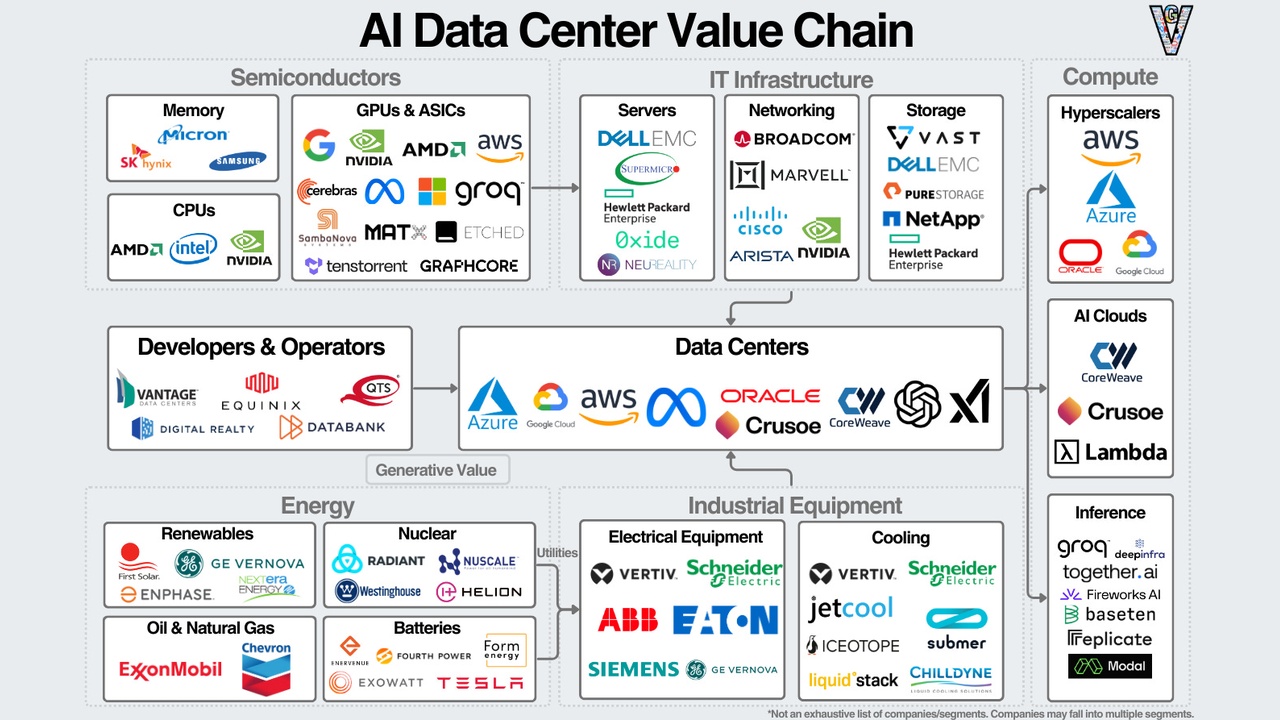
Mapping the AI Data Center Value Chain
This chart visualizes the broad ecosystem of companies adopting SOFCs, which directly supports the section’s discussion of widespread industry validation across hyperscalers, colocation giants, and other market segments.
(Source: Generative Value)
USA Focus, Bloom Energy’s Data Center Power Dominance
The United States is the undisputed epicenter of the SOFC-for-data-center market, a trend overwhelmingly driven by the AI power crunch. Major projects are concentrated in key data center alleys and new frontier states, including New Mexico (Oracle), Wyoming (AI Campus), Ohio (AEP), California (Intel, Google), North Carolina (Apple), and Virginia (Microsoft). This geographic concentration is a direct response to where new, power-hungry AI campuses are being built and where local grid infrastructure is insufficient to meet multi-gigawatt demands. Outside the U.S., the 20 MW Day One project in Singapore is a significant indicator of future trends. It demonstrates that the model of using on-site SOFCs is viable and necessary in other power-constrained, high-demand digital hubs globally.
2.45 GW Deals, Bloom Energy’s Proven Commercial Scale
Recent deployments prove that SOFC technology has graduated from pilot projects to a commercially mature, bankable solution capable of supporting the world’s most demanding computing infrastructure. The sheer scale of the agreements—from Equinix crossing the 100 MW threshold to the gigawatt-scale contracts with AEP (1 GW) and Oracle (2.45 GW)—removes any doubt about the technology’s readiness for prime time. Supplier maturity is a key component of this. Bloom Energy‘s ability to secure these landmark deals is underpinned by its established manufacturing base and its plan to double production capacity to 2 GW annually. This demonstrates a supply chain that is scaling to meet the exponential demand from the AI industry, positioning SOFCs as a go-to solution for primary, on-site power generation.

Fuel Cell Market for Data Centers Surges
This chart quantifies the commercial maturation discussed in the section, showing the market for fuel cells in data centers growing to over $1B, a direct result of the gigawatt-scale deals mentioned.
(Source: Persistence Market Research)
Bloom Energy SOFC Future Outlook (2026-2027)
The most critical strategic development to monitor is the evolving relationship between data center operators, fuel cell providers, and electric utilities. The next 18 months will determine whether the dominant model becomes collaborative grid management or full-scale grid defection.
- The AEP framework agreement announced in November 2024 provides a blueprint for a collaborative model, where utilities act as facilitators for deploying on-site generation to retain large customers and manage load.
- Conversely, the Wyoming project’s regulatory approval in January 2026 for a 900 MW deployment and Oracle‘s massive 2.45 GW plan in New Mexico (April 2026) signal that hyperscalers are fully prepared to build and operate their own “AI power plants” independent of the grid if necessary.
- The expansion of Bloom Energy‘s partnership with Equinix, announced in February 2025, shows the continued momentum for on-site power within the colocation sector, which serves a broad base of enterprise customers.
The questions your competitors are already asking
This report covers one angle of SOFC commercial deployment for AI data center power. The questions that matter most depend on your work.
- What is the deployment status of the 2.45 GW Oracle and 900 MW Wyoming AI campus SOFC projects?
- Which SOFC companies are gaining or losing ground in the data center power market?
- What is the outlook for SOFC deployment in the AI data center market by 2026?
- What does 2024-2025 performance data show for SOFCs as a primary power source for data centers?
This report does not answer these. Enki Brief Pro does.
Your question, your angle, your framework. SWOT, PESTL, scenario modelling. The same niche depth, built around the decision your work actually depends on.
