

Solar Investment for Security, Total Energies 440 MW Project, $300 M Financing, and 5-Year High Clean Fund Inflows (2026)
The effective closure of the Strait of Hormuz in 2026 has fundamentally reframed the calculus for energy investment, elevating national security and supply chain resilience above pure cost optimization. For the renewable energy sector, this geopolitical shock has acted as a powerful accelerant, transforming the narrative from a climate-focused initiative to an urgent economic and strategic imperative. The crisis validated the role of renewables as a hedge against fossil fuel price volatility, unlocking a new wave of security-driven capital and accelerating the deployment of commercially mature technologies like solar and wind. Investors are now prioritizing assets that offer insulation from geopolitical chokepoints, a trend confirmed by capital flows into clean energy funds reaching a five-year high.
Renewable Adoption for Energy Security Following the Hormuz Crisis
The Strait of Hormuz disruption has decisively shifted the primary driver for renewable energy adoption from climate policy to national security, a change validated by immediate economic benefits and a surge in investor appetite.
- Between 2021 and 2024, renewable project adoption was largely driven by decarbonization targets and corporate ESG mandates, often competing with low-cost, readily available fossil fuels.
- The 2026 crisis provided a stark real-world validation of renewable energy’s security value. Solar power alone began saving Europe over €100 million per day by providing a direct hedge against the fossil fuel price shocks caused by the conflict.
- This shift in perception triggered a rapid redirection of capital, with investors “piling into clean-power funds at the fastest pace in five years” as a direct response to the volatility in traditional energy markets.
- Even oil-producing nations in the Middle East are accelerating their own renewable projects to diversify their energy mix and secure domestic power. Oman began construction on the North Oman Solar project, while Saudi Energy reported an 89% profit jump in Q 1 2026, driven in part by its investments in renewable integration.
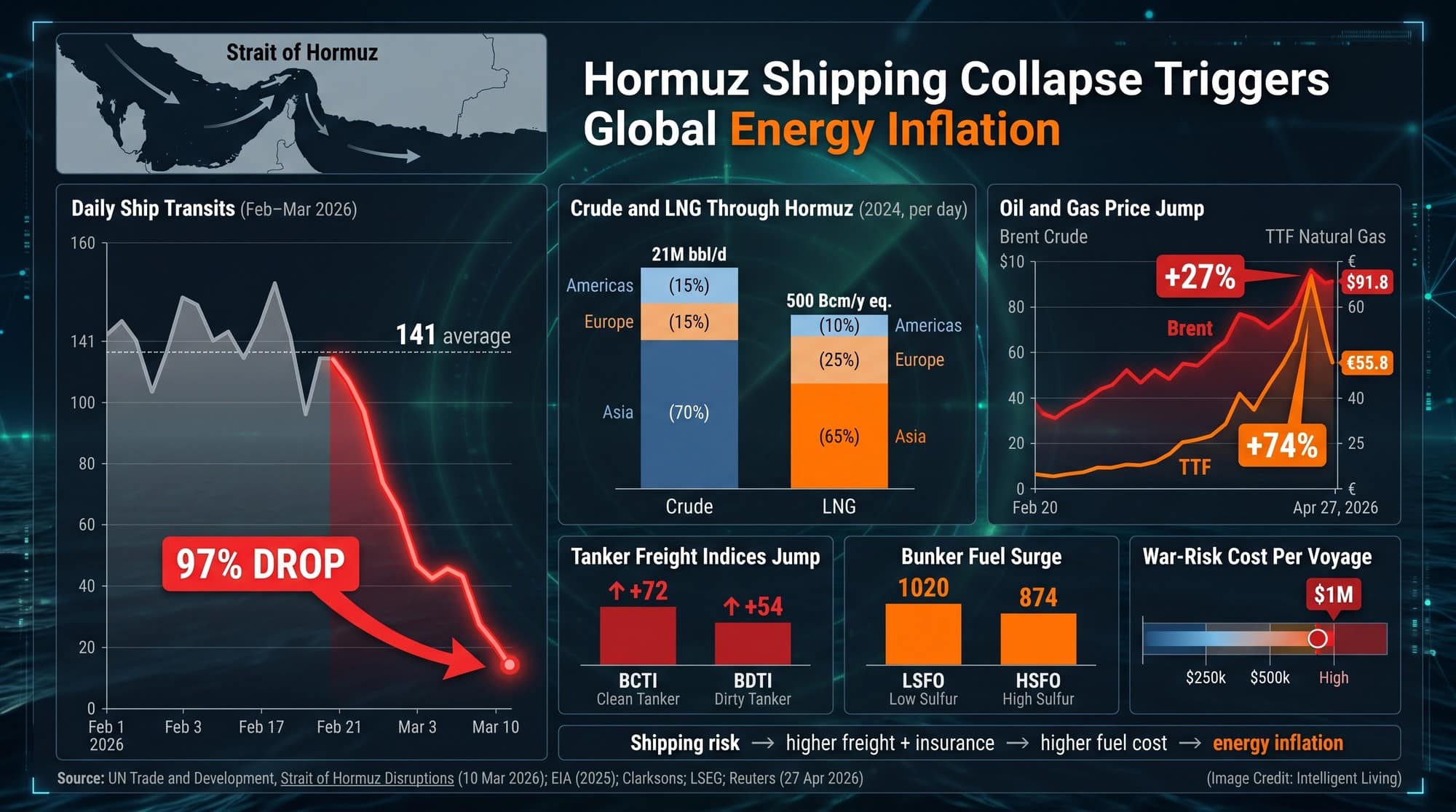
Hormuz Crisis Triggers Energy Price Shock
This chart shows the 2026 shipping collapse and resulting energy price surge that shifted the driver for renewable adoption to energy security, as described in the section.
(Source: Intelligent Living)
$300 M in Financing, Total Energies Project Acceleration
The security premium placed on stable, non-Gulf energy sources has unlocked significant financing for large-scale renewable projects, enabling developers to fast-track deployment and secure market positions.
- The crisis created a clear business case for projects that could deliver predictable power generation independent of geopolitical chokepoints. This dynamic has made fixed-price renewable power more attractive to offtakers and financiers alike.
- In a signal of this trend, Total Energies and its partner Nextnorth secured $300 million to start a 440 MW solar project in the Philippines. This represents the largest international financing for a solar project in the country, underscoring the new urgency to build out domestic generation capacity in energy-importing nations.
- The broader market is responding in kind. The push away from volatile fossil fuels is expected to accelerate structural demand for electrification and alternative energy, a sentiment reflected in the record inflows to clean power investment funds.
Table: Renewable Energy Investment Highlights, May 2026
| Partner / Project | Time Frame | Details and Strategic Purpose | Source |
|---|---|---|---|
| Total Energies / Nextnorth | May 2026 | Secured $300 million in financing to begin construction of a 440 MW solar project in the Philippines. The investment aims to bolster the country’s energy security and reduce reliance on imported fossil fuels. | ESG News |
| Saudi Energy | May 2026 | Reported an 89% profit jump in Q 1 2026, driven by grid expansion and demand growth, which includes integration of renewable energy projects as part of its diversification strategy. | GCC Business Watch |
| Clean Power Funds | May 2026 | Global investors are moving capital into clean-power funds at the fastest rate in five years, driven by the Iran conflict and the desire for assets insulated from fossil fuel volatility. | Carbon Brief |
Middle East vs. Asia, Geographic Project Acceleration
The Hormuz crisis has catalyzed renewable energy development globally, prompting both energy-exporting regions to diversify and energy-importing regions to secure their domestic supply.

Asia’s Pre-Crisis Reliance on Hormuz Oil
This chart highlights Asia’s significant pre-crisis dependence on oil from Hormuz, explaining the region’s post-crisis push to accelerate renewable projects for energy security.
(Source: AI Power Weekly)
- In the Middle East, the crisis has highlighted the economic risks of over-reliance on hydrocarbon exports. In response, Oman began construction on the North Oman Solar project and the Riyah-1 and Riyah-2 wind farms, with the solar facility slated for commercial operation in Q 2 2026.
- In Asia, a region highly dependent on LNG and oil imports transiting the Strait, the focus is on rapidly increasing domestic generation. The 440 MW solar project in the Philippines by Total Energies is a direct result of this push for greater energy independence.
- In Europe, the conflict reinforces the strategic value of its existing renewable fleet. The ability of solar to save the continent over €100 million daily during the price spike serves as a powerful justification for accelerating further deployment to insulate the economy from future shocks.
Commercial Scale Deployment of Solar and Wind Validated
The urgent need for secure, reliable power has prioritized the large-scale deployment of commercially mature technologies like solar and wind over the development of more nascent energy solutions.

Renewables Were Mature Before the Crisis
This chart shows the steady pre-crisis growth of solar and wind, validating them as the mature, scalable technologies that could be rapidly deployed when the crisis hit.
(Source: Wood Mackenzie)
- Prior to the 2026 crisis, energy transition strategies often balanced the deployment of mature technologies with R&D investment in long-term solutions. The conflict has shifted the immediate priority to deploying what works now.
- The decision to fast-track construction of projects like Oman’s North Oman Solar, which leverages proven photovoltaic technology, demonstrates a focus on speed and reliability. These projects can be financed and built on predictable timelines, offering a direct answer to the current security challenge.
- The volatility in fossil fuel markets has also improved the financial viability of mature renewables. The stability of fixed-price power purchase agreements for solar and wind is now a significant strategic advantage, helping projects like the one in the Philippines secure the long-term offtake commitments needed to obtain financing.
SWOT Analysis of Renewable Investment Post-Hormuz
While the Hormuz crisis has created a powerful tailwind for renewable investment by highlighting its security benefits, growth is tempered by underlying weaknesses in global supply chains and the need for significant grid modernization.

Hormuz Disruption Exposes Supply Chain Weakness
This infographic directly illustrates the systemic supply chain impacts of the crisis, a key weakness identified in the section’s SWOT analysis for post-Hormuz renewable investment.
(Source: Qwinn Business Partners)
Table: SWOT Analysis for Renewable Energy Investment
| SWOT Category | 2021 – 2024 | 2025 – 2026 | What Changed / Validated |
|---|---|---|---|
| Strength | Decreasing levelized cost of energy (LCOE); growing ESG-driven demand. | Demonstrated ability to hedge against extreme fossil fuel price volatility; acts as a source of secure, domestic energy. | The 2026 crisis provided empirical, large-scale proof of renewables’ value as a financial and security hedge, as seen in Europe’s €100 million daily savings from solar. |
| Weakness | Intermittency challenges; high dependence on China-centric manufacturing for key components like solar panels. | Supply chain vulnerabilities remain a critical constraint; grid capacity limitations can slow deployment of new generation. | The crisis has exposed the risk of swapping one geopolitical dependency (Gulf oil) for another (Chinese control of the solar supply chain), making this weakness more acute. |
| Opportunity | Supportive climate policies (e.g., Paris Agreement); growing corporate PPA market. | Massive influx of security-focused capital; accelerated government permitting and policy support to fast-track energy independence. | The investment driver has expanded beyond climate to include national security, unlocking a much larger and more urgent pool of capital, evidenced by fund inflows hitting a 5-year high. |
| Threat | Political backlash over land use and subsidies; competition from natural gas as a “bridge fuel.” | Failure to secure long-term offtake agreements can still stall projects despite strong fundamentals; rapid, unmanaged deployment can lead to grid instability. | The threat of natural gas competition has diminished as the crisis highlighted its price volatility and supply insecurity, strengthening the case for stable, fixed-price renewables. |
Scenario Modelling: Energy Security as the Primary Renewables Driver
The critical signal for the next 12-24 months is whether governments and corporations will translate the immediate security imperative into long-term industrial policy, focusing on domesticating supply chains and modernizing grid infrastructure to support rapid renewable deployment.
- If this happens: Governments will enact and expand policies that directly incentivize domestic clean energy manufacturing, similar to the logic behind the U.S. Inflation Reduction Act, to reduce reliance on foreign suppliers.
- Watch this: Track investment patterns in vertically integrated manufacturers with secure domestic supply chains, such as First Solar in the U.S., versus companies that remain dependent on overseas production. This will signal whether the market is truly pricing in supply chain risk.
- These could be happening: A bifurcation in global strategy emerges. Some nations will prioritize secure, albeit more expensive, domestic supply chains. Others will continue to source the lowest-cost components, creating a fragmented market. This trend will be amplified by new regulations for high-growth sectors; for instance, data center regulations may soon mandate on-site renewable generation to ensure operational resilience, further driving demand for secure and reliable clean energy.
The questions your competitors are already asking
This report covers one angle of the energy investment landscape’s realignment following a major geopolitical crisis. The questions that matter most depend on your work.
- What is the outlook for security-driven solar and wind deployment in Europe and the US by 2030?
- Which energy assets—from LNG terminals and oil tankers to utility-scale solar projects—are gaining or losing ground with investors after the Hormuz disruption?
- What are the opportunities for renewable project financing in markets that now prioritize supply chain resilience over pure cost optimization?
- Which maritime operators are adopting new routes and fuel strategies to bypass the Strait of Hormuz?
This report does not answer these. Enki Brief Pro does.
Your question, your angle, your framework. SWOT, PESTL, scenario modelling. The same niche depth, built around the decision your work actually depends on.
