

Offshore Wind German Grid Risk, Total Energies Claim, 16 GW of Projects Affected, and €50 B in Jeopardy (2021 to 2026)
German Offshore Wind Grid Crisis, Total Energies Compensation Claim, and 16 GW at Risk
Germany’s offshore wind expansion faces a systemic crisis as the development of critical grid infrastructure fails to keep pace with renewable generation, prompting major developers like Total Energies SE to seek compensation. This growing disconnect between policy ambition and infrastructure reality now threatens not only individual multi-billion-euro projects but also Germany’s national climate targets and overall investor confidence in the sector.
- Between 2021 and 2024, the primary risk for offshore wind developers was project execution, but systemic vulnerabilities were emerging. Grid operator Tenne T began signaling supply chain constraints for high-voltage direct current (HVDC) technology, and projects like En BW’s 900 MW He Dreiht offshore wind farm faced initial commissioning pushbacks due to grid connection work.
- The situation escalated dramatically from 2025 to 2026, shifting the dominant risk from project-level execution to systemic grid availability. In a stark signal of collapsing market confidence, a major German auction for offshore wind capacity in August 2025 closed without a single bid.
- In response to persistent uncertainty, Total Energies publicly announced its intent to seek compensation for grid delays and reportedly explored returning its Heligoland offshore wind concession. This move was rejected by the German government, escalating the dispute.
- The German Offshore Wind Energy Association (BWO) quantified the threat, warning that up to 16 GW of offshore projects and associated investments of up to €50 billion are jeopardized by these delays, making the country’s 2030 target of 30 GW unfeasible.
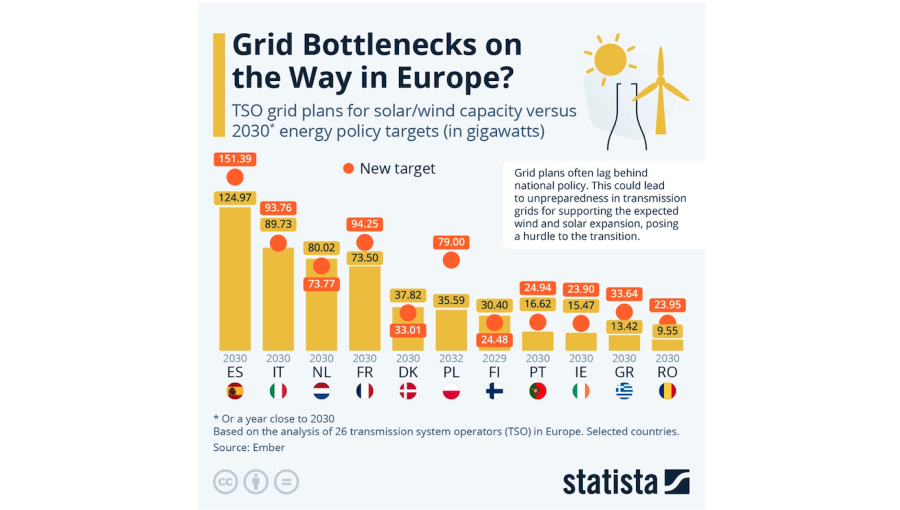
European Grid Plans Lag Renewable Energy Targets
This chart is matched to the introductory section on the German grid crisis because it provides broader European context. It shows that Germany’s grid problems are part of a larger trend where grid development is failing to keep pace with renewable energy ambitions across the continent.
(Source: bne IntelliNews)
€50 B in Jeopardy, German Offshore Wind Projects Delayed by Grid Failures
The failure to synchronize grid build-out with renewable project development has placed up to €50 billion in planned investments at risk, evidenced by a series of high-profile project delays, a failed auction, and postponed tenders that have severely damaged investor confidence. These events are not isolated incidents but symptoms of a structural market failure that Germany is now scrambling to correct through significant policy reform.
- The August 2025 auction failure was a critical catalyst, demonstrating that developers were no longer willing to bid on projects without firm assurances on grid connection timelines and a viable regulatory framework. This market failure directly prompted a government response.
- Consequently, the German government postponed the 2.5 GW of offshore wind tenders scheduled for 2026 until 2027. This delay is intended to provide time to revise the tender design to prevent future failures, including the potential introduction of Contracts for Difference (Cf Ds) to de-risk investments.
- The risk of developer exits is now material. Total Energies is reportedly considering withdrawing from the German North Sea and Baltic Sea projects it previously secured, a move that would delay construction by years and mirror similar strategic pivots in other challenging markets.
- The problem impacts the entire industry. Ørsted is facing a two-month delay for the onshore grid connection of its massive Hornsea 3 project, while the commissioning of the He Dreiht and Borkum Riffgrund 3 projects has also been delayed, contributing to Germany narrowly missing its 10, 000 MW offshore wind target in 2025.

German Offshore Wind Project Viability Analyzed
This chart directly supports the section’s heading about financial jeopardy and project delays. An analysis of project viability is the core reason for the €50 billion at risk, making this a highly relevant and specific match.
(Source: LinkedIn)
Table: German Offshore Wind Projects Impacted by Grid Delays
| Developer | Project / Area | Status as of June 2026 | Source |
|---|---|---|---|
| Total Energies | North Sea & Baltic Sea sites (2.5 GW) | Seeking compensation due to uncertain grid connection timeline; reportedly considering project withdrawal. | Bloomberg |
| Ørsted | Borkum Riffgrund 3 (900 MW) | Commissioning delayed; grid link not expected until 2026 due to delays from grid operator Tenne T. | tamarindo.global |
| En BW | He Dreiht (950 MW) | Delayed, contributing to Germany missing its 2025 capacity targets. | Renewable Energy Industry |
| Various | Auctioned areas N-10.1 & N-10.2 (2.5 GW) | 2026 tenders postponed to 2027 by the government following a failed 2025 auction with zero bids. | Renewables Now |
Germany vs. US, Total Energies Exits Due to Systemic Market Risks
The grid bottleneck is a particularly acute problem in Germany, centered on the immense challenge of transmitting abundant wind power from the North Sea to industrial demand centers in the south. This has created a risk profile that prompted Total Energies to pursue compensation, a move that mirrors its strategic pattern of exiting other international markets, such as the U.S., where it faced intractable systemic obstacles.
- The fundamental geographical disconnect in Germany’s energy system requires a massive build-out of high-voltage direct current (HVDC) transmission corridors. The 7-to-9-year planning and construction timeline for this infrastructure is severely misaligned with the rapid two-year development cycle of offshore wind projects, creating a persistent backlog.
- Total Energies‘ actions in Germany follow its recent strategic pivot in the U.S. offshore wind market. There, the company struck a deal to receive a reported $1 billion reimbursement from the U.S. government to relinquish its leases, demonstrating a clear corporate strategy to withdraw from markets with high regulatory and infrastructure uncertainty.
- However, the German government has taken a harder line than its U.S. counterpart. It rejected Total Energies’ request to return its Heligoland offshore wind concession, citing a “binding commitment.” This refusal to negotiate a clean exit further escalates the dispute and highlights the financial stakes for both the developer and the German state.
Total Energies Highlights HVDC Bottleneck for Offshore Wind Grid Integration
While offshore wind turbine technology is mature and commercially scalable, the entire energy system’s viability is now constrained by the lagging manufacturing capacity of essential HVDC transmission technology. This supply chain bottleneck, which was a background concern from 2021 to 2024, has become the primary cause of multi-year project delays and threatens the financial models of the entire German offshore wind sector.
- In the period from 2021-2024, grid operators like Tenne T were already flagging global supply chain shortages for key HVDC components like converter stations and specialized cables. However, developers continued to bid on and win new sea acreage under the assumption that grid access would materialize.
- By 2025, this supply chain constraint had morphed into a full-blown crisis. Tenne T confirmed that multiple offshore grid connection systems tendered in 2024 are facing delays of up to two years, directly impacting the timelines for projects won by Total Energies and others.
- The failure is not in the wind farms themselves but in the essential transmission infrastructure needed to connect them to customers. This reveals a critical immaturity in the global supply chain’s ability to scale at the pace demanded by ambitious energy transition targets, a risk that has now been fully priced into the market, as shown by the failed auctions. The issues around wind energy 2025 continue to grow due to these supply chain pressures.
SWOT Analysis of Germany’s Offshore Wind Sector Amid Grid Delays
Germany’s offshore wind sector possesses strong foundational policy ambitions and significant developer interest but is severely undermined by weak grid infrastructure and regulatory misalignment. This dynamic has created a critical threat to near-term targets while simultaneously forcing an opportunity for fundamental policy reform.
Table: SWOT Analysis for Germany’s Offshore Wind Sector
| SWOT Category | 2021 – 2024 | 2025 – 2026 | What Changed / Validated |
|---|---|---|---|
| Strengths | Ambitious government targets (30 GW by 2030). Presence of major global developers (RWE, Ørsted). Legal framework for grid delay compensation. | Government remains committed to targets despite setbacks. Experienced developers like RWE continue construction on existing projects (Nordseecluster). | The underlying policy ambition and presence of capitalized developers remain a strength, providing a foundation for recovery if regulatory issues are solved. |
| Weaknesses | Known infrastructure lag (North-South divide). Long permitting for transmission. Decoupling of generation and grid planning. | Grid bottleneck became the single greatest market risk. Regulatory framework (uncapped negative bids) proved untenable, leading to auction failure. | The structural weakness of misaligned planning cycles was validated as the primary cause of the crisis, forcing the government to address it directly. |
| Opportunities | Potential for policy reform to accelerate grid build-out. Development of a domestic HVDC supply chain. | Drafting of the “Grid Package” (Netzpaket) to reform grid connection policy. Postponement of 2026 auctions allows for a redesign with Cf Ds to restore confidence. | The market crisis has become a powerful catalyst for necessary reforms that could create a more stable, albeit higher-cost, investment environment. |
| Threats | Risk of project delays and cost overruns. Growing strain on the global HVDC supply chain. | Mass project delays (16 GW). Loss of investor confidence (failed 2025 auction). Failure to meet 2030 targets confirmed. Risk of developer exits (Total Energies). | The threat of a systemic market stall became reality, moving from a hypothetical risk to a tangible event that is now actively delaying the energy transition. |
Total Energies’ Claim Signals a Shift to Higher-Cost, Higher-Certainty Projects
The most likely forward scenario for Germany’s offshore wind market is a significant recalibration toward a model where developers assume greater financial responsibility for grid connections in exchange for more reliable timelines. This new, higher-cost, higher-certainty environment will favor large, well-capitalized, and experienced players like RWE and Ørsted who can manage increased upfront capital expenditure and complex logistical challenges.
- *If* the German government successfully passes its “Grid Package” (Netzpaket) and implements a new auction design featuring Contracts for Difference (Cf Ds) before summer 2026…
- *…watch for* renewed but more cautious bidding interest in the rescheduled 2027 auctions. Bid prices will likely be higher to reflect the integrated cost of grid connections or increased financial guarantees required from developers.
- *This could be happening* as the combination of the failed August 2025 auction and Total Energies’ public compensation claim has forced the government’s hand, making substantial policy change inevitable to restore market viability and prevent further project withdrawals.

TotalEnergies Stock Outperforms Oil Peers in 2026
This chart is matched with the section on TotalEnergies’ strategic shift. The company’s strong stock performance provides corporate context, suggesting it has the financial stability to make strategic moves, such as exiting risky markets and focusing on projects with higher certainty, as the heading implies.
(Source: Bloomberg.com)
The questions your competitors are already asking
This report covers one angle of the growing investment risk in Germany’s offshore wind sector. The questions that matter most depend on your work.
- What is actually happening with the TotalEnergies compensation claim for its Heligoland offshore wind concession?
- What is the outlook for Germany’s 16 GW of at-risk offshore wind projects meeting their commissioning targets?
- Which developers and grid operators are gaining or losing ground amidst Germany’s offshore wind grid crisis?
This report does not answer these. Enki Brief Pro does.
Your question, your angle, your framework. SWOT, PESTL, scenario modelling. The same niche depth, built around the decision your work actually depends on.
