

Palo Alto Networks 2025: Securing Critical Energy Infrastructure with AI-Powered OT Security
Palo Alto Networks Projects Drive Commercial Adoption of AI-Powered OT Security in 2025
Palo Alto Networks is solidifying its position in the Operational Technology security market by integrating its AI-powered platforms with major infrastructure and service providers, shifting from product development to large-scale ecosystem partnerships.
- Between 2021 and 2024, Palo Alto Networks focused on product development, culminating in the October 2024 launch of new solutions powered by Precision AI to protect critical infrastructure and industrial operations. This established the foundational technology for securing remote OT and mitigating risks in harsh industrial environments.
- Starting in 2025, the strategy transitioned to commercial adoption and market penetration through high-value partnerships. The April 2025 agreement with AT&T to provide an AI-powered, secure architecture based on Zero Trust principles directly addresses the needs of distributed energy assets and remote operations.
- The expansion into securing AI agents through integrations with platforms like IBM watsonx, announced in November 2025, extends protection to the automated systems that will increasingly manage OT environments, demonstrating a forward-looking approach to industrial cybersecurity.
- The landmark partnership with Google Cloud, which surpassed $1.5 billion in sales by April 2025, provides the scalable infrastructure and AI tools necessary for energy companies to deploy and secure their own AI and OT workloads in the cloud.
Palo Alto Networks Investment Analysis: Capital Allocation for AI Platform Dominance
Palo Alto Networks executed a clear strategic pivot in 2025, redirecting capital from shareholder returns to an aggressive multi-billion-dollar acquisition campaign designed to construct an end-to-end AI security platform.
- In 2025, the company shifted from its prior share repurchase plan, which returned $3.14 billion to shareholders, toward funding a series of transformative acquisitions. This change signaled a strategic decision to prioritize market consolidation and technology acquisition over short-term financial returns.
- The $25 billion agreement to acquire Cyber Ark, announced in mid-2025, represents a massive investment to enter the Identity Security market, a critical component for securing both human and machine identities in complex OT and IT environments.
- The $3.35 billion acquisition of Chronosphere in November 2025 provides next-generation observability capabilities. This technology is being integrated into the Cortex Agenti X platform to deliver real-time, automated remediation for AI-native applications that are increasingly used in industrial settings.
- The acquisition of Protect AI for over $500 million, completed in July 2025, was a foundational investment that provided the core technology for the Prisma AIRS platform, specifically its AI model scanning and runtime protection capabilities.
Table: Palo Alto Networks Strategic Investments 2025
| Partner / Project | Time Frame | Details and Strategic Purpose | Source |
|---|---|---|---|
| Chronosphere Acquisition | November 2025 | Acquired for $3.35 billion to integrate next-generation observability with Cortex Agenti X for real-time, agentic remediation in AI-native environments. | WSJ |
| Cyber Ark Acquisition | July/August 2025 | Announced a $25 billion deal to enter the Identity Security market, aiming to create a unified platform for human and machine identities in the AI era. | Cyber Ark |
| Protect AI Acquisition | July 2025 | Completed the acquisition for a reported $500 M+ to obtain AI model scanning and runtime security technology, forming the basis of the Prisma AIRS platform. | Yahoo Finance |
Palo Alto Networks Partnership Strategy: Building an AI Security Ecosystem in 2025
Palo Alto Networks is building a defensible market position by embedding its AI security platforms into the core ecosystems of cloud hyperscalers, AI infrastructure leaders, and major enterprise service providers.
- The landmark partnership with Google Cloud, which generated over $1.5 billion in sales by April 2025, is the cornerstone of this strategy. It involves co-development to deeply integrate Prisma AIRS with Google’s Vertex AI and Gemini models, making Palo Alto Networks a native security layer for cloud and AI workloads.
- The collaboration with NVIDIA, announced in October 2025, directly targets the security of “AI factories.” This partnership combines Palo Alto Networks’ zero-trust protection with NVIDIA’s AI infrastructure, securing the foundational hardware where AI models for industrial and enterprise use are trained.
- An expanded partnership with Okta in July 2025 aims to unify AI-driven platforms to combat identity-based attacks. This is critical for securing the nearly 2, 000 joint customers who must protect access to both IT and OT systems.
- The agreement with AT&T in April 2025 focuses on delivering an AI-powered, secure architecture based on Zero Trust principles. This collaboration provides a direct channel to protect distributed enterprise assets, including remote energy and utility infrastructure.
Table: Palo Alto Networks Strategic Partnerships
| Partner / Project | Time Frame | Details and Strategic Purpose | Source |
|---|---|---|---|
| Google Cloud | April 2025 | Expanded multi-billion dollar partnership for co-development and co-marketing of AI security solutions, surpassing $1.5 billion in sales on Google Cloud Marketplace. | Palo Alto Networks |
| NVIDIA | October 2025 | Partnership to secure “AI factories” by combining Palo Alto Networks’ zero-trust protection with NVIDIA’s AI infrastructure for model training and deployment. | Palo Alto Networks |
| Okta | July 2025 | Expanded partnership to unify AI-driven security platforms and combat identity attacks for nearly 2, 000 joint customers. | Okta |
| AT&T | April 2025 | Strategic agreement to provide an AI-powered, secure architecture based on ZTNA principles to protect users and data regardless of location. | AT&T |
| IBM | November 2025 | Native integration of Prisma AIRS with IBM’s AI agent platforms, including watsonx, to provide real-time threat prevention. | PR Newswire |
Geographic Expansion: Palo Alto Networks Targets Global Markets for AI Security
Palo Alto Networks leverages its North American base and targeted international partnerships to deploy its AI-powered OT security solutions globally, establishing a presence in key economic regions.
- North America remains the primary theater of operations, evidenced by strategic partnerships with U.S.-based technology giants like Google, NVIDIA, and IBM, as well as the managed services agreement with AT&T. A similar partnership with Bell Canada shows a clear strategy to dominate the North American market.
- The acquisition of Israeli-based Cyber Ark for $25 billion not only provides critical identity security technology but also deepens Palo Alto Networks’ footprint in a major global hub for cybersecurity innovation. This follows a pattern of acquiring Israeli startups to source advanced technology.
- The partnerships with global systems integrators like Accenture and Cognizant provide Palo Alto Networks with a worldwide sales and implementation channel, enabling the deployment of its platforms across Europe and Asia-Pacific.
Technology Maturity 2025: Palo Alto Networks’ AI Security Reaches Commercial Scale
Palo Alto Networks’ AI technology has progressed from a proprietary internal framework to a suite of commercially available, market-defining platforms that are now being integrated at scale through major acquisitions and partnerships.
- From 2021 to 2024, the company focused on developing its underlying Precision AI framework and launching its first major AI-native platform, Cortex XSIAM. This period was characterized by product development, highlighted by the October 2024 launch of AI solutions specifically for OT security.
- In 2025, the technology reached full commercial maturity with the launch of specialized platforms like Prisma AIRS for securing the AI lifecycle and Cortex Agenti X for governing AI agents. These products address specific, high-growth segments of the AI security market.
- The acquisitions of Chronosphere and Cyber Ark in 2025 are not for foundational R&D but for integrating mature, best-of-breed technologies into the existing platform. This shift from building to buying and integrating confirms the readiness of Palo Alto Networks’ core AI architecture to absorb and scale new capabilities.
SWOT Analysis: Palo Alto Networks’ Strategic Position in AI Security
Palo Alto Networks’ dominant platform strategy and data advantage create a strong market position, but this is counterbalanced by the significant financial and integration risks associated with its aggressive acquisition-led growth.
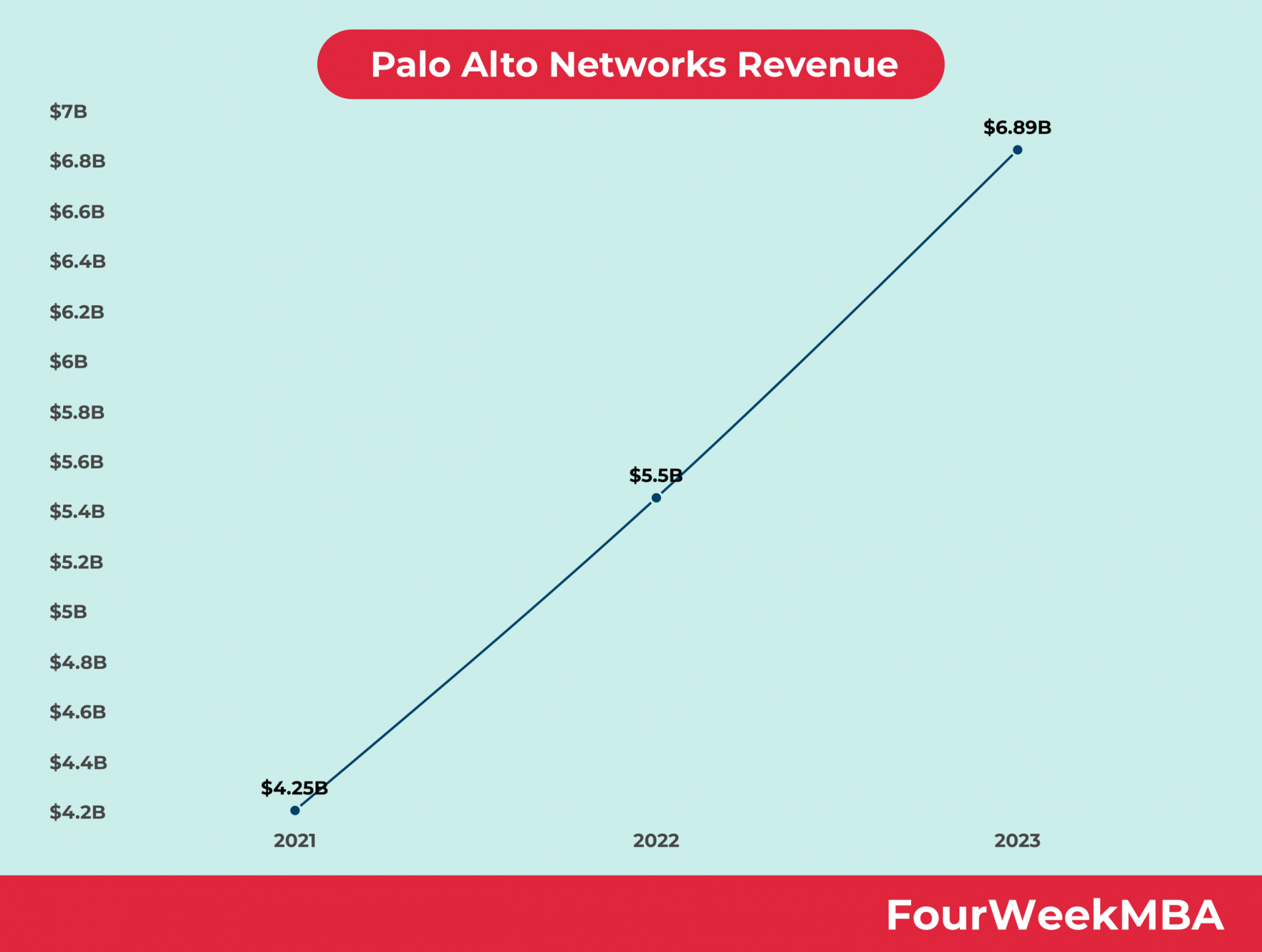
Palo Alto Networks’ Strong Revenue Growth
This chart displays the consistent upward trend in Palo Alto Networks’ total revenue from 2019 through 2023, illustrating the company’s strong financial performance.
(Source: FourWeekMBA)
- The company’s primary strength is its cohesive platformization strategy, which moves customers from fragmented tools to an integrated AI-driven ecosystem.
- Its most significant risk is the execution challenge of integrating over $28 billion in recent acquisitions while maintaining a coherent product vision and delivering on promised synergies.
Table: SWOT Analysis for Palo Alto Networks
| SWOT Category | 2021 – 2024 | 2025 – Today | What Changed / Resolved / Validated |
|---|---|---|---|
| Strengths | Strong growth in NGS ARR driven by Cortex and Prisma. Development of proprietary Precision AI framework and vast security data lake. Established leadership in network security. | Proven platformization model with strong customer adoption. Deep integration with hyperscalers (Google Cloud). Comprehensive platform covering AI lifecycle, identity (Cyber Ark), and observability (Chronosphere). | The strategy shifted from building individual AI-powered products to constructing a fully integrated platform through partnerships and M&A, validated by the $1.5 B+ Google sales milestone. |
| Weaknesses | Perception as a collection of products rather than a single platform. Competition from best-of-breed point solutions in cloud and security operations. | High capital expenditure on acquisitions ($25 B for Cyber Ark). Risk of complex and costly product integration. Decelerating, though still substantial, NGS ARR growth rate (from 47% to 34%). | The company addressed the “point solution” weakness by acquiring market leaders, but this created a new weakness related to financial risk and the complexity of integrating these large companies. |
| Opportunities | Address customer fatigue from security tool sprawl. Leverage AI to automate Security Operations Centers (SOCs). Expand into cloud-native security. | Consolidate the fragmented security market. Secure the emerging “agentic workforce” with Cortex Agenti X. Expand TAM to a projected $500 billion by 2030 by securing the entire AI economy. | The opportunity grew from consolidating existing security markets to defining and capturing the entirely new market of AI security, validated by the launch of Prisma AIRS. |
| Threats | Competition from other platform players (Fortinet) and cloud-native specialists (Crowd Strike). General macroeconomic headwinds impacting IT budgets. | Inability to successfully integrate massive acquisitions, leading to a disjointed product portfolio. Competition from tech giants like Microsoft, which holds 11.4% market share. The pace of AI-driven attacks outstripping defensive capabilities. | The primary threat evolved from direct product competition to the strategic risk of failing to execute its high-stakes, capital-intensive platform integration strategy. |
Future Outlook: Palo Alto Networks to Dominate AI Security Through Platform Integration
The success of Palo Alto Networks’ market-defining strategy in the coming year depends entirely on its ability to seamlessly integrate its multi-billion-dollar acquisitions into a single, autonomous security platform.
- The primary focus for 2026 will be the technical and commercial integration of Cyber Ark and Chronosphere. Success will be measured by the company’s ability to offer a unified solution for identity, observability, and security operations that is simpler and more effective than purchasing standalone products.
- Growth in Next-Generation Security ARR, which contributed $400 million from AI in Q 3 2025 alone, will be a key metric to watch. Sustaining high growth will validate the heavy investment in AI and demonstrate that the platform strategy is resonating with customers.
- Deepening the partnerships with Google Cloud and NVIDIA will be critical. These alliances position Palo Alto Networks as the default security layer for the infrastructure that powers the AI economy, a crucial advantage for securing OT environments in the energy sector as they adopt more AI-driven processes.
Frequently Asked Questions
What was Palo Alto Networks’ main strategic shift in 2025?
In 2025, Palo Alto Networks pivoted from focusing on internal product development to a strategy of aggressive market consolidation and ecosystem building. This involved a multi-billion-dollar acquisition campaign to acquire key technologies and establishing high-value partnerships with major infrastructure providers like Google Cloud and AT&T to drive large-scale commercial adoption of its AI security platforms.
Why did Palo Alto Networks acquire companies like Cyber Ark and Chronosphere?
These acquisitions were strategic moves to build an end-to-end AI security platform. The $25 billion acquisition of Cyber Ark was to enter the critical Identity Security market for human and machine identities. The $3.35 billion acquisition of Chronosphere provides next-generation observability technology, which is being integrated into the Cortex Agenti X platform for automated remediation in AI-native environments.
How is Palo Alto Networks specifically helping to secure critical energy infrastructure?
Palo Alto Networks is securing critical energy infrastructure through its AI-powered OT (Operational Technology) security solutions. A key initiative is the April 2025 partnership with AT&T, which aims to deliver a secure architecture based on Zero Trust principles, directly addressing the security needs of distributed energy assets and remote industrial operations common in the energy sector.
What are Prisma AIRS and Cortex Agenti X?
These are specialized AI security platforms launched by Palo Alto Networks in 2025. Prisma AIRS (AI Runtime Security) is a platform designed to secure the entire AI lifecycle, including AI model scanning and runtime protection. Cortex Agenti X is a platform developed to secure and govern the use of AI agents, which are automated systems that will increasingly manage OT and IT environments.
What is the biggest risk or challenge facing Palo Alto Networks after its 2025 acquisitions?
The most significant risk is the execution challenge of successfully integrating over $28 billion in recent acquisitions, primarily Cyber Ark and Chronosphere. The company’s success depends on its ability to combine these large, complex companies and their technologies into a single, cohesive security platform, as failure to do so could result in a disjointed and ineffective product portfolio.
Experience In-Depth, Real-Time Analysis
For just $200/year (not $200/hour). Stop wasting time with alternatives:
- Consultancies take weeks and cost thousands.
- ChatGPT and Perplexity lack depth.
- Googling wastes hours with scattered results.
Enki delivers fresh, evidence-based insights covering your market, your customers, and your competitors.
Trusted by Fortune 500 teams. Market-specific intelligence.
Explore Your Market →One-week free trial. Cancel anytime.
