

Baidu Autonomous Driving 2026: Commercial Deployments Signal Global Mobility Strategy
Baidu Apollo Go Commercial Scale Projects Transform Global Autonomous Ride-Hailing 2026
Baidu has transitioned its Apollo autonomous driving platform from domestic development to aggressive international commercial deployment, securing partnerships with major ride-hailing operators to scale its technology globally.
- Between 2021 and 2024, Baidu focused on establishing domestic leadership, securing China’s first permits for fully driverless robotaxi services in Beijing in April 2022 and forming a joint venture with Geely for intelligent EVs, Jidu Auto. This period validated the technology within a controlled market.
- From 2025, the strategy shifted to global expansion, marked by a multi-year global partnership with Uber announced in July 2025 to deploy thousands of Apollo Go vehicles on its platform. This was followed by a specific deployment in Dubai in February 2026.
- Baidu replicated this model in Europe through a partnership with Lyft in August 2025, targeting Germany and the UK for a 2026 launch, demonstrating a repeatable market-entry strategy through established networks.
- The application of its AI extends beyond consumer mobility to industrial sectors, evidenced by a partnership with CATL in February 2025 to promote autonomous mobility services and apply AI in industrial settings, showing the platform’s versatility.
Baidu’s Apollo Go Expands Globally
This infographic details the global expansion of Baidu’s ‘Apollo Go’ autonomous ride-hailing service, aligning with the section’s focus on its transformation to a global commercial scale.
(Source: eu.36kr.com)
Baidu’s Investment Analysis Reveals Billions in AI Infrastructure Capital Expenditure 2026
Baidu is engaged in a massive, multi-billion dollar capital expenditure cycle to build the proprietary full-stack AI infrastructure required to power its autonomous driving ambitions and compete with global tech giants.
- Baidu is part of a collective $7 billion (RMB 50 billion) capital expenditure from China’s tech giants in the first half of 2024 alone, demonstrating the immense financial commitment required for AI infrastructure.
- The company is directly funding its ecosystem growth, launching a $145 million venture fund in May 2023 to support startups building on its ERNIE platform, which underpins the intelligence layer of its autonomous systems.
- To finance this expansion, Baidu raised offshore debt at record-low rates in September 2025 to fund the expansion of its AI infrastructure, including cloud services and data centers essential for Apollo Go.
- Early strategic investment in its proprietary chip division, Kunlun, included a funding round that valued the unit at $2 billion in March 2021, a foundational move to secure the hardware supply chain for its AI and autonomous driving platforms.

AI Infrastructure Investment to Surge
This chart’s projection of over $6.5 trillion in cumulative AI infrastructure investment by 2035 provides context for the multi-billion dollar capital expenditures discussed in the section.
(Source: Medium)
Table: Baidu’s Key Investments in AI and Autonomous Driving
| Partner / Project | Time Frame | Details and Strategic Purpose | Source |
|---|---|---|---|
| Offshore Debt Issuance | 2025-09-15 | Raised offshore debt at record-low rates to fund expansion of AI infrastructure, including cloud services and data centers to support platforms like Apollo Go. | Kr ASIA |
| AI-specific Investment | 2024-H 1 | Invested $580 Million (RMB 4.2 Billion) in AI, primarily for chips and related infrastructure critical for autonomous driving and cloud services. | Global Times |
| Wenxin Investment Fund | 2023-05-31 | Established a $145 Million venture fund to back startups building on its ERNIE platform, which provides the intelligence for its autonomous systems. | Tech Crunch |
| Jidu Auto Venture | 2022-01-26 | Raised nearly $400 million in Series A financing for its intelligent EV venture with Geely, funding the development of autonomous electric vehicles. | CNBC |
| Kunlun AI Chip Unit | 2021-03-15 | Raised external funding for its AI semiconductor business at a $2 billion valuation, securing capital to develop proprietary chips for its AI platforms. | CNBC |
Baidu’s Global Partnerships Accelerate Autonomous Vehicle Deployment in 2026
Baidu has executed a two-pronged partnership strategy, collaborating with global ride-hailing leaders for market access while forging deep domestic alliances with automotive and technology firms to control the end-to-end intelligent vehicle value chain.
- The international expansion of Apollo Go is driven by key partnerships with Uber and Lyft, announced in mid-2025, to deploy autonomous vehicles on their established platforms in the Middle East, Europe, and other global markets.
- In China, Baidu deepened its automotive integration by partnering with automaker Changan Automobile in August 2023 to build a dedicated AI data center for autonomous driving R&D, moving beyond software integration to co-developing core infrastructure.
- The joint venture with Geely in January 2021 to create Jidu Auto, a standalone intelligent EV company, represents Baidu‘s most significant move to vertically integrate its AI and autonomous driving technology directly into vehicle manufacturing.
- To secure its technology stack, Baidu has maintained long-term collaborations with foundational hardware providers like Intel and Arm to optimize its platforms, ensuring its software runs efficiently on core processing architectures.
Table: Baidu’s Strategic Partnerships in Autonomous Mobility
| Partner / Project | Time Frame | Details and Strategic Purpose | Source |
|---|---|---|---|
| Uber | 2026-02-10 | Partnered to deploy Apollo Go autonomous vehicles on the Uber platform in Dubai, marking a key commercial launch in the Middle East. | Uber Investor Relations |
| Lyft | 2025-08-04 | Partnered to deploy Apollo Go’s RT 6 autonomous vehicles in Europe, starting with Germany and the UK in 2026, to penetrate the European ride-hailing market. | Lyft Investor Relations |
| CATL | 2025-02-27 | Strategic partnership to jointly promote autonomous mobility services and apply AI in industrial settings, linking autonomous tech with a leading battery manufacturer. | CATL |
| Toyota | 2024-04-25 | Teamed up with Toyota to incorporate Baidu‘s AI technology into vehicles sold in China, validating its platform with a major global automaker. | CNBC |
| Changan Automobile | 2023-08-21 | Inaugurated a dedicated AI data center powered by Baidu‘s cloud and Baige AI computing platform to accelerate autonomous driving R&D. | Data Center Dynamics |
| Geely Holding | 2021-01-11 | Established a standalone joint venture company (Jidu Auto) to produce intelligent and connected electric vehicles, integrating Baidu‘s AI directly into manufacturing. | Geely Holding |
Baidu’s Autonomous Driving Expands from China to Global Markets in Europe and the Middle East
Baidu has strategically expanded its autonomous driving operations from a China-centric model to a global footprint, establishing commercial beachheads in the Middle East and Europe through targeted partnerships.
- Between 2021 and 2024, Baidu’s geographic focus was overwhelmingly domestic, centered on securing operational permits in key Chinese cities like Beijing and building out its robotaxi service, Apollo Go, within China.
- The year 2025 marked a definitive shift to international markets. Baidu established a presence in the Middle East through partnerships with Autogo in Abu Dhabi and a major deployment plan with Uber in Dubai, announced in early 2026.
- Europe became the next target with the August 2025 partnership with Lyft, which plans to launch Apollo Go robotaxis in Germany and the UK starting in 2026, pending regulatory approvals.
- While expanding globally, Baidu continues to solidify its domestic base, as seen with the September 2025 deal with China Merchants Group, a major state-owned enterprise, to apply AI in transportation across China.
Baidu’s Autonomous Driving Technology Reaches Commercial Scale Deployment Stage 2026
Baidu‘s Apollo autonomous driving technology has matured from a development and pilot phase to a commercially scalable platform, validated by its deployment in public ride-hailing services and integration with global automotive and technology partners.
- In the 2021-2024 period, the technology’s maturity was demonstrated by achieving key regulatory milestones, such as receiving the first permits in China for fully driverless services on public roads in Beijing in 2022. This phase focused on technical validation and operational safety within a domestic framework.
- The period from 2025 to today signals a move to commercial scale. The multi-year partnership with Uber to deploy thousands of vehicles globally is a significant commercial validation that transcends pilot programs.
- The development of the purpose-built Apollo Go RT 6 autonomous vehicle, which is being deployed with partners like Lyft and in Dubai, shows a shift from retrofitting existing cars to producing a dedicated, mass-manufacturable AV platform.
- The technology stack’s maturity is further confirmed by its adoption by major international automakers like Toyota in April 2024 for its vehicles sold in China, indicating that the platform is robust enough for third-party commercial integration.

Baidu’s AI Business Growth Accelerates
This chart’s depiction of accelerating revenue from Baidu’s AI business validates the section’s claim that its autonomous driving technology is reaching a commercially scalable stage.
(Source: eu.36kr.com)
SWOT Analysis 2026: Baidu’s Strengths in Autonomous Driving AI Infrastructure
Baidu‘s primary strength lies in its vertically integrated AI infrastructure, but it faces significant financial pressure from high capital expenditures and intense competition, creating both opportunities for market leadership and threats from more cost-efficient rivals.
- Strengths: Baidu leverages its full-stack AI ecosystem, from Kunlun chips to the Apollo platform, creating a powerful competitive advantage that is difficult to replicate.
- Weaknesses: The company is in a massive CAPEX race against heavily funded competitors like Alibaba, and its legacy advertising business is in decline, putting pressure on profitability to fund its AI ambitions.
- Opportunities: Global expansion through partnerships with Uber and Lyft opens up new revenue streams and markets for its mature Apollo Go platform.
- Threats: The rise of lower-cost, highly efficient AI models from competitors like Deep Seek could challenge the economic model of Baidu‘s high-investment approach.

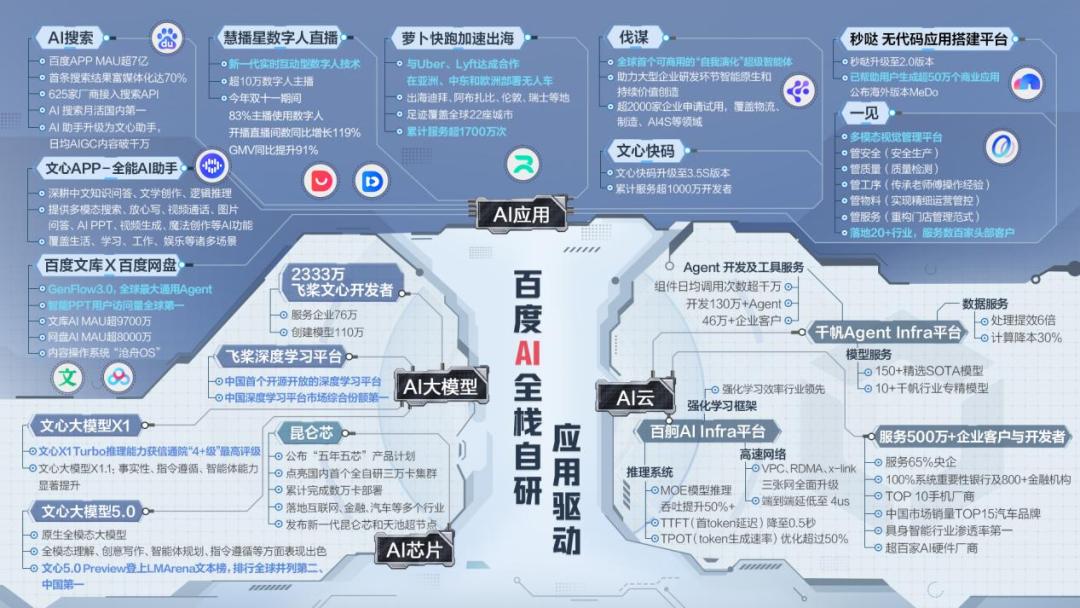
Baidu Positioned as Full-Stack AI Leader
This chart illustrates Baidu’s vertical integration across the AI value chain, visually representing the core strength in its full-stack AI ecosystem as described in the SWOT analysis.
(Source: eu.36kr.com)
Table: SWOT Analysis for Baidu’s Autonomous Driving Strategy
| SWOT Category | 2021 – 2024 | 2025 – Today | What Changed / Resolved / Validated |
|---|---|---|---|
| Strengths | Established full-stack AI infrastructure (Kunlun chips, Paddle Paddle, ERNIE model). Secured domestic leadership via the Geely JV and regulatory wins in Beijing. | Leveraged full-stack to secure major global partnerships (Apple, Samsung, Uber, Lyft). Demonstrated technological leadership with ERNIE 5.0 and a clear chip roadmap (M 100/M 300). | The integrated stack was validated as a key differentiator, enabling large-scale international partnerships that less integrated rivals could not secure. |
| Weaknesses | Heavy R&D spending ($15.7 Billion over a decade) without clear, large-scale monetization pathways for AI beyond advertising. High reliance on domestic market. | Facing a massive CAPEX race, with competitors like Alibaba planning a $53 billion investment. Legacy ad revenue declined 18% Yo Y in Q 3 2025, increasing pressure on AI to deliver profits. | The financial strain of the AI pivot became more acute. While AI Cloud revenue grew, it has not yet offset the decline in the core business, making the company financially vulnerable. |
| Opportunities | Focused on domestic market penetration in autonomous driving (Apollo Go in China) and building a developer ecosystem around Paddle Paddle. | Aggressively pursuing global expansion for Apollo Go in the Middle East (Dubai) and Europe (Germany, UK) through partnerships with Uber and Lyft. | The opportunity shifted from domestic dominance to global commercialization. The partnerships validated a clear, repeatable strategy for entering new international markets. |
| Threats | US technology sanctions on semiconductors posed a risk to hardware supply chains. Domestic competition from Alibaba and Tencent was intensifying. | The emergence of highly efficient, low-cost AI models from startups like Deep Seek threatens to undercut the pricing power of Baidu‘s high-investment models. | The competitive threat evolved from large, established rivals to include nimble, cost-disruptive startups, forcing Baidu to compete on both performance and price. |
Forward-Looking Outlook: Baidu’s 2026 Autonomous Driving Focus on Profitability and Scale
Baidu‘s strategic priority for its autonomous driving division in 2026 is to translate its international deployments and technological leadership into a profitable business model.
- The successful execution of the Uber deployment in Dubai and the Lyft launch in Europe will be the most critical indicators of Baidu‘s ability to commercialize Apollo Go at scale and navigate complex international regulatory environments.
- Financial performance of the AI Cloud and autonomous driving units will be under intense scrutiny. Investors will watch for a clear path to profitability to justify the billions in ongoing capital expenditure, especially as AI Cloud revenue grew 33% Yo Y in Q 3 2025.
- The performance and market adoption of its proprietary Kunlunxin AI chips, with the M 100 inference chip planned for launch in early 2026, will be crucial for managing the long-term operational costs of its autonomous vehicle fleet and data centers.
- Continued competition from both domestic tech giants and specialized autonomous vehicle startups will test Baidu‘s ability to maintain its market lead and defend its pricing power against lower-cost alternatives.
Frequently Asked Questions
What is Baidu’s main strategy for expanding its Apollo Go autonomous driving service globally in 2026?
Baidu’s strategy is to partner with major, established ride-hailing operators to accelerate market entry. As detailed in the post, it has formed multi-year global partnerships with Uber (announced July 2025) and Lyft (announced August 2025) to deploy its Apollo Go vehicles on their existing platforms, giving Baidu immediate access to new markets like Dubai, Germany, and the UK.
Where is Baidu deploying its autonomous vehicles outside of China?
According to the report, Baidu is launching its Apollo Go robotaxi service in the Middle East and Europe. Specifically, the company partnered with Uber for a commercial deployment in Dubai starting in February 2026. Through its partnership with Lyft, it is also launching in Germany and the UK during 2026.
How is Baidu funding its massive investment in AI and autonomous driving?
Baidu is funding its expansion through several financial strategies. The article highlights that in September 2025, Baidu raised offshore debt at record-low rates to fund its AI infrastructure. It is also part of a collective $7 billion capital expenditure by Chinese tech giants in H1 2024 and previously launched a $145 million venture fund (May 2023) to support its ERNIE AI platform.
What makes Baidu’s autonomous driving technology ready for commercial deployment in 2026?
The technology is considered commercially ready because it has moved beyond pilot programs to large-scale deployments. Key validations include achieving fully driverless permits in China, developing the mass-manufacturable Apollo Go RT6 vehicle, and securing multi-year partnerships with Uber and Lyft to deploy thousands of vehicles on their public ride-hailing networks.
Who are Baidu’s key domestic partners in building its autonomous driving ecosystem?
Baidu has formed several key domestic alliances to control the intelligent vehicle value chain. Its most significant is the Jidu Auto joint venture with automaker Geely to manufacture intelligent EVs. It also partnered with Changan Automobile to build a dedicated AI data center for autonomous R&D and with CATL, a leading battery manufacturer, to link autonomous tech with industrial applications.
