

Royal Caribbean Group’s Top 10 AI Projects Drive Efficiency and Net-Zero Goals in 2025 and 2026
Royal Caribbean Group is leveraging Artificial Intelligence to redefine operational efficiency and advance its sustainability targets, establishing a data-driven framework that underpins its financial and environmental objectives for 2025 and 2026. By integrating AI into core functions from fuel consumption to food supply management, the company has transitioned the technology from a conceptual tool to a primary driver of commercial performance. This analysis examines the key projects and partnerships that define Royal Caribbean’s AI strategy, highlighting its shift from foundational investment to measurable, at-scale deployment.
Royal Caribbean Group’s Commercial Scale AI Projects Signal Full Industry Adoption
Royal Caribbean Group has advanced its AI strategy from building foundational infrastructure between 2021 and 2024 to executing commercially-scaled projects with quantifiable returns in 2025 and 2026. This progression demonstrates a mature adoption cycle, where initial investments in connectivity and security now power sophisticated operational and revenue-generating AI systems across its global fleet.
- During the 2021-2024 period, the company focused on establishing the necessary technological backbone for its AI ambitions. This included a pivotal partnership with Space X’s Starlink to provide fleet-wide high-speed internet, collaborations with NTT DATA for IT modernization, and the deployment of Darktrace’s AI for cybersecurity, creating a secure and connected environment for future applications.
- From 2025 onwards, Royal Caribbean Group shifted to deploying AI at a commercial scale with measurable impact. The “WIN on Waste” program now uses AI to predict food consumption, achieving a 50% reduction in food waste, while a sophisticated dynamic pricing engine manages over 15 million daily price points to optimize revenue.
- The launch of the Icon of the Seas serves as a platform for these advanced applications, utilizing AI for route optimization to maximize fuel efficiency. This tangible application of AI directly supports the company’s long-term goal of introducing a net-zero cruise ship by 2035.
- The company also launched AI-powered tools for its partners, including the revamped “Royal Genie” tool in January 2026. This generative AI product allows travel agents to create personalized digital brochures, demonstrating the extension of its AI strategy into its sales and partner ecosystem.
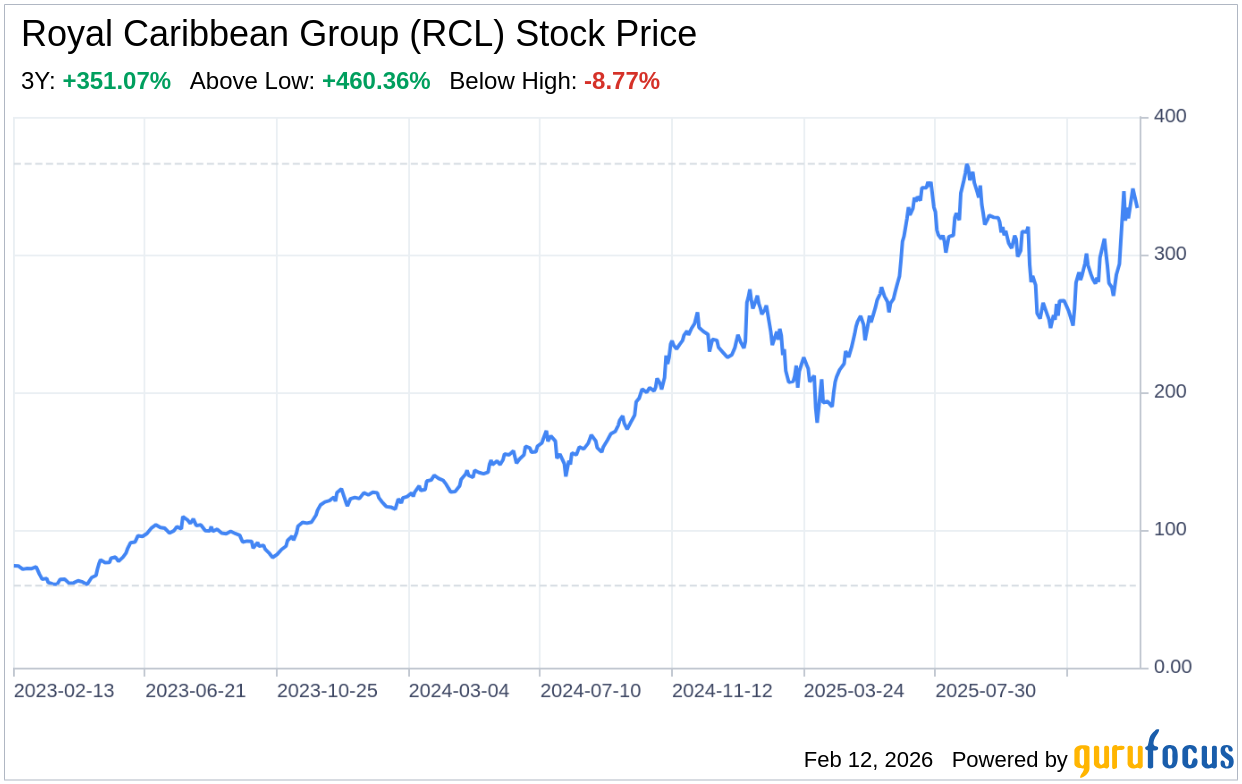
Stock Growth Aligns With AI Strategy
The chart’s stock price surge from 2023-2026 directly visualizes the period of strategic AI investment and commercialization described in the text.
(Source: GuruFocus)
Royal Caribbean Group’s Investment Strategy Funds AI-Driven Financial Performance
Royal Caribbean Group’s investment strategy is directly funding the technology and infrastructure required to achieve its ambitious “Perfecta Program” financial targets. The company has allocated significant capital towards new ship classes that serve as platforms for AI innovation, exclusive destinations that integrate technology, and internal digital capabilities, all designed to drive revenue growth and operational cost savings.
- The “Perfecta Program, ” introduced in March 2025, is a three-year financial initiative targeting a triple-digit adjusted EPS and high-teen return on invested capital, underpinned by investments in AI and digital platforms to drive efficiencies.
- A major capital expenditure was the order for two new “Discovery Class” ships in January 2026. These vessels represent a significant investment in next-generation hardware purpose-built to deploy advanced AI and guest-facing digital products.
- The company is expanding its high-margin land-based portfolio with heavy investment in private destinations. This includes the Royal Beach Club Paradise Island, opening in December 2025, and the Royal Beach Club Cozumel, set to open in 2026.
- To enhance local ecosystems, Royal Caribbean Group launched the Port Partners business accelerator in January 2026 in Seward, Alaska, which includes a $20, 000 pitch prize to support new local businesses that improve the destination experience.

Financials Show Impact of Investment Strategy
This chart displays key financial metrics (Revenue, EBITDA, EPS), validating the section’s claim that strategic investments are driving financial performance targets.
(Source: Seeking Alpha)
Table: Royal Caribbean Group Strategic Investments
| Partner / Project | Time Frame | Details and Strategic Purpose | Source |
|---|---|---|---|
| New Discovery Class Ships | Jan 29, 2026 | Significant capital investment in ordering two new ships from Chantiers de l’Atlantique, with options for four more. These ships are designed as platforms for next-generation AI and digital products. | Royal Caribbean orders 2 Discovery Class ships in France |
| Port Partners Business Accelerator | Jan 22, 2026 | Launched an accelerator in Seward, Alaska, including mentorship and a $20, 000 prize. This investment aims to cultivate local businesses that enhance the guest experience at port destinations. | Royal Caribbean launches Seward Port Partners accelerator |
| Expansion of Private Destinations | May 15, 2025 | Investing heavily to expand its portfolio of exclusive destinations from three to eight by 2028, including the Royal Beach Club Cozumel (2026) and Royal Beach Club Paradise Island (2025). | ROYAL CARIBBEAN GIVES THRILLING FIRST LOOK AT PERFECT … |
| “Perfecta Program” Financial Initiative | Mar 4, 2025 | A three-year strategic program targeting superior financial performance, including triple-digit adjusted EPS. The program’s success is directly linked to investments in technology and AI to drive revenue and efficiency. | ROYAL CARIBBEAN GROUP INTRODUCES THE “PERFECTA … |
Royal Caribbean Group’s Partnerships Build an End-to-End AI Ecosystem
Royal Caribbean Group’s partnership strategy has evolved from securing foundational infrastructure to collaborating on specialized, high-impact technology deployments. By engaging with leaders in shipbuilding, cybersecurity, and enterprise software, the company has constructed a comprehensive ecosystem that supports its complex, AI-driven operations from ship to shore.
- In 2025 and 2026, partnerships focused on fleet expansion and securing the data pipeline. This included agreements with shipbuilders Chantiers de l’Atlantique and Meyer Turku to construct technologically advanced vessels and a collaboration with Crowd Strike to secure the vast amounts of data processed by AI systems.
- The partnership with Wärtsilä, extended in September 2024, leverages AI-powered predictive maintenance across 37 vessels. This collaboration is critical for improving asset efficiency, reducing emissions, and advancing toward net-zero goals.
- Between 2021 and 2023, the company established the core of its digital infrastructure. The fleet-wide agreement with Space X’s Starlink in 2022 provided the essential high-speed connectivity, while partnerships with Cisco for application performance and Zscaler for zero-trust security created a reliable and secure network.
- To modernize its software stack, Royal Caribbean Group partnered with IBS Software in 2023 to implement its i Travel Cruise retail platform for guest personalization and with Fresche Solutions in 2024 to use an AI tool for automating the modernization of legacy IBM i systems.

Business Canvas Maps AI Partner Ecosystem
The business model canvas visually outlines the company’s operational structure, highlighting the role of ‘Technology and IT Service Providers’ which directly supports the section’s theme of a partnership ecosystem.
(Source: Vizologi)
Table: Royal Caribbean Group Technology and AI Partnerships
| Partner / Project | Time Frame | Details and Strategic Purpose | Source |
|---|---|---|---|
| Chantiers de l’Atlantique | Jan 29, 2026 | Agreement to construct new “Discovery Class” ships, ensuring the fleet is built with hardware capable of supporting future AI-driven experiences and operational systems. | Royal Caribbean orders 2 Discovery Class ships in France |
| Meyer Turku | Oct 1, 2025 | Extended a long-term partnership to secure rights for building future ships, including the Icon class, which heavily feature AI-based systems for route optimization and guest services. | Royal Caribbean Group Extends Meyer Turku Partnership Through … |
| Wärtsilä | Sep 16, 2024 | Signed a lifecycle agreement to use AI-powered predictive maintenance (Expert Insight) across 37 vessels to improve efficiency, reduce costs, and lower emissions. | Wärtsilä, Royal Caribbean to spur sustainability goals… |
| Fresche Solutions | Mar 12, 2024 | Purchased the X-Analysis AI tool to automate the discovery and modernization of its legacy IBM i systems, speeding up internal transformation efforts. | X-Analysis AI Solves Mysteries and Speeds IBM i Modernization… |
| Darktrace | Sep 7, 2023 | Deployed Self-Learning AI for cybersecurity to autonomously detect and respond to threats by learning the normal behavior of every user and device across the digital environment. | Royal Caribbean – Darktrace |
| Space X Starlink | Aug 30, 2022 | Initiated fleet-wide deployment of Starlink’s satellite internet service, providing the foundational high-speed, low-latency connectivity required for data-intensive AI applications at sea. | Royal Caribbean partners with Space X’s Starlink for onboard internet |
Royal Caribbean Group’s Global Strategy Centers on European Shipbuilding and Americas Destinations
Royal Caribbean Group’s geographic strategy leverages European shipbuilding expertise to build its technologically advanced fleet while focusing its high-margin destination investments in the Americas. This approach concentrates its capital-intensive supply chain in established European hubs and directs its customer-facing growth initiatives towards key cruise markets in North America and the Caribbean.
- Shipbuilding operations are centered in Europe, with long-term partnerships in France (Chantiers de l’Atlantique) and Finland (Meyer Turku). These agreements secure the production pipeline for its most advanced vessels, which serve as the hardware for its AI and sustainability initiatives.
- The company’s private destination strategy is concentrated in the Americas to cater to its largest customer base. This includes the development of the Royal Beach Club Cozumel in Mexico (opening 2026) and the Royal Beach Club Paradise Island in The Bahamas (opening 2025).
- Royal Caribbean Group is also investing in port-side ecosystems in North America, demonstrated by the launch of the Port Partners accelerator program in Seward, Alaska, in January 2026. This initiative is designed to enhance the value of its Alaskan itineraries by fostering local business growth.
Royal Caribbean Group’s AI Technology Reaches Commercial Scale
Royal Caribbean Group’s AI technology has progressed from a foundational, infrastructure-building phase between 2021 and 2024 to a commercially mature and scaled deployment in 2025 and 2026. The company now operates multiple AI systems that deliver quantifiable financial and operational results, validating its earlier investments in connectivity, data platforms, and cybersecurity.
- The period between 2021-2024 was characterized by investments in enabling technologies. Key actions included the fleet-wide implementation of Space X’s Starlink for connectivity and partnerships with NTT DATA and D 2 i Q to modernize IT and edge computing capabilities, which were prerequisites for large-scale AI.
- By 2025, the company’s AI applications demonstrated commercial maturity. The AI-driven revenue management system now actively manages 15 million price points daily, directly contributing to the company’s record $17.9 billion revenue for the full year 2025.
- The “WIN on Waste” program is another example of a scaled AI application. Its ability to predict food consumption and reduce waste by 50% across the fleet represents a direct and measurable return on investment, impacting both operational expenditures and sustainability metrics.
- The launch of generative AI tools like the “Royal Genie” in January 2026 for travel partners marks a further evolution. This moves AI from an internal operational tool to an external-facing product that enhances the company’s sales and marketing ecosystem.

AI-Driven Routes Show Commercial-Scale Application
This infographic provides a specific example of a commercial-scale AI application (energy-efficient routing), which illustrates the quantifiable operational results mentioned in the section.
(Source: Royal Caribbean Group)
Royal Caribbean Group SWOT Analysis for AI Strategy 2026
Royal Caribbean Group’s strategic position is defined by its successful transition from building AI capabilities to achieving quantifiable commercial results. Its primary strength lies in its proven ability to leverage AI for revenue growth and cost reduction, while its main challenge is managing competitive pressures and the complexities of its expanding data ecosystem.
- Strengths: Proven ROI from AI in revenue management and operational efficiency.
- Weaknesses: High dependency on external partners for critical infrastructure like shipbuilding and connectivity.
- Opportunities: Expanding generative AI for hyper-personalization and growing high-margin ancillary revenue through tech-integrated destinations.
- Threats: Increasing competition from other cruise lines adopting AI and escalating cybersecurity risks.

Market Share Data Informs SWOT Analysis
The chart provides essential competitive context by showing Royal Caribbean’s market position, directly relating to the strategic threats and competitive pressures discussed in a SWOT analysis.
(Source: AltexSoft)
Table: SWOT Analysis for Royal Caribbean Group
| SWOT Category | 2021 – 2024 | 2025 – 2026 | What Changed / Resolved / Validated |
|---|---|---|---|
| Strengths | Established foundational tech partnerships (Space X, NTT DATA) to build a connected and modern IT environment. Secured fleet with AI-driven cybersecurity (Darktrace). | Demonstrated quantifiable ROI from AI, including managing 15 million daily price points for revenue and a 50% food waste reduction. Achieved record financials ($17.9 B revenue, $4.3 B net income for 2025) linked to AI and the “Perfecta Program.” | The strategy was validated; initial infrastructure investments were successfully converted into large-scale, revenue-generating, and cost-saving AI applications. |
| Weaknesses | High dependency on partners for critical infrastructure. Presence of complex legacy systems requiring modernization (as addressed by the Fresche Solutions partnership). | Stock flagged as “Overvalued” relative to peers, indicating potential market concerns about sustaining high growth. Continued structural reliance on a few key shipbuilders in Europe for fleet expansion. | Financial success introduced valuation scrutiny. The core weakness of dependency on hardware partners remains unchanged but is managed through long-term agreements. |
| Opportunities | Identified potential to leverage data for guest personalization and operational optimization. Planned investments in private destinations and sustainable ship technology. | Executing on advanced AI applications, including generative AI for sales (“Royal Genie”) and analyzing guest behavior for agents. Expanding high-margin private destinations (Royal Beach Club Cozumel in 2026). | The opportunity evolved from conceptual to applied. The company is now actively deploying generative AI and integrating technology into its destination expansion strategy to drive new revenue streams. |
| Threats | Growing cybersecurity risks associated with creating a more connected, digital fleet. General competitive pressure in the cruise market. | Direct AI competition from rivals (e.g., Norwegian’s ‘Nora’ Gen AI chatbot). Increased cyber risk from processing massive datasets (guest behavior, pricing). | The competitive threat has become specific to AI capabilities. Cybersecurity risks have scaled in complexity along with the depth of data integration across the company’s operations. |
Forward-Looking Insights: Royal Caribbean Group’s AI Flywheel and Net-Zero Goals
The most critical action for Royal Caribbean Group is to sustain the momentum of its AI-driven “flywheel, ” where operational efficiencies and enhanced guest experiences fuel revenue growth, which in turn funds further technological innovation. The company’s success in 2026 and beyond will depend on its ability to expand its AI applications from operational optimization to creating deeply personalized, end-to-end guest journeys while making measurable progress toward its 2035 net-zero ship objective.
- Monitor the company’s progress toward its “Perfecta Program” financial targets for 2026-2027. The achievement of these goals is directly linked to the continued success of its AI-powered revenue management and cost-efficiency initiatives.
- The opening of the Royal Beach Club Cozumel in 2026 will be a key test of the company’s strategy to integrate technology into its land-based destinations to drive high-margin ancillary revenue and manage guest experiences.
- Expect further expansion of generative AI tools beyond sales support. The next phase will likely involve real-time, personalized onboard digital assistants for guests, leveraging the data from onboard behavior analysis.
- Track milestones related to the company’s goal of a net-zero emissions cruise ship by 2035. Announcements on the performance of AI-based route optimization and other fuel efficiency technologies on new ships like the Discovery Class will be critical indicators of progress.
Frequently Asked Questions
What are Royal Caribbean’s top AI projects?
Royal Caribbean’s key AI projects include a dynamic pricing engine managing 15 million daily prices, the “WIN on Waste” program that uses AI to cut food waste by 50%, AI-powered route optimization for fuel efficiency, and the “Royal Genie” generative AI tool for travel agents to create personalized brochures.
How is AI helping Royal Caribbean achieve its sustainability and net-zero goals?
The company uses AI to support its goal of a net-zero cruise ship by 2035. AI-powered route optimization on ships like the Icon of the Seas maximizes fuel efficiency. Additionally, a partnership with Wärtsilä uses AI for predictive maintenance to improve asset efficiency and lower emissions across the fleet.
What is the “Perfecta Program”?
The “Perfecta Program” is a three-year financial initiative introduced in March 2025. It aims for superior financial performance, including a triple-digit adjusted EPS, by leveraging investments in AI and digital platforms to drive revenue growth and operational cost savings.
Who are Royal Caribbean’s key technology partners for its AI strategy?
Royal Caribbean’s key partners include Space X’s Starlink for high-speed connectivity, Wärtsilä for AI-powered predictive maintenance, Darktrace for AI cybersecurity, and shipbuilders like Chantiers de l’Atlantique and Meyer Turku who build the technologically advanced vessels that run these systems.
How has Royal Caribbean’s AI strategy evolved between 2024 and 2026?
Between 2021 and 2024, the company focused on building foundational infrastructure, such as fleet-wide high-speed internet with Starlink and modernizing IT systems. From 2025 onwards, the strategy shifted to deploying AI at a commercial scale, delivering measurable results in revenue management, waste reduction, and partner support, proving the return on its earlier investments.
