

Chevron Energy Transition, $1 B Fund, GE Vernova Power Deal, and 125, 000 Acre Lithium Play (2021-2025)
Powering AI, Chevron’s $9 B US Investment and Pivot to Critical Materials
In 2025, Chevron executed a significant strategic pivot from broad energy transition exploration to a focused, dual-pronged approach that leverages its core competencies. The company is now monetizing its natural gas assets by directly powering the high-demand AI data center market while simultaneously securing a strategic position in the battery supply chain through domestic lithium extraction.
- Prior to 2025, Chevron’s new energy initiatives consisted of a more diversified portfolio, primarily channeled through its venture capital arms without a large-scale, integrated strategy directly linked to its core operations.
- This strategy crystallized in January 2025 with the announcement of a joint plan with GE Vernova and Engine No. 1 to develop up to 4 GW of natural gas-fired power, directly connecting its primary hydrocarbon product to the rapidly growing electricity demand from the technology sector.
- Complementing this, Chevron made a decisive move into the battery supply chain by acquiring 125, 000 acres in the Smackover Formation for Direct Lithium Extraction (DLE), leveraging its subsurface expertise to become a critical materials supplier rather than a battery manufacturer.
- The company also consolidated its position in long-duration storage by advancing its majority stake in the Advanced Clean Energy Storage (ACES) green hydrogen hub in Utah, a project that represents a move from venture-style investments to large-scale infrastructure development.
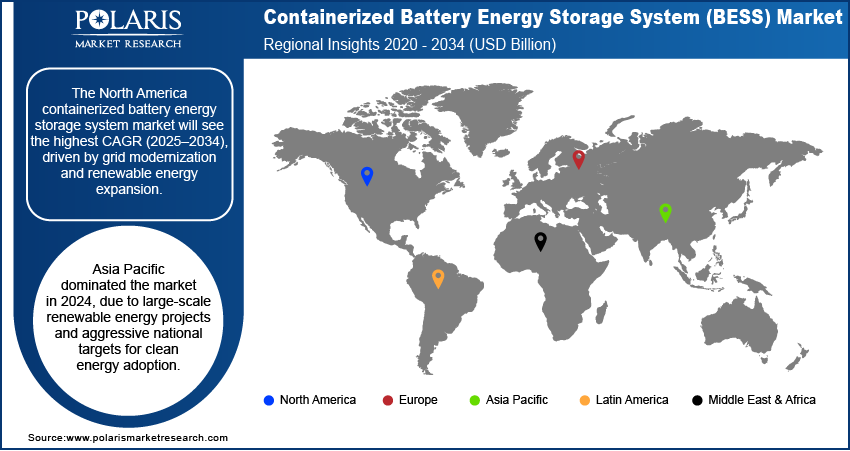
North America BESS Market Poised for High Growth
The section details Chevron’s $9B US investment, partly driven by the high energy demands of AI. This chart directly illustrates the burgeoning North American market for Battery Energy Storage Systems (BESS), a key application for the ‘critical materials’ like lithium that Chevron is pivoting towards and a crucial component for supporting power-intensive industries.
(Source: Polaris Market Research)
$9 B in US Projects, Chevron’s Capital Allocation for Gas & Lithium
Chevron’s 2025 capital allocation of nearly $9 billion for U.S. projects reveals a clear financial strategy: fund its strategic entry into energy transition markets, like lithium, using the robust cash flow generated from strengthening its core hydrocarbon and new power generation assets.
- The commitment of nearly $9 billion to U.S. energy projects in 2025 provides the capital foundation for supporting both the expansion of traditional assets and the infrastructure required for its new power-for-AI business model.
- A significant, though unspecified, portion of this investment underpins the company’s entry into the lithium market, covering the acquisition and evaluation of 125, 000 acres in Arkansas and Texas to assess the commercial viability of DLE technology.
- Alongside these direct investments, Chevron launched its $1 billion Future Energy Fund III, continuing its venture capital approach to identify and invest in lower-carbon innovation and disruptive startups globally.

Energy Industry Investment Priorities Revealed
This section focuses on Chevron’s specific capital allocation choices between traditional gas and new ventures like lithium. The chart provides the broader industry context, revealing where other energy players are placing their investment bets, allowing for a direct comparison of Chevron’s strategy against prevailing industry investment priorities.
(Source: Turbomachinery Magazine)
Table: Chevron Strategic Investments (2025)
| Project / Fund | Time Frame | Details and Strategic Purpose | Source |
|---|---|---|---|
| Future Energy Fund III | Nov 12, 2025 | A $1 billion commitment to a venture capital fund dedicated to investing in lower-carbon energy technologies and innovation startups. | Chevron Investor Day |
| Smackover Formation Lithium Project | Jun 17, 2025 | Acquisition of 125, 000 acres in Arkansas and Texas to evaluate and potentially develop domestic lithium resources using Direct Lithium Extraction (DLE) technology, a key material for batteries. | Yahoo Finance |
| U.S. Capital Projects | May 5, 2025 | Planned investment of nearly $9 billion across U.S. energy projects in 2025, covering traditional oil and gas as well as infrastructure for new energy initiatives like power generation. | Chevron |
| Advanced Clean Energy Storage (ACES) | Feb 21, 2025 | Advancement of the large-scale green hydrogen production and storage hub in Delta, Utah. Chevron holds a majority stake in this joint venture project. | SEC.gov |
Chevron 3 Major Energy Deals, GE Vernova to Mitsubishi Power (2025)
Chevron’s 2025 partnerships are highly strategic, focusing on alliances with established market leaders to amplify its core competencies and de-risk its entry into new markets like data center power and green hydrogen storage.
- The agreement with GE Vernova and Engine No. 1 to power data centers combines Chevron’s natural gas supply with GE’s turbine technology and Engine No. 1’s focus on creating value through the energy transition, forming a complete value chain.
- Through its majority ownership in the ACES Delta joint venture with Mitsubishi Power, Chevron is positioned at the center of one of the world’s largest green hydrogen storage projects, leveraging a partner with deep expertise in hydrogen-ready power turbines and systems integration.
- The June 2025 acquisition of lithium-prospective acreage from Terra Volta Resources demonstrates a strategy of securing key physical assets and resources first, establishing a strong operational base before forming more complex development partnerships.

Electrification and Renewables Rise Across Major Sectors
The section discusses major deals with industrial powerhouses like GE and Mitsubishi. This chart provides the strategic rationale for such partnerships by showing the pervasive trend of electrification and renewable energy adoption across key sectors, which is the core business area for these companies and the focus of the deals.
(Source: REN21)
Table: Chevron Key Partnerships (2025)
| Partner / Project | Time Frame | Details and Strategic Purpose | Source |
|---|---|---|---|
| Terra Volta Resources | Jun 17, 2025 | Acquired leaseholds totaling over 100, 000 acres in the Smackover Formation to evaluate domestic lithium production, marking a direct entry into the battery materials sector. | Argus Media |
| GE Vernova & Engine No. 1 | Jan 28, 2025 | A joint plan to develop up to 4 GW of power generation, using natural gas to meet the rising energy demand from AI data centers. | Chevron |
| Mitsubishi Power | Jan 16, 2025 | As the majority owner of the ACES Delta, LLC joint venture, Chevron is developing a landmark green hydrogen production and storage facility in Utah. | Mitsubishi Power |
US Focus, Chevron’s Permian-to-Lithium Belt Strategy
In 2025, Chevron’s energy transition activities consolidated heavily within the United States, creating a distinct geographic strategy that links its hydrocarbon-rich assets in the Permian Basin to the emerging battery material hubs in the South.
- The 2025 strategy established a clear U.S. domestic focus, with plans revealed for a 2.5 GW natural gas-fired power plant in the Permian Basin to directly supply electricity to a large AI data center, monetizing in-basin gas at a premium.
- Simultaneously, the acquisition of 125, 000 acres in the Smackover Formation across Arkansas and Texas creates a new strategic operating area for Chevron in America’s emerging “Lithium Belt, ” leveraging its extensive domestic operational and geological expertise.
- The Advanced Clean Energy Storage (ACES) project in Delta, Utah, further anchors its large-scale storage ambitions in the U.S. West, targeting grid stabilization for a region with high renewable penetration and a need for long-duration storage solutions.
- This domestic concentration contrasts with a pre-2025 approach where new energy investments were more geographically diffuse and often managed through global venture capital funds without a clear regional-operational link.
DLE & Hydrogen Storage, Chevron’s Commercial-Scale Technology Bets
Chevron’s 2025 technology strategy deliberately avoids early-stage R&D risks by focusing on the commercial-scale deployment of proven or near-proven technologies, such as salt cavern hydrogen storage and market-ready Direct Lithium Extraction (DLE) solutions.
- Instead of pursuing fundamental battery chemistry research, Chevron is focusing its efforts on evaluating and deploying Direct Lithium Extraction (DLE), a technology that has advanced from the pilot stage to near-commercial viability and aligns with its core competency in subsurface fluid management.
- The ACES project in Utah relies on the established technologies of electrolysis for green hydrogen production and salt cavern storage, a method long utilized by the oil and gas industry for hydrocarbon storage, and scales them to an unprecedented size for grid applications.
- Even its power generation play for AI utilizes proven combined-cycle gas turbines from partners like GE Vernova, applying existing, reliable technology to a new and booming market, thereby minimizing technical execution risk.
- This approach marks a shift from the 2021-2024 period, which saw more venture-style investments in a wider array of early-stage technologies, to a 2025 focus on deploying capital on mature technologies at scale.
SWOT Analysis, Chevron’s Pragmatic Transition vs. Missed Opportunity
Chevron’s 2025 strategy demonstrates a clear strength in leveraging existing assets for new revenue streams, particularly in powering the digital economy. However, this pragmatic approach also exposes a potential long-term weakness by ceding ground in the rapidly advancing and high-growth battery technology and manufacturing sector.

IEA Projects Major Shift in Global Energy Mix
This section provides a high-level SWOT analysis of Chevron’s strategy. The chart offers the essential macro context, illustrating the significant global shift in the energy mix projected by the IEA. This backdrop is crucial for evaluating whether Chevron’s strategy is a ‘pragmatic’ response or a ‘missed opportunity’ in the face of this long-term transition.
(Source: CarbonCredits.com)
Table: SWOT Analysis for Chevron’s Energy Transition Strategy
| SWOT Category | 2021 – 2024 | 2025 | What Changed / Validated |
|---|---|---|---|
| Strengths | Strong cash flow from core O&G business; extensive subsurface and project management expertise; global operational footprint. | Leveraged core competencies to enter new markets: gas-to-power for AI data centers and subsurface expertise for lithium extraction. Secured majority stake in ACES hydrogen project. | Validated ability to translate oil and gas skills into adjacent low-carbon sectors (lithium brine, hydrogen storage) and create new, high-margin demand for its core products (natural gas). |
| Weaknesses | Limited direct operational experience in renewables or battery manufacturing; new energy strategy perceived as fragmented or lagging peers. | Continued lack of direct investment in battery manufacturing or large-scale BESS deployment. Strategy is dependent on the continued value of natural gas. | The 2025 strategy confirmed a deliberate choice to be a materials and power supplier rather than a vertically integrated renewable energy or battery producer, a move that could limit upside. |
| Opportunities | Growing demand for low-carbon energy; policy support for renewables and storage; potential to leverage existing infrastructure for new uses. | Capitalized on explosive AI-driven electricity demand. Entered the high-growth domestic lithium market. Positioned to lead in large-scale hydrogen storage. | The AI boom provided a unique opportunity to create a high-value, non-traditional market for its natural gas, directly linking its legacy business to the digital economy’s growth. |
| Threats | Activist investor pressure; risk of stranded assets due to accelerating energy transition; competition from more agile renewable developers. | Potential for DLE technology to be uneconomical at scale. Risk of being outmaneuvered by battery-focused competitors. Policy shifts, like the “One Big Beautiful Bill Act, ” altering investment incentives. | The risk of being relegated to a commodity supplier in the new energy economy was accepted. The company is betting it can generate higher returns this way than by competing in crowded battery manufacturing markets. |
Chevron’s Lithium Pilot: The DLE Decision and Market Impact
The single most critical signal to watch for Chevron’s energy transition strategy is the selection of a Direct Lithium Extraction (DLE) technology partner and the subsequent results of a pilot project in the Smackover Formation, which will validate its entire battery materials thesis.
- If Chevron successfully pilots a DLE technology that demonstrates high efficiency and favorable economics, expect an accelerated Final Investment Decision (FID) on a commercial-scale production facility, positioning the company as a major domestic lithium supplier ahead of analyst expectations.
- Watch for the specific DLE technology provider selected. A choice of a partner with existing commercial operations would indicate a de-risking approach, while an alliance with a newer, more innovative firm could signal a greater appetite for securing a sustainable technological advantage.
- A successful DLE project would validate Chevron’s “picks and shovels” strategy for the energy transition, proving it can profitably enter the battery supply chain by leveraging its core competencies without taking on the risks of manufacturing batteries or electric vehicles.
- Conversely, a stalled or canceled pilot would be a significant setback, raising questions about the viability of oil and gas companies pivoting into the battery materials space and potentially forcing a strategic re-evaluation.

Lithium Battery Market Forecast Shows 25% CAGR
The section examines Chevron’s pilot project for Direct Lithium Extraction (DLE). This chart justifies the strategic importance of the pilot by highlighting the explosive growth (25% CAGR) forecasted for the lithium battery market, which is the end market for the extracted lithium.
(Source: Market Report Analytics)
The questions your competitors are already asking
This report covers one angle of Chevron’s commercial strategy for its energy storage and battery material initiatives. The questions that matter most depend on your work.
- What is the status of the Chevron-GE Vernova partnership to power AI data centers with natural gas?
- Chevron’s Smackover Formation activities. Is its DLE initiative progressing from pilot to commercial-scale lithium production?
- Chevron’s investments in the ACES hydrogen hub. Is the project on track for its long-duration storage targets and profitability?
This report does not answer these. Enki Brief Pro does.
Your question, your angle, your framework. SWOT, PESTL, scenario modelling. The same niche depth, built around the decision your work actually depends on.
