

US-Iran War 2026: Data Center Infrastructure at Risk, Forcing a Global Energy and Investment Pivot
Data Center Risk 2026: US-Iran War Transforms Hypothetical Threats into Kinetic Attacks
The escalation of the US-Iran conflict in 2026 has transformed long-standing theoretical risks into direct kinetic and cyber attacks, exposing the acute vulnerability of concentrated digital infrastructure. The era of treating geopolitical hotspots as viable large-scale deployment zones is over, as the physical security of data centers is now a primary operational concern.
- Between 2021 and 2024, the primary threat vector was cyber-based. US agencies like CISA issued warnings about Iranian-affiliated actors, such as “Cyber Av 3 ngers, ” demonstrating their capability by compromising operational technology like PLCs in US water systems. This established a baseline of credible, but not yet kinetic, threats against critical infrastructure.
- The conflict in February 2026 marked a severe escalation. In early March 2026, Iranian drone strikes successfully hit two Amazon Web Services (AWS) data centers in the United Arab Emirates and damaged another in Bahrain. This event shifted the data center risk paradigm from purely digital defense to surviving in a kinetic battlefield.
- Beyond physical strikes, the conflict intensified cyber warfare. The post-conflict environment is defined by what security analysts call a strategy of sustained cyber probing and infrastructure targeting. This creates persistent operational risk for any enterprise with a presence in the Gulf, threatening network integrity and application availability.
- The war also created a dual-chokepoint crisis for physical infrastructure. The Strait of Hormuz became a contested military zone, threatening not only 20% of the world’s oil transit but also the subsea fiber-optic cables connecting Europe, Asia, and Africa, placing trillions in planned technology investments at immediate risk.
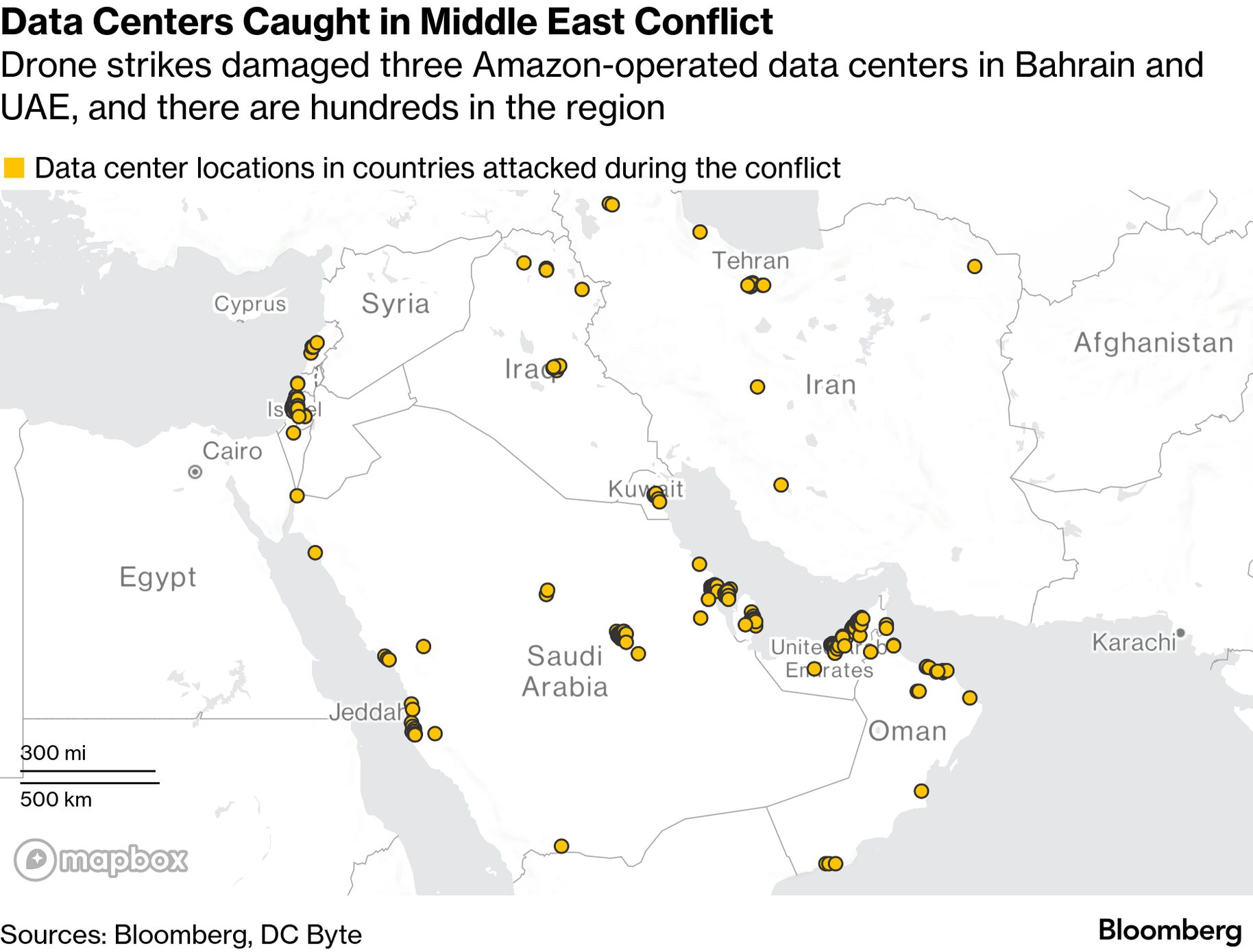
Map Shows Data Centers in Conflict Zone
This map illustrates the high concentration of data centers in the Middle East, directly visualizing the new kinetic attack risks to digital infrastructure described in the section.
(Source: Bloomberg.com)
Investment Fallout 2026: Iran Conflict Freezes Cap Ex and Triggers Project Delays
The war has abruptly halted momentum in global IT and infrastructure spending, forcing a widespread freeze on capital expenditures and a strategic reassessment of long-term projects due to acute geopolitical and economic uncertainty. Before the conflict, businesses were showing signs of moving past a period of investment paralysis, but the war reintroduced a level of uncertainty that has chilled hiring and capital deployment.

Pre-Conflict AI Projects Show Massive Scale
This chart quantifies the massive power requirements of planned AI projects, providing context for the capital expenditures that are now frozen due to the conflict’s uncertainty.
(Source: Semafor)
- Analysis from IDC in March 2026 provided the first quantitative look at the impact, revising global IT spending growth forecasts downward significantly. The forecast for 2026 was cut from a pre-conflict estimate of 6.8% to a post-conflict 4.5%, reflecting the widespread postponement of technology investments.
- Gartner advised business leaders to shift focus from expansionist projects to operational resilience, preparing for cascading failures across supply chains, IT, and finance. This defensive posture prioritizes business continuity over growth, fundamentally altering investment criteria for new infrastructure projects.
- Corporate leaders have already signaled this strategic shift. The chairman of Tata Group, for example, publicly stated the need to diversify sourcing and create plans for prolonged disruption, reflecting a broad-based move to de-risk supply chains and operational footprints.
Table: Forecasted Impact on Global IT Spending Growth (Post-Conflict)
| Year | Pre-Conflict Forecast (Feb 2026) | Post-Conflict Forecast (Mar 2026) | Strategic Implication | Source |
|---|---|---|---|---|
| 2026 | 6.8% | 4.5% | Immediate freeze on discretionary spending and postponement of major capital-intensive projects, particularly in AI deployment. | IDC |
| 2027 | 7.1% | 5.2% | Continued caution as enterprises re-evaluate long-term infrastructure commitments amid sustained market volatility and higher input costs. | IDC |
Geographic De-Risking: War Forces a Retreat from Middle East Digital Hubs
The US-Iran conflict is forcing a rapid and strategic retreat from the Middle East as a central hub for digital infrastructure, accelerating investment into politically stable regions with secure energy supplies. The physical attacks on cloud facilities have invalidated the risk models that justified massive capital deployment into the Gulf.

Middle East Digital Hubs Face Direct Threats
This map highlights the density of data centers in the Persian Gulf, illustrating the physical risk that is forcing a strategic retreat from the region as a digital hub.
(Source: Bloomberg.com)
- From 2021 to 2024, capital flowed into the Gulf region to build a major digital hub. This was exemplified by major investments from hyperscalers and state-backed initiatives like the Aramco Digital and Groq partnership in Saudi Arabia, which aimed to build the world’s largest AI inferencing data center.
- The direct attacks on AWS facilities in 2026 rendered the entire region high-risk, stalling its ambitions. The conflict’s impact on data center investment in the Middle East is now a primary concern for global operators, who must factor in active military threats.
- This instability is redirecting capital to perceived “safe haven” regions. Alberta, Canada, for instance, announced a goal to attract $100 billion in AI data center infrastructure, explicitly leveraging its political stability and energy resources as a key differentiator.
- The conflict also acts as an accelerant for data sovereignty. The deepening of geopolitical fault lines forces nations to align with tech blocs, reinforcing data localization mandates and driving demand for in-country data centers within secure and stable borders.
Energy Security for AI: Conflict Exposes Fossil Fuel Dependency as a Critical Failure Point
The war-induced energy price shock has revealed the critical vulnerability of powering the AI boom with fossil fuels, forcing a strategic convergence of AI infrastructure development and renewable energy security. The extreme volatility in fossil fuel prices has made energy security a non-negotiable requirement for scalable AI operations.

Conflict Threatens Key Global Oil Chokepoint
This visual demonstrates how the conflict impacts the Strait of Hormuz, directly explaining the ‘war-induced energy price shock’ and its effect on fossil fuel dependent infrastructure.
(Source: Geopolitical Futures)
- The pre-conflict trend from 2021-2024 showed a deepening dependency on fossil fuels. With data centers projected to consume 8% of total U.S. power by 2030, utilities were delaying the retirement of coal plants and adding new natural gas capacity specifically to meet the surging demand from AI.
- The conflict in 2026 triggered an immediate energy price shock that exposed this weakness. European natural gas prices surged approximately 70% as traffic through the Strait of Hormuz was halted, dramatically increasing data center operational costs and making budgeting unpredictable.
- This crisis has reframed the transition to renewables as a security imperative. The disruption of fossil fuel shipments provides a compelling financial and security case for investing in price-stable, homegrown renewable energy sources like solar and wind, which are decoupled from geopolitical chokepoints. This has accelerated the push toward an AI data center energy grid bypass.
- As a result, the new investment model prioritizes long-term Power Purchase Agreements (PPAs) with renewable projects and the co-location of data centers with dedicated generation. This shift to secure clean energy, as explored in strategies by companies like Google and Apple, is now central to ensuring the financial viability and operational stability of future AI infrastructure.
SWOT Analysis: Navigating Data Center Infrastructure in a Post-Conflict World
The US-Iran conflict has fundamentally altered the strategic landscape for data center infrastructure, amplifying weaknesses related to geographic concentration and energy dependency while creating urgent opportunities for resilient, decentralized, and sustainably powered models.
Table: SWOT Analysis for Data Center Infrastructure Post-Conflict
| SWOT Category | 2021 – 2024 (Pre-Conflict) | 2025 – Today (Post-Conflict) | What Changed / Validated |
|---|---|---|---|
| Strengths | Massive capital availability for AI-driven expansion; rapid deployment capabilities of hyperscalers. | Operators in politically stable regions with secure energy can command a premium; resilience becomes a primary competitive advantage. | The value proposition has shifted from pure performance and low cost to security, stability, and energy independence. |
| Weaknesses | Growing dependency on fossil fuels for power; high geographic concentration of assets in a few key hubs (e.g., Northern Virginia, UAE). | Physical vulnerability of data centers in geopolitical hotspots confirmed; extreme Op Ex sensitivity to volatile energy prices. | Latent vulnerabilities in geography and energy sourcing were validated as acute, existential threats to business continuity. |
| Opportunities | Expansion into emerging markets with low-cost power and government incentives, particularly the Middle East. | Accelerated investment into secure, localized renewable energy (solar, wind, nuclear); massive Cap Ex shift to “safe haven” regions like Canada and parts of the U.S. | The primary opportunity has pivoted from cost arbitrage in emerging markets to security-focused investment in developed, stable nations. |
| Threats | State-sponsored cyber threats focused on espionage and potential disruption; supply chain bottlenecks for components like GPUs. | Direct kinetic attacks on facilities; global energy supply disruption via chokepoints; sustained cyber warfare against OT systems. | Threats escalated from digital and theoretical to physical and definite, requiring a complete overhaul of risk management. |
Forward Outlook: A Forced Evolution Toward Resilient, Decarbonized Digital Infrastructure
The primary strategic imperative for the next 12-24 months is to de-risk digital and energy supply chains; operators who fail to pivot to geographically diverse and sustainably powered infrastructure will face escalating costs and operational failures. The conflict has served as a brutal but effective catalyst, forcing a strategic reckoning that the technology industry has been slow to address.

Geopolitical Risk to LNG Supply Chains Visualized
This chart shows the dependency of major economies on LNG from the conflict zone, underscoring the ‘Forward Outlook’ imperative to de-risk energy supply chains.
(Source: S&P Global)
- If this happens: The trend of de-risking from geopolitical hotspots continues. Watch this: A significant increase in data center construction announcements in North America and stable European countries, coupled with a freeze or public cancellation of previously announced megaprojects in the Middle East.
- If this happens: Energy security becomes the top priority for AI infrastructure. Watch this: A surge in large-scale corporate PPAs for solar, wind, and even nuclear power from hyperscalers like Equinix and cloud providers. This signals a structural shift to secure energy independent of volatile global commodity markets.
- This could be happening: Companies move to secure fragile supply chains. Watch for an increase in partnerships or M&A activity focused on securing key data center components, such as power electronics and cooling systems, and diversifying manufacturing away from single-region dependencies, especially for critical hardware facing a supply crisis.
Frequently Asked Questions
How did the 2026 US-Iran war change the main risks for data centers?
The war transformed the primary risk from theoretical cyber threats into direct physical (kinetic) attacks. Before the conflict, the main concerns were cyberattacks on systems. However, Iranian drone strikes on AWS data centers in the UAE and Bahrain in March 2026 proved that the physical security of facilities in geopolitical hotspots is now a primary operational concern, shifting the paradigm to surviving on a kinetic battlefield.
What was the immediate impact of the conflict on global IT spending?
The conflict caused a significant global IT spending slowdown. An analysis from IDC revised the 2026 growth forecast downward from a pre-conflict estimate of 6.8% to just 4.5%. This reflects a widespread freeze on capital expenditures and the postponement of major technology projects as businesses shifted their focus from expansion to operational resilience.
Why are companies now avoiding data center investments in the Middle East?
The direct physical attacks on cloud facilities in the UAE and Bahrain rendered the entire region high-risk, invalidating the risk models that had justified large-scale investment there. The conflict’s impact on the Strait of Hormuz and the demonstrated vulnerability to kinetic strikes have forced a strategic retreat, with capital now flowing to perceived “safe haven” regions with political stability and secure energy.
How did the war expose the energy vulnerability of the AI industry?
The war triggered an energy price shock that revealed the critical weakness of powering the AI boom with fossil fuels. With the Strait of Hormuz contested, European natural gas prices surged approximately 70%, dramatically increasing data center operational costs. This has reframed the transition to renewables as a security and financial imperative, accelerating the push for price-stable, homegrown energy sources like solar and wind.
According to the analysis, what is the main strategic priority for data center operators now?
The primary strategic imperative for the next 12-24 months is to de-risk both digital and energy supply chains. This involves pivoting to geographically diverse infrastructure in politically stable regions and securing long-term, sustainably powered energy sources (like solar, wind, and nuclear) to become independent from volatile global commodity markets and geopolitical chokepoints.
