

Apple’s PPA Strategy Under Pressure: How AI Will Reshape Data Center Energy by 2026
Industry Risks: AI Demand Forces Apple to Scale Beyond Established PPA Model
Apple’s renewable energy strategy for its data centers is undergoing a fundamental shift from a mature, steady-state procurement model to an accelerated, multi-pronged approach designed to counteract the exponential energy demand of artificial intelligence. The company’s long-standing reliance on Power Purchase Agreements (PPAs) and Green Bond-funded projects, which successfully powered its operations through 2024, is now being aggressively scaled up and supplemented with hardware-level efficiency innovations to manage the immense power requirements of its new AI services.
- Between 2021 and 2024, Apple maintained its 100% renewable status for its data centers, which consumed 2.344 billion k Wh in 2023, through a diversified portfolio of solar, wind, and biogas projects. This period was characterized by targeted PPAs, such as a 200 MW wind agreement in Oregon and a 61 MW solar farm for its Reno data center, alongside broad supplier decarbonization programs.
- Starting in 2025, Apple initiated a significant acceleration in procurement to address rising consumption, which surpassed 2.5 billion k Wh in 2024. The company announced a $600 million investment to support 650 MW of new renewable capacity across Europe, a scale of investment concentrated in a single period that marks a clear departure from the prior strategy.
- This strategic pivot includes a parallel focus on demand-side management. In February 2025, Apple began producing its own energy-efficient AI servers built on custom Apple silicon in Houston. This vertical integration is a direct attempt to mitigate the energy-intensive nature of AI workloads at the source, a risk that threatens the sustainability of all hyperscale AI data centers.
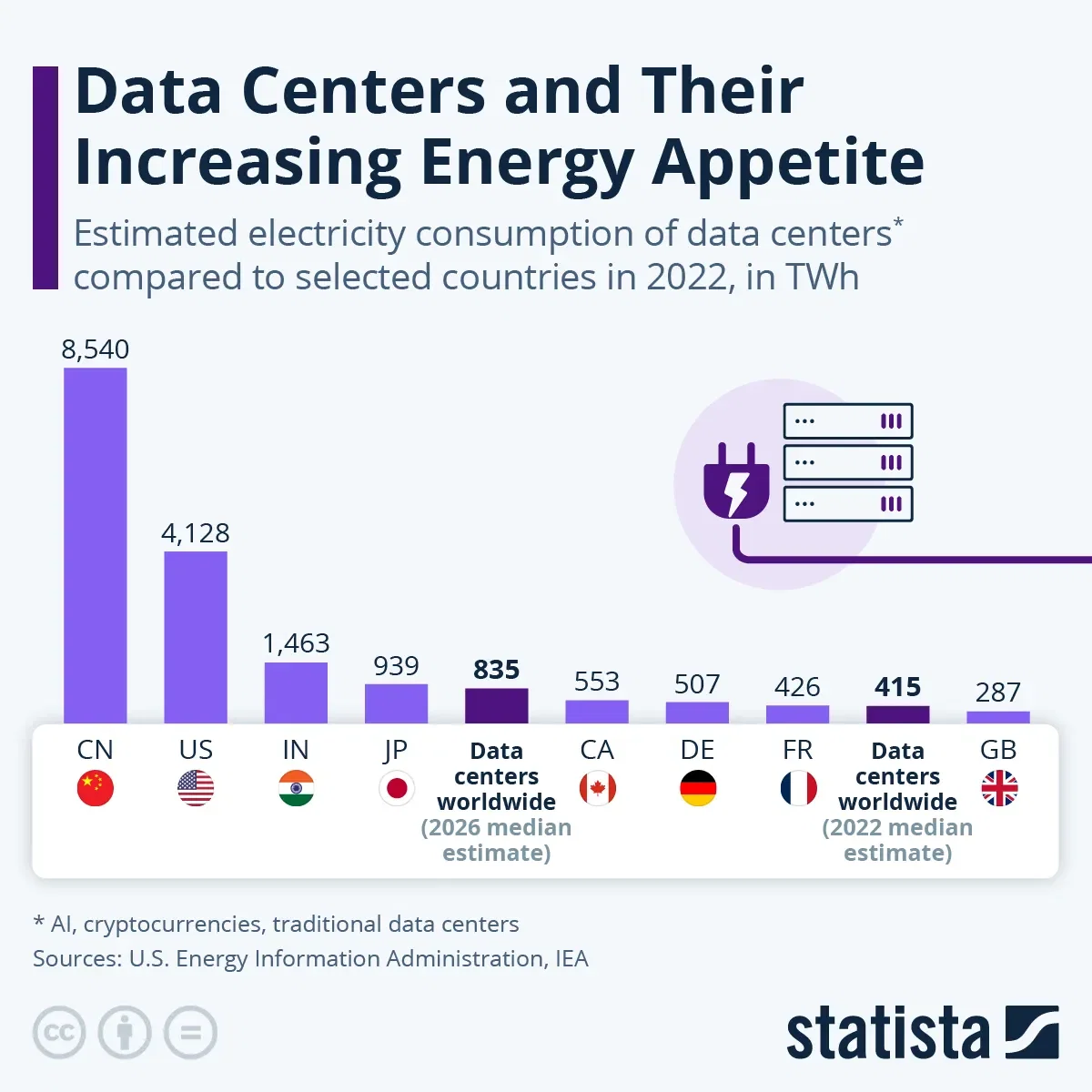
AI to Double Data Center Energy Use by 2026
This chart illustrates the exponential industry-wide energy demand driven by AI, which is the primary risk forcing Apple to scale its procurement strategy.
(Source: Voronoi)
Investment: Procurement Spending Accelerates to Match AI-Driven Consumption
Apple’s investment activity in 2025 reveals a decisive financial mobilization to secure future energy supply, moving beyond the generalized Green Bond program to execute large, concentrated capital deployments for new renewable generation. The scale of financial commitments announced in 2025, totaling hundreds of billions for U.S. investment and over $600 million specifically for European renewables, reflects a direct response to the projected energy growth driven by AI services like Apple Intelligence.
- In October 2025, Apple dedicated over $600 million in financing to deliver 650 MW of new solar and wind capacity across several European countries. This single investment vehicle is a more direct and larger-scale mechanism than the company’s previous project-by-project funding sourced from its broader $4.7 billion Green Bond program.
- The company significantly increased its U.S. investment pledge in August 2025, accelerating its commitment to $600 billion over four years. This capital is explicitly earmarked for expanding its domestic infrastructure, including its network of data centers that are powered entirely by Apple-supported renewable projects.
- Investment in its China Clean Energy Fund also grew, with a new $99.3 million fund announced in March 2025. This brings total investment in the fund to over $250 million, signaling a continued focus on decarbonizing its manufacturing supply chain, which indirectly impacts the lifecycle emissions of its data center hardware.
Table: Apple’s Strategic Energy and Data Center Investments (2025)
| Partner / Project | Time Frame | Details and Strategic Purpose | Source |
|---|---|---|---|
| Clean Energy and Conservation Projects | 2025-11-13 | $99, 000, 000 investment into the China Clean Energy Fund and U.S. conservation efforts, reinforcing supply chain and carbon offset strategies. | Yahoo Finance |
| European Renewable Capacity Expansion | 2025-10-29 | Over $600, 000, 000 in financing to secure 650 MW of new solar and wind capacity across Europe, directly addressing rising customer and data center energy use. | Energy Institute |
| U.S. Commitment Acceleration | 2025-08-06 | Increased total U.S. investment commitment to $600 billion, which includes capital for expanding data centers powered by 100% renewable energy. | Apple Newsroom |
| China Clean Energy Fund II | 2025-03-28 | Launched a second investment fund in China with $99, 300, 000 (720 million yuan) to build new renewable projects for its supply chain. | Carbon Credits |
Partnership Data: A Shift to Large-Scale Utility PPAs in 2026
Apple’s partnership strategy has sharpened, evolving from broad-based supplier coalitions to high-megawatt, long-term PPAs with major European energy developers. While the 2021-2024 period saw Apple leading multi-company initiatives like the Clean Energy Procurement Academy, 2025 was defined by a series of bilateral agreements with utilities like Engie and European Energy to underwrite the construction of new, large-scale solar and wind farms. This signals a move to secure guaranteed, large blocks of power to match the anticipated load from its expanding data center footprint and AI services.
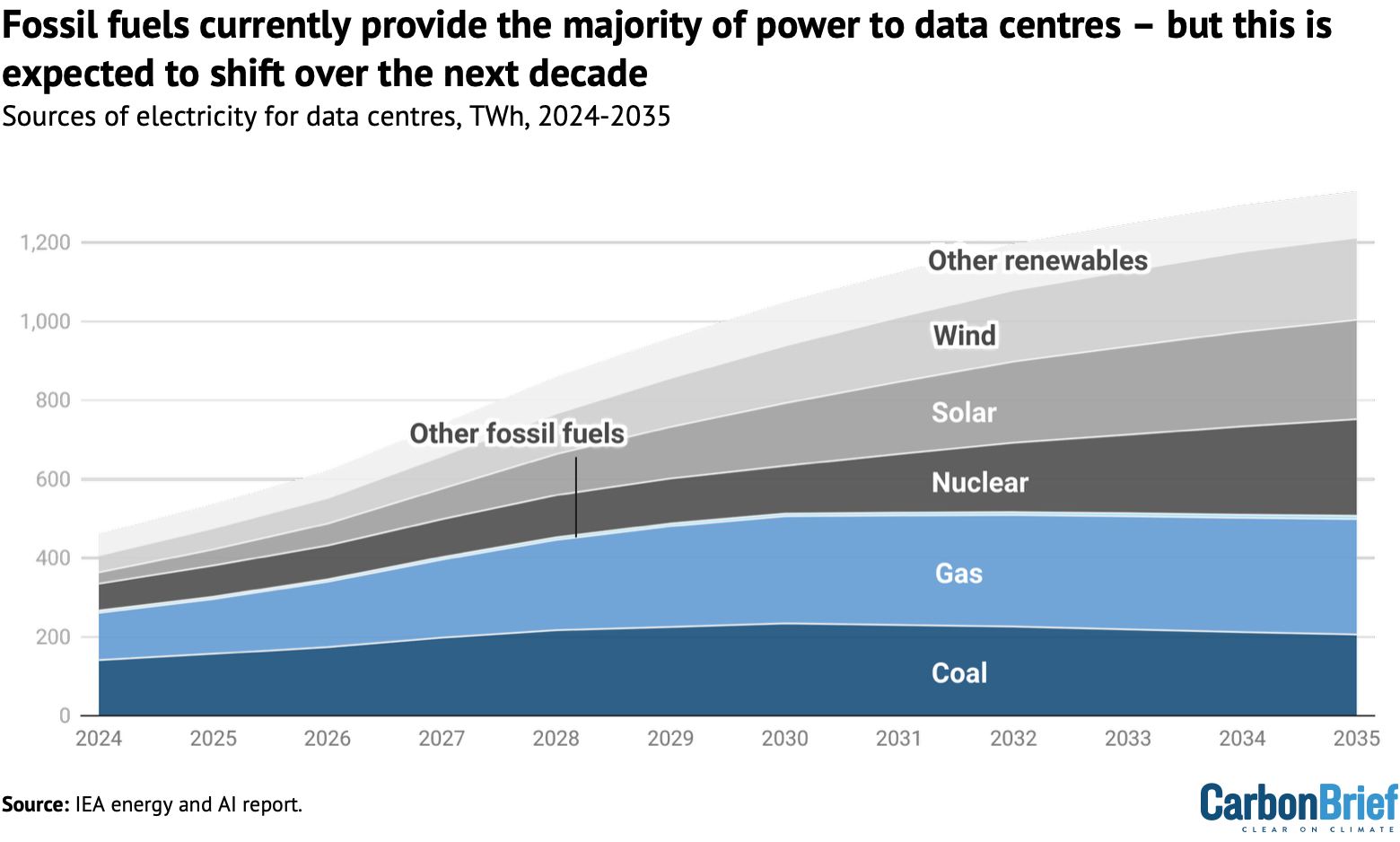
Renewables to Meet Surging Data Center Demand
This forecast shows that new data center demand will be met by renewables, contextualizing Apple’s strategic shift to large-scale PPAs to secure this new capacity.
(Source: Carbon Brief)
- In October 2025, Apple executed a 15-year PPA with Engie for 138 MW of new solar and wind capacity in Italy. This type of long-term contract with a major utility provides the financial certainty required to bring new generation assets online, a core tenet of Apple’s “additionality” principle.
- Also in October 2025, Apple entered into one of Latvia’s first corporate PPAs with European Energy for a 110 MW solar farm and a similar 110 MW PPA with HELLENi Q ENERGY in Greece. These partnerships establish Apple as an anchor offtaker in emerging European renewable markets.
- This contrasts with earlier partnerships, such as the October 2023 launch of a training academy with peers like Amazon and Meta, which focused on enabling the wider supply chain rather than direct, large-scale energy procurement for Apple’s own operational needs.
Table: Apple’s Key Renewable Energy Partnerships (2025)
| Partner / Project | Time Frame | Details and Strategic Purpose | Source |
|---|---|---|---|
| Engie | 2025-10-22 | A 15-year PPA to support 138 MW of new solar and wind projects in Italy to power Apple’s European operations and data centers. | Engie Newsroom |
| Econergy | 2025-10-15 | A 19-year PPA for a 40 MW solar array in Poland, part of the broader 650 MW European expansion to decarbonize regional grids. | PVKnow How |
| European Energy | 2025-10-15 | A 10-year PPA for a 110 MW solar farm in Latvia, securing clean energy to match the electricity used by customers’ Apple devices. | W.Media |
| Foxconn / TECO | 2025-07-30 | Apple’s manufacturing partner Foxconn took a stake in TECO to build AI data centers, signaling supply chain alignment to support Apple’s infrastructure needs. | CNBC |
Geography: Europe and Australia Emerge as Key Expansion Zones for Apple’s Data Center Power
Apple’s geographic focus for new renewable energy procurement has decisively shifted toward Europe and Australia in 2025, a strategic move to secure power in key growth markets and align with its goal of matching customer product energy use with local clean electricity. While the U.S. remains a core area of investment for data center infrastructure, particularly in states like Nevada, Arizona, and Texas, the most significant new energy generation projects announced recently are concentrated abroad.

Apple’s Global Data Center Footprint in 2024
This infographic establishes Apple’s 2024 energy consumption baseline and key locations, highlighting the starting point for the geographic expansion into Europe described in the section.
(Source: LinkedIn)
- The October 2025 announcement of 650 MW of new capacity is spread across Europe, with major solar and wind projects secured via PPAs in Italy (138 MW), Latvia (110 MW), Greece (110 MW), and Poland (40 MW). This indicates a coordinated strategy to reinforce its energy supply in the EU.
- In November 2025, Apple signed a long-term PPA for the 108 MWp Lancaster Solar Park in Victoria, Australia. This project is a cornerstone of its goal to source 1 million MWh of clean electricity annually within Australia, demonstrating a model of localized procurement.
- This contrasts with the 2021-2024 period, where flagship projects were often U.S.-centric, such as the Montague Wind Facility supporting the Prineville, Oregon data center. The new data center activity planned near Reno, Nevada, highlights ongoing U.S. expansion but also brings to light resource concerns in desert regions, potentially driving interest in alternative solutions like grid bypass technologies.
- Continued investment in China through its Clean Energy Fund shows an ongoing commitment to decarbonizing its manufacturing footprint in Asia, a separate but parallel geographic priority.
Technology Maturity: Pairing Mature PPAs with Proprietary Silicon to Manage AI Demand
Apple’s technology strategy is a dual-pronged approach, leveraging the commercially mature PPA financing model for energy procurement while simultaneously deploying proprietary, cutting-edge hardware to control energy consumption at its source. The rapid maturation of AI has forced Apple to innovate beyond just buying renewable energy and into designing the fundamental hardware that powers its services, representing a critical step toward managing future data center loads.

Servers and Cooling Dominate Energy Consumption
This breakdown shows that servers and cooling are the largest energy consumers, explaining why Apple is focusing on proprietary silicon and hardware efficiency to manage demand.
(Source: Aspen Global Change Institute)
- The PPA model, Apple’s primary tool for over a decade, is a fully mature and bankable mechanism. The 2025 European deals with Engie and European Energy validate its continued effectiveness at scale, but the sheer volume of new capacity needed exposes its limitations in a world of exponential AI growth.
- In February 2025, Apple advanced its hardware strategy from R&D to commercial production by launching a Houston facility to build advanced AI servers. These servers, based on custom Apple silicon, are engineered for energy efficiency, giving Apple a critical lever to control the performance-per-watt of its data centers.
- The company is also deploying proven operational technologies to improve efficiency. In Denmark, plans are underway to connect a data center to a district heating network to recycle waste heat, a mature concept that enhances circularity. This, combined with using AI to optimize facility energy use, demonstrates a holistic approach to efficiency.
- The ultimate test for Apple will be moving beyond annualized renewable matching toward genuine 24/7 carbon-free energy, a technological and market challenge that requires integrating energy storage or firm renewables like geothermal power, which remains in the early stages for most hyperscalers.
SWOT Analysis: Apple’s Data Center Energy Strategy
Apple’s established leadership in corporate renewable procurement provides a strong foundation, but the unprecedented energy demand from AI introduces significant new threats that its current strategy may not fully address. The company’s key opportunity lies in leveraging its vertical integration capabilities, particularly with custom silicon, to create a durable competitive advantage in energy-efficient computing. This SWOT analysis examines the evolution of these factors from the stable period of 2021-2023 to the volatile, AI-driven environment of 2024-2025.

Hyperscalers Race to Expand Data Center Capacity
This chart provides critical competitive context for Apple’s SWOT analysis by comparing its data center capacity and expansion plans against those of other major tech companies.
(Source: Freethink Media)
Table: SWOT Analysis for Apple’s Data Center Energy Procurement
| SWOT Category | 2021 – 2023 | 2024 – 2025 | What Changed / Resolved / Validated |
|---|---|---|---|
| Strengths | Maintained 100% renewable energy status since 2018; effective use of Green Bonds ($4.7 B program) and PPAs to fund new projects like the 200 MW Montague Wind Facility. | Massive balance sheet enables large-scale investments like the $600 M European renewable fund; vertical integration with energy-efficient Apple silicon for new AI servers. | Apple validated it can leverage its financial strength to rapidly accelerate procurement in response to a specific threat (AI), shifting from a generalized funding model to targeted, high-impact investments. |
| Weaknesses | Data center electricity use (2.3 B k Wh) was low compared to peers, suggesting potential under-scaling of infrastructure for an AI-era. Annual “net” renewable matching obscures hourly grid reliance on fossil fuels. | The pace of PPA execution, while accelerated, may still lag behind the exponential growth curve of AI-driven energy demand. Public reporting on data center water use in stressed regions is limited. | The AI boom confirmed that Apple’s previously sufficient procurement pace and infrastructure scale were not prepared for the industry’s next phase, forcing a reactive, large-scale investment push. |
| Opportunities | Expand the Supplier Clean Energy Program to decarbonize the full value chain; pioneer new efficiency measures within data centers. | Lead the industry by moving from annual to 24/7 carbon-free energy matching with storage and firm renewables; leverage efficient Apple silicon as a marketing and sustainability advantage. | The AI energy crisis created a clear business case for Apple to differentiate itself through hardware efficiency, transforming its custom silicon project from a performance play into a critical sustainability tool. |
| Threats | General supply chain disruptions and competition for prime renewable project sites. | AI energy demand could triple data center consumption by 2028, overwhelming the PPA market and making 100% renewable goals harder to maintain; resource constraints (water, grid) in new sites like Reno. | The threat of AI-driven energy demand became an acute, immediate challenge in 2025, moving from a future risk to a primary driver of corporate strategy and investment. |
Scenario Modelling and Summary
If AI-driven data center demand continues its exponential growth toward 2026, Apple’s current strategy of accelerating solar and wind PPAs, combined with hardware efficiency gains, will prove insufficient to maintain its 100% renewable commitment on a credible, hour-by-hour basis. This will force the company to pivot its investment focus toward firm, dispatchable clean energy sources and large-scale energy storage to address the intermittency of its current portfolio. The success of this transition will determine whether Apple can maintain its climate leadership or if its carbon footprint will grow in real terms despite its accounting practices.
- Watch Signal 1: Energy Consumption Growth. Apple’s next environmental report will be critical. If reported data center energy consumption shows a year-over-year increase significantly higher than the ~8% seen between 2023 and 2024, it will signal that efficiency gains from Apple silicon are not keeping pace with AI-driven demand.
- Watch Signal 2: Commissioning of European Projects. The timely completion of the 650 MW of solar and wind projects across Europe is essential. Any delays will create a gap between energy demand and supply, forcing reliance on grid power and potentially unbundled RECs.
- Watch Signal 3: Investment in Firm Power. The key indicator of a strategic pivot will be Apple’s first major investment or PPA for technologies that provide 24/7 power. Look for announcements related to geothermal energy, long-duration energy storage, or green hydrogen projects connected to its data center fleet.
- Watch Signal 4: New Data Center Siting. Announcements for new AI data centers will reveal Apple’s approach to resource constraints. Siting new facilities in regions with abundant renewable energy and water, or co-locating them with new firm power generation, would validate a more resilient long-term strategy.
Frequently Asked Questions
Why is Apple’s established PPA strategy for data centers suddenly changing?
Apple’s strategy is changing because the exponential energy demand from new AI services is overwhelming its previously stable procurement model. The article states that the company’s long-standing reliance on Power Purchase Agreements (PPAs), which was sufficient through 2024, is now being aggressively scaled up to counteract the immense power requirements of its new AI initiatives.
What are the two main ways Apple is addressing the increased energy demand from AI?
Apple is using a two-pronged approach. First, it is accelerating its energy procurement with massive investments, such as committing over $600 million for 650 MW of new renewable capacity in Europe. Second, it is managing demand at the source by producing its own energy-efficient AI servers using custom Apple silicon, which is a direct attempt to mitigate the high power consumption of AI workloads.
Where is Apple focusing its new renewable energy investments?
According to the article, Apple’s geographic focus for new energy projects in 2025 has shifted decisively toward Europe and Australia. It has announced major solar and wind projects in Italy, Latvia, Greece, and Poland, totaling 650 MW. Additionally, it signed a PPA for a 108 MWp solar park in Victoria, Australia, to help power its operations and match customer energy use locally.
What is the most significant threat to Apple’s renewable energy goals moving forward?
The primary threat is that AI-driven energy demand could grow so quickly that it outpaces Apple’s ability to build new renewable projects. The article’s SWOT analysis highlights that AI energy demand could triple data center consumption by 2028, overwhelming the PPA market and making it much harder for Apple to maintain its 100% renewable goal, especially on a real-time, 24/7 basis.
Besides buying more renewable energy, what other technology is Apple using to manage data center power consumption?
Apple is leveraging its vertical integration by designing and building its own energy-efficient AI servers in-house. These servers, built on custom Apple silicon, are engineered to optimize performance-per-watt, giving Apple a critical tool to control energy consumption directly at the hardware level. This is a key part of its strategy to manage the sustainability of its AI data centers.
