

AI Data Center Energy 2026: The Grid Bypass and Rise of On-Site Power
Industry Risks: AI Power Demand Forces a Shift from Renewables to On-Site Generation
The strategy for powering hyperscale data centers has fundamentally shifted from pursuing long-term renewable Power Purchase Agreements (PPAs) to deploying immediate, on-site generation, a change driven by the inability of public grids to support the gigawatt-scale demands of the artificial intelligence boom. This pivot from a sustainable, grid-reliant model to an energy-first, off-grid strategy introduces significant sustainability and financial risks. The industry is now defined by a pragmatic, yet contradictory, dual approach: using fossil fuels for rapid scaling while exploring nascent clean technologies for the long term.
- Between 2021 and 2024, the primary focus for hyperscalers like Oracle was achieving corporate sustainability goals, such as its target to power 100% of operations with renewable energy by 2025. This was pursued through direct contracts and partnerships with colocation providers like Digital Realty that used green energy, culminating in achievements like powering all European Cloud regions with 100% renewables by early 2023.
- Starting in 2025, colossal AI contracts, such as Oracle’s reported $300 billion cloud deal with Open AI, rendered the grid-dependent renewable strategy insufficient for meeting aggressive deployment timelines. The need for speed and massive capacity forced a strategic pivot to circumventing grid connection queues, which can take years to clear.
- This led to the adoption of on-site power generation at an unprecedented scale. The most significant example is Oracle’s partnership with Volta Grid to deploy 2.3 GW of modular natural gas power for its Texas AI data centers, prioritizing rapid capacity expansion over immediate sustainability alignment.
- Simultaneously, to address the long-term need for clean, reliable baseload power, companies are moving beyond traditional renewables. Oracle is exploring Small Modular Reactors (SMRs) for a planned 1 GW data center, while also deploying cleaner on-site solutions like solid oxide fuel cells from Bloom Energy, which can be installed in as little as 55 days.
Investment: Multi-Hundred-Billion Dollar Capital Outlays Signal a New Era of Infrastructure Buildout
The industry’s pivot to self-sufficient power infrastructure is backed by staggering capital commitments that dwarf previous investment cycles, with single companies planning to raise and spend tens of billions of dollars annually to secure the energy and computing resources required for AI. This financial escalation highlights the high-stakes environment where securing power has become as critical as securing silicon. The sheer scale of these investments, including competitor actions, confirms a market-wide trend toward vertically integrated infrastructure projects.
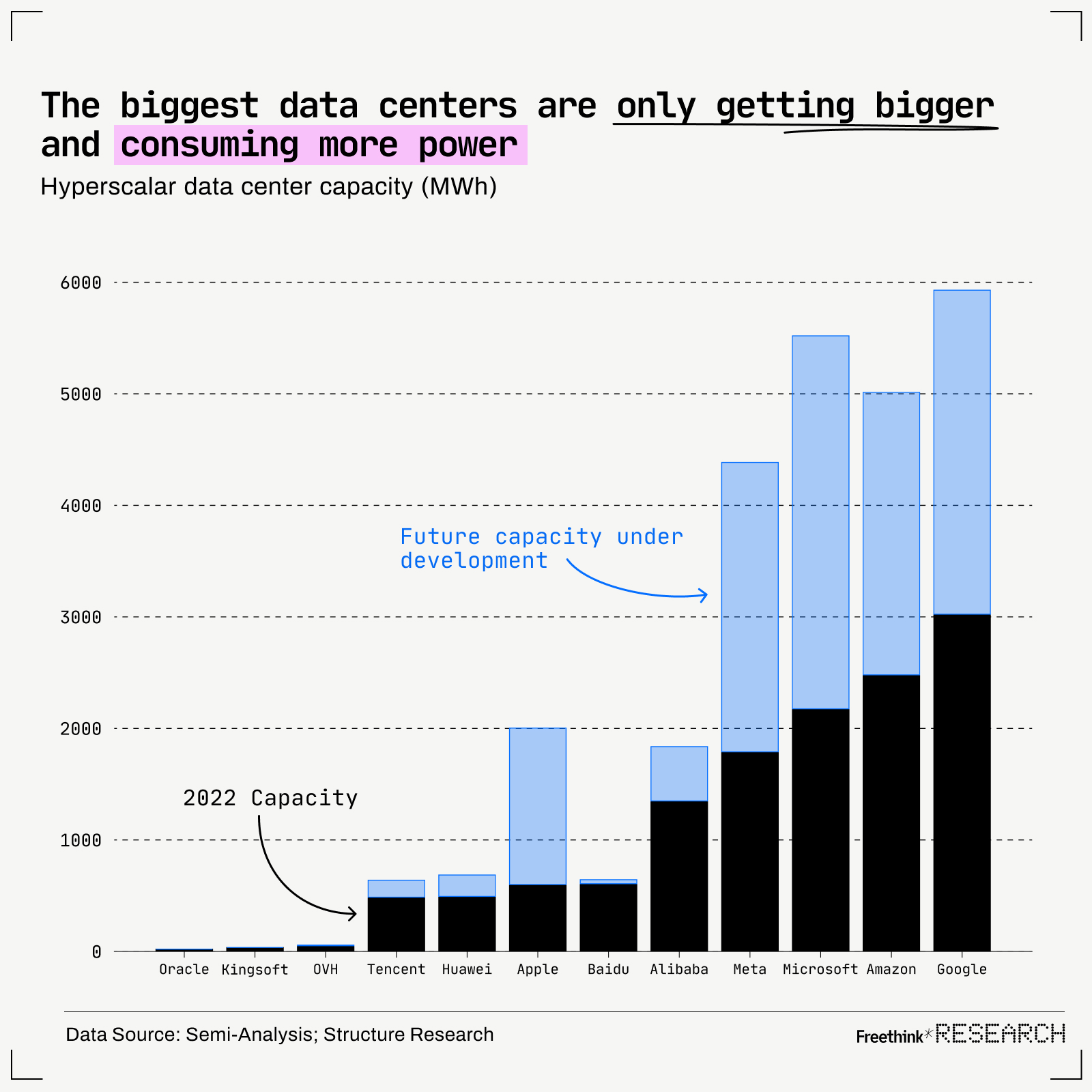
Hyperscalers Plan Massive Power Capacity Expansion
This chart illustrates the “new era of infrastructure buildout” by showing the massive power capacity expansion planned by major hyperscalers, the direct physical result of their multi-billion-dollar capital outlays.
(Source: Freethink Media)
- Oracle signaled its intent to raise up to $50 billion in calendar year 2026 through debt and equity to fund its massive AI data center expansion, indicating that near-term negative free cash flow is an accepted consequence of capturing market share.
- The capital intensity of this strategy is severe, with a single large, gas-powered data center in Texas estimated to have an annual operating expenditure exceeding $1 billion for power alone.
- These investments are part of broader initiatives like the $500 billion “Stargate” AI project with Open AI, which includes a $165 billion campus in New Mexico and a $15 billion renewables-powered hub in Wisconsin, demonstrating a blended approach to funding both fossil-fueled and greenfield clean energy sites.
- Competitors are making similarly large investments. Microsoft announced a $40 billion plan for new data centers in Texas through 2027 and expects to spend over $100 billion on infrastructure leases globally, underscoring the industry-wide nature of this capital-intensive arms race.
Table: AI Data Center and Energy Infrastructure Capital Commitments (2025-2026)
| Company / Project | Time Frame | Details and Strategic Purpose | Source |
|---|---|---|---|
| Oracle | 2026 | Planned fundraising of $45 – $50 billion in a single calendar year to finance a global AI data center buildout, prioritizing speed and scale. | Wall Street Journal |
| Microsoft (Competitor) | 2026-2027 | Investment of $40 billion into three new Texas data centers to support its own AI growth, indicating a regional rush for power and space. | Reuters |
| Oracle / Open AI (Project Jupiter) | 2025-Ongoing | Development of a $165 billion data center campus in New Mexico, a key component of the broader $500 billion Stargate AI program. | El Paso Matters |
| Oracle / Vantage (Stargate Lighthouse) | 2025-Ongoing | A $15 billion investment in a Wisconsin data center hub designed to be powered by new renewable energy sources, serving as a sustainable counterpoint to gas-powered sites. | Renewables Now |
| Oracle (International Expansion) | 2025 | Commitments of $14 billion for AI and cloud infrastructure in Saudi Arabia and $2 billion in Germany, expanding the power-hungry footprint globally. | W.Media |
Partnerships: A New Ecosystem Forges Around On-Site Power and AI Infrastructure
The urgent need for gigawatt-scale power has catalyzed a new ecosystem of partnerships that connects cloud providers, AI companies, data center developers, and on-site energy specialists. This network is designed to bypass traditional utility constraints by creating self-contained power and computing islands. The structure of these deals reveals a strategic focus on securing power generation capability as a core component of the data center development process, a stark departure from the previous model of sourcing power from the existing grid.
- The alliance between Oracle and Volta Grid, announced in October 2025, is the clearest signal of this trend. The agreement to deploy 2.3 GW of on-site natural gas generation establishes a scalable, grid-independent power model specifically for rapid AI data center deployment.
- The relationship between the demand driver and the infrastructure provider is codified in the multi-billion-dollar agreements between Open AI and Oracle. These contracts create the financial certainty needed to undertake massive, speculative infrastructure projects.
- Specialized data center developers like Vantage Data Centers have become crucial intermediaries, partnering with both Oracle and Open AI to develop the physical campuses, such as the sustainable “Stargate” site in Wisconsin, which will integrate new solar, wind, and battery storage resources.
- To complement its natural gas strategy with cleaner alternatives, Oracle partnered with Bloom Energy in July 2025 to deploy on-site solid oxide fuel cells. This technology offers rapid deployment (under 90 days) and cleaner operation with no water consumption, providing a bridging solution that is faster than grid upgrades but cleaner than traditional generators.
Table: Key Strategic Partnerships for AI Data Center Power and Infrastructure (2025)
| Partners | Time Frame | Details and Strategic Purpose | Source |
|---|---|---|---|
| Oracle, Open AI, Vantage Data Centers | Oct 2025 | Development of the “Stargate” campus in Wisconsin, aiming for nearly 1 GW of AI capacity by 2028 powered by new zero-emission energy. This project serves as a model for sustainable AI infrastructure. | Business Wire |
| Oracle, Volta Grid, Energy Transfer | Oct 2025 | Volta Grid will deploy 2.3 GW of modular natural gas generators for Oracle’s AI data centers, with gas supplied by Energy Transfer. This bypasses grid delays for rapid scaling. | Volta Grid |
| Oracle, Open AI, Soft Bank | Sep 2025 | Expansion of the “Stargate” project with five new U.S. data centers. Two sites led by Soft Bank are planned to scale to 1.5 GW, demonstrating diverse partnership structures for development. | Yahoo Finance |
| Oracle, Bloom Energy | Jul 2025 | Deployment of on-site solid oxide fuel cells at select data centers. This provides a rapidly deployable, cleaner power source that uses no water and has minimal air pollution. | Bloom Energy |
Geography: AI Power Demand Reshapes Data Center Site Selection in 2026
The geographic strategy for data center placement has shifted from proximity to major internet hubs to proximity to viable power sources, fundamentally altering the map of digital infrastructure. Whereas the 2021-2024 period saw continued expansion in established markets, the post-2025 AI boom is driving development in regions like Texas, Wisconsin, New Mexico, and Ohio, where land is available and a path to power, whether on-grid or off-grid, can be established. This has triggered an intense regional competition for energy resources.

Data Center Boom Strains Regional Grids
This chart provides a concrete example of the geographic shift in site selection, showing how a data center boom in a power-rich state like Arizona can severely strain the local energy grid.
(Source: Solar Topps)
- Between 2021 and 2024, expansion focused on strengthening presence in established cloud markets and expanding into new sovereign regions. Key projects included a second data center in Chile, a new cloud region in Saudi Arabia, and partnerships in France and West Africa, all under the umbrella of the 2025 renewable energy goal.
- From 2025 onward, the map is being redrawn around energy availability. Texas has become a primary hub for Oracle’s gas-powered strategy due to its favorable regulatory environment and robust natural gas infrastructure, with multiple gigawatt-scale projects planned.
- Wisconsin was selected by Oracle, Open AI, and Vantage for the “Stargate” campus specifically for its potential to develop new renewable energy generation, marking a strategic choice to build a green energy ecosystem from scratch around a data center.
- New Mexico and Ohio have also emerged as key locations for the Stargate expansion with Oracle and Soft Bank, with plans to deliver a combined 7 GW of capacity across sites in Texas and New Mexico. These less-traditional data center locations were chosen for their ability to accommodate massive physical and energy footprints.
Technology Maturity: On-Site Power Solutions Move from Niche to Commercial Scale
The technology used to power data centers is rapidly evolving from reliance on mature, grid-scale renewables to the at-scale deployment of modular, on-site power generation technologies. The period from 2021-2024 was characterized by procuring energy from established solar and wind farms. The period from 2025-2026 is defined by the commercial validation of on-site gas generation and fuel cells as primary power sources and the serious consideration of next-generation nuclear for data center applications, a technology previously confined to R&D for this purpose.

Data Center Power Mix Evolves
This forecast shows the changing mix of power generation technologies, directly illustrating the section’s theme of on-site solutions like gas and nuclear gaining prominence alongside renewables.
(Source: Carbon Brief)
- In the 2021-2024 period, the core technologies were well-established renewable energy sources and energy efficiency software. Oracle’s Opower platform and its use of energy-efficient hardware like the Exadata X 10 M represented efforts to optimize consumption within the traditional grid-connected model.
- The announcement in October 2025 of the 2.3 GW modular natural gas deployment by Volta Grid for Oracle marks the first large-scale commercial validation of this approach for powering primary AI workloads, moving it from a backup solution to a core infrastructure component.
- On-site fuel cells, provided by partners like Bloom Energy, have also reached commercial maturity for data center applications. Their key value propositions of rapid deployment (under 90 days), high efficiency, and low local emissions make them a viable alternative to both grid connections and conventional generators.
- The most significant technological shift is the move toward nuclear power. While hyperscalers like Alibaba and Microsoft have explored nuclear PPAs, Oracle’s plan to directly power a future 1 GW data center with Small Modular Reactors (SMRs) represents a paradigm shift, treating a power plant as an integrated part of the data center design.
SWOT Analysis: Navigating the On-Site Power Strategy for AI Data Centers
The industry’s forced pivot to on-site generation creates a complex new strategic landscape. While the approach provides a critical path to rapid growth and power security, it introduces substantial financial liabilities and a “sustainability debt” that directly conflicts with prior environmental commitments. This analysis contrasts the strategic position before and after the AI-driven power crisis of 2025.

On-Site Strategy Conflicts With 2050 Goals
This chart contextualizes the SWOT analysis by visualizing the long-term sustainability goals that the industry’s new fossil-fuel-reliant strategy directly conflicts with, highlighting the “sustainability debt.”
(Source: Device42)
Table: SWOT Analysis for the AI Data Center On-Site Power Strategy
| SWOT Category | 2021 – 2024 Position (Grid-Reliant Renewables) | 2025 – 2026 Position (On-Site Generation) | What Changed / Validated |
|---|---|---|---|
| Strengths | Alignment with ESG goals; leverage of mature renewable energy markets (PPAs); strong green credentials with 100% renewable operations in Europe. | Power Security & Speed: Ability to deploy GW-scale capacity in 12-18 months vs. 5+ years for grid upgrades. Direct control over power supply and cost structure. | The primary competitive advantage shifted from sustainability metrics to speed-to-market and power sovereignty. The ability to bypass the grid became the key strength. |
| Weaknesses | Dependence on grid availability and transmission capacity; vulnerability to energy price volatility; slower deployment tied to utility timelines. | Sustainability Debt & Cost: Massive reliance on natural gas (2.3 GW+) directly contradicts 2025 renewable goals. Extreme capital intensity ($50 B funding plan) and high operating costs (>$1 B/year per site). | The strategy created a direct conflict between growth and sustainability. The financial model shifted to massive upfront capital burn for long-term market capture. |
| Opportunities | Leadership in corporate sustainability; development of energy efficiency software (Opower); expansion into new regions with green energy potential (e.g., NEOM). | New Business Models: Potential to become an energy provider by selling excess power back to the grid. First-mover advantage in integrating SMRs with data centers. Forge a new infrastructure paradigm. | The scale of self-generation created the opportunity to vertically integrate into the energy market. The technological risk of SMRs became a strategic opportunity for differentiation. |
| Threats | Grid instability; rising PPA costs; competition for limited renewable energy supply from other industries. | Execution & Financial Risk: Potential for project delays to jeopardize massive contracts (e.g., $300 B Open AI deal). Negative cash flow and increased leverage could attract shareholder scrutiny. Stranded assets if gas generation cannot be decarbonized. | The primary threat shifted from external market factors to internal execution risk. The long-term viability of billions in fossil fuel assets became a major financial and regulatory threat. |
Scenario Modelling and 2026 Outlook
The defining strategic challenge for 2026 will be demonstrating a credible path to reconcile the immense fossil fuel-based buildout with long-term sustainability commitments. The success of the industry’s on-site power strategy hinges on its ability to decarbonize its newly acquired natural gas assets before regulatory pressure mounts and the “sustainability debt” becomes a permanent liability. Failure to execute this transition risks stranding billions in assets and losing the social license to operate these power-hungry facilities.

AI Boom Drives Unprecedented Power Demand
This chart quantifies the immense scale of the 2026 strategic challenge, showing the AI boom will more than double power demand, forcing a buildout that includes the natural gas assets that need decarbonizing.
(Source: Statista)
- If a clear roadmap for decarbonization emerges: Watch for announcements of pilot projects to convert natural gas turbines to run on green hydrogen or the successful integration of on-site generation with a rapidly greening public grid. This would validate the “gas as a bridge” narrative. Success in developing alternative clean baseload power like geothermal or SMRs would be the ultimate confirmation of this strategy.
- If project timelines slip and costs escalate: Watch for any announced delays to the major AI data center projects, like the “Stargate” initiative. Such delays, whether due to supply chain shortages or financial strain from the massive capital burn, could threaten the economics of the large cloud contracts driving this boom.
- If regulatory and public pressure intensifies: Watch for updated environmental reports and carbon offset strategies from companies like Oracle. A failure to present a credible plan to address the emissions from its 2.3 GW gas fleet could lead to increased scrutiny from investors, regulators, and local communities, potentially hindering future development.
Frequently Asked Questions
Why are AI data centers moving to on-site power instead of relying on the public grid?
The public grid infrastructure is unable to meet the massive, gigawatt-scale power demands and rapid deployment timelines required by the AI boom. Grid connection queues can take several years, so companies are building on-site generation, like natural gas plants, to bypass these delays and bring new data centers online in 12-18 months.
Doesn’t using natural gas for power contradict the tech industry’s sustainability goals?
Yes, it creates a significant ‘sustainability debt’ and directly conflicts with prior commitments to use 100% renewable energy. The article describes this as a pragmatic trade-off, prioritizing speed and capacity over immediate sustainability. Companies are using natural gas as a ‘bridge’ solution while simultaneously investing in future clean technologies like Small Modular Reactors (SMRs) and solid oxide fuel cells.
How much money is being invested in this new AI infrastructure?
The investments are staggering, reaching hundreds of billions of dollars. The article notes that Oracle plans to raise up to $50 billion in 2026 alone to fund its expansion. This is part of broader initiatives like the $500 billion ‘Stargate’ project with Open AI. Competitors like Microsoft are also making huge investments, such as a $40 billion plan for new data centers in Texas.
What specific on-site power technologies are being deployed besides natural gas?
While modular natural gas is the primary solution for rapid scaling, companies are also deploying cleaner alternatives. The article highlights the use of on-site solid oxide fuel cells from providers like Bloom Energy, which can be installed quickly and produce power with minimal local emissions and no water usage. For the long-term, companies are exploring next-generation nuclear power, specifically Small Modular Reactors (SMRs), for clean, reliable baseload power.
What are the biggest risks associated with this ‘grid bypass’ strategy?
The main risks are financial and environmental. Financially, the strategy requires immense capital and high operating costs, creating negative cash flow and increasing leverage. There is also execution risk—if projects are delayed, massive contracts could be jeopardized. Environmentally, the heavy reliance on natural gas creates a ‘sustainability debt’ and the risk of having ‘stranded assets’ if regulations against fossil fuels tighten before these plants can be converted to cleaner fuels.
