

AI Data Center Grid Strain: Why Power Availability is the Top Constraint for Growth in 2026
Grid Constraints Emerge as the Leading Commercial Risk for AI Data Center Expansion
The defining risk for AI data center expansion has shifted from computational efficiency to the physical availability of grid-scale power, creating a primary bottleneck for commercial growth. The sheer density of AI workloads now presents a systemic challenge to regional electricity grids that were not designed for such concentrated, high-magnitude loads. This has transformed site selection from a function of latency and fiber access to a critical search for available megawatts.
- In the period between 2021 and 2024, the industry focus was on forecasting demand, with entities like the U.S. Department of Energy predicting a potential tripling of electricity consumption by 2028. The grid impact, however, remained a largely theoretical risk discussed in forward-looking reports.
- From 2025 to today, this theoretical risk has materialized into an acute commercial barrier. Reports now confirm that new AI data center clusters are pushing local power grids to their operational limits, turning “speed to power” into the most critical factor for project viability and deployment timelines.
- The source of this strain is the order-of-magnitude difference in workload intensity. A single AI-related task can consume up to 1, 000 times more electricity than a traditional web search, explaining why a handful of AI facilities can destabilize a regional power supply in a way hundreds of conventional data centers never could.
- This operational reality is forcing a strategic re-evaluation of growth, with analysts like Gartner predicting that power shortages will restrict 40% of AI data centers by 2027, a direct consequence of demand outstripping local grid capacity.

Data Centers Heavily Strain Regional Grids
This chart illustrates the article’s core thesis by showing how the massive power demand from new data centers is straining regional power grids, such as in Arizona.
(Source: Solar Topps)
Investment Strategy Pivots to Secure Power and Mitigate Energy Bottlenecks
Capital deployment in the AI data center sector is increasingly directed at mitigating energy constraints, with multi-billion dollar investments now strategically linked to regions offering large-scale, reliable power. This marks a departure from earlier investment patterns that prioritized network connectivity, as securing a stable power source has become the dominant factor for ensuring a project’s financial and operational success.
- Between 2021 and 2024, major investments such as Meta’s more than $10 billion commitment for a new campus in Louisiana were notable for their immense scale and focus on AI optimization.
- By 2025, the strategic rationale for capital allocation explicitly incorporated energy security. Microsoft’s $15.2 billion commitment to develop data centers in the UAE is directly tied to the region’s ability to support renewable energy partnerships and provide sufficient power capacity.
- This trend shows capital is now following power availability. The focus on energy sourcing is also evident in downstream investments, such as Microsoft’s purchase of 3.5 million carbon credits to offset the emissions from its power-intensive AI operations, directly addressing a consequence of massive grid reliance.
Table: Key Investments Driven by AI Energy Demand
| Partner / Project | Time Frame | Details and Strategic Purpose | Source |
|---|---|---|---|
| Microsoft UAE Investment | Dec 9, 2025 | A $15.2 billion commitment to build new data centers, with a stated focus on leveraging renewable energy partnerships. This move secures growth in a region with available energy resources, mitigating grid constraints seen elsewhere. | Forbes |
| Google UK Investment | Sep 17, 2025 | A £5 billion investment in UK-based AI infrastructure and research. This includes securing expanded energy capacity, highlighting that even in established markets, power is a critical component of AI expansion capital. | Computing.co.uk |
| Meta Louisiana Campus | Dec 4, 2024 | An investment of over $10 billion for an AI-optimized data center campus in Northeast Louisiana. The choice of location reflects a strategy to build massive-scale facilities in areas with sufficient grid capacity to support them. | Turner Construction |
| Microsoft Carbon Credit Purchase | Jan 23, 2025 | A 25-year agreement to purchase 3.5 million carbon credits from Re.green. This investment directly addresses the environmental externality of high energy consumption required for AI, a key part of the financial model. | Carbon Credits |
Partnerships Shift to Direct Energy Procurement for AI Data Centers
To bypass grid limitations and secure the vast amounts of electricity needed for AI, hyperscalers are forging direct alliances with energy producers. This marks a strategic evolution from being passive utility customers to becoming active partners in energy generation and procurement, fundamentally changing the relationship between the tech and energy sectors.
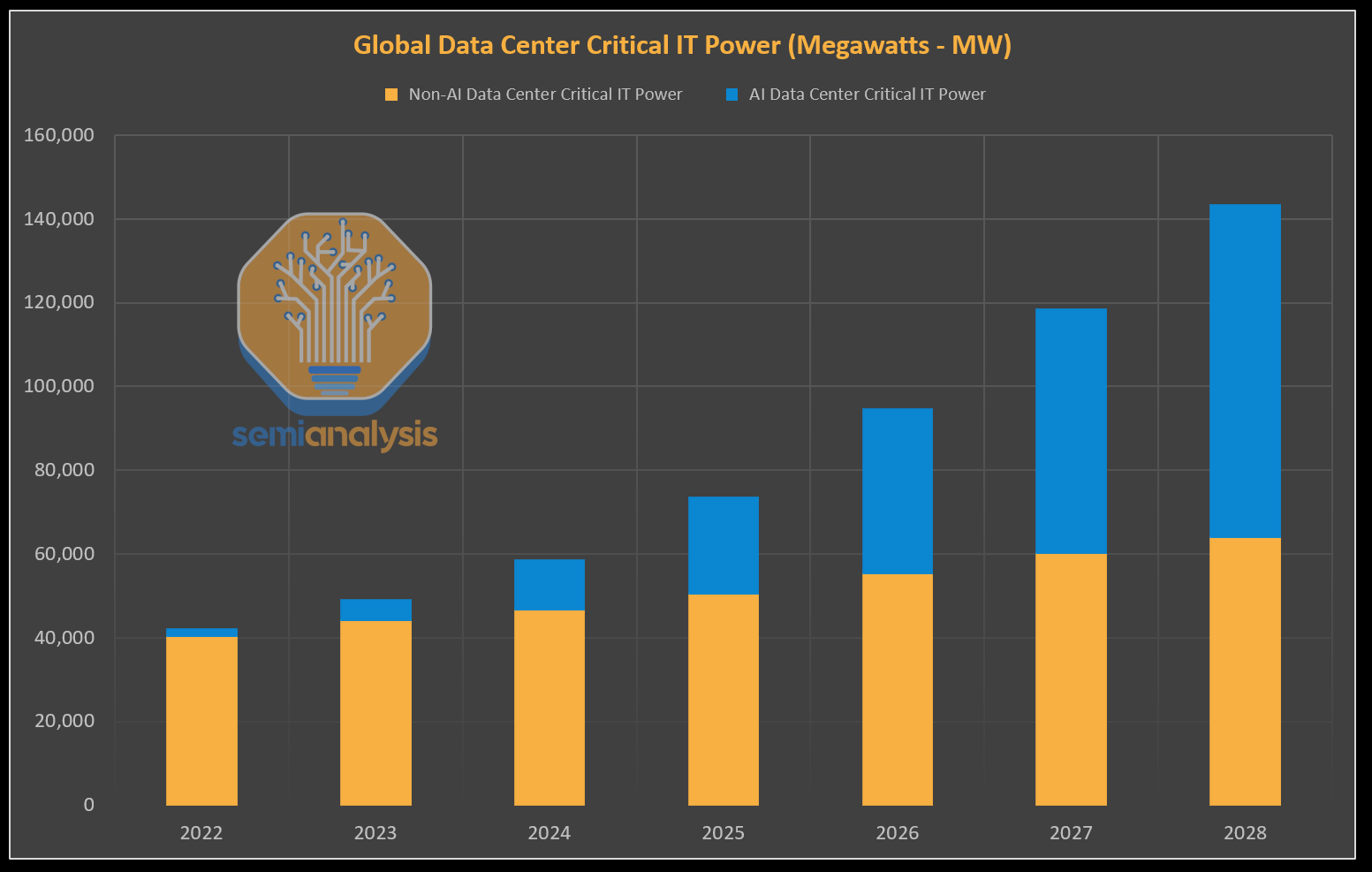
AI Power Demand Will Eclipse Traditional Usage
This chart visually demonstrates why companies are forming new energy partnerships, as AI-specific power needs are projected to dwarf all other data center consumption.
(Source: SemiAnalysis)
- In the 2021-2024 timeframe, industry collaborations often centered on broad sustainability goals, such as the Climate Neutral Data Centre Pact, which set renewable energy usage targets for signatories like AWS, Google, and Microsoft.
- By late 2025, these general commitments evolved into specific, large-scale energy procurement deals designed to power AI infrastructure. Microsoft’s Power Purchase Agreement (PPA) with Iberdrola for 150 MW of dedicated wind power in Spain is a prime example of this trend.
- This model secures a long-term supply of clean energy, de-risking operations from volatile grid prices and capacity shortfalls. It demonstrates that securing power is now as critical as securing the specialized hardware, like GPUs, needed for AI.
Table: Strategic Partnerships for AI Data Center Power
| Partner / Project | Time Frame | Details and Strategic Purpose | Source |
|---|---|---|---|
| Microsoft / Iberdrola | Dec 29, 2025 | A Power Purchase Agreement for 150 MW of wind power in Spain. This alliance directly secures a large-scale renewable energy source to power Microsoft’s data centers, ensuring a stable and sustainable power supply for AI workloads. | Carbon Credits |
| Climate Neutral Data Centre Pact | Ongoing (2021-2024) | A self-regulatory initiative with signatories including AWS, Google, and Microsoft. The pact required members to match 75% of electricity use with renewables by 2025, establishing an early framework for the large-scale procurement seen today. | Rated Power |
Geographic Expansion Follows Power Availability, Reshaping the Data Center Map
The geographic distribution of new AI data center projects is now dictated by power availability and grid capacity, driving development away from traditionally dense but power-constrained markets toward new regions with energy surpluses. This energy-first approach to site selection is creating a new global map for digital infrastructure, where access to megawatts is more valuable than millisecond latency.
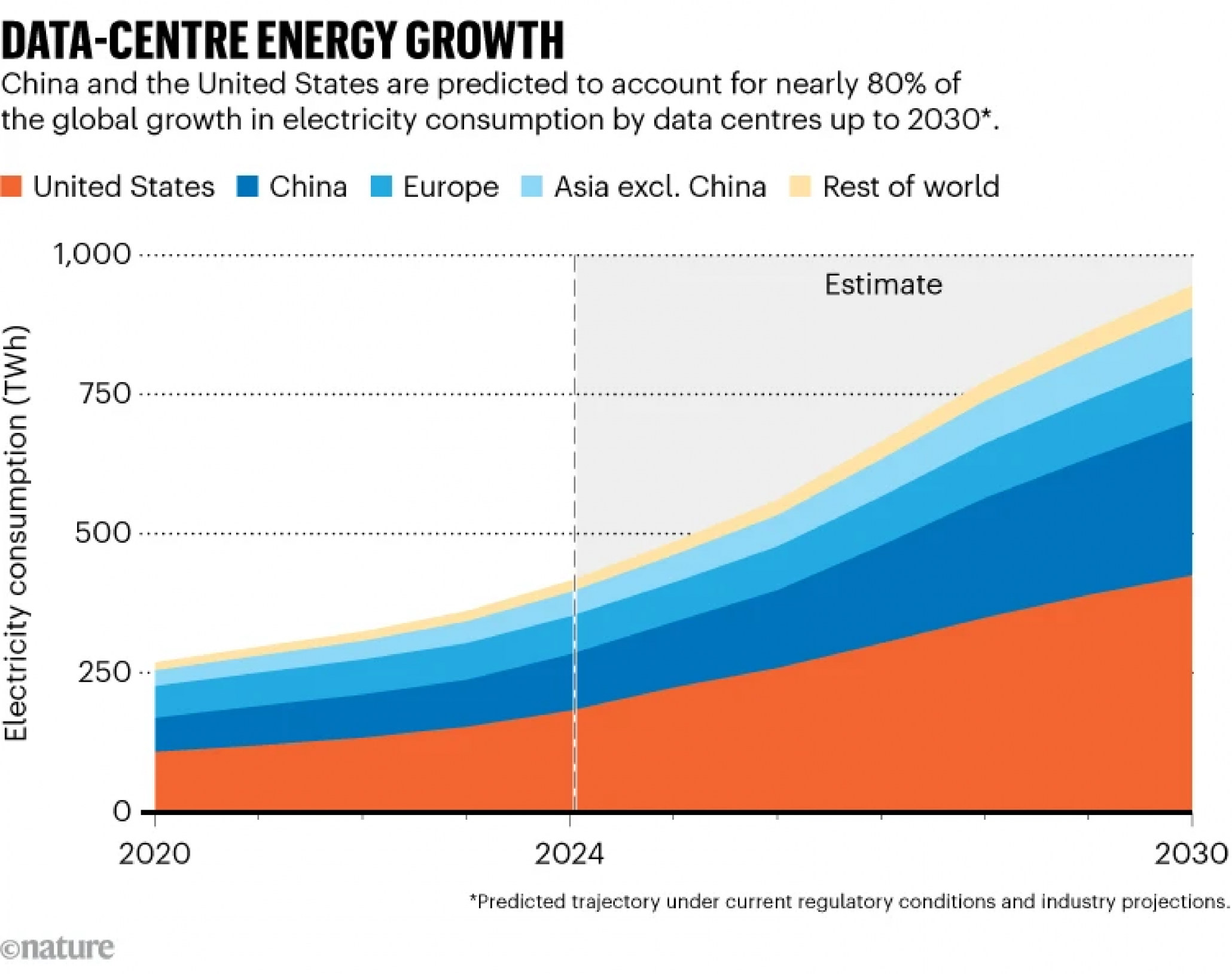
US and China Dominate Data Center Growth
Highlighting the concentration of growth in the US and China, this chart supports the theme of a new data center map being drawn around power-rich regions.
(Source: Scientific American)
- Prior to 2024, data center hubs were primarily chosen for their proximity to population centers and robust fiber networks, leading to high concentrations in areas like Northern Virginia, Silicon Valley, and London.
- Data from 2024-2025 reveals a strategic pivot to power-rich regions. Microsoft’s $15.2 billion investment in the UAE and Meta’s $10 billion campus in Louisiana are clear signals of this move to areas with available grid capacity.
- Similarly, Alberta, Canada, is emerging as a destination for hyperscale AI due to its energy resources, evidenced by projects like the Wonder Valley AI Data Centre Park, which aims to become the world’s largest AI data center.
- Conversely, regulatory and public pressure is mounting in established but strained regions. A recent UK government report calling for mandatory reporting on energy and water use signals a potential slowdown in development in power-scarce markets, reinforcing the geographic shift.
Technology Maturity: On-Site Generation and Alternative Power Sources Reach Commercial Viability
To overcome public grid limitations, the industry is rapidly advancing beyond conventional power contracts to pilot and deploy alternative, dedicated energy solutions. Technologies such as hydrogen fuel cells and Small Modular Reactors (SMRs) are transitioning from research concepts to commercially viable options for providing the reliable, gigawatt-scale power that AI data centers require and public grids often cannot guarantee.

Individual Server Power Consumption Is Skyrocketing
This chart shows the rapid power consumption increase at the server level, justifying the need for new, powerful on-site generation technologies discussed in the section.
(Source: dev/sustainability)
- Between 2021 and 2024, the primary technology focus for energy management was improving Power Usage Effectiveness (PUE) at the facility level, largely through the adoption of advanced liquid cooling systems.
- The period from 2024-2025 shows a clear maturation of *power sourcing* technologies. Microsoft’s successful pilot of hydrogen fuel cells to power a row of data center servers is a critical validation of clean, on-site generation at a commercially relevant scale.
- Concurrently, the discussion around using Small Modular Reactors (SMRs) to power data centers has moved from theoretical to a strategic consideration for major tech companies, reflecting the search for carbon-free, baseload power.
- This is complemented by hardware-level innovations. The development of energy-efficient systems like the NVIDIA DGX B 300 and the personal-scale DGX Spark shows that managing power consumption at the chip level is a mature and necessary response to high energy costs and grid constraints.
SWOT Analysis: Grid Strain Defines AI Data Center Opportunities and Threats
The core strength of AI infrastructure, its immense computational power, is directly linked to its greatest weakness: a massive and concentrated demand for electricity. This dynamic creates significant external threats from grid instability and regulation, while also generating opportunities for companies that can secure innovative and dedicated power solutions.

Forecasts Confirm Explosive Energy Demand Growth
As a summary of multiple forecasts, this chart validates the central premise of the SWOT analysis: that immense and accelerating energy demand is the defining industry challenge.
(Source: dev/sustainability)
- Strengths have evolved from hardware-level efficiency to system-wide optimization, using AI itself to reduce energy consumption.
- Weaknesses have scaled from being a rack-level engineering challenge to a systemic, grid-level crisis.
- Opportunities have shifted from general sustainability initiatives to strategic, large-scale investments in dedicated renewable and alternative power sources, which now represent a key competitive advantage.
- Threats have materialized from financial forecasts into tangible operational barriers, including power shortages, public health costs, and regulatory intervention.
Table: SWOT Analysis for AI Data Center Power Consumption and Grid Interaction
| SWOT Category | 2021 – 2024 | 2025 – Today | What Changed / Resolved / Validated |
|---|---|---|---|
| Strength | Focus on GPU efficiency for high-performance computing, as demonstrated in rankings like the Green 500. | Use of AI to optimize data center operations, with Google’s Deep Mind reducing cooling energy by 40%. | The strategy for efficiency expanded from improving hardware performance-per-watt to using sophisticated software for system-level energy management. |
| Weakness | High power density of 50-100 k W per rack was identified as a significant design and cooling challenge for new facilities. | Extreme power demand (over 100 k W/rack) and facility-level consumption (approaching 1 GW) are now causing direct strain on local power grids. | The problem of high power consumption has scaled from an internal engineering issue to an external systemic crisis affecting regional infrastructure. |
| Opportunity | General industry commitments to renewable energy procurement and improving PUE through pacts and incremental upgrades. | Massive, direct investments in dedicated renewable energy, exemplified by Microsoft’s 150 MW wind PPA, and exploration of alternative power like nuclear. | The approach shifted from gradual greening to strategic, large-scale energy sourcing as a primary business enabler and competitive differentiator. |
| Threat | Threats were primarily financial, focused on forecasts of rising electricity costs and their impact on operational expenditures. | Threats are now operational and regulatory, including real-world grid strain, projected power shortages (Gartner), and calls for mandatory energy use reporting (UK). | The risk profile has matured from a predictable financial variable to a complex mix of immediate operational barriers and long-term regulatory uncertainty. |
Scenario Model: Grid Constraints Will Force a Market Fragmentation
If grid modernization and new generation capacity fail to keep pace with AI-driven demand, expect a fragmentation of the data center market where future growth becomes exclusively concentrated in regions with independent or dedicated power solutions. Development in traditionally strategic but power-constrained areas will stall, leading to a bifurcated market defined by energy access.
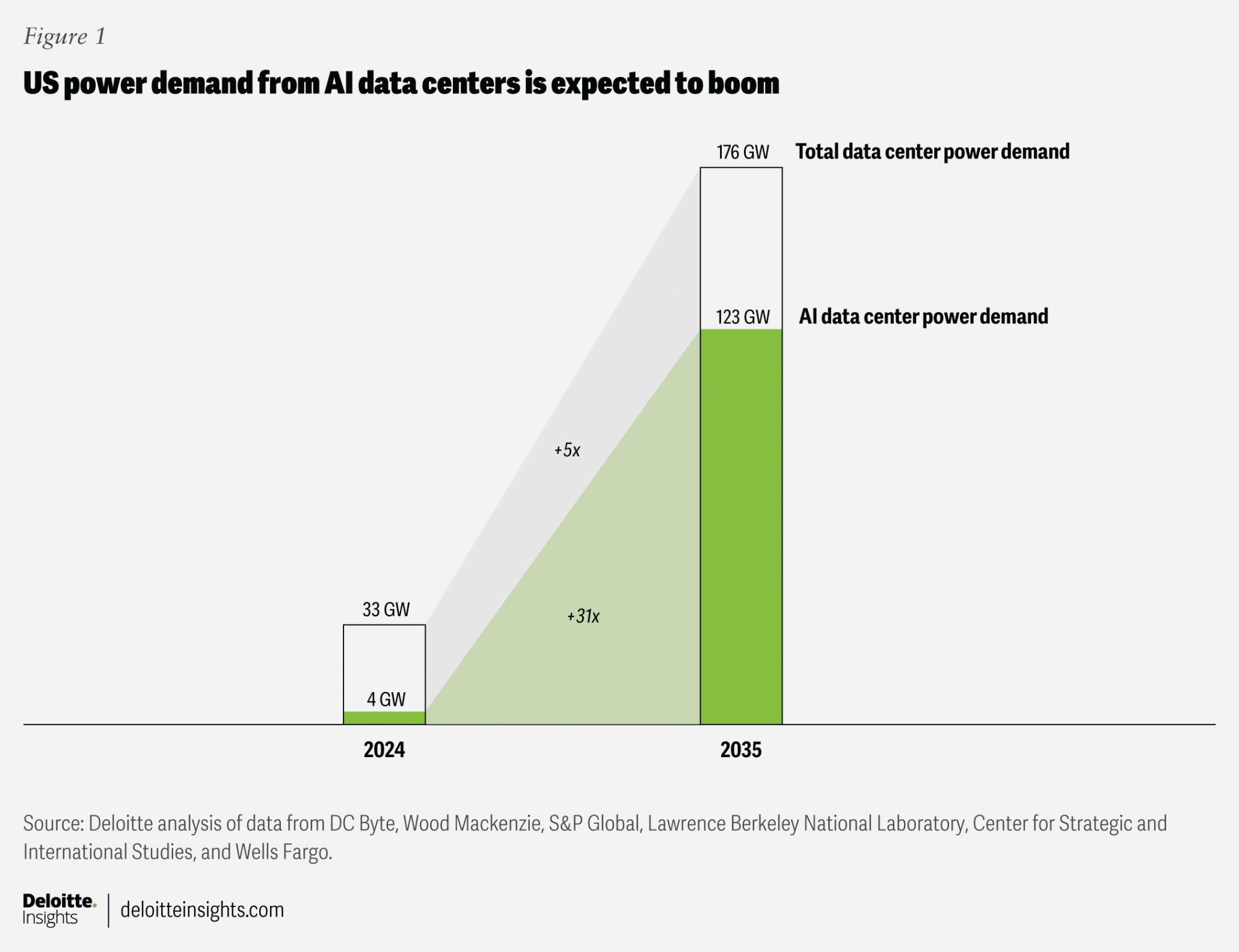
AI Power Demand Forecast to Surge 31-Fold
The dramatic 31-fold projected increase in AI power demand provides a stark quantitative basis for the scenario model’s warning of potential market fragmentation.
(Source: Deloitte)
- If this happens: The availability of reliable, gigawatt-scale power will become the single most important determinant of project viability, superseding all other factors like latency, tax incentives, and labor availability.
- Watch this: Track the success of projects that are co-located with dedicated power generation, such as those exploring SMRs or large-scale solar-plus-storage. Conversely, monitor for an increase in data center project cancellations or indefinite delays where developers explicitly cite power procurement challenges as the primary cause.
- These could be happening now: Early signals of this fragmentation are already visible. Microsoft’s $15.2 billion investment in the power-rich UAE and the industry’s pivot toward nuclear energy represent a strategic decoupling from constrained public grids. At the same time, regulatory actions like the UK’s call for energy reporting could be the first step toward a growth slowdown in power-scarce regions.
Frequently Asked Questions
Why has power availability suddenly become the biggest problem for AI data centers?
The issue stems from the massive increase in workload intensity. A single AI task can use up to 1,000 times more electricity than a traditional web search. This creates highly concentrated, large-scale power demands that regional electricity grids were not built to handle, turning the search for available megawatts into the primary bottleneck for growth.
How are major tech companies responding to these power constraints?
They are adopting a two-pronged strategy. First, they are shifting multi-billion dollar investments to power-rich regions, such as Microsoft’s $15.2 billion commitment in the UAE and Meta’s $10 billion campus in Louisiana. Second, they are forging direct energy procurement partnerships, like Microsoft’s Power Purchase Agreement (PPA) for 150 MW of dedicated wind power, to secure their own energy supply and bypass grid limitations.
Is the location of new data centers changing because of this energy crisis?
Yes. The geographic focus is shifting away from traditional, power-constrained hubs like Northern Virginia and London. Instead, new developments are targeting regions with energy surpluses. The article highlights this trend with major projects moving to areas like the UAE, Northeast Louisiana, and Alberta, Canada, where grid capacity and energy resources are more readily available.
What new technologies are being considered to power AI data centers?
The industry is moving beyond traditional grid power to explore dedicated, on-site generation. The article points to two key technologies reaching commercial viability: hydrogen fuel cells, which Microsoft has successfully piloted to power servers, and Small Modular Reactors (SMRs), which are now being strategically considered by major tech companies for carbon-free, baseload power.
What is the key difference between the energy challenges of today versus a few years ago?
Between 2021 and 2024, the challenge was primarily an internal engineering problem focused on making individual facilities more efficient (improving PUE). Today, it has escalated into a systemic, external crisis. The problem is no longer just about high operating costs but about the physical impossibility of sourcing enough power, leading to operational threats like power shortages and increased regulatory scrutiny.
Experience In-Depth, Real-Time Analysis
For just $200/year (not $200/hour). Stop wasting time with alternatives:
- Consultancies take weeks and cost thousands.
- ChatGPT and Perplexity lack depth.
- Googling wastes hours with scattered results.
Enki delivers fresh, evidence-based insights covering your market, your customers, and your competitors.
Trusted by Fortune 500 teams. Market-specific intelligence.
Explore Your Market →One-week free trial. Cancel anytime.
