

SOFC for Data Centers, 380 MW Fit Energy Deal, 300 MW ECL Partnership, and 10+ Commercial Agreements (2021 to 2026)
The exponential growth of artificial intelligence has collided with an aging and congested U.S. electrical grid, where interconnection queues for new projects stretch from three to five years. In response, 2026 has become a pivotal year where data center developers are aggressively adopting on-site fuel cell technology, not as an environmental initiative, but as a pragmatic strategy to bypass gridlock and accelerate speed-to-market. This shift to “behind-the-meter” generation represents a solution to a critical infrastructure failure, with companies leveraging fuel-flexible systems that run on natural gas today while holding the promise of a future transition to green hydrogen.
Grid Bypass Strategy: Data Center SOFC Adoption and 32% Off-Grid Projections
The adoption of on-site fuel cells for data centers has shifted from a niche, backup power application to a mainstream commercial strategy for ensuring project viability. The primary driver is no longer sustainability but speed-to-market, as grid interconnection delays have become the single largest bottleneck for deploying new AI capacity. This has created a surge in demand for on-site power solutions that can be deployed in months, not years.
The Pragmatic Pivot to On-Site Power
Between 2021 and 2024, fuel cells were largely considered for backup power or in small-scale pilots, secondary to primary grid connections. The market changed dramatically in 2025 and 2026 as the AI-driven power crunch intensified. Data from May 2026 shows U.S. interconnection queues for large projects average three to five years, a timeline that is commercially unacceptable for hyperscalers (From Backup to Prime Power: How AI Data Centers Are …). This gridlock is the catalyst forcing developers to secure their own power generation behind the meter.
From Backup to Baseload Power
The nature of AI workloads, which require constant, high-availability power, has elevated fuel cells from an emergency backup role to a primary, baseload power source. A January 2026 report from Bloom Energy projects that nearly one-third (32%) of U.S. data centers could operate fully off-grid by 2030 to meet this need for reliable power (Bloom Energy’s 2026 Data Center Power Report). The projected need for an additional 150 GW of power in the U.S. by 2028 for data centers underscores the scale of the grid’s shortfall and the opportunity for AI data center fuel cells to fill the gap (US Utilities Plan $1.4 T for AI Data Centers – Tech Insider).
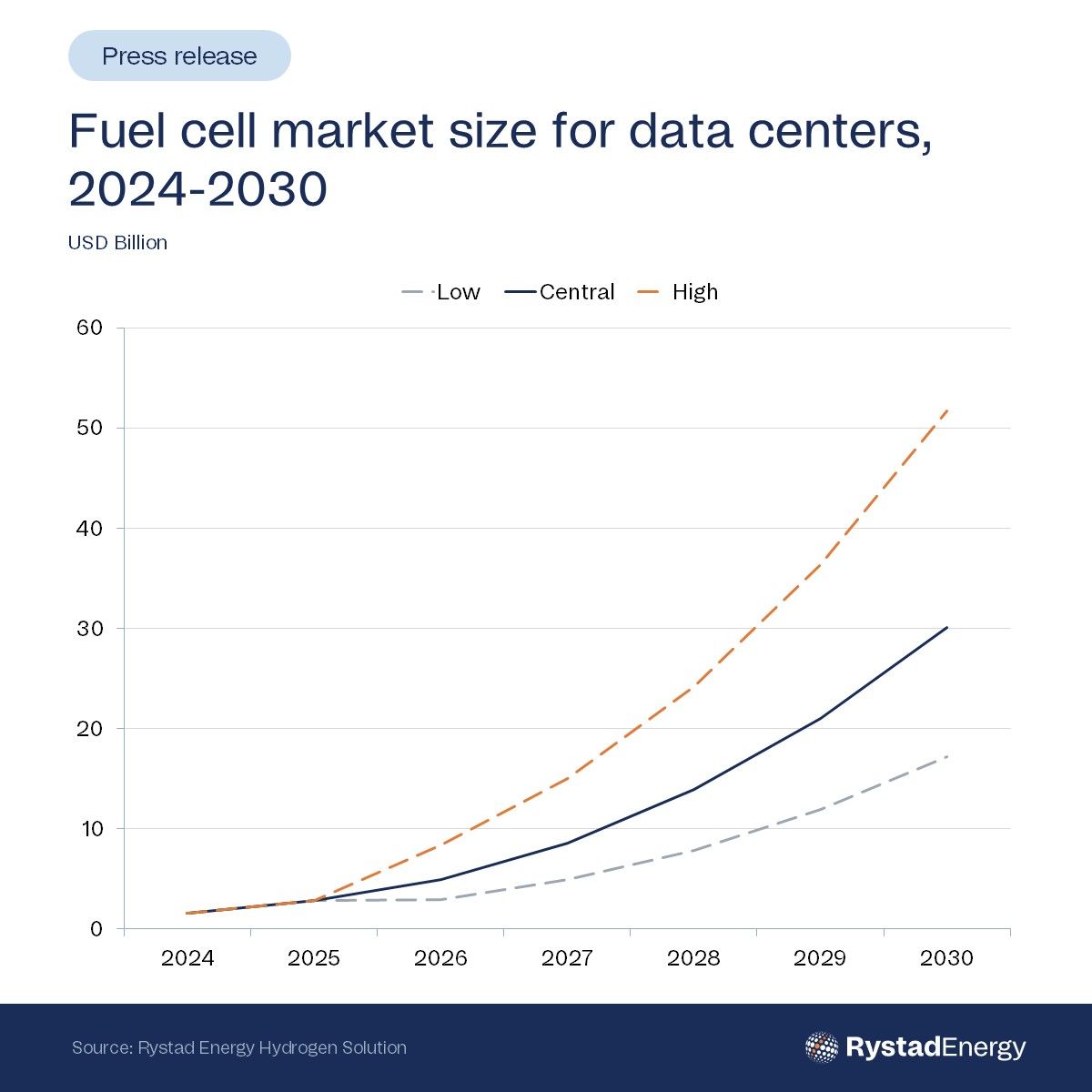
Fuel Cell Data Center Market Set for Multi-Billion Dollar Growth by 2030
The fuel cell market size for data centers is projected to reach $30 billion by 2030 under a central scenario, with a high-growth outlook exceeding $50 billion. This indicates a strong, escalating demand for fuel cell-powered data centers capable of operating off-grid.
(Source: Rystad Energy — via Grid Interconnection Delays 2026: A Threat to US Energy)
Strategic Partnerships: Fuel Cell Energy 380 MW Deal and ECL-Power Cell Alliance
Strategic alliances between fuel cell manufacturers, data center developers, and energy firms are the primary commercial mechanism for deploying large-scale, off-grid power. These partnerships de-risk projects by securing manufacturing capacity, integrating complex technologies, and structuring financing for capital-intensive, multi-megawatt deployments. The scale of these collaborations has grown significantly, shifting from single-digit megawatt pilots before 2024 to agreements for hundreds of megawatts in 2026.
Manufacturer and Developer Alliances
The most significant trend in 2026 is the formation of direct partnerships to build out portfolios of off-grid data centers. These deals provide fuel cell manufacturers with a predictable order book and give developers certainty over their power supply, a critical factor in attracting tenants and financing. The structure of these deals enables faster and more scalable deployment than a project-by-project approach.
Technology and System Integrator Pacts
In addition to developer deals, technology integrators are playing a crucial role. Partnerships between fuel cell producers and major engineering firms are creating standardized, repeatable power solutions for the data center market. This work is essential for reducing project complexity and deployment timelines, making on-site generation a more accessible option for a wider range of data center operators beyond the hyperscale giants.
Table: Key Data Center Fuel Cell Partnerships and Commercial Agreements (2026)
| Partnership / Project | Time Frame | Details and Strategic Purpose | Source |
|---|---|---|---|
| ECL / Power Cell (supported by Bosch) | July 2026 | Strategic partnership for over 300 MW of hydrogen-powered data centers. ECL will use Power Cell’s fuel cell systems as the primary power source for its off-grid AI data centers, starting with a campus in Santa Clara. | Power Cell and ECL Announce 300 MW+ Hydrogen Power … |
| Siemens Energy / Fuel Cell Energy | July 2026 | A collaborative agreement to jointly develop and offer integrated solutions using Fuel Cell Energy’s carbonate and solid oxide fuel cells with Siemens Energy’s electrification and automation systems for data centers. | Siemens and Fuel Cell Energy partner on fuel cell power … |
| Fuel Cell Energy / Fit Energy | June 2026 | A strategic agreement for up to 380 MW of clean power generation. Fit Energy plans to deploy Fuel Cell Energy’s platforms at its data center sites to provide baseload power independent of the grid. | Fuel Cell Energy and Fit Energy Announce Strategic … |
| Bloom Energy / Nebius | May 2026 | A $2.6 billion deal for Bloom Energy to supply fuel cells to power Nebius’s European AI data centers. This agreement signals significant adoption of the off-grid model outside the US market. | Bloom Energy Partners with Nebius in $2.6 Billion Deal to … |
| Oracle / Bloom Energy | April 2026 | Agreement to use Bloom Energy’s fuel cells to power ‘Project Jupiter’, a planned data center development in El Paso, Texas. This highlights hyperscaler interest in fuel cells for new campus developments. | Oracle, Border Plex, and Bloom Energy to Power Project … |
US Market Focus: Off-Grid Data Centers Driven by Grid Congestion
The United States is the clear epicenter of the off-grid data center movement, a direct consequence of severe grid congestion in its primary data center markets. While European and Asian markets are also seeing growth in emerging fuel cell applications, the scale and urgency of deployment in the U.S. are driven by acute infrastructure failures rather than policy mandates alone. The geographic concentration of activity highlights where the grid is most stressed.
US Gridlock Hotspots
From 2021 to 2024, fuel cell deployments were scattered and often tied to state-level incentives. By 2026, activity has consolidated in regions with the longest grid interconnection queues, such as Northern Virginia, Silicon Valley, and major hubs in Texas and Arizona. The decision by 13 US states in August 2026 to reconsider data center tax breaks is a direct reaction to the immense strain these facilities are placing on local power infrastructure, further incentivizing developers to pursue grid-independent solutions (13 US States Move to Scrap Data Center Tax Breaks …).
European Market Dynamics
In Europe, the drivers are more mixed. While grid constraints exist, decarbonization goals and stricter emissions regulations also play a significant role. The $2.6 billion agreement between Bloom Energy and Nebius in May 2026 for European AI data centers shows that the off-grid model is gaining traction, but it is often framed within a broader strategy to meet both power and environmental targets (Bloom Energy Partners with Nebius…). The slower development of the UK’s hydrogen policy, as noted in January 2026, could temper near-term growth in that specific market (Policy delays, project exits cloud UK hydrogen outlook).
Commercial Scale Deployment: SOFCs for Baseload Data Center Power
Solid Oxide Fuel Cells (SOFCs) have reached commercial maturity for baseload data center power, a status validated by the shift from small-scale pilots before 2024 to multi-hundred-megawatt agreements in 2026. The technology’s key advantages, including high electrical efficiency and fuel flexibility, have made it the leading choice for developers seeking a reliable, 24/7 on-site power source that offers a clear path to future decarbonization.
SOFC as the Dominant Technology
The progression from the 2021-2024 period, which saw demonstrations of 1-5 MW systems, to the current era is marked by the introduction of standardized, utility-scale solutions. In March 2026, Fuel Cell Energy announced a packaged 12.5 MW power block specifically designed for the data center market, a sign of product maturation (Fuel Cell Energy Scales Up for Data Centers). This modular approach allows for scalable deployments that can match the power requirements of modern AI facilities, solidifying the role of fuel cells in data centers.
The ‘Hydrogen-Ready’ Bridge
A critical factor in the adoption of hydrogen and fuel cells is their fuel flexibility. Most current deployments run on natural gas, providing a pragmatic “bridge” solution that solves the immediate power problem while bypassing the high costs and supply chain immaturity of green hydrogen. A July 2026 report highlighted that low demand and financial obstacles continue to challenge the green hydrogen sector (Green Hydrogen Crisis: Low Demand Halts Projects). The ability of SOFCs to operate on natural gas today and transition to hydrogen blends or pure hydrogen in the future makes them a financially viable and strategically sound long-term investment for data center operators.
SWOT Analysis: Off-Grid Data Centers in 2026
The market for off-grid data centers is defined by a powerful structural tailwind, grid failure, which creates a substantial opportunity. However, this growth trajectory is exposed to significant risks related to fuel costs, supply chain development, and an evolving regulatory environment. The strategic imperative has shifted from proving the technology to managing the operational and commercial complexities of large-scale, independent power generation.
Table: SWOT Analysis for Off-Grid Hydrogen Data Centers
| SWOT Category | 2021 – 2023 | 2024 – 2026 | What Changed / Validated |
|---|---|---|---|
| Strengths | High reliability (99.99%+ uptime); low emissions compared to diesel generators; small physical footprint. | Ability to bypass 3-5 year grid interconnection queues; rapid deployment timeline (months vs. years); proven baseload capability for 24/7 AI workloads. | The core value proposition shifted from a “green backup” to a “pragmatic grid bypass” strategy, validating speed-to-market as the key strength. |
| Weaknesses | High capital expenditure (Cap Ex) compared to grid power; reliance on natural gas pipeline infrastructure; perceived technology risk. | Ongoing reliance on natural gas, exposing projects to price volatility; logistical complexity of on-site fuel management; nascent supply chain for green hydrogen. | The primary weakness shifted from technology risk to fuel price and supply chain exposure, a commercial and operational challenge, not a technical one. |
| Opportunities | Growing data center power demand; potential to use green hydrogen; government incentives for clean energy. | Massive, non-discretionary AI power demand exceeding 1, 000 TWh globally (The Global Data Centre Power Crisis…); ability to secure power for gigawatt-scale AI campuses; future revenue from hydrogen blending. | The opportunity scaled from powering individual data centers to enabling entire AI ecosystems, driven by the failure of public infrastructure. The fuel cells for AI market expanded dramatically. |
| Threats | Competition from other clean sources (solar + storage); uncertain long-term economics; policy dependence. | Regulatory pushback on natural gas use (e.g., Texas denying tax exemptions, Texas Denies Tax Exemption…); community opposition to new energy infrastructure; slow development of green hydrogen production and transport. | Threats matured from technology competition to regulatory and social license risks, as seen with state-level tax incentive debates and project opposition. |
2027 Outlook: Fuel Supply and Regulatory Scrutiny
The critical variable for the off-grid data center market in 2027 will be the ability of developers to manage fuel supply and navigate increasing regulatory scrutiny. As hundreds of megawatts of new on-site generation come online, the focus will shift from securing deals to executing them reliably and cost-effectively. The long-term viability of the fuel cells for AI data centers model depends on solving these next-order challenges.
If Fuel Costs Rise
A sustained increase in natural gas prices could erode the economic advantage of bypassing the grid, particularly for projects that have not secured long-term, fixed-price fuel contracts. If this occurs, watch for an accelerated push toward demonstrating higher blends of hydrogen, even if at a premium, to de-risk exposure to fossil fuel market volatility and align with corporate ESG mandates.
If Regulators Intervene
The proliferation of behind-the-meter gas-fired generation is attracting attention from regulators and environmental groups. If this leads to new permitting requirements, emissions standards, or the removal of tax incentives, watch for project timelines to lengthen and costs to increase. This could slow the pace of new deployments or force a more rapid pivot to projects that can secure a verifiable green hydrogen supply.
The questions your competitors are already asking
This report covers one angle of the on-site data center power market. The questions that matter most depend on your work.
- Natural gas price risk for data center fuel cells
- Green hydrogen supply contracts for data centers
- Bloom Energy vs FuelCell Energy data center deals
- Grid connection wait times Virginia vs Texas
This report does not answer these. Enki Brief Pro does.
Your question, your angle, your framework. SWOT, PESTL, scenario modelling. The same niche depth, built around the decision your work actually depends on.
