

PPL Data Center Grid Overhaul, $23 B Capex Plan, Blackstone JV, and 25.2 GW Demand (2025-2026)
Grid Constraints from Data Centers, PPL Faces 25.2 GW Queue
The sudden and explosive electricity demand from data centers has shattered traditional utility load forecasting models, creating unprecedented grid reliability and cost recovery risks for incumbents like PPL Corporation. After years of flat demand, the utility and its grid operator, PJM Interconnection, are now confronted with a multi-gigawatt surge that their infrastructure was not designed to handle. This abrupt shift from predictable, incremental growth to exponential, concentrated demand creates a fundamental mismatch between the rapid deployment cycles of the tech industry and the decadal planning horizons of regulated utilities.
- Prior to 2025, utility planning was characterized by relatively flat load growth. The primary challenge has now shifted to managing a demand surge, with PPL alone facing a queue of potential data centers representing 25.2 GW of new load in its service territories.
- This regional crisis reflects a national trend. The Electric Power Research Institute (EPRI) projects data centers could consume up to 17% of total U.S. electricity by 2030, while PJM’s long-term summer peak demand forecast has risen from 160 GW in 2025 to 253 GW by 2046, almost entirely due to data center growth.
- The core risk lies in the collision of timelines. Data center developers expect to connect gigawatt-scale facilities in 24-36 months, whereas permitting and constructing the required generation and transmission infrastructure takes five to ten years, creating a critical and growing power supply gap.
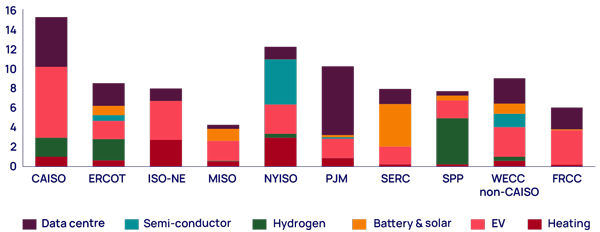
Data Centers Drive Massive Power Demand on PJM Grid
The section discusses grid constraints and a massive 25.2 GW connection queue PPL faces. The chart directly illustrates the cause by showing the immense forecast for new power demand from data centers specifically on the PJM grid, which is PPL’s primary service territory.
(Source: Wood Mackenzie)
$23 Billion in Capex, PPL’s Response to Data Center Demand
In response to the unprecedented demand surge, PPL Corporation has initiated a massive, accelerated capital expenditure program focused on reinforcing grid infrastructure and adding new generation capacity. This multi-billion-dollar investment plan represents a fundamental strategic pivot for the utility, shifting from a maintenance and modest upgrade posture to a rapid, large-scale buildout. The primary objective is to prevent systemic grid failures and capture the significant revenue opportunity presented by the data center industry.
- PPL announced a $23 billion capital plan for 2026-2029, a 15% increase from previous plans, with spending ramping up to $4.3 billion in 2025 and $5.2 billion in 2026.
- The majority of the increased spending is targeted at grid capacity, including a $2 billion increase in transmission investments and a broader $6.8 billion allocation through 2028 to modernize transmission lines specifically to handle the new load.
- This investment is not speculative but a direct reaction to concrete interconnection requests. The utility has also proposed $700 million to $850 million for new high-voltage infrastructure to connect the data centers to the grid.

Recent Forecasts Show Sharply Higher Energy Demand
The section details PPL’s $23 billion capital expenditure as a response to data center demand. The chart provides the justification for this significant investment by visualizing how recent energy demand forecasts have been revised sharply higher, forcing utilities to plan for a new high-growth future.
(Source: Bipartisan Policy Center)
PPL Corporation Capital Investment Plan
| Time Period | Investment Value (USD) | Details and Strategic Purpose | Source |
|---|---|---|---|
| 2026-2029 | $23 Billion | Overall capex plan for transmission, grid modernization, and generation to accommodate a 25.2 GW data center queue. Represents a 15% increase over prior plans. | Utility Dive |
| Through 2028 | $6.8 Billion | Targeted allocation to expand grid capacity and modernize transmission lines to handle high-density load from AI and data centers. | The Morning Call |
| 2026 | $5.2 Billion | Planned annual capital expenditure for grid upgrades and system enhancements as part of the accelerated investment cycle. | Yahoo Finance |
| 2025 | $4.3 Billion | Planned annual capital expenditure, marking the start of the significant ramp-up in spending to address new load growth. | Yahoo Finance |
| Proposed | $700 M – $850 M | Specific proposal for new high-voltage infrastructure investments to directly support and connect new data center facilities. | Energy Oil & Gas |
PPL and Blackstone Joint Venture for New Gas Generation (2025)
PPL’s most significant strategic action is its joint venture with Blackstone Infrastructure to build, own, and operate new natural gas generation, marking a reversal of the industry trend of divesting generation assets. This move is a pragmatic recognition that the 24/7, high-availability power required by data centers cannot currently be met at scale by intermittent renewable sources on the compressed timelines demanded. The partnership provides a vehicle to finance and construct the necessary dispatchable power quickly while sharing financial risk.
- On July 15, 2025, PPL and Blackstone Infrastructure announced a joint venture to develop new natural gas-fired, combined-cycle generation facilities in Pennsylvania.
- The explicit goal of the partnership is to provide reliable, baseload power to support the massive data center development occurring in PPL’s service territory.
- This strategy is not isolated to Pennsylvania. PPL is pursuing a similar direct development approach to build new natural gas generation in Kentucky to serve data center demand in that region, indicating a corporate-wide pivot to gas as a bridge fuel.

US Electricity Sales Showed Stability Before Data Center Surge
The section describes a new joint venture for gas generation, a significant move to add supply. The chart provides critical historical context, showing that U.S. electricity sales were stable for years before the recent data center surge. This past stability explains why the current demand growth is so disruptive and requires major new generation projects.
(Source: Bipartisan Policy Center)
PPL Strategic Power Generation Partnerships
| Partner / Project | Time Frame | Details and Strategic Purpose | Source |
|---|---|---|---|
| Blackstone Infrastructure | Announced Jul 2025 | Joint venture to build, own, and operate new gas-fired, combined-cycle power generation in Pennsylvania. Directly targets serving new data center load with reliable, dispatchable power. | PPL Investors |
| PPL Direct Development | Announced Nov 2025 | Building new natural gas-fired power generation in Kentucky. This mirrors the Pennsylvania strategy, confirming a corporate-wide response to data center demand across its service territories. | Industrial Info Resources |

GenAI Drives Surge in Data Center Power Demand
The section focuses on PPL’s strategic partnerships for power generation. The chart highlights the key driver for these new strategies by showing that generative AI is causing a surge in data center power demand, identifying the technological shift that necessitates new approaches to securing power.
(Source: Beth Kindig – Medium)
Pennsylvania and Kentucky, PPL’s Data Center Power Hotspots
PPL’s strategic response is geographically concentrated in its service territories that have become hotspots for data center development, primarily in Pennsylvania and Kentucky. The location of these states, particularly Pennsylvania’s position within the constrained PJM Interconnection, makes them both attractive to developers and a significant challenge for grid planning. The utility’s infrastructure investments are therefore highly targeted to these specific regions where the demand is materializing.
- Pennsylvania is the epicenter of PPL’s challenge, with the 25.2 GW queue of data centers located within its service territory. This area is part of the broader PJM market, which is experiencing explosive data center growth, putting immense pressure on local transmission and generation.
- The decision to build new natural gas plants with Blackstone in Pennsylvania is a direct geographic response to this localized demand concentration, aiming to place new generation close to the new load.
- PPL’s simultaneous move to build gas generation in Kentucky demonstrates that this is not a one-off issue but a recurring pattern. Data center developers are actively seeking locations with power and land availability, and PPL’s service areas in both states have become key targets.

Data Centers Correlate with Electricity Price Hikes
The section identifies PPL’s territories in Pennsylvania and Kentucky as data center ‘hotspots.’ The chart explains a key economic characteristic of these hotspots, demonstrating a correlation between the growth of data centers and increases in local electricity prices.
(Source: CNBC)
SWOT Analysis, PPL’s Strategy for Data Center Demand
PPL’s pivot to meet data center demand is a high-risk, high-reward strategy that positions the company to capture significant growth but also exposes it to substantial financial and regulatory vulnerabilities. The success of this strategy hinges on the materialization of forecasted demand and the ability to manage the financial risks associated with a massive, fossil-fuel-dependent infrastructure buildout. This SWOT analysis breaks down the core strategic factors based on recent market activities and announcements.
- The primary strength is PPL’s incumbent position, which provides an existing infrastructure base and a regulated framework to recover massive capital investments, as seen in the $23 billion plan.
- A key opportunity is the immense revenue growth from signing long-term Power Purchase Agreements (PPAs) with financially strong data center clients, de-risking the generation investments.
- The central threat is the speculative nature of AI demand forecasts; if growth falters, PPL and its ratepayers could be left with billions in stranded natural gas assets in a carbon-constrained future.

US Electricity Demand Flatlines, Decoupling From GDP
The section covers a SWOT analysis of PPL’s strategy. The chart, showing that U.S. electricity demand had previously flatlined, illustrates the old paradigm. This provides essential context for a SWOT analysis, highlighting the ‘Threat’ of a fundamental market shift and a potential ‘Weakness’ if strategy was based on outdated trends.
(Source: Wood Mackenzie)
SWOT Analysis: PPL’s Data Center Power Strategy
| SWOT Category | Evidence and Signals (2025-2026) | Source |
|---|---|---|
| Strengths | Incumbent utility with a regulated rate base to fund a $23 billion capex plan. Existing transmission corridors and right-of-way facilitate expansion. Deep operational experience within the PJM market. | Utility Dive |
| Weaknesses | Reliance on building new fossil fuel generation (natural gas) runs counter to long-term decarbonization goals and faces potential regulatory hurdles. Long utility planning and construction cycles are mismatched with the rapid pace of the tech industry. | PPL Investors |
| Opportunities | Massive load and revenue growth from a new class of high-demand industrial customers. Justification for a significant rate base expansion approved by regulators. Ability to secure long-term PPAs that provide revenue certainty for decades. | BCG |
| Threats | Risk of stranded assets if AI demand forecasts prove inflated or if energy efficiency in AI processing improves dramatically. Ratepayer and regulatory backlash against rising electricity costs and new fossil fuel infrastructure. Competition from alternative on-site generation like SMRs or fuel cells. | American Affairs Journal |

AI Power Demand Scenarios Project Explosive Growth
This section, also on SWOT analysis, focuses on PPL’s power strategy. The chart, which presents multiple scenarios for explosive growth in AI power demand, is a perfect tool for strategic planning. It helps quantify the ‘Opportunities’ and ‘Threats’ under different growth trajectories, a core component of a thorough SWOT analysis.
(Source: Dwarkesh Podcast)
PPL 2026 Outlook, The Risk of Stranded Gas Generation Assets
The critical strategic question for PPL heading into 2026 is whether data center operators will sign binding, long-term PPAs that fully transfer the investment risk of new generation and transmission from the utility and its general ratepayers to the data centers themselves. The success or failure of this multi-billion-dollar pivot hinges on the execution of these complex financial agreements. Without them, the company’s bet on natural gas becomes a significant stranded asset risk.
- If this happens: Data center developers commit to 20- to 30-year PPAs at prices sufficient to cover the capital and operating costs of the new Blackstone gas plants and associated transmission upgrades.
- Watch this: Public filings with the Pennsylvania Public Utility Commission and FERC for approval of these PPAs. The specific terms, pricing structures, and risk allocation mechanisms within the PPL–Blackstone JV will be the key signals.
- These could be happening: PPL successfully secures its financial returns and growth trajectory, solidifying its role in powering the AI economy. Alternatively, if data center operators balk at long-term commitments, preferring flexible or shorter-term power contracts, PPL may be forced to scale back its investment plans, jeopardizing grid reliability and leaving a multi-gigawatt demand unserved.

Peak Load Curtailment Could Add 100 GW of Grid Capacity
The section discusses the risk of PPL’s future gas generation assets becoming stranded. The chart presents a direct alternative to building new generation by showing that peak load curtailment could add significant grid capacity. This alternative pathway increases the risk that the new gas plants could be underutilized, thus becoming ‘stranded assets’.
(Source: LinkedIn)
The questions your competitors are already asking
This report covers one angle of the unfolding utility grid crisis driven by data center power demand. The questions that matter most depend on your work.
- Is PPL Corporation a good investment as it navigates the data center demand boom?
- What is actually happening with the PPL and Blackstone transmission joint venture since the announcement?
- What is the outlook for new transmission deployment in the PJM region to meet the 253 GW peak demand forecast?
- Who are PPL’s key suppliers for its multi-billion-dollar grid expansion plan?
This report does not answer these. Enki Brief Pro does.
Your question, your angle, your framework. SWOT, PESTL, scenario modelling. The same niche depth, built around the decision your work actually depends on.
