

Onshore Wind for Irish Data Centers, 80% CRU Mandate, 8 GW Capacity, and Microsoft PPA Strategy (2021 to 2026)
8 GW Capacity, Eir Grid’s Data Center Power Policy and Renewable Projects
Ireland’s policy toward data center energy consumption shifted from passive grid accommodation before 2025 to a mandatory “bring your own power” model, forcing operators to directly finance the country’s renewable energy expansion. This change was a direct response to the escalating strain on the national grid, which threatened both energy security and future economic development.
- Between 2021 and 2024, Ireland experienced soaring, unmanaged electricity demand from data centers, with consumption share rising from 14% to over 20%. This concentrated growth, primarily around Dublin, led to severe grid constraints and a de facto moratorium on new connections, treating data centers as passive but problematic consumers.
- The market was reset in December 2025 with the Commission for Regulation of Utilities’ (CRU) new connection policy. This framework mandates that new data centers meet at least 80% of their annual demand with power from *additional* renewable projects in Ireland and provide their own on-site generation or storage for grid stability.
- The policy immediately catalyzed a new market for Corporate Power Purchase Agreements (CPPAs). Hyperscalers like Microsoft, which holds nearly 1 GW of renewable agreements in Ireland, began aggressively securing long-term contracts to underwrite the development of new wind and solar farms to meet their obligations.
- This regulatory pressure also spurred grid-support innovation. Microsoft reprogrammed backup batteries at its Dublin data centers to supply power to the grid, while Statkraft launched Ireland’s first four-hour grid-scale Battery Energy Storage System (BESS) in February 2026, demonstrating a new class of required flexible assets.
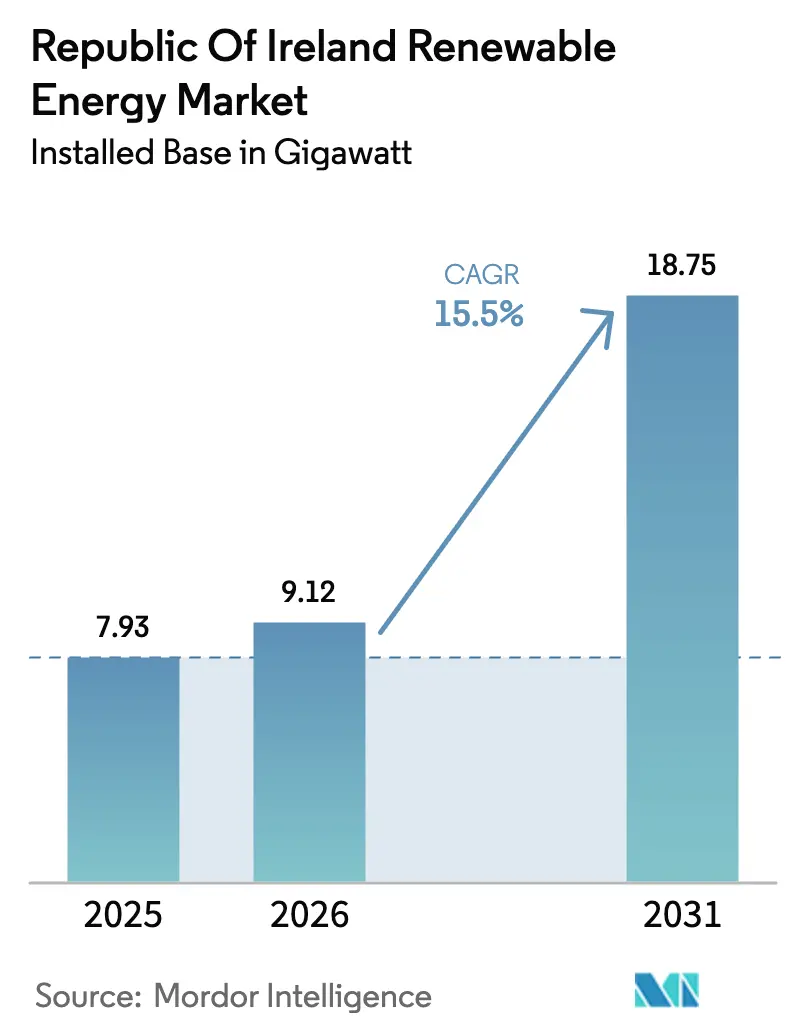
Ireland’s Renewable Capacity To Exceed 18 GW by 2031
The section discusses Ireland’s current power capacity and renewable projects. The chart directly visualizes the projected growth of Ireland’s renewable capacity, providing a forward-looking perspective on the section’s themes.
(Source: Mordor Intelligence)
Bord na Móna €3 B Investment in Renewables and Data Center Supply (2025 to 2026)
Ireland’s new energy policy directly catalyzed billions in private and state-backed investment into renewable generation and grid infrastructure, with data center off-take agreements serving as the financial bedrock for development. The policy effectively de-risked new renewable projects by creating a class of mandated, high-volume buyers.
- State-owned utility Bord na Móna announced a €3 billion investment plan to deliver 7.5 GW of renewable energy. This strategic pivot is aimed squarely at capturing the new, policy-driven demand from the data center sector.
- In the private sector, renewable developers secured financing based on the new market structure. Power Capital Renewable Energy obtained a major strategic equity partnership with Omnes and Infranity in September 2025 to accelerate its pipeline of solar projects targeting the corporate PPA market.
- The market for grid-balancing assets also saw new investment. The launch of Statkraft’s four-hour BESS and continued operation of assets from funds like Gore Street Energy Storage Fund signal the growing investment case for technologies that support a grid with high levels of intermittent renewables.
- This energy investment is now intrinsically linked to digital infrastructure growth. The Ireland data center market, valued at USD 2.99 billion in 2025, is projected to reach USD 4.05 billion by 2031, a trajectory dependent on the successful execution of this new energy investment model.

Data Center Power Mix Shifting to Renewables
The section details a major investment in renewables to supply data centers. The chart perfectly illustrates the macro-level trend that this specific investment contributes to: the shifting power mix of data centers towards renewable sources.
(Source: Carbon Brief)
Table: Strategic Energy Investments in Ireland (2025 – 2026)
| Investor / Project | Time Frame | Details and Strategic Purpose | Source |
|---|---|---|---|
| Bord na Móna | May 2026 | Announced a €3 billion investment plan to develop 7.5 GW of renewable energy, positioning the state company to supply the growing demand from data centers and other large energy users. | Think Business.ie |
| Power Capital Renewable Energy / Omnes & Infranity | Sep 2025 | Secured a strategic equity partnership to provide growth capital to fast-track its development pipeline of solar projects, specifically to supply the corporate market created by the new policy. | Omnes Capital |
| Statkraft | Feb 2026 | Launched Ireland’s first four-hour grid-scale Battery Energy Storage System (BESS), a critical technological milestone for providing long-duration storage to balance intermittent renewables and meet grid stability requirements. | RTE |
| Celtic Interconnector | 2026 (Ongoing) | Progress continues on the 700 MW high-voltage subsea power cable linking Ireland to France. The project enhances energy security and provides a route for future renewable energy exports. | Renewable Energy Industry |

Data Center Electricity Demand Forecast to Soar
This section outlines strategic energy investments in Ireland. The chart provides the fundamental reason for these investments by forecasting a massive increase in electricity demand from data centers, establishing the need for strategic action.
(Source: Carbon Brief)
Data Center PPAs, Microsoft, Google, and Bord Gáis Energy Agreements
The CRU’s policy transformed the partnership model in Ireland’s energy sector, forcing deep, long-term integration between data center operators, utilities, and renewable developers through Power Purchase Agreements. These agreements are no longer just a green procurement tool but a mandatory component of securing a license to operate and grow.
- Hyperscalers are now essential energy market partners. Operators like Amazon and Google are actively signing multi-year CPPAs with renewable developers to meet their 100% renewable goals and comply with the new regulations. These deals provide the financial certainty needed to build new wind and solar farms.
- Utilities are repositioning as intermediaries and aggregators. Bord Gáis Energy signed multiple long-term PPAs in July 2025 with solar developers including Highfield Energy and Power Capital Renewable Energy, positioning itself to become Ireland’s largest off-taker of solar power to serve the corporate market.
- Specialized energy providers are forming direct supply relationships with corporate clients. Flogas signed a three-year CPPA in September 2025 with Kildare Innovation Campus to supply renewable electricity from a 5.1 MW wind farm, showcasing the growing trend of corporate energy sourcing outside the traditional utility model.
- Technology providers are enabling new self-sufficient models. The partnership between Pure Data Centre Group and power solutions provider AVK to launch a microgrid data center in Dublin demonstrates a model of on-site, resilient power generation that can operate independently of the main grid.

Data Centers to Drive Global Electricity Demand
The section focuses on agreements by global tech giants like Microsoft and Google. The chart shows the explosive global demand driven by data centers, which is the primary motivation for these companies to secure large-scale power agreements globally, including in Ireland.
(Source: Carbon Brief)
Table: Key Energy and Data Center Partnerships in Ireland (2025 – 2026)
| Partner / Project | Time Frame | Details and Strategic Purpose | Source |
|---|---|---|---|
| Pure Data Centre Group & AVK | Mar 2026 | Partnered to launch Europe’s first microgrid data center in Dublin, demonstrating a model of on-site, resilient power generation that complies with the new grid support requirements. | CNBC |
| Flogas & Kildare Innovation Campus | Sep 2025 | Flogas signed a three-year Corporate PPA to supply renewable electricity from the 5.1 MW Cuillalea wind farm, showcasing the trend of direct corporate energy sourcing. | re News.Biz |
| Bord Gáis Energy & Solar Developers | Jul 2025 | Signed multiple long-term PPAs with developers including Highfield Energy, BNRG, and Power Capital to become Ireland’s largest solar power off-taker and supply the corporate market. | Business & Finance |

US Electricity Prices Surge Amid Data Center Boom
This section’s table lists key energy partnerships. The chart, showing US price surges, serves as a cautionary tale, highlighting the price volatility risk that the long-term partnerships and PPAs listed in the table are strategically designed to mitigate.
(Source: LinkedIn)
Dublin vs. Regions, Eir Grid’s Data Center Siting and Grid Constraints
While Dublin remains the epicenter of Ireland’s data center market, the new grid policy actively incentivizes development in other regions to alleviate transmission bottlenecks and promote balanced national energy demand. This marks a deliberate effort to reverse the pattern of hyper-concentration that led to the grid crisis.
- Between 2021 and 2024, data center growth was intensely focused around Dublin, home to the primary campuses of Amazon, Oracle, Microsoft, and Google. This concentration created severe, localized grid constraints and was the primary driver for the de facto connection moratorium.
- The December 2025 CRU policy fundamentally alters the geographic calculus for new investments by explicitly prioritizing grid connections for data centers located in regions where the electricity network is not constrained.
- The government’s “Green Energy Parks” concept, a key pillar of the January 2026 Large Energy User Action Plan (LEAP), further encourages the co-location of data centers with large-scale renewable generation, which is often sited in rural or coastal areas far from Dublin.
- Ireland’s strategy also has an international dimension. By championing a pan-European “supergrid” and advancing projects like the 700 MW Celtic Interconnector to France, Dublin aims to turn its geographic position into an energy export advantage, mitigating the risks of its isolated grid.

Data Centre Growth Shifts Away from Legacy Hubs
The section discusses EirGrid’s policy to encourage data center development outside of the constrained Dublin area. The chart visualizes this exact trend, showing growth shifting away from established hubs like Dublin to new regions.
(Source: LinkedIn)
700 MW Interconnector, Statkraft’s BESS Deployment and Grid Modernization
Ireland’s data center policy is accelerating the commercial deployment of mature renewable technologies like wind and solar, while simultaneously creating a critical proving ground for emerging grid-balancing technologies such as long-duration battery storage. The extreme demand profile of data centers serves as both the problem and the catalyst for deploying these solutions at scale.
- The 2021-2024 period was defined by the challenge of integrating vast amounts of onshore wind onto a grid with lagging flexibility, leading to curtailment and stability issues. The technology deployment was outpacing the grid’s ability to manage it.
- The post-2025 era is marked by rapid technological diversification and integration. Solar PV emerged as a major contributor, with grid-scale generation surpassing the 1 GW mark for the first time in April 2026, while total onshore renewable capacity reached 8 GW.
- A crucial technological validation occurred in February 2026 with the launch of Statkraft’s four-hour duration grid-scale BESS. This project proved the technical feasibility of providing the long-duration storage required to balance a grid with high penetration of variable renewables, a core tenet of the government’s new policy.
- Grid-scale infrastructure technology is also advancing from plan to reality. Progress on the 700 MW Celtic Interconnector to France signals a concrete step toward reducing Ireland’s physical energy isolation and enabling it to function as part of a larger, more resilient European network.
CRU’s 80% Mandate, SWOT Analysis of Ireland’s Energy Policy (2021 to 2026)
The strategic analysis reveals a policy that leverages Ireland’s strength in attracting foreign investment to address its weakness of grid limitations, creating an opportunity to fund a massive renewable build-out, but introducing the threat of increased costs and implementation delays.

Ireland’s LEAP Model for Data Center Energy
This section concerns high-level energy policy analysis and regulatory mandates. The chart refers to the ‘LEAP Model,’ a sophisticated energy planning and policy analysis tool used to evaluate pathways for achieving goals like the CRU’s 80% mandate.
(Source: CleanTechnica)
Table: SWOT Analysis for Ireland’s Data Center Energy Policy
| SWOT Category | 2021 – 2024 | 2025 – 2026 | What Changed / Validated |
|---|---|---|---|
| Strength | Established as Europe’s data center capital, attracting massive FDI from tech giants like Microsoft, Amazon, and Google. Abundant wind resources were a latent asset. | Continued to attract data center investment despite stricter rules. The “bring your own power” policy transformed tech giants into anchor customers for new renewable projects. | The policy validated that Ireland’s attractiveness to tech companies was strong enough to withstand significant new regulatory burdens, turning FDI into a direct funding mechanism for green infrastructure. |
| Weakness | An isolated national grid with limited interconnection capacity. Severe grid congestion around Dublin, leading to a de facto moratorium on new data center connections. High electricity prices. | Grid constraints remain, but the policy shifts the burden of managing them to the large energy users themselves. The high cost of compliance is now a primary concern for new entrants. | The weakness of the public grid was formally acknowledged and addressed by outsourcing the solution. The core physical limitations of the grid, however, will take years of infrastructure build-out to resolve. |
| Opportunity | Potential to decarbonize the electricity grid and leverage vast offshore wind resources for national use. | The 80% mandate created a guaranteed market for renewable developers, accelerating the build-out of wind and solar. Projects like the Celtic Interconnector create a pathway to become a major EU renewable energy exporter. | The 2025 policy created a direct, legally binding link between digital economy growth and green economy growth, something that was only a theoretical opportunity before. |
| Threat | Unmanaged growth in data center electricity demand threatened to derail climate targets and cause blackouts. Over-reliance on fossil fuels for backup power was increasing. | Increased cost and complexity could make Ireland less competitive for data center investment compared to other European hubs. Significant risk of delays in planning and permitting for new renewable projects and grid upgrades. | The threat shifted from a physical one (grid collapse) to an economic one (loss of competitiveness). The success of the entire strategy now depends on the administrative efficiency of the planning system. |
Forward Outlook, CRU Policy Execution and 2026 Data Center Investment
The success of Ireland’s energy strategy in the year ahead hinges on the rapid and streamlined execution of the CRU policy, specifically the administrative capacity to permit new renewable projects at a pace that matches the pipeline of data center demand.
- If the planning and permitting system for new wind farms, solar farms, and grid upgrades faces significant delays, watch for hyperscalers pausing new large-scale investment announcements or shifting future European builds to hubs with more predictable energy procurement pathways.
- This could mean the six-year “glide path” for the 80% renewable mandate becomes a critical bottleneck. If data centers cannot secure compliant PPAs due to a lack of permitted projects, it could lead to a new, policy-driven moratorium, stalling growth.
- Conversely, if the “Green Energy Parks” concept gains traction and new renewable projects are successfully fast-tracked, watch for a surge in announcements for hybrid projects that combine data centers, dedicated generation, and large-scale battery storage on a single site.
- This could mean Ireland successfully creates a replicable, albeit complex, blueprint for aligning digital and green economy growth. Such success would likely attract a new wave of investment into integrated energy-tech infrastructure, solidifying its position as a leader in sustainable digital development.

European Data Center Energy Demand to Surge
This section provides a forward outlook on policy and investment. The chart provides the essential European market context, showing the demand surge that will shape Ireland’s data center sector and influence policy and investment decisions.
(Source: European Capital Insights – Substack)
The questions your competitors are already asking
This report covers one angle of Ireland’s strategy to harness its data center boom to fund national renewable energy goals. The questions that matter most depend on your work.
- What is actually happening with renewable project development since the CRU mandated its new data center connection policy?
- Which hyperscalers are gaining ground in securing Corporate Power Purchase Agreements to meet Ireland’s new 80% renewable mandate?
- Microsoft’s grid support activities in Dublin. Is its initiative to supply power from data center batteries progressing from pilot to a wider grid service?
This report does not answer these. Enki Brief Pro does.
Your question, your angle, your framework. SWOT, PESTL, scenario modelling. The same niche depth, built around the decision your work actually depends on.
