

Toyota Supply Chain Localization, $13.9 B NC Plant, cellcentric JV, and 5 Plant Expansions (2024 to 2026)
Supply Chain Risk Mitigation, Toyota Multi-Pathway Strategy Execution
By 2026, Toyota is executing a deliberate de-risking of its global supply chain through a “multi-pathway” strategy that prioritizes profitable, mature hybrid technology to fund a methodical, long-term transition to battery electric and hydrogen fuel cell vehicles. This approach is designed to insulate the company from geopolitical trade friction, volatile demand for pure electric vehicles (EVs), and critical mineral supply constraints by avoiding an over-leveraged commitment to a single technology pathway.
- The company recalibrated its near-term EV ambitions in late 2024, reducing its 2026 global production target by a third from 1.5 million to 1.0 million units, a direct reaction to slowing EV demand growth and market instability. This contrasts with the more aggressive EV targets set during the 2021-2024 period.
- Concurrent with the EV target revision, Toyota announced plans to sharply increase production of its highly profitable hybrid vehicles, aiming for 5 million units in 2026. This leverages its dominant 58% global market share in the hybrid segment to generate the capital required for future technology development.
- This dual strategy serves as a geopolitical hedge, reducing reliance on the lithium and cobalt supply chains concentrated in a few nations, which have become a focal point of trade disputes. It allows the company to adapt to varied regional consumer preferences and uneven charging infrastructure deployment across its key markets.
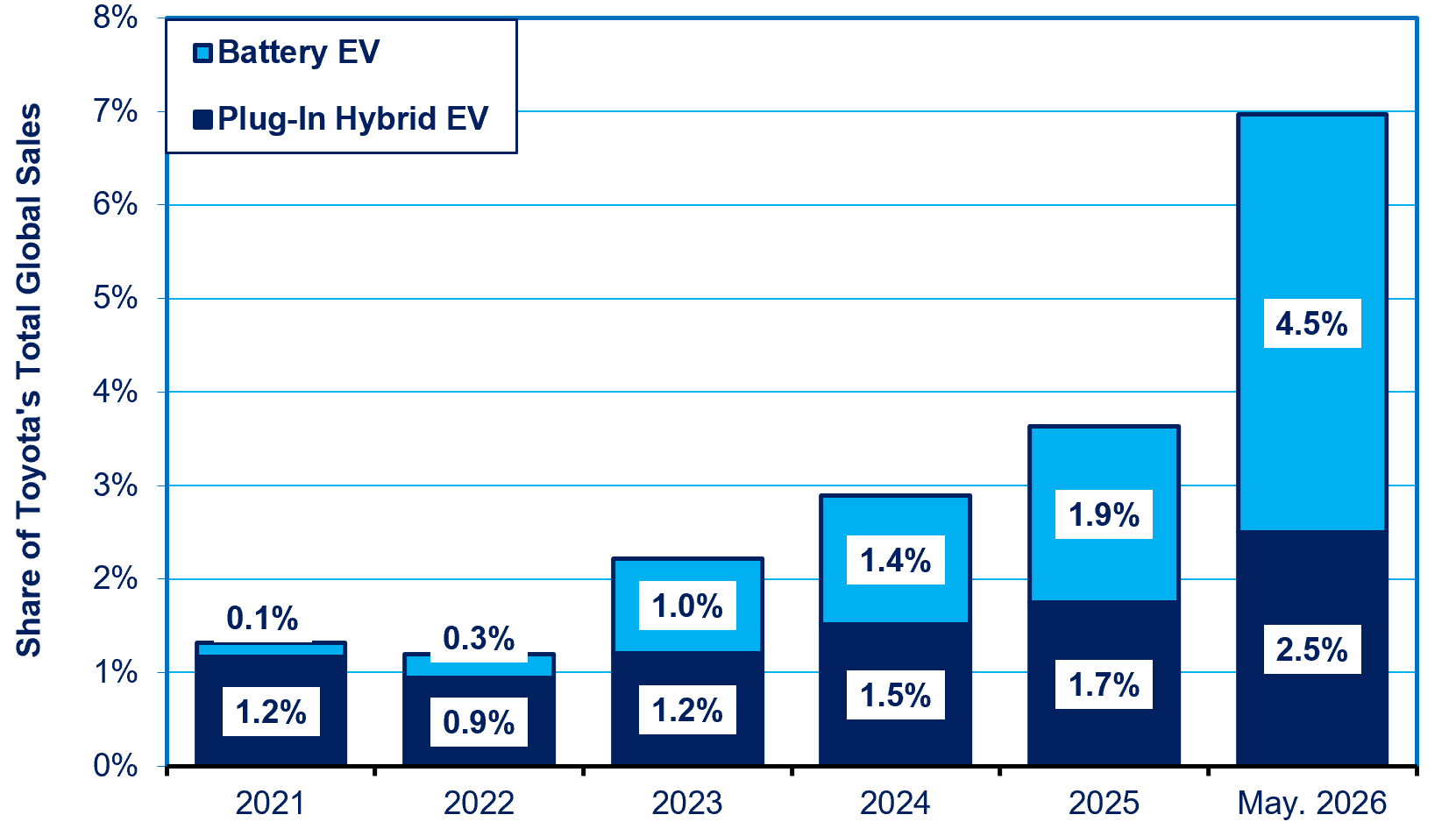
Toyota’s Electrified Vehicle Sales Share Forecasted to Hit 7% by May 2026
Toyota’s combined Battery EV (BEV) and Plug-In Hybrid EV (PHEV) share in global sales is projected to surge to 7.0% by May 2026, a significant leap from 1.3% in 2021. Notably, BEVs are expected to account for 4.5% of this total by May 2026, surpassing PHEVs (2.5%) and marking a reversal from 2021 when PHEVs dominated.
Rapid BEV Pivot Demands Major Supply Chain Re-engineering for Toyota
Toyota’s accelerating shift towards BEVs, now projected to lead its electrified sales mix, signals an aggressive reorientation of its manufacturing and supply chains. This strategic pivot indicates a commitment to mitigating geopolitical risks by localizing battery and critical component sourcing, essential for meeting surging BEV demand globally.
(Source: Surprise CEO Switch At Toyota: How Will It Affect EV Strategy?)
$14.8 B in North American Investment, Toyota Battery and Hybrid Production
Toyota’s primary investment focus through 2026 is the aggressive onshoring of its electrified vehicle supply chain in North America, committing nearly $15 billion to new and existing facilities to build resilience and comply with regional trade agreements.
- The cornerstone of this strategy is the $13.9 billion investment in the Toyota Battery Manufacturing, North Carolina (TBMNC) plant. The facility began its initial phase of production in late 2025 and is designed to supply batteries for hybrids, plug-in hybrids, and future BEVs.
- To support the surge in hybrid demand, Toyota is investing an additional $912 million across five existing U.S. manufacturing plants. This investment, announced in late 2025, is dedicated to expanding the production of hybrid powertrain components and vehicles.
- The company made a strategic decision to delay the start of its U.S. BEV production from 2025 to the first half of 2026. This allows its newly localized battery and component supply chain to mature before commencing high-volume BEV manufacturing, mitigating the production scaling issues faced by competitors.
Table: Toyota North American Electrification Investments (2025-2026)
| Partner / Project | Time Frame | Details and Strategic Purpose | Source |
|---|---|---|---|
| Toyota Battery Manufacturing, North Carolina (TBMNC) | 2025 – Ongoing | $13.9 billion investment for a new battery manufacturing plant. Began production in late 2025 to supply batteries for HEVs, PHEVs, and future BEVs, ensuring compliance with local content rules for incentives. | Reuters |
| U.S. Hybrid Production Expansion | 2025 – Ongoing | $912 million investment across five U.S. plants in Alabama, Kentucky, Missouri, and Tennessee. Aims to increase production of hybrid powertrain components to meet surging consumer demand. | Toyota Pressroom |
| U.S. BEV Production Start | H 1 2026 | Production of Toyota’s first U.S.-made BEVs was postponed to the first half of 2026. The delay allows for supply chain stabilization and design adjustments in response to market conditions. | Reuters |

Toyota’s Electrified Sales Surpass 7% Mark, Driven by BEV Surge
Toyota’s combined global sales share for Battery EVs and Plug-In Hybrid EVs rocketed from 1.3% in 2021 to 7.0% by May 2026. Notably, Battery EVs (4.5%) for the first time outpaced Plug-In Hybrid EVs (2.5%) in May 2026, signaling a strategic acceleration towards full electrification.
Strategic Pivot to BEVs Reshapes Toyota’s Future
The shift where Battery EVs (4.5%) now outstrip Plug-In Hybrid EVs (2.5%) in Toyota’s global sales by May 2026 is a critical inflection point, moving beyond historical hybrid dominance. This strategic pivot signals Toyota’s intensified focus on pure electrification, demanding new supply chain capabilities, accelerated battery production, and infrastructure investments to compete effectively in a rapidly evolving market.
Hybrid Electric Vehicle Sales Surge, Outpacing BEVs in Early 2025
U.S. light-duty vehicle sales in 1Q25 reveal a significant shift, with hybrid electrics (HEVs) surging past battery electric vehicles (BEVs) to capture over 12% of the market. While BEVs reached 8-9%, HEVs” accelerated adoption indicates strong consumer preference for a bridge technology, making up a combined 22% of total sales for all non-ICE vehicles.
(Source: Toyota teases future EV, plans three-row electric SUV by 2026)
Toyota Hydrogen Alliances with cellcentric, BMW, and Shudao Group (2024-2026)
To de-risk its long-term bet on hydrogen, Toyota is building a web of strategic alliances across Europe and Asia to share development costs, create technical standards, and accelerate the commercialization of fuel cell technology, with a clear focus on the heavy-duty transport sector.
- In Europe, Toyota formalized its entry into the cellcentric joint venture in July 2026. This partnership with Daimler Truck and Volvo Group positions Toyota at the center of developing and producing fuel cell systems for heavy-duty trucks, a market where hydrogen offers distinct advantages over batteries.
- This move complements Toyota’s long-standing collaboration with BMW Group on hydrogen fuel cell technology for passenger vehicles, which was strengthened in September 2024 to co-develop next-generation systems and components.
- In Asia, Toyota established a hydrogen-focused joint venture with China’s Shudao Group in April 2025. The partnership is designed to promote and apply Toyota’s fuel cell electric vehicle (FCEV) technology within China’s massive commercial vehicle market.
- For its electric vehicles in China, Toyota has adopted a pragmatic approach by sourcing batteries from local giant BYD. This allows the company to compete effectively in the world’s largest auto market while it continues to develop its own proprietary solid-state batteries.
Table: Toyota Strategic Technology Partnerships (2024-2026)
| Partner / Project | Time Frame | Details and Strategic Purpose | Source |
|---|---|---|---|
| cellcentric (with Daimler Truck & Volvo Group) | July 2026 | Toyota formally joined the JV to co-develop, produce, and commercialize fuel cell systems for heavy-duty trucks in Europe, sharing R&D costs and building a market ecosystem with major truck OEMs like TRATON. | Sustainable Truck & Van |
| Shudao Group | April 2025 | Established a joint venture in China to promote FCEV technology for commercial vehicles, leveraging a local partner to navigate the complex Chinese market and policy environment. This is critical as China has strong domestic players. | Fuel Cells Works |
| BMW Group | Sept 2024 | Strengthened a long-standing partnership to continue co-development of hydrogen fuel cell technologies for passenger vehicles, sharing expertise and costs for a technology with a longer commercialization horizon. | Toyota Global Newsroom |
| BYD | Ongoing | Sourcing Blade Batteries from BYD for select BEVs sold in China. This pragmatic move accelerates Toyota’s BEV product launches in a highly competitive market while its in-house battery technology, including semiconductors from firms like Broadcom, matures. | IFRI |
North America vs. Europe vs. Asia, Toyota Regional Strategy Focus
Toyota’s geopolitical strategy is not a single global blueprint but a set of distinct, tailored approaches for its three key continents, reflecting different regulatory pressures, market dynamics, and infrastructure readiness. The company is prioritizing manufacturing self-sufficiency in North America, collaborative R&D in Europe, and market-access partnerships in Asia.
- North America: The strategic imperative is supply chain localization. From 2025 onwards, activity has centered on building out a regional manufacturing footprint for batteries and hybrid components, driven by the USMCA trade agreement and a desire to de-risk from trans-Pacific shipping and tariffs. The $13.9 billion North Carolina battery plant is the physical manifestation of this regional strategy.
- Europe: The focus is on collaborative leadership in future technologies, particularly hydrogen for heavy-duty transport. Unlike the U.S. strategy of vertical integration, Toyota’s 2026 entry into the cellcentric JV with truck makers Daimler and Volvo shows a preference for sharing costs and building a common technological platform to create a new market.
- Asia: The strategy in China is one of pragmatic adaptation. Faced with intense competition from domestic EV players, Toyota is leveraging joint ventures (Shudao Group for hydrogen) and sourcing from competitors (BYD for batteries) to maintain a foothold, a stark contrast to the self-sufficient model being built in the U.S.
Technology Readiness, Toyota Hybrid Scale vs. Future Tech Pilots
By 2026, Toyota’s technology portfolio shows a clear separation between commercially scaled, cash-generating platforms and strategically nurtured future options, with hybrids funding the deliberate, phased-in development of BEVs and hydrogen systems.
- Hybrids (Commercial Scale): While a mature technology before 2024, the period from 2025 to 2026 saw hybrids elevated to the central pillar of Toyota’s financial and manufacturing strategy. Surging demand transformed them from a compliance tool into the primary engine funding the company’s entire electrification effort.
- BEVs (Strategic Scaling): The 2021-2024 period was characterized by setting ambitious BEV targets. The shift in 2025-2026 is toward a more cautious, supply-chain-led scaling. The delay of U.S. production to H 1 2026 shows a deliberate move to ensure manufacturing readiness before committing to mass volume, a lesson learned from the production challenges of rivals.
- Hydrogen (Advanced Pilot): In the 2025-2026 timeframe, hydrogen development has pivoted decisively toward commercial vehicle applications. The planned 2026 launch of its third-generation fuel cell system, promising a 20% range increase and lower costs, marks a transition from R&D to a viable niche commercial product, supported by ventures with companies like Chevron and ENN Natural Gas exploring hydrogen infrastructure.
- Solid-State Batteries (Pilot Production): This technology remains Toyota’s long-term objective for leadership in the EV space. The start of pilot production in 2026, with mass production aimed for 2027-28, is a critical milestone that moves the technology out of the lab and into a manufacturing context for the first time. The success of this could affect the entire SMMT-tracked market.
Toyota Geopolitical Strategy SWOT Analysis (2021-2026)
Toyota’s core strengths in manufacturing excellence and its dominant hybrid vehicle portfolio provide a significant financial and operational buffer against market volatility. However, the company faces external threats from aggressive, BEV-focused competitors and geopolitical trade policies, while its measured multi-pathway approach carries the internal risk of being perceived as lagging in the all-electric transition.
- The company’s primary strength is its ability to generate substantial profits from its hybrid lineup, which it uses to fund investments in BEV and hydrogen technology without compromising near-term financial stability.
- A key weakness is the slower rollout of a diverse, high-volume BEV portfolio compared to competitors like Tesla and BYD, which could cede early-adopter market share in key regions.
- The main opportunity lies in leveraging its hydrogen partnerships to establish a dominant position in the future heavy-duty fuel cell truck market, a segment where batteries are less advantageous. Natural gas producers like Chevron could become key partners.
- The most significant threat is continued geopolitical friction, particularly U.S.-China tariffs, which directly impact profitability, and the rapid pace of innovation from Chinese EV manufacturers.
Table: SWOT Analysis for Toyota’s Geopolitical Supply Chain Strategy
| SWOT Category | 2021 – 2024 | 2025 – 2026 | What Changed / Resolved / Validated |
|---|---|---|---|
| Strengths | Manufacturing excellence (Toyota Production System), established hybrid leadership, strong brand reputation. | High profitability from surging hybrid demand, proven ability to scale complex manufacturing, robust balance sheet to fund capex. | The 2025-2026 hybrid boom validated the financial strength of its existing technology, turning it into a powerful funding mechanism for the EV transition. |
| Weaknesses | Limited BEV lineup, perceived caution on full electrification, reliance on Japanese supply chain. | Slower BEV market penetration vs. rivals, risk of brand perception as a laggard, complexity of managing three separate technology pathways. | The EV demand slowdown in 2025 validated Toyota’s caution, but its BEV product gap remains a persistent weakness as competitors scale. |
| Opportunities | Leverage hybrid dominance, explore hydrogen for niche applications, expand electrification in emerging markets. | Localize supply chains to capture government incentives (U.S.), lead heavy-duty hydrogen sector via partnerships (cellcentric), develop next-gen solid-state batteries. | The $13.9 B U.S. investment and the cellcentric JV show a decisive move to turn broad opportunities into concrete, region-specific strategic actions. |
| Threats | Aggressive BEV startups, shifting government regulations and subsidies, potential supply chain disruptions from Asia. | Escalating U.S.-China tariffs ($9 B cost impact), intense price competition from Chinese EV makers, volatility in critical mineral prices. | Geopolitical and trade risks, which were theoretical threats pre-2024, became tangible financial realities in 2025-2026, validating the strategy of localization as a necessary defense. |
H 1 2026 US BEV Launch, Toyota Supply Chain Test
The single most critical event for Toyota in the year ahead is the scheduled launch of its first U.S.-produced battery electric vehicle in the first half of 2026, as the success of this milestone will serve as the ultimate validation of its multi-billion-dollar supply chain localization strategy in North America.
- If the launch and subsequent production ramp-up proceed smoothly, it will confirm that Toyota’s strategic delay was a prudent move and that its massive investment in the North Carolina battery plant can deliver at scale.
- Watch for announcements on the specific battery performance, chemistry, and cost metrics from the TBMNC plant. This data will be a key signal of Toyota’s ability to compete on technology and price with established EV leaders who have more mature battery supply chains.
- Monitor initial sales volumes and the vehicle’s eligibility for U.S. federal tax credits. Strong early sales would indicate that Toyota’s brand loyalty can successfully translate to the BEV segment and that its localization strategy is yielding the intended financial benefits for consumers.
- Conversely, any further delays, quality issues, or an inability to meet production targets could signal that even Toyota’s legendary manufacturing expertise is challenged by the immense complexity of vertical EV integration, potentially forcing a prolonged reliance on hybrids and ceding more ground in the BEV market.
The questions your competitors are already asking
This report covers one angle of Toyota’s multi-pathway electrification strategy. The questions that matter most depend on your work.
- Competitor supply chain localization in North America
- Toyota North Carolina battery plant production timeline and chemistry
- Hydrogen trucking infrastructure development Europe
- Solid state battery commercialization timeline
This report does not answer these. Enki Brief Pro does.
Your question, your angle, your framework. SWOT, PESTL, scenario modelling. The same niche depth, built around the decision your work actually depends on.
