

Chevron Middle East Expansion, $19 B Capex, Leviathan Gas FID, and 2 Key Projects (2024 to 2026)
Chevron’s Strategic Pivot to Middle East Amid Regional Supply Disruptions
Chevron is leveraging a conflict-strengthened balance sheet and minimal current exposure to execute a counter-cyclical expansion into the Middle East, pivoting from a US-heavy portfolio to secure low-cost, long-life gas and oil reserves. The company’s CEO, Mike Wirth, signaled this strategic shift in June 2026, positioning Chevron to capitalize on market conditions fundamentally reshaped by regional conflict and sustained high commodity prices.
- Prior to 2025, Chevron’s strategy was heavily weighted towards its US operations and disciplined capital spending. This shifted in 2026 as market turmoil created a unique opening for expansion. The ongoing Iran conflict has removed an average of 11.3 million barrels per day of regional crude output as of May 2026, driving a 65% increase in oil prices and creating a compelling case for securing new, stable production sources.
- The company’s current low exposure to the Middle East, which accounts for less than 5% of its total production, has become a strategic advantage. Unlike more exposed rivals such as Exxon Mobil, Chevron is insulated from the immediate operational disruptions of the conflict, allowing it to plan opportunistic acquisitions in a post-conflict recovery scenario.
- This market disruption has paradoxically fortified Chevron’s financial position. The company’s market capitalization surged by over 30% in early 2026 to nearly $400 billion. It also anticipated an upstream earnings boost of between $1.6 billion and $2.2 billion in Q 1 2026, providing a strong capital base for its expansionary ambitions.
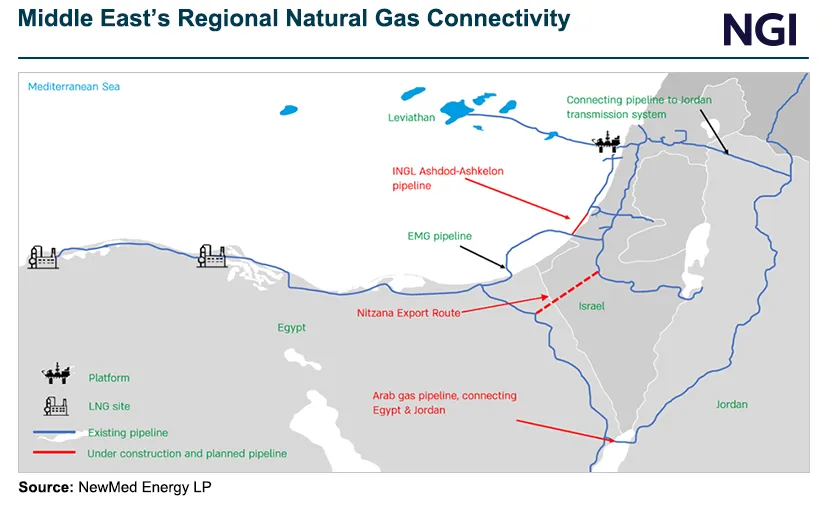
Map Details Eastern Mediterranean Gas Infrastructure
This section discusses Chevron’s strategic pivot to the Middle East. The map of Eastern Mediterranean gas infrastructure provides the direct geographic and asset-level context for this strategic move, visualizing the area of focus and existing assets.
(Source: Natural Gas Intelligence)
$19 B in 2026 Capex, Chevron Balances US Shale with International Growth
Chevron’s 2026 capital budget of $18 billion to $19 billion reveals a disciplined yet opportunistic strategy, dedicating over half its spending to US assets while funding key international projects that signal a long-term portfolio rebalancing. This increase from its 2025 budget of $14.5 billion to $15.5 billion provides the capital for both domestic growth and strategic international expansion.
- The budget allocates approximately $17 billion to upstream activities, with a significant portion, around $10.5 billion, directed to the United States. Of that, roughly $6 billion is earmarked for its high-return US shale portfolio, primarily in the Permian Basin.
- A key international commitment was the Final Investment Decision (FID) announced in January 2026 for the expansion of the Leviathan gas field offshore Israel. This project is a cornerstone of its Eastern Mediterranean strategy, designed to increase affordable gas supply to Israel, Egypt, and Jordan.
- The company’s spending plans stand in contrast to a period of global underinvestment in the upstream sector. This disciplined capital allocation allows Chevron to advance high-return projects while the broader industry contends with supply constraints and the need for new production sources.

Chevron Details Permian Production and Capex Plans
The section heading explicitly mentions balancing US Shale with international growth and Capex. This chart directly illustrates the US Shale component (Permian) of Chevron’s portfolio, detailing its production and capital expenditure plans, which is essential context for the ‘balancing’ argument.
(Source: Seeking Alpha)
Table: Chevron Strategic Capital Investments
| Partner / Project | Time Frame | Details and Strategic Purpose | Source |
|---|---|---|---|
| Leviathan Gas Field Expansion | Jan 2026 | Final Investment Decision taken to expand the major Eastern Mediterranean gas field. This move aims to increase supply for domestic markets in Israel, Egypt, and Jordan, cementing Chevron’s role as a key regional energy provider. | Chevron |
| 2026 Organic Capex Budget | Dec 2025 | Announced an $18 billion to $19 billion budget. $17 billion is for upstream, with $10.5 billion in the U.S. (including $6 billion for shale). The budget supports high-return projects and shareholder distributions. | Chevron |
| Tamar Gas Field Expansion | Feb 2025 | Ongoing project to increase production capacity at the Tamar gas field offshore Israel to 1.6 billion cubic feet per day. This complements the Leviathan project and enhances regional energy security. | [PDF] Chevron |
| 2025 Organic Capex Budget | Dec 2024 | Set a $14.5 billion to $15.5 billion budget for 2025, providing foundational capital for operations and growth. This was a lower figure than the subsequent 2026 budget, reflecting a ramp-up in spending. | Chevron |
Chevron Joint Ventures Target Gas and New Energies (2025 to 2026)
Chevron is executing its growth strategy through targeted partnerships, consolidating its position in core international assets while forming new collaborations in carbon capture and power generation to address both energy security and the energy transition. This dual-pronged approach leverages partnerships to share risk, access technology, and enter new markets.
- In April 2026, Chevron increased its stake in the Petroindependencia heavy oil joint venture in Venezuela to 49% through an asset swap. This move optimizes its existing international footprint, with executives stating the company could increase its Venezuelan output by 50% within two years.
- The company is advancing its lower-carbon agenda through the Bayou Bend CCS project, a joint venture with Talos Low Carbon Solutions and Carbonvert. This offshore carbon capture and sequestration hub is a key part of its strategy to reduce the carbon intensity of its operations.
- In a significant diversification move, Chevron partnered with Engine No. 1 and GE Vernova in January 2025 to develop plans for delivering up to four gigawatts of power to U.S. data centers. This project directly targets the surging power demand from the AI industry.

Ethane Carrier Deliveries to Surge Through 2028
The section focuses on joint ventures targeting gas and new energies. A surge in ethane carrier deliveries indicates significant investment in the midstream gas value chain, a sector often developed through partnerships and JVs, thus illustrating the logistical backbone of the gas strategy.
(Source: East Daley Analytics)
Table: Chevron Key Partnerships and Collaborations
| Partner / Project | Time Frame | Details and Strategic Purpose | Source |
|---|---|---|---|
| Petroindependencia, S.A. | Apr 2026 | Consolidated its position in a Venezuelan heavy oil JV through an asset swap, increasing its stake to 49%. This move optimizes its existing international portfolio for higher returns and potential production growth. | Chevron |
| Engine No. 1 and GE Vernova | Jan 2025 | Launched a joint development plan to provide up to 4 GW of power solutions for U.S. data centers, addressing the rapid energy demand growth from the artificial intelligence sector and marking a key commercial venture into new energies. | Chevron |
| Talos and Carbonvert | Oct 2025 | Entered a joint venture via its New Energies division to develop the Bayou Bend CCS project, a major offshore carbon capture hub. This alliance is central to its strategy of building a lower-carbon business line. | Clifford Chance |
| Chevron Lummus Global | Feb 2025 | A long-standing joint venture with Lummus Technology that serves as a key vehicle for licensing advanced refining and petrochemical process technologies to clients globally, including in the Middle East. | Oil and Gas Middle East |
Eastern Mediterranean vs. US, Chevron’s Geographic Rebalancing
While the United States remains Chevron’s investment core, accounting for over 50% of its 2026 capital budget, a strategic rebalancing is underway with concrete expansion in the Eastern Mediterranean’s gas sector and stated intent to grow across the broader Middle East. This shift aims to diversify the company’s production base and capture opportunities in low-cost hydrocarbon regions.
- The U.S. currently dominates Chevron’s capital allocation, with approximately $10.5 billion of its 2026 capex budget directed there. This reflects the high returns and operational control offered by its Permian Basin assets.
- The Eastern Mediterranean has emerged as the primary vector for international growth. Activity is centered on Israel’s offshore gas fields, with the Leviathan and Tamar projects poised to increase supply for domestic and regional markets, including Egypt and Jordan.
- The company’s stated goal to expand its Middle East footprint is rooted in its current minimal exposure. With less than 5% of its production sourced from the region, Chevron has a significant opportunity to grow its presence without the legacy risks faced by competitors.

Chevron Guides for Major Production Growth by 2027
This section discusses the comparison and rebalancing between the Eastern Mediterranean and the US. A chart showing the company’s overall production growth guidance provides the high-level result and strategic goal of this geographic rebalancing effort.
(Source: Natural Gas Intelligence)
$400 B Valuation, Chevron’s SWOT for Middle East Expansion
Chevron’s strategic position for a Middle East expansion is defined by its formidable financial standing and low regional exposure, creating a significant opportunity for growth. However, this is tempered by extreme geopolitical volatility and the long-term pressures of the energy transition.
- The company’s strengths include a robust balance sheet, bolstered by high commodity prices, and a disciplined capital framework that provides flexibility for strategic acquisitions.
- Its primary weakness is a portfolio heavily weighted towards the US, which a Middle East expansion would help rebalance.
- The main opportunity lies in acquiring low-cost, long-life reserves in a region where asset valuations may be suppressed due to perceived risk, while capitalizing on strong regional gas demand.
- Threats are dominated by the geopolitical instability of the region and the potential for project delays or cost overruns, alongside the persistent challenge of aligning long-cycle fossil fuel investments with global decarbonization goals.

Big Oil Cash Returns Since 2021
This section introduces a SWOT analysis. This chart compares Chevron’s cash returns to its ‘Big Oil’ peers, providing crucial competitive context for the ‘Strengths’ and ‘Weaknesses’ portions of the SWOT, underpinning the company’s financial position relative to the industry.
(Source: Energy Connects)
Table: SWOT Analysis for Chevron’s Middle East Expansion
| SWOT Category | Description | Supporting Data / Signals |
|---|---|---|
| Strengths | Strong financial position and low initial risk exposure provide a solid platform for opportunistic growth. | Market cap surged to nearly $400 B (Mar 2026). Middle East exposure is less than 5% of total production. 2026 capex budget increased to $18 B-$19 B. |
| Weaknesses | An upstream portfolio heavily concentrated in the United States creates a need for geographic diversification. | Over 50% (~$10.5 B) of 2026 capex is allocated to the US, indicating a heavy reliance on a single region for production growth. |
| Opportunities | Secure low-cost, long-life hydrocarbon assets in a resource-rich region and capitalize on growing natural gas demand. | Middle East onshore breakeven price is $27/barrel. IEA projects 3.5% gas demand growth in the Middle East in 2026. Global inventories are projected to hit critical lows. |
| Threats | Extreme geopolitical instability, project execution risk in a complex region, and long-term energy transition pressures. | Regional conflict caused 11.3 M b/d of shut-ins. CEO acknowledges recovery “will take time.” Large-scale projects like CCUS are needed to maintain a social license to operate. |
FID and JVs, Key Signals for Chevron’s Middle East Expansion
The primary signal to watch is whether Chevron follows its CEO’s statement with concrete capital commitments in the Middle East beyond the Eastern Mediterranean, such as new joint ventures with National Oil Companies or successful bids in exploration licensing rounds. These actions would validate the strategic pivot from rhetoric to reality.
- Monitor for announcements of new exploration block awards or farm-in agreements in key Gulf countries like Saudi Arabia, the UAE, and Qatar. Such deals would be the most direct indicator of a tangible expansion beyond its current holdings.
- Future annual reports and investor briefings will be crucial. A quantifiable increase in the percentage of Chevron’s upstream capital budget allocated to the MENA region in its 2027 plans would confirm a long-term commitment.
- The successful execution of the Leviathan Phase 1 B expansion will serve as a critical test of Chevron’s ability to deliver large-scale projects in a geopolitically complex environment, setting a precedent for further regional investments.
The questions your competitors are already asking
This report covers one angle of Chevron’s Middle East expansion strategy. The questions that matter most depend on your work.
- Which IOCs are gaining or losing ground in the Middle East upstream market?
- Is Chevron a good investment at this stage of the commodity cycle?
- Chevron’s $19B capex. Is the Middle East expansion on track to secure low-cost reserves?
This report does not answer these. Enki Brief Pro does.
Your question, your angle, your framework. SWOT, PESTL, scenario modelling. The same niche depth, built around the decision your work actually depends on.
