

Bloom Energy SOFC for Data Centers, 2.8 GW Oracle Deal, $25 B Brookfield Financing, and 4 Major Agreements (2024 to 2026)
Industry Adoption Shifts to Data Center Scale, Bloom Energy Projects Follow Grid Constraints (2024 to 2026)
The commercial adoption of Solid Oxide Fuel Cells (SOFCs) has pivoted from diverse, smaller-scale industrial applications to massive, multi-gigawatt deployments dedicated to powering AI data centers, a shift driven by the inability of traditional power grids to meet surging demand. Prior to 2025, fuel cells were primarily adopted for behind-the-meter reliability and efficiency gains in manufacturing and commercial facilities. The acute power deficit created by the AI boom has repositioned fuel cells from a niche, cost-plus-reliability solution to a mission-critical necessity for hyperscale growth.
- Between 2021 and 2024, industry adoption focused on applications like on-site power for manufacturers and behind-the-meter microgrids, where fuel cells provided resilience against grid outages and incremental efficiency improvements. These deployments validated the technology’s reliability but represented a fragmented, project-by-project market.
- Starting in 2025, the adoption model shifted dramatically towards utility-scale deployments directly serving data centers. Multi-gigawatt agreements with partners like Oracle and American Electric Power (AEP) signal that fuel cells are now being procured as primary, baseload power infrastructure, capable of being deployed in months, not the years required for grid upgrades or new power plants.
- This strategic pivot confirms that for data center operators, the economic calculus has changed. The high cost of delayed market entry or operational downtime for an AI cluster now far exceeds the capital cost premium of rapidly deployable on-site power solutions like those from Bloom Energy.
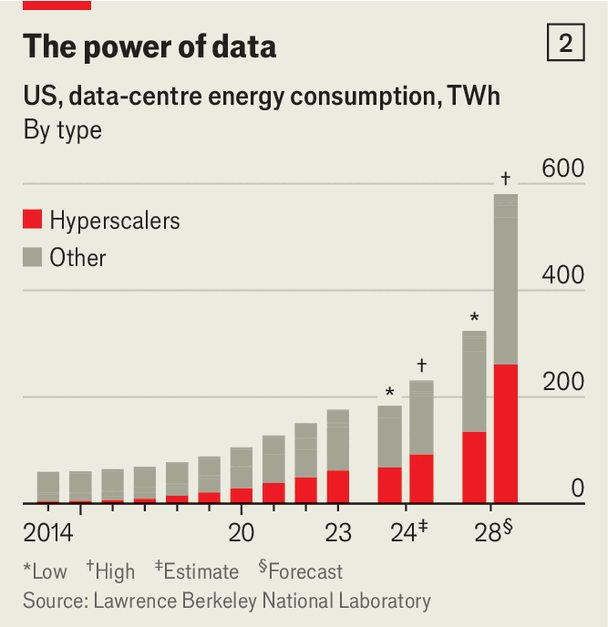
US Data Center Energy Use Forecast to Surge
The chart provides the core rationale for the section’s topic. The forecast surge in data center energy use is the primary driver for the ‘Industry Adoption Shifts to Data Center Scale’ and the reason Bloom’s projects are needed to alleviate ‘Grid Constraints’.
(Source: Vested Finance)
$25 B Brookfield Financing, Bloom Energy’s Data Center Power Strategy
Capital inflows have massively scaled and shifted focus, moving from general corporate financing to large-scale, dedicated project finance vehicles specifically designed to build and own fuel cell assets for the AI industry. This strategic financing model, pioneered by Bloom Energy and Brookfield, de-risks deployment for both the technology provider and the end-user, accelerating market penetration by converting large capital expenditures into predictable operational expenses.
- The model was validated in October 2025 with an initial $5 billion strategic partnership between Brookfield and Bloom Energy, creating a dedicated vehicle to fund and deploy fuel cell technology for data centers.
- Rapid and overwhelming demand from the AI sector led to a fivefold expansion of this partnership to $25 billion by July 2026, a clear signal of institutional investor confidence in the long-term viability and bankability of fuel cell assets.
- While the Brookfield partnership represents the largest vehicle, other financing models are emerging. A $125 million project funding partnership with HPS Investment Partners and Industrial Development Funding (IDF) in December 2024 shows a growing ecosystem of capital providers willing to underwrite these projects under Power Purchase Agreement (PPA) structures.

Installation & Electricity Revenue Growth Surges in 2025
This chart illustrates the direct financial outcome of Bloom’s financing and data center strategy. Securing large-scale financing enables a rapid increase in deployments, which translates directly into the surge in installation and electricity revenue shown for 2025.
(Source: IO Fund)
Table: Bloom Energy Strategic Financing Partnerships
| Partner / Project | Time Frame | Details and Strategic Purpose | Source |
|---|---|---|---|
| Brookfield | Jul 2026 | Partnership expanded from $5 B to $25 B. The joint venture finances, builds, and owns fuel cell projects, providing energy-as-a-service to data center clients and de-risking large-scale deployments for Bloom Energy. | Fuel Cell Works |
| HPS Investment Partners & IDF | Dec 2024 | Initial $125 million in funding to support the installation of 19 MW of Bloom Energy Servers under PPA structures. This partnership diversifies funding sources and validates the PPA model for smaller-scale deployments. | Bloom Energy |

Fuel Cell Stocks Surge, Led by Bloom Energy
This chart complements the ‘Table: Strategic Financing Partnerships’ by showing the market’s reaction. Bloom’s ability to secure innovative financing de-risks its model, sparking investor confidence not just in the company but across the sector, positioning Bloom as a leader.
(Source: Nutty – Substack)
Bloom Energy 4 Major Partnerships, From AEP to Oracle (2024 to 2026)
Strategic partnerships have matured from component-level integrations to multi-gigawatt, long-term offtake agreements with hyperscalers and utilities, providing Bloom Energy with an extensive and visible revenue backlog. This evolution confirms the company’s role as a critical infrastructure provider, with its technology now being embedded into the long-term strategic planning of the world’s largest technology and energy companies.
- The 2.8 GW supply agreement with Oracle, announced in April 2026, is a landmark deal where a hyperscaler is directly procuring fuel cells as the primary power source for its cloud and AI infrastructure, bypassing traditional utility procurement timelines.
- The agreement with American Electric Power (AEP) for up to 1 GW of fuel cells represents a structural shift in the utility business model. AEP, a major utility, is procuring fuel cells as a solution to serve the immense power needs of its data center customers, integrating distributed generation directly into its resource planning.
- The expanded $25 billion partnership with Brookfield provides the financial architecture that underpins these massive deployments, enabling customers to procure power through service agreements rather than large upfront capital investments.

Bloom Energy Stock Rallies Sharply in 2026
The chart’s timeline aligns perfectly with the section’s focus on major partnerships from 2024 to 2026. A sharp stock rally in 2026 is a logical and direct consequence of the market reacting positively to the announcement of significant deals with major players like AEP and Oracle.
(Source: Barchart.com)
Table: Bloom Energy Strategic Commercial Agreements
| Partner / Customer | Time Frame | Details and Strategic Purpose | Source |
|---|---|---|---|
| Oracle | Apr 2026 | Agreement to supply up to 2.8 GW of fuel cells to power Oracle‘s AI and cloud infrastructure. This deal establishes Bloom Energy as a direct power provider for a major hyperscaler, bypassing grid constraints for rapid expansion. | Seeking Alpha |
| American Electric Power (AEP) | Jun 2026 | A $2.65 billion, 20-year offtake project for a 1 GW fuel cell facility. This marks a major utility procuring fuel cells at scale as a generation asset to serve data center load, validating fuel cells as a grid-level solution. | Yahoo Finance |

Bloom Energy Stock Surges Over 1,300%
This chart provides a powerful, high-level visualization of the long-term value created by the successful deals listed in the ‘Table: Strategic Commercial Agreements’. The immense stock surge reflects the cumulative impact of securing a strong customer base and proving the business model.
(Source: Vested Finance)
US Market Dominance, Bloom Energy Focus on Data Center Hubs
While fuel cell technology has global applications, recent large-scale commercial activity for Bloom Energy has overwhelmingly concentrated in the United States, specifically targeting regions with high data center density and escalating grid constraints. This focused geographic strategy allows for operational efficiencies but also concentrates market risk within the US regulatory and economic environment.
- Before 2024, Bloom Energy had established a significant international presence, particularly in South Korea’s fuel cell market. However, the scale of these deployments was smaller than the multi-gigawatt projects now underway in the US.
- From 2025 to 2026, the company’s strategic focus has decisively shifted to the US market. The multi-gigawatt agreements with US-based entities like AEP (for a project in Wyoming) and Oracle reflect a direct response to the domestic AI power crunch.
- This geographic concentration allows Bloom Energy to streamline its supply chain, deployment teams, and service infrastructure around key data center hubs. However, it also increases exposure to US-specific energy policy, natural gas prices, and regulatory changes, making diversification a key long-term strategic consideration.

Bloom Energy Leads $773M Stationary Fuel Cell Market
The chart directly and quantitatively supports the section’s heading. It provides clear evidence of ‘US Market Dominance’ by showing Bloom Energy’s leading share in the stationary fuel cell market.
(Source: Global Market Insights)
Technology at Commercial Scale, Bloom Energy’s SOFC High-Efficiency
Bloom Energy‘s Solid Oxide Fuel Cell (SOFC) technology has crossed a critical maturity threshold where its proven high efficiency, reliability, and deployment speed are now primary economic drivers for adoption, particularly in the data center market. The conversation has shifted from proving technological viability to demonstrating economic superiority when speed and reliability are paramount.
- The technology delivers electrical efficiency of over 60%, significantly higher than many alternatives. For applications with heat demand, its Combined Heat and Power (CHP) efficiency can exceed 90%, offering superior fuel economy and lower operating costs.
- The value proposition has been validated by its performance. Bloom Energy‘s systems have powered facilities through over 1, 700 grid outages, a critical metric for data centers where uptime is measured in fractions of a percent and downtime costs millions.
- Deployment speed has become a key competitive advantage. The ability to deliver a 100 MW project in as little as 90 days, compared to the multi-year timeline for traditional power projects, provides a solution to the immediate power needs of the AI industry.

SOFCs Hold Significant Share in 2025 Market
This chart directly supports the section’s focus on SOFC technology. By showing that Solid Oxide Fuel Cells hold a significant market share, it validates the claim that the technology is at ‘Commercial Scale’ and is a major force in the industry.
(Source: Global Market Insights)
SWOT Analysis, Bloom Energy’s AI Power Market Strengths
Bloom Energy‘s strengths in technology and strategic partnerships are capitalizing on the immense market opportunity from AI, but it faces significant execution and concentration risks that could challenge its rapid growth.

Fuel Cells Show Fastest Adoption to GW-Scale
This chart highlights a key ‘Strength’ for Bloom Energy’s SWOT analysis. The rapid scalability of fuel cells to the gigawatt-scale is a critical competitive advantage, especially when addressing the urgent and massive power needs of the AI market.
(Source: OutspokenGeek – Substack)
Table: SWOT Analysis for Bloom Energy (2024-2026)
| SWOT Category | Strengths | Weaknesses | Opportunities | Threats |
|---|---|---|---|---|
| Analysis | High-efficiency SOFC technology (>60%), fuel flexibility, rapid deployment timelines, and a strong backlog supported by multi-gigawatt deals with Oracle and AEP. The $25 B Brookfield partnership provides a significant financing advantage. | High customer concentration, with the Brookfield joint ventures accounting for 55% of revenue in Q 3 2025. Current reliance on natural gas as a primary fuel source presents a carbon risk, although the technology is hydrogen-ready. | The unprecedented power demand from AI data centers, which is forecasted to reach 8-12% of US demand by 2030. Grid constraints create a massive market for distributed generation. The IRA’s 30% ITC enhances project economics. | Significant execution risk in doubling manufacturing capacity to 2 GW by the end of 2026. Any supply chain disruptions or project delays could impact the company’s ability to meet its aggressive growth targets and revenue guidance of ~80% for 2026. |

Fuel Cell Market to Reach $70.2B by 2033
This chart quantifies the ‘Opportunity’ aspect of the SWOT analysis table. The massive projected market growth provides the strategic context for Bloom Energy’s long-term planning and investment, representing a significant external factor for success.
(Source: Market.us)
Bloom Energy 2027 Outlook, Scaling Beyond the 2 GW Capacity Target
For Bloom Energy to sustain its growth trajectory beyond 2026, it must successfully execute its 2 GW manufacturing capacity expansion while simultaneously securing the project pipeline and supply chain to absorb this new output.
- If this happens: If Bloom Energy successfully achieves its 2 GW annual production capacity by the end of 2026, supported by the continued flow of capital from partners like Brookfield.
- Watch this: Then watch for announcements of new multi-hundred-megawatt data center projects in 2027, both with existing partners like Oracle and new hyperscale customers. Also, monitor any strategic moves to establish manufacturing or major deployment hubs in Europe or Asia to serve international data center growth.
- These could be happening: Conversely, any downward revisions to revenue guidance, reports of delays in the factory ramp-up, or signs of supply chain bottlenecks for key materials would be early indicators that the aggressive growth phase may be moderating. The company’s ability to maintain its double-digit cost reduction curve while scaling production will be a critical metric to watch in quarterly earnings reports.

Stationary Fuel Cell Market Growth Accelerates Post-2026
The chart’s timeline and trend directly align with the section’s ‘2027 Outlook’. The forecasted acceleration of market growth after 2026 provides the justification for Bloom’s strategy of ‘Scaling Beyond the 2 GW Capacity Target’.
(Source: Global Market Insights)
The questions your competitors are already asking
This report covers one angle of Bloom Energy’s commercial trajectory. The questions that matter most depend on your work.
- Bloom Energy competitors for data center power
- Hydrogen fuel availability for data centers
- Data center grid constraints in Europe
- Bloom Energy supply chain for manufacturing expansion
This report does not answer these. Enki Brief Pro does.
Your question, your angle, your framework. SWOT, PESTL, scenario modelling. The same niche depth, built around the decision your work actually depends on.
