

SOFC Utility Leasing Model, WATT Fuel Cell 7, 250 Hope Gas Deal and a 500 Unit Pilot (2023-2026)
SOFC Commercial Adoption: From Pilots to Utility-Scale Residential Programs
The commercial adoption of residential Solid Oxide Fuel Cells (SOFCs) has shifted from isolated pilots to scalable, utility-led service models, demonstrating a viable strategy for natural gas utilities to create new revenue streams while enhancing grid resilience. The Hope Gas partnership with WATT Fuel Cell exemplifies this evolution, transforming the utility’s role from a simple commodity supplier to an integrated home energy service provider. This model leverages existing gas infrastructure to deliver a high-value service, creating a template for other regional utilities to follow.
- Before 2025, the focus was on technology validation and initial partnership formation. This included WATT Fuel Cell achieving key technology milestones in May 2022 to improve efficiency and reduce emissions, followed by the formal launch of the WATT HOME™ program with Hope Gas in July 2023 for an initial deployment of 500 residential units.
- The period from 2025 onward marks a transition to commercial execution and long-term scale. This is defined by the expanded multi-year agreement for Hope Gas to deploy a total of 7, 250 residential fuel cells, with the first 2 k W WATT HOME unit installed in December 2025 and a structured rollout of 750 systems planned for 2026.
- This strategic pivot allows utilities to hedge against electrification by increasing gas throughput and offering energy resiliency as a service. This approach directly addresses the growing consumer demand for reliable backup power driven by the increasing frequency of grid outages.
- While WATT Fuel Cell and Hope Gas are pioneering this residential model, other SOFC players like Bloom Energy have focused on larger commercial and industrial applications, such as data centers, indicating a broadening of fuel cell use cases across different market segments.
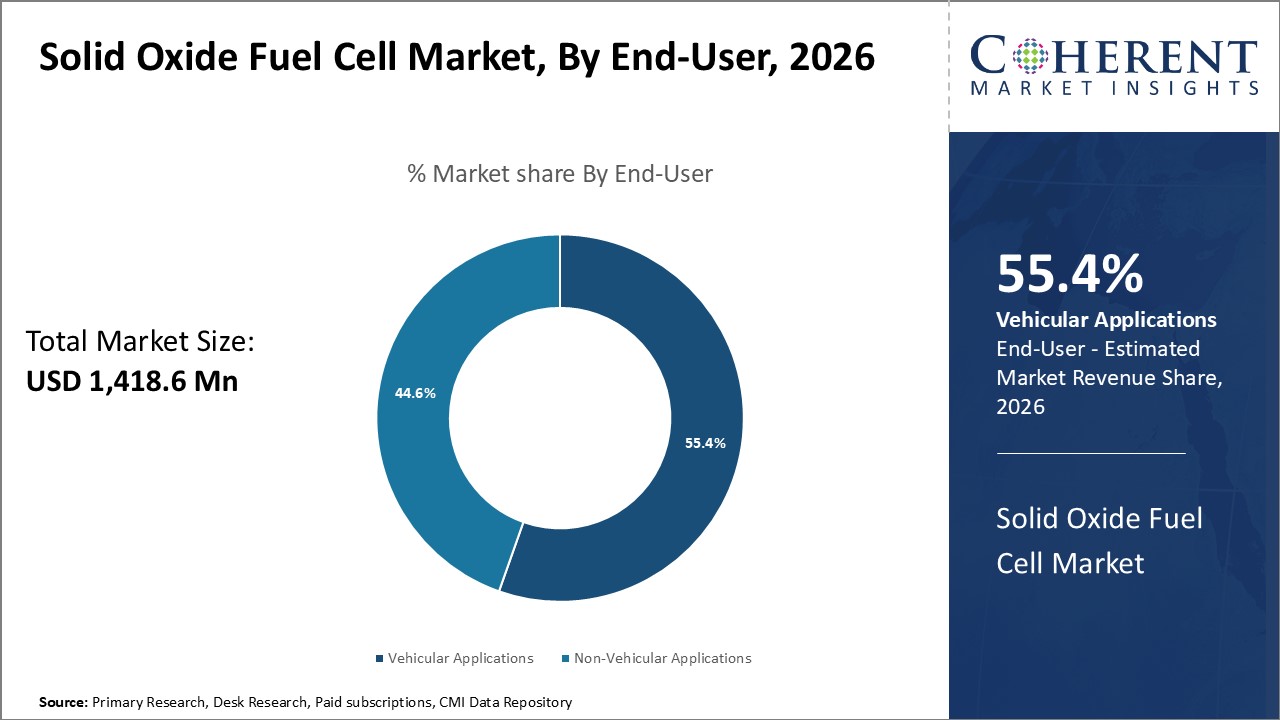
Residential SOFCs Part of $1.4B Market
This chart quantifies the 2026 market opportunity for Solid Oxide Fuel Cells. The significant non-vehicular segment highlights the addressable market for the residential programs discussed in this section.
(Source: Coherent Market Insights)
Partnership Analysis: The Hope Gas and WATT Fuel Cell Model for DERs
The partnership between Hope Gas and WATT Fuel Cell establishes a new symbiotic business model for deploying distributed energy resources (DERs) that de-risks commercialization for the technology manufacturer while creating a durable, service-based revenue stream for the utility. This structure overcomes the primary barrier to residential adoption, the high upfront capital cost, by reframing the technology as a subscription-based service. The model’s success hinges on aligning the utility’s access to customers and infrastructure with the manufacturer’s need for a scalable and predictable market.
- For the utility, Hope Gas, the model diversifies revenue away from volatile commodity sales and into a recurring leasing fee. It also increases natural gas throughput by adding thousands of new, continuously operating appliances to its network, strengthening the value proposition of its core infrastructure.
- For the manufacturer, WATT Fuel Cell, the agreement provides a bankable offtake for 7, 250 units, justifying its May 2024 expansion of its advanced manufacturing plant in Pennsylvania. This guaranteed demand accelerates production scaling and drives down per-unit costs.
- This utility-led approach bypasses the high costs of direct-to-consumer marketing and sales, granting WATT Fuel Cell immediate access to Hope Gas’s base of 140, 000 customers in West Virginia.
- For customers, the program offers an affordable pathway to energy resilience. It provides quiet, reliable backup power that integrates with their existing natural gas connection, eliminating the need to handle and store fuel for conventional generators.
Table: WATT Fuel Cell and Hope Gas Partnership Milestones
| Partner / Project | Time Frame | Details and Strategic Purpose | Source |
|---|---|---|---|
| Hope Gas and WATT Fuel Cell | 2026 – 2028 | Multi-year deployment plan for 7, 250 residential SOFC systems. The schedule includes 750 units in 2026, 2, 500 in 2027, and 4, 000 in 2028. This provides a clear roadmap for manufacturing and installation scale-up. | PA Environment Daily |
| WATT Fuel Cell | December 2025 | Installation of the first 2 k W WATT HOME™ unit in Clarksburg, WV, under the new agreement. This event marks the start of the commercial rollout ahead of the broader 2026 launch. | Yahoo Finance |
| WATT Fuel Cell | May 2024 | Expansion of its advanced manufacturing plant in Mount Pleasant, PA, to increase capacity for its tubular SOFC technology in preparation for commercial growth driven by the utility partnership. | WATT Fuel Cell |
| Hope Gas and WATT Fuel Cell | July 2023 | Launch of the initial WATT HOME™ pilot program to deploy 500 Imperium® SOFC units to Hope Gas customers, validating the business model and technology in a real-world residential setting. | WATT Fuel Cell |
US Regional Focus, Hope Gas Deploys WATT Fuel Cell SOFCs in West Virginia
The successful implementation of this new utility business model is deeply rooted in its hyper-regional focus, concentrating deployment and manufacturing within a specific geographic corridor. This strategy aligns Hope Gas’s dense West Virginia customer base and existing pipeline network with WATT Fuel Cell’s Pennsylvania-based manufacturing hub. This regional synergy minimizes logistical complexity, strengthens local economies, and creates a contained, replicable ecosystem for scaling distributed generation.
- Between 2021 and 2024, the activity was concentrated on establishing this regional foundation. WATT Fuel Cell expanded its Mount Pleasant, PA manufacturing facility, while Hope Gas identified its West Virginia service area as the ideal deployment ground for the pilot program.
- From 2025 forward, the strategy is about executing within this defined territory. The deployment of 7, 250 units is planned exclusively within the Hope Gas service area in West Virginia, leveraging the utility’s established infrastructure and trusted customer relationships to ensure efficient installation and service.
- This regional model contrasts with the global supply chains and international project deployments seen in other energy sectors, such as maritime fuel cells with partners like Samskip. The Hope Gas model provides a blueprint for how local utilities can partner with regional technology manufacturers to solve local energy challenges like grid reliability.
Technology Maturity: SOFCs Reach Commercial Scale in Residential Applications
The Hope Gas program validates that Solid Oxide Fuel Cell technology has matured from a niche, high-cost solution to a commercially viable product for mass residential deployment when supported by the correct business model. This partnership effectively moves SOFC technology to a new stage of market adoption by solving the key challenge of affordability through a utility leasing structure. The progression from technology development to large-scale commercial offtake demonstrates the technology’s readiness for the residential backup power market.

SOFC Market Demonstrates Explosive 41.7% Growth
The projected 41.73% compound annual growth rate signals the technology’s maturation. This rapid expansion supports the argument that SOFCs have reached commercial viability for mass deployment.
(Source: Mordor Intelligence)
- The 2021-2024 period focused on technical refinement and pilot-scale validation. Key events included WATT’s announcement of major efficiency gains in May 2022 and the launch of the 500-unit pilot in 2023, which served to prove the technology’s performance and reliability in a residential setting.
- The period from 2025 onward represents the transition to commercial scale. The agreement for 7, 250 units and the structured multi-year rollout starting in 2026 confirm both technical maturity and market acceptance, moving beyond the pilot phase into a predictable, long-term deployment program.
- The technology’s high electrical efficiency of 50-60%, fuel flexibility, and lower emissions compared to traditional generators make it a compelling solution. The utility partnership model makes these benefits accessible to a broad customer base.
SWOT Analysis of the WATT Fuel Cell and Hope Gas Partnership Model
The strategic partnership between WATT Fuel Cell and Hope Gas creates a powerful first-mover advantage in the residential energy-as-a-service market but also exposes both parties to risks associated with market adoption and the broader energy transition. An analysis of its strengths, weaknesses, opportunities, and threats reveals the key factors that will govern its long-term success and replicability. The model’s core strength is its ability to align the interests of the utility, the technology provider, and the customer.
- Strengths are centered on the innovative business model that creates recurring revenue for the utility and guaranteed offtake for the manufacturer, while Weaknesses include dependence on a single utility partner and the public perception of natural gas.
- Opportunities lie in replicating this model with other gas utilities nationwide and integrating future fuels like hydrogen, a path being explored by companies like GM Defense for military applications.
- Threats include accelerated policy-driven electrification that could devalue gas infrastructure, as well as increasing competition from rapidly improving battery storage technologies.
Table: SWOT Analysis for the SOFC Utility Leasing Model
| SWOT Category | 2021 – 2024 | 2025 – Today | What Changed / Validated |
|---|---|---|---|
| Strengths | – High-efficiency SOFC technology demonstrated. – Initial 500-unit pilot partnership formed with a trusted utility. |
– Signed a large-scale 7, 250 unit offtake agreement. – Leasing model removes upfront cost barrier for consumers. |
The model was validated to be commercially attractive enough to secure a large, multi-year order, confirming the strength of the utility-led service model over direct-to-consumer sales. |
| Weaknesses | – Commercialization dependent on a single pilot program. – Manufacturing capacity limited prior to the 2024 expansion. |
– Revenue model remains concentrated with one utility partner (Hope Gas). – Dependent on natural gas, facing headwinds from electrification trends. |
While scaling production, the business remains highly concentrated on a single partner and region, increasing market risk if the program underperforms or is not replicated elsewhere. |
| Opportunities | – Growing consumer concern over grid reliability due to outages. – Natural gas infrastructure is underutilized and seeking new revenue. |
– Replicate the leasing model with other gas utilities nationwide. – Future-proof by integrating hydrogen blends into the fuel mix. |
The model is now a proven blueprint. The opportunity is to market this success case to other utilities, positioning it as a proactive strategy to retain customers and grow revenue. |
| Threats | – High upfront cost of SOFC systems compared to traditional generators. – Competition from established generator brands. |
– Aggressive state and federal electrification mandates. – Falling costs and increased adoption of residential solar-plus-battery systems. |
The primary threat has shifted from competing with legacy generators to competing with all-electric solutions. The long-term viability depends on a continued role for gas in the home. |
Scenario Modelling: WATT Fuel Cell’s Hope Gas Program as a National Template
The critical factor for 2026 will be the execution of the initial 750-unit deployment and the resulting market signals; if successful, the Hope Gas program will become the definitive template for other gas utilities seeking to enter the energy-as-a-service market. A smooth rollout will validate the model’s scalability and financial viability, likely triggering similar partnership announcements from other regional utilities by late 2026 or early 2027. Conversely, any significant delays in installation or reports of system underperformance would temper industry enthusiasm and slow broader adoption of the model.

North America to Lead Future $16.5B Market
This forecast underscores the stakes for creating a national template, as North America represents the largest market. The potential reward for a successful, replicable model is substantial.
(Source: Mordor Intelligence)
- If this happens: The first 750 installations in 2026 proceed on schedule, with positive customer feedback and system performance data reported by Hope Gas.
- Watch this: Look for announcements of similar pilot programs or requests for information (RFIs) from other gas utilities in the Appalachian region and beyond, particularly those in areas with grid reliability concerns.
- These could be happening: WATT Fuel Cell may begin formal discussions with other utilities, using the Hope Gas deployment data to secure a second major partnership agreement. Other fuel cell manufacturers may pivot their strategies to compete in the residential utility services market, moving beyond their current focus in areas like data centers or transportation.
The questions your competitors are already asking
This report covers one angle of the utility-led service model for residential SOFCs. The questions that matter most depend on your work.
- Hope Gas activities in West Virginia. Is the WATT Fuel Cell partnership progressing from the 500-unit pilot to the 7,250-unit deployment?
- What is the outlook for residential SOFC deployment by regional gas utilities by 2030?
- Which regional gas utilities are adopting the SOFC energy-as-a-service model?
This report does not answer these. Enki Brief Pro does.
Your question, your angle, your framework. SWOT, PESTL, scenario modelling. The same niche depth, built around the decision your work actually depends on.
