

Meta Advanced Reactor Deals: 6.6 GW Procurement, Terra Power & Oklo Pacts, and 3 Major Agreements (2021-2026)
Advanced Reactor Adoption, Meta’s 6.6 GW Commitment Signals Market Shift
Meta’s procurement of 6.6 GW of nuclear capacity has fundamentally altered the market for advanced reactors, shifting the sector from a dependency on government demonstration programs to a new reality driven by commercial demand from technology companies. The insatiable and non-negotiable power needs of AI are creating a class of highly credit-worthy offtakers, establishing a clear commercialization path for next-generation nuclear technologies. This marks a structural pivot from exploratory interest to large-scale, bankable offtake agreements that now define the industry’s growth trajectory.
- Prior to 2025, the advanced nuclear sector was characterized by research-focused initiatives and early-stage regulatory engagement, such as the U.S. Department of Energy’s Advanced Reactor Demonstration Program (ARDP). The market lacked a significant, credit-worthy commercial customer base to underwrite the high costs of first-of-a-kind deployments.
- The turning point occurred in December 2024 when Meta issued a formal Request for Proposals (RFP) for up to 4 GW of new nuclear generation. This was followed in 2026 by definitive agreements, creating a powerful demand signal that is forcing the nuclear supply chain, investors, and regulators to respond to concrete, commercially-driven timelines.
- This trend extends across Big Tech, as the limitations of intermittent renewables for powering 24/7 data centers have become clear. While companies like Microsoft and Amazon have made their own moves into nuclear, Meta’s multi-gigawatt commitment has established it as the market-maker, validating nuclear as the primary solution for carbon-free baseload power.
- The Big Tech turn to nuclear is no longer theoretical; it is an active procurement strategy. The scale of these commitments provides the financial de-risking necessary for advanced reactor developers to move from design to construction and commercial operation.
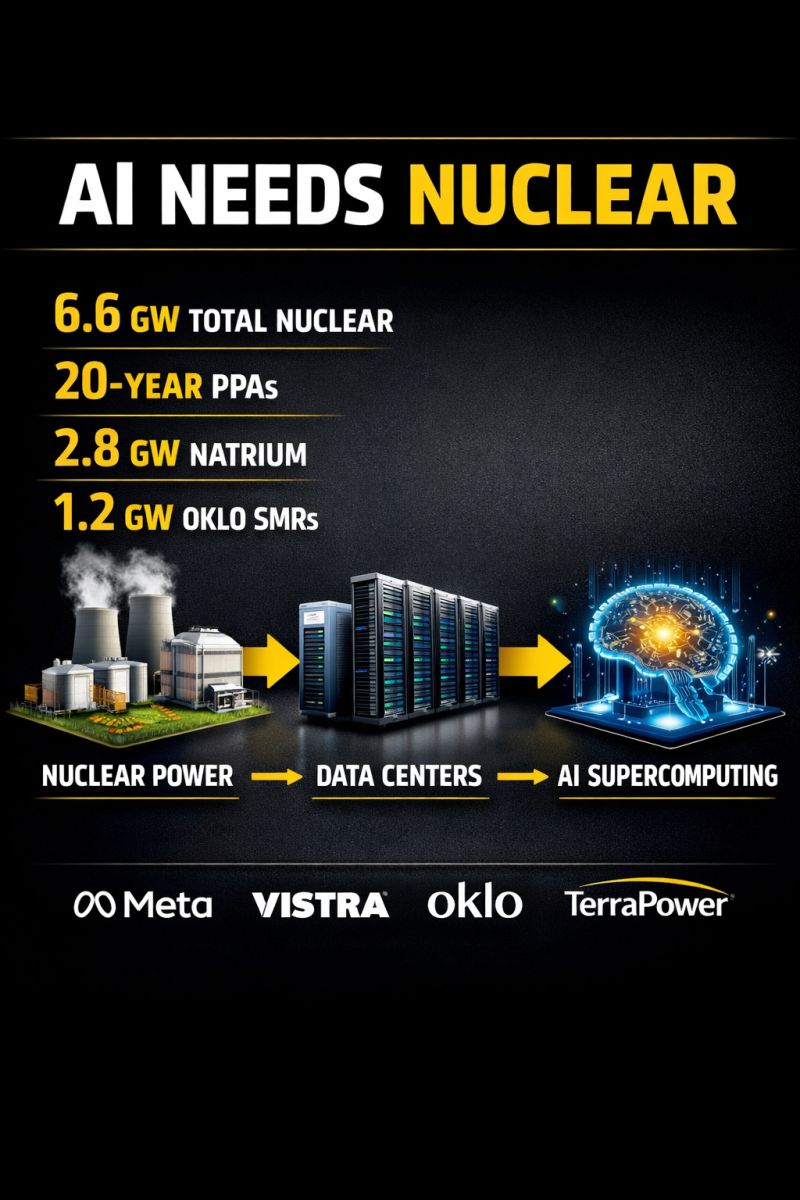
Meta Commits to 6.6 GW Nuclear Power
This infographic summarizes Meta’s landmark 6.6 GW nuclear procurement. It directly supports the section’s focus on this commitment as the key driver of a market shift for advanced reactors.
(Source: LinkedIn)
Meta 3 Nuclear Partnerships, 6.6 GW Secured from Vistra and Terra Power (2025-2026)
Meta has executed a hybrid procurement strategy, securing immediate and near-term baseload power from existing nuclear plants while simultaneously catalyzing the development of advanced Small Modular Reactors (SMRs). This dual-track model is designed to mitigate short-term supply risk for its data centers while underwriting the commercial future of the next-generation nuclear industry. The agreements combine long-term Power Purchase Agreements (PPAs) for operational assets with direct financial support and offtake commitments for technologies not yet deployed at scale.

Meta’s Nuclear Deals Lead Big Tech
This chart details Meta’s specific agreements with partners like Vistra and TerraPower, as mentioned in the heading. It provides a clear breakdown of the partnerships driving Meta’s hybrid procurement strategy.
(Source: Trellis)
- The first track of the strategy focuses on securing over 3.2 GW of firm, carbon-free power from operating nuclear facilities through 20-year PPAs. Agreements with Vistra Corp. for its Ohio plants and Constellation Energy for its Illinois facility provide long-term price stability and supply certainty, which are critical for managing the operational costs of AI workloads.
- The second, more pioneering track involves partnerships for a combined 4.0 GW of advanced nuclear capacity with Terra Power and Oklo Inc. These agreements are unprecedented in the corporate world, as Meta is providing direct development funding and long-term offtake commitments, significantly de-risking these multi-billion-dollar projects.
- The financial model for these advanced reactor deals is also innovative. The agreement with Oklo includes a prepayment mechanism, allowing Meta to provide upfront capital for crucial early-stage work like fuel procurement and site development. This is a vital lifeline for a pre-revenue startup and accelerates its path to market.
Table: Key Nuclear Power Agreements for Meta’s AI Infrastructure
| Partner / Project | Time Frame | Details and Strategic Purpose | Source |
|---|---|---|---|
| Terra Power | 2032 – 2035 | Agreement for up to 2.8 GW of capacity from eight Natrium™ reactors. Includes funding support for the first two units to accelerate commercialization. | Reuters |
| Oklo Inc. | 2030 – 2032 | Development of a 1.2 GW power campus in Pike County, Ohio, using multiple Aurora Powerhouse reactors. Includes a prepayment mechanism for upfront funding. | Yahoo Finance |
| Vistra Corp. | Effective Jan 2026 | 20-year PPA for the entire 2, 176 MW capacity of the Perry and Davis-Besse nuclear plants in Ohio to provide immediate baseload power. | RTO Insider |
| Constellation Energy | Begins in 2027 | 20-year PPA for approximately 1, 100 MW from the Clinton Clean Energy Center in Illinois, securing near-term clean power. | CNBC |
Ohio Focus, Meta’s Nuclear Strategy Anchors Prometheus AI Supercluster
Meta’s nuclear procurement strategy is geographically concentrated in Ohio, a deliberate move to directly power its massive Prometheus AI supercluster in New Albany and other regional data centers. This approach demonstrates a strategic shift toward co-locating energy generation with data center load, minimizing transmission losses and dependencies on a strained grid. The selection of Ohio as the anchor for its nuclear ambitions transforms the state into a central hub for the convergence of AI and advanced energy.
- Before 2025, advanced nuclear projects like Terra Power’s first plant were primarily sited based on federal programs, such as the location near a retiring coal plant in Kemmerer, Wyoming. Meta’s strategy has shifted this dynamic, pulling development toward its own load centers.
- The agreements with Vistra secure the output of the Perry and Davis-Besse nuclear plants, both located in Ohio, providing over 2 GW of in-state, carbon-free power directly to the grid that serves Meta’s facilities.
- The forward-looking partnership with Oklo is explicitly tied to Ohio, with plans to develop a 1.2 GW advanced reactor campus in Pike County. This project is intended to directly support the long-term growth of Meta’s Ohio data center fleet.
- This geographical focus on Ohio is a direct response to the energy demands of the Prometheus AI supercluster, which is projected to consume at least 1 GW of power alone. By securing generation within the same state, Meta aims to create a more resilient and localized energy ecosystem for its most critical AI infrastructure.
Advanced Reactor Maturity, Meta’s Pacts Validate Natrium and Aurora Designs
Meta’s multi-billion-dollar offtake commitments provide critical commercial validation for two leading advanced reactor designs, accelerating their progression from demonstration status to commercial-scale deployment. By backing both Terra Power’s utility-scale Natrium reactor and Oklo’s smaller Aurora Powerhouse, Meta is underwriting distinct technological pathways and signaling market confidence despite prior regulatory and supply chain challenges.

Investment Drives Down Advanced Nuclear Costs
This chart shows how capital influx is projected to lower the cost of advanced nuclear energy. This visualizes the section’s core argument that Meta’s commitments help validate and accelerate the commercial maturity of new reactor designs.
(Source: The Breakthrough Institute)
- In the 2021-2024 period, the industry faced significant hurdles. In January 2022, the U.S. Nuclear Regulatory Commission (NRC) dismissed Oklo’s initial application for its Aurora reactor, highlighting the steep regulatory learning curve. Concurrently, concerns grew over the undeveloped supply chain for High-Assay Low-Enriched Uranium (HALEU) fuel, a dependency for many advanced designs.
- The period from 2025 to today shows a marked acceleration. In mid-2026, Terra Power began construction on its first Natrium demonstration plant in Wyoming, a major milestone. Meanwhile, Oklo uprated its Aurora reactor design to 75 MW specifically to better serve the data center market, a move directly validated by its 1.2 GW campus agreement with Meta.
- These partnerships validate two different technological approaches. Terra Power’s Natrium reactor features an integrated molten salt energy storage system, allowing it to function as a flexible, dispatchable power source. Oklo’s Aurora is a compact, factory-fabricated fast reactor designed for scalability and co-location with data centers.
SWOT Analysis, Meta’s Nuclear Strategy and Market Execution Risks
Meta’s aggressive nuclear procurement strategy establishes a significant first-mover advantage in securing a long-term supply of clean, reliable power for its AI ambitions. However, this leadership position exposes the company to considerable execution risks tied to the commercialization of unproven technologies, the financial stability of its startup partners, and a complex regulatory and supply chain environment.

French Reactor Outages Highlight Execution Risks
This chart provides a stark, real-world example of the ‘market execution risks’ mentioned directly in the section heading. The significant downtime in the French nuclear fleet illustrates the operational challenges Meta’s strategy faces.
(Source: World Nuclear Industry Status Report)
Table: SWOT Analysis for Meta’s Nuclear Procurement Strategy
| SWOT Category | 2021 – 2024 | 2025 – 2026 | What Changed / Resolved / Validated |
|---|---|---|---|
| Strengths | – Goal of 100% renewable energy for operations. – Early exploration of clean, firm power sources. |
– Secured 6.6 GW of nuclear capacity. – First-mover advantage in corporate nuclear procurement. – Long-term price and supply stability via 20-year PPAs. |
The strategy shifted from a renewable energy goal to a concrete, executed plan for securing 24/7 carbon-free power, establishing market leadership. |
| Weaknesses | – Exposure to volatile renewable energy markets. – Lack of a clear path to power massive AI growth with clean energy. |
– Heavy reliance on pre-revenue partners (Oklo) and first-of-a-kind technology (Natrium). – Financial exposure through development funding and prepayments. |
The commitment to advanced reactors has crystallized the company’s dependence on the successful and timely execution of its unproven technology partners. |
| Opportunities | – Potential to influence the emerging advanced nuclear market. – Ability to leverage balance sheet to de-risk new tech. |
– Catalyze the entire advanced nuclear industry and its supply chain. – Create a new template for corporate clean energy procurement. – Achieve ESG goals while powering massive growth. |
Meta’s demand signal in 2025-2026 has been validated as a powerful catalyst capable of accelerating the entire advanced nuclear sector’s commercialization. |
| Threats | – Regulatory uncertainty at the NRC. – Underdeveloped HALEU fuel supply chain. – Potential for public opposition to new nuclear projects. |
– NRC licensing delays for Terra Power and Oklo. – HALEU fuel supply bottlenecks, historically reliant on Russia. – Construction cost overruns and delays, typical for nuclear projects. |
The threats have transitioned from theoretical risks to immediate, tangible hurdles for the specific projects Meta is backing, with timelines now directly tied to regulatory and supply chain performance. |
Meta’s Next Move: Watch for Supply Chain and Regulatory Milestones in 2026
The most critical indicators for the success of Meta’s nuclear strategy will be tangible progress in regulatory approvals and the domestic HALEU fuel supply chain over the next 12-18 months. These factors represent the longest lead-time items and the most significant constraints on meeting the ambitious 2030-2035 deployment timeline. The outcome will determine whether the current AI power crisis accelerates a nuclear build-out or faces a significant bottleneck.

US Lags China in New Nuclear Construction
This chart highlights the gap between the US’s large operational fleet and its lack of new builds, where China leads. This perfectly illustrates the context for the ‘supply chain and regulatory milestones’ that the section identifies as critical hurdles in the US.
(Source: Information Technology and Innovation Foundation (ITIF))

Nuclear Sector Stocks Surge in 2026
This chart’s data on outperforming nuclear stocks directly reflects the ‘Strengths’ and ‘Opportunities’ detailed in the SWOT analysis. It quantifies the positive market reaction to strategies like Meta’s during the 2025-2026 timeframe.
(Source: Moomoo)
- If this happens: The NRC grants a construction permit for Oklo’s Ohio campus ahead of schedule or significant new domestic HALEU production capacity is announced and financed.
- Watch this: Other hyperscalers, particularly Microsoft and Amazon, will likely accelerate their own nuclear strategies by signing multi-gigawatt, multi-partner offtake agreements that mirror Meta’s hybrid approach of mixing legacy and advanced reactors.
- These could be happening: A surge in private equity and venture capital investment into nuclear component manufacturers and fuel cycle companies. Reactor developers may begin announcing standardized designs optimized specifically for behind-the-meter data center applications, moving beyond utility-scale grid connections.
The questions your competitors are already asking
This report covers one angle of the commercial path for advanced nuclear reactors. The questions that matter most depend on your work.
- Which tech companies are gaining or losing ground in the race to secure advanced nuclear power for AI data centers?
- What is the outlook for advanced reactor deployment for powering AI data centers by 2035?
- What is actually happening with Meta’s TerraPower and Oklo partnerships since the agreements were signed?
- Which hyperscale data center operators are adopting advanced nuclear power, and who is likely to follow Meta’s lead?
This report does not answer these. Enki Brief Pro does.
Your question, your angle, your framework. SWOT, PESTL, scenario modelling. The same niche depth, built around the decision your work actually depends on.
