

Bloom Energy SOFC Data Center Deals, $5 B Brookfield Partnership and 2.8 GW Oracle Agreement (2021 to 2026)
Bloom Energy’s 100 MW Equinix Deal Signals Data Center Shift to On-Site Power (2021 to 2026)
The explosive growth of AI has created a systemic power deficit that aging grid infrastructure cannot service, forcing data center operators to adopt on-site power generation as a primary solution. Before 2025, fuel cell applications were diverse and often focused on smaller-scale, grid-tied reliability for commercial buildings. The period from 2025 onward marks a fundamental market repositioning, where multi-megawatt fuel cell deployments have become a critical enabler for hyperscale data centers facing multi-year grid connection delays.
- Between 2021 and 2024, deployments were smaller and demonstrated technology viability in various sectors. The market was characterized by a mix of industrial, commercial, and utility-scale pilots.
- Starting in 2025, the market focus consolidated almost exclusively on providing large blocks of primary power for data centers. This pivot was driven by an acute need, with U.S. data center power demand projected to double by 2027 and grid interconnection queues extending beyond seven years.
- Bloom Energy‘s agreements with Equinix to deploy over 100 MW at 19 data centers and with American Electric Power (AEP) for up to 1 GW of fuel cells exemplify this shift from niche backup power to essential primary infrastructure.
- This adoption is a direct response to market failure. The inability of the grid to keep pace with AI-driven demand created the opportunity for a premium, rapidly deployable solution like Solid Oxide Fuel Cells (SOFC).
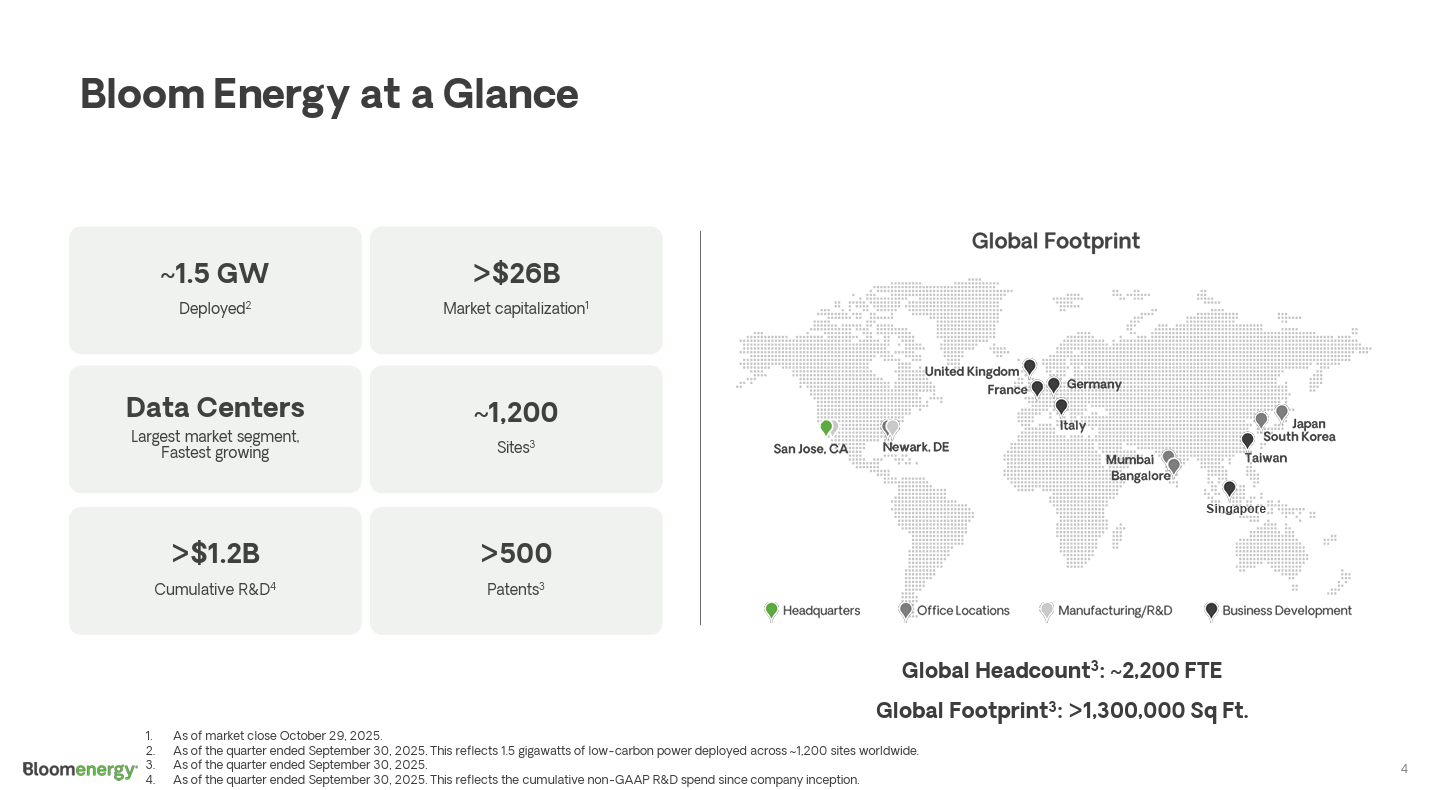
Bloom Energy Highlights Data Center Segment Dominance
The section discusses the Equinix deal as a key signal of the shift to on-site power for data centers. The chart visually reinforces this point by showing Bloom Energy’s resulting dominance or significant presence within the data center segment.
(Source: Arya’s Substack)
$3.2 B in 2026 Revenue Guidance, Bloom Energy Scales to Meet AI Demand
To capitalize on the data center power crunch, Bloom Energy is making significant investments in manufacturing capacity and product development, directly supported by a quantifiable surge in its order backlog. These financial commitments and production enhancements are not speculative; they are a direct reaction to secured, multi-gigawatt orders from hyperscale clients who have pre-committed to the technology as a core part of their infrastructure strategy.
- In March 2026, the company announced a major manufacturing expansion to support the production of its new 12.5 MW utility-grade power block, a product specifically designed for the data center market.
- This expansion is justified by a massive increase in demand, with the company reporting a 2.5 x increase in its product backlog and a 1.5 x rise in its services backlog as of February 2026, primarily driven by AI data center orders.
- The market has validated this strategy with a 400% increase in the company’s stock price over the past year and a 2026 revenue guidance of $3.2 billion, representing a more than 50% increase from its 2025 revenue of $2.02 billion.
- Federal incentives provide a crucial financial backstop, with the 30% Clean Electricity Investment Tax Credit under Section 48 E helping to offset the higher upfront capital expenditure of fuel cell systems compared to traditional generators.

Bloom Energy Reports Massive Q1 2026 Growth
The section heading provides a full-year revenue guidance for 2026. The chart complements this by offering a specific, granular data point of ‘Massive Q1 2026 Growth,’ illustrating the strong start to the year required to meet the annual target.
(Source: 24/7 Wall St.)
Table: Bloom Energy Strategic Investments and Expansions
| Partner / Project | Time Frame | Details and Strategic Purpose | Source |
|---|---|---|---|
| Manufacturing Expansion | Mar 23, 2026 | Expansion of manufacturing capabilities to support the production of the new 12.5 MW power block solution, aimed at fulfilling large-scale data center orders. | Fuel Cell Energy |
| Product & Services Backlog Growth | Feb 06, 2026 | Reported a 2.5 x increase in product backlog and a 1.5 x rise in services backlog, a direct indicator of market capture in the AI data center segment. | Yahoo Finance |
Data Center Partnerships, Bloom Energy Secures $5 B Brookfield and 2.8 GW Oracle Deals
Bloom Energy‘s commercial strategy hinges on a three-pronged partnership model that secures demand, provides financing, and establishes utility integration. By collaborating with hyperscale data center operators, global asset managers, and major utilities, the company has constructed a de-risked ecosystem to support its rapid growth. These are not speculative MOUs but binding, large-scale agreements that provide clear revenue visibility.
- The cornerstone of its demand pipeline is the master services agreement with Oracle, which was expanded in April 2026 to a massive 2.8 GW. This agreement alone repositions Bloom Energy as a primary power provider for a leading AI infrastructure company.
- To address the high capital cost of its systems, Bloom Energy formed a $5 billion AI infrastructure partnership with Brookfield in January 2026. This provides a “power-as-a-service” model, removing the upfront CAPEX barrier for customers.
- The company is also working with traditional utilities to integrate its solutions, evidenced by a deal for American Electric Power (AEP) to purchase up to 1 GW of fuel cells to power data centers in its service area.
- A collaboration with Diversified Energy and TESIAC, formed in March 2025, targets off-grid data centers by leveraging alternative fuel sources like coal mine methane, opening a separate market segment.

Bloom Energy Revenue Surges via AI Data Centers
The section highlights major data center deals with Brookfield and Oracle. The chart directly visualizes the outcome of these partnerships, showing a revenue surge specifically driven by the AI data center sector that these deals serve.
(Source: 24/7 Wall St.)
Table: Bloom Energy Key Strategic Partnerships
| Partner / Project | Time Frame | Details and Strategic Purpose | Source |
|---|---|---|---|
| Oracle | Apr 14, 2026 | Expansion of a Master Services Agreement to 2.8 GW for deploying fuel cell systems to power Oracle‘s AI data centers. This secures a multi-year, gigawatt-scale customer. | The Motley Fool |
| Brookfield | Jan 22, 2026 | A $5 billion partnership to finance the deployment of Bloom‘s fuel cells. This creates a capital-light model for customers, accelerating adoption. | Data Center Dynamics |
| Equinix | Aug 14, 2025 | Agreement to expand deployment to over 100 MW at 19 data centers. This demonstrates a repeatable model with a major colocation provider. | PR Newswire |
| American Electric Power (AEP) | Nov 14, 2024 | Supply agreement for AEP to purchase up to 1 GW of fuel cells to power data centers, integrating on-site power with a major utility’s strategy. | Utility Dive |
United States Focus, Bloom Energy Concentrates on Data Center Hubs with Grid Constraints
Bloom Energy’s commercial activity is heavily concentrated in the United States, specifically in regions where data center growth is colliding with grid capacity limits. The geographic focus is not a matter of choice but a strategic imperative, targeting markets where the economic pain of grid delays is highest. Activity in Europe and Asia, while present, remains secondary to the immediate, large-scale opportunity in North America.
- Before 2025, Bloom‘s installations were more geographically dispersed, including significant projects in South Korea. However, the scale and urgency of the U.S. data center market have since commanded the company’s primary focus.
- The partnerships with Equinix (data centers in six U.S. states) and AEP (utility service territories in the U.S. Midwest and South) confirm this domestic concentration.
- This geographic strategy directly targets the core problem. Regions like Northern Virginia, Silicon Valley, and other data center alleys are facing moratoriums or extreme delays on new grid connections, making them prime markets for on-site power solutions.

Analysts Forecast Strong Bloom Energy Revenue Growth
The section describes Bloom’s strategy of focusing on US data center hubs with grid constraints. The chart connects this strategy to its perceived success, showing that analysts recognize this focus and are consequently forecasting strong growth.
(Source: Yahoo Finance)
Bloom Energy TRL 9 SOFC Technology Validated at Commercial Scale
Bloom Energy‘s ability to capture the data center market is built on its mature Solid Oxide Fuel Cell (SOFC) technology, which has achieved Technology Readiness Level 9 (TRL 9). This designation, meaning the system is proven in an operational environment, is a critical differentiator that provides the bankability and reliability required for mission-critical data center facilities. The company is not selling a future promise but a proven, scalable, and immediately deployable product.
- The period between 2021 and 2024 saw the company prove its SOFC technology across various applications, establishing the operational track record necessary for large-scale adoption.
- The launch of the packaged 12.5 MW power block in March 2026 is a clear signal of technology maturity. It moves the product from a customized solution to a standardized, factory-built system engineered for rapid, repeatable deployment at data center scale.
- In contrast, competitors like Plug Power focus on Proton Exchange Membrane (PEM) technology, which is better suited for mobility applications, while other firms like Ceres Power are also targeting the data center market but lack Bloom‘s scale of announced commercial deployments.
- This high TRL de-risks adoption for data center operators, who cannot afford to gamble on unproven technology for primary power. This makes Bloom‘s SOFCs one of the top fuel cell technologies for this application.
SWOT Analysis of Bloom Energy’s Market Repositioning for AI Data Centers
Bloom Energy‘s strategic pivot has successfully aligned its mature technology with an urgent, high-value market need, but this rapid growth introduces significant operational risks. The company’s strengths are its first-mover advantage and proven technology, while its primary weakness is the immense challenge of scaling manufacturing to meet a multi-billion-dollar backlog. The main opportunity is capturing a dominant share of the on-site data center power market, but this is threatened by emerging competition and potential supply chain bottlenecks.
Table: SWOT Analysis for Bloom Energy’s Data Center Strategy
| SWOT Category | 2021 – 2024 | 2025 – 2026 | What Changed / Validated |
|---|---|---|---|
| Strengths | Mature (TRL 9) SOFC technology with proven operational history in diverse applications. Established manufacturing base in the U.S. | Demonstrated ability to secure multi-gigawatt, multi-billion dollar deals with hyperscalers (Oracle, Equinix). First-mover advantage in on-site power for AI. | The market validated that speed-to-power and reliability are more valuable than pure cost, confirming the business case for premium on-site generation. |
| Weaknesses | Higher Levelized Cost of Energy (LCOE) compared to conventional power. Revenue growth was steady but not explosive. | Massive backlog (2.5 x increase in product backlog) creates immense pressure on manufacturing capacity and supply chain. LCOE remains ~40% higher than gas turbines. | The weakness of high cost has been partially mitigated by the greater cost of grid delays. However, the new weakness is execution risk at an unprecedented scale. |
| Opportunities | Growing corporate demand for clean energy and ESG goals. Potential for hydrogen fuel transition. | The AI power crisis has created a massive, urgent Total Addressable Market (TAM). Grid constraints are now a primary demand driver, not a secondary one. | The opportunity shifted from a gradual, ESG-driven transition to an acute, infrastructure-driven necessity. Bloom is now an enabler of the AI industry, not just a clean energy company. |
| Threats | Competition from other clean energy technologies (solar, wind) and traditional power. Policy uncertainty. | Competitors (e.g., Fuel Cell Energy, Ceres Power) are also targeting the data center market. Supply chain constraints for SOFC raw materials. Risk of failing to execute on large contracts, damaging credibility. | The primary threat is no longer being out-competed on cost by renewables, but failing to deliver on its own backlog, and allowing competitors to gain a foothold. |
$5 B in Backlog, Bloom Energy Execution on Oracle Deal is the Top Signal to Watch
The single most critical factor for Bloom Energy‘s trajectory through 2026 is its ability to execute on its massive order book, particularly the 2.8 GW Oracle deployment. The company has successfully sold the vision; now it must deliver the physical infrastructure at an unprecedented scale and pace. All other indicators are secondary to its operational capacity to turn backlog into revenue and installed megawatts.
- If Bloom Energy successfully ramps up manufacturing and meets its deployment timelines for Oracle, watch for announcements of new multi-gigawatt agreements with other hyperscalers like Meta, Google, and Amazon. Success will breed success.
- The company’s quarterly reports on margins and production output will be the most important signals. If margins improve with scale and production numbers align with deployment schedules, it validates the long-term profitability of the model.
- Conversely, any announced delays, supply chain-related issues, or downward revisions to production targets would be a major red flag, potentially signaling that the company cannot scale to meet the opportunity it has created.

Bloom Energy Backlog to Reach $20B
The section heading focuses on the current $5B backlog and the importance of execution. The chart directly addresses this topic by projecting future backlog growth to $20B, illustrating the potential trajectory and scale of the company’s order book.
(Source: Stocktwits)
The questions your competitors are already asking
This report covers one angle of Bloom Energy’s commercial pivot to capitalize on the AI data center power crisis. The questions that matter most depend on your work.
- Which companies are gaining or losing ground in the on-site data center power market?
- What is the outlook for fuel cell deployment in AI data centers by 2028?
- Bloom Energy’s $5 B Brookfield partnership. Is it progressing from a financing agreement to scaled-up project deployments?
- Which hyperscale data center operators are adopting on-site primary power, and what are the key terms of their deployments?
This report does not answer these. Enki Brief Pro does.
Your question, your angle, your framework. SWOT, PESTL, scenario modelling. The same niche depth, built around the decision your work actually depends on.
