

Fuel Cell Manufacturing 2026: Doosan’s High-Stakes SOFC Pivot and Execution Risks
Doosan’s Commercial Shift: Fuel Cell Projects Move From PAFC to High-Risk SOFC Applications
Doosan is executing a high-stakes commercial transition, shifting its project focus from mature Phosphoric Acid Fuel Cell (PAFC) stationary power plants to higher-value but operationally unproven Solid Oxide Fuel Cell (SOFC) applications for data centers and maritime industries, a move that exposes the company to significant execution risk.
- Between 2021 and 2024, commercial activity was defined by stable, large-scale PAFC projects. This included supplying the world’s largest hydrogen fuel cell plant in Incheon, providing 15 MW to the North Gyeongsang ‘Hydrogen Town’, and initiating exports to China, demonstrating market leadership with a proven technology.
- Since January 2025, the commercial focus has pivoted to next-generation SOFCs and their demanding applications. Strategic agreements with SK ecoplant and Hyosung Heavy Industries to power data centers and an MOU with LG Electronics for waste-heat recovery solutions signal a strategic move into more complex, integrated energy systems.
- The inherent risk of this pivot materialized in April 2025 with the mutual termination of three hydrogen fuel cell supply contracts valued at a staggering $560 million (₩818 billion). These cancellations, attributed to project delays and financial challenges, highlight severe difficulties in managing new, large-scale deployments.
- Despite this major setback, the strategy received partial validation in November 2025 when Doosan secured a ₩96.4 billion, 20-year Power Purchase Agreement (PPA) with KEPCO. This deal demonstrates continued utility-scale confidence in its ability to deliver long-term hydrogen power solutions.
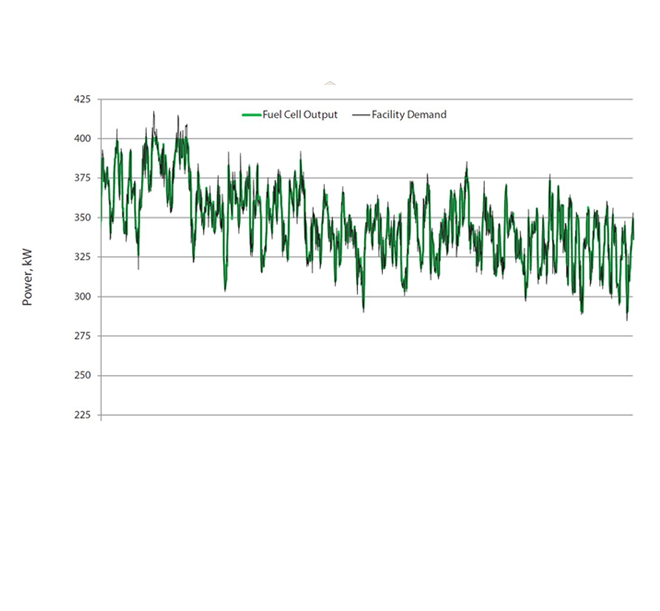
Doosan’s Fuel Cell Power Generation
This chart shows the load-following capability of Doosan’s fuel cell technology, a key performance characteristic for the stationary power applications mentioned.
(Source: Doosan Fuel Cell)
Investment vs. Cancellations: Doosan’s $560 M Contract Failure Overshadows Manufacturing Expansion
A massive $560 million contract cancellation in the second quarter of 2025 serves as a critical red flag for Doosan’s project execution capability, creating a stark contrast with its concurrent strategic investments in new manufacturing capacity and undermining market confidence.

Doosan Financials Show 2025 Loss
The chart’s 2025 earnings dip directly corresponds to the $560 million contract cancellation detailed in this section, visualizing its financial impact.
(Source: Simply Wall St)
- The simultaneous termination of three major supply agreements in April 2025, totaling ₩818 billion ($560 million), points to fundamental issues in project management and financial oversight. This event erased a significant portion of the company’s order book and damaged its reputation for reliable delivery.
- This operational failure occurred just months before the company launched its new 50 MW annual capacity SOFC factory in July 2025. This facility, built to mass-produce next-generation systems, represents the cornerstone of its future growth strategy but now faces pressure to prove its viability.
- The precarious financial situation is further highlighted by persistent net losses, which widened to ₩2.58 billion in Q 2 2025 even as revenue grew. This suggests that while Doosan is expanding, it has not yet established a profitable operational model for its new ventures.
Table: Key Financial Events and Cancellations
| Partner / Project | Time Frame | Details and Strategic Purpose | Source |
|---|---|---|---|
| Multiple Unspecified Projects | Apr 2025 | Termination of three hydrogen fuel cell supply contracts totaling $560 Million (₩818 Billion) due to project delays and financial issues. A major operational failure. | Hydrogen Insight |
| SOFC Mass Production Factory | Jul 2025 | Investment in a new 50 MW annual capacity SOFC factory in Jeollabuk-do, South Korea. A strategic investment to capture the high-efficiency stationary power market. | H 2 View |
| Doosan Corp. Venture Fund | Sep 2025 | Establishment of a $75 Million corporate venture fund to invest in new technologies, including green energy and fuel cells, to build long-term synergies. | Enki AI |
Doosan Fuel Cell Partnership Strategy: Shifting from Technology Licensing to Market Application
Doosan’s partnership strategy has demonstrably evolved from securing foundational technology licenses between 2021 and 2024 to building application-specific alliances since 2025, a deliberate move designed to accelerate market entry and de-risk the commercialization of its new SOFC systems.
- In the 2021–2024 period, partnerships centered on technology acquisition. The definitive deals included a collaboration with UK-based Ceres Power to license its core SOFC stack technology and a strategic partnership with Ballard Power Systems to develop PEM fuel cells for mobility, effectively buying access to critical intellectual property.
- Since 2025, the focus has shifted to forging market-driven collaborations to create demand for its newly manufactured products. An agreement with SK ecoplant and Hyosung Heavy Industries in November 2025 directly targets the Korean data center market, while an MOU with LG Electronics in February 2026 aims to develop integrated waste-heat recovery solutions.
- This commercial push is supported by a critical supply chain agreement with Alleima in January 2025. This deal secures a supply of specialized coated steel strips, a vital component for the mass production of SOFC stacks at Doosan’s new factory.
Table: Evolution of Strategic Partnerships
| Partner / Project | Time Frame | Details and Strategic Purpose | Source |
|---|---|---|---|
| LG Electronics | Feb 2026 | MOU to jointly develop a business model converting fuel cell waste heat into clean power, targeting the Combined Heat and Power (CHP) market. | Next MSC |
| SK ecoplant, Hyosung Heavy Industries | Nov 2025 | Strategic cooperation to supply hydrogen baseload and backup power for Korean data centers, creating a direct sales channel for Doosan’s new SOFC systems. | Fuel Cells Works |
| Alleima | Jan 2025 | Supply agreement for coated steel strip, securing a critical material for the mass production of SOFCs for stationary and maritime applications. | Alleima |
| Shell, Hyundai Heavy Industries (KSOE) | Oct 2022 | Consortium to develop and install a 600 k W SOFC Auxiliary Power Unit on an LNG vessel, a key demonstration project for the maritime market. | Offshore Energy |
| Ballard Power Systems, Hy Axiom | Apr 2022 | Strategic partnership to develop PEM hydrogen fuel cells for land-based mobility applications, licensing external expertise to enter a new market. | Doosan Fuel Cell |
Geographic Expansion: Doosan’s Fuel Cell Strategy Shifts From Domestic Dominance to High-Stakes China JV
Doosan’s geographic strategy has matured from a strong domestic focus supplemented by initial exports between 2021 and 2024 to a deeper, more integrated push into China via a major joint venture, though South Korea remains the center of its commercial and operational activities.
- From 2021 to 2024, South Korea was the dominant market, home to large-scale PAFC deployments like the Incheon Light Dream Power Plant. International expansion was cautious, marked by the company’s first-ever fuel cell export to China in 2021 (1.76 MW) and a subsequent 4.84 MW sale in 2022.
- A strategic shift occurred in November 2022 with the signing of a master agreement with China’s ZKRG Smart Energy. This deal included supplying 105 MW of fuel cells and forming a joint venture for local manufacturing, moving beyond simple exports to establish an industrial foothold in a key growth market.
- Despite this international ambition, South Korea remains the core of Doosan’s business. The construction of the new 50 MW SOFC factory in Jeollabuk-do and the signing of major domestic contracts, such as the ₩96.4 billion KEPCO PPA and a ₩411.8 billion long-term service agreement in Ulsan, confirm that its primary revenue and growth drivers are still domestic.
Fuel Cell Technology Maturity: Doosan Advances SOFC from R&D to Mass Production
Doosan has successfully transitioned its Solid Oxide Fuel Cell (SOFC) technology from a development and licensing stage into full-scale mass production, positioning it to compete in high-efficiency power markets, though large-scale commercial validation remains a critical next step.

Stationary Fuel Cell Market Growth
This forecast quantifies the growing stationary power market that Doosan is targeting with its mass production of SOFC technology.
(Source: Market.us)
- Between 2021 and 2024, the company’s technology portfolio was characterized by commercially mature PAFC systems alongside the strategic incubation of next-generation technologies. During this time, Doosan licensed SOFC technology from Ceres Power, initiated a maritime SOFC demonstration project with Shell and Hyundai Heavy Industries (KSOE), and partnered with Ballard Power Systems to develop PEM systems.
- A clear inflection point was reached in July 2025 with the official commencement of mass production at its new 50 MW SOFC factory. This event marks the transition of its SOFC technology from a pilot and demonstration phase to a commercially scalable product line.
- The technology pipeline has diversified accordingly, with recent announcements including a high-efficiency SOFC system boasting up to 64% electrical efficiency for data centers, a biogas-fueled PAFC model developed with Korea Western Power, and an integrated fuel cell carbon capture system co-developed with KHNP.
- With manufacturing now online, the primary challenge shifts from research and development to demonstrating in-field reliability, achieving cost-competitiveness, and proving the bankability of its new SOFC products in demanding, real-world applications.
SWOT Analysis: Doosan’s Fuel Cell Strategy at a Crossroads in 2026
Doosan’s strategic pivot has amplified both its strengths in technology diversification and its weaknesses in financial and operational execution, creating a high-risk, high-reward scenario that hinges on its ability to capitalize on new market opportunities without repeating past failures.

Fuel Cell Market Opportunity Soars
This chart illustrates the large, growing market opportunity, providing crucial context for the ‘Opportunities’ discussed in the SWOT analysis.
(Source: Market Research Reports & Consulting)
- The company has successfully built a diversified technology portfolio but now faces the immense challenge of commercializing it profitably.
- Its aggressive partnership strategy has accelerated market access but also exposes it to risks associated with external project delays and partner financial health.
- The market opportunity in high-growth sectors like AI data centers is significant, but so is the threat from established competitors and the company’s own execution missteps.
Table: SWOT Analysis for Doosan’s Fuel Cell Business
| SWOT Category | 2021 – 2024 | 2025 – Today | What Changed / Resolved / Validated |
|---|---|---|---|
| Strength | Dominant market position in mature PAFC technology in South Korea. Stable revenue from existing projects and service agreements. | Diversified technology portfolio (PAFC, SOFC, PEM). New 50 MW SOFC mass production facility. Strong partnerships with tech leaders (Ceres) and market players (SK ecoplant). | The company successfully transitioned from a single-technology player to a diversified energy solutions provider, validated by the factory launch and new partnerships. |
| Weakness | Over-reliance on PAFC technology and the domestic South Korean market. Slower to enter high-growth SOFC/PEM segments compared to some global peers. | Persistent unprofitability (₩2.58 B net loss in Q 2 2025). Demonstrated project execution failure with the $560 M contract cancellations in April 2025. | The pivot to new technologies has introduced significant operational and financial stress, proving the company struggles to manage large, complex projects profitably. This weakness was validated, not resolved. |
| Opportunity | Growing demand for hydrogen power in South Korea. Initial export opportunities in China for PAFC systems. | Massive energy demand from AI data centers, a perfect fit for high-efficiency SOFCs. Decarbonization pressure in the maritime sector. Deeper market access in China via the ZKRG joint venture. | The market opportunity has become more specific and urgent. Doosan’s SOFC technology is now timed to meet the power demands of the AI boom, an opportunity that was less defined in the earlier period. |
| Threat | Competition from other fuel cell technology providers (Bloom, Fuel Cell Energy). Policy changes affecting hydrogen subsidies. | Intense competition in the SOFC market. Risk of reputational damage and loss of investor confidence from project failures. Inability to convert revenue growth into profit could lead to financial instability. | The primary threat has shifted from external market competition to internal execution risk. The $560 M cancellation proves that the biggest threat to Doosan’s growth may be its own operational shortcomings. |
2026 Outlook: Can Doosan Translate SOFC Production into Profitable Growth?
Doosan’s success in 2026 is entirely dependent on its ability to flawlessly execute its SOFC commercial rollout, converting its new manufacturing capacity into profitable, successfully delivered projects and thereby overcoming the shadow of its major 2025 contract failures.

Global Fuel Cell Market Nears $20B
This market forecast provides the backdrop for Doosan’s 2026 outlook, showing the significant growth potential the company aims to capture.
(Source: MarketsandMarkets)
- If Doosan secures and successfully delivers on its initial SOFC contracts for data centers with partners like SK ecoplant, watch for a significant improvement in its financial performance and market sentiment. This would signal that its execution capabilities are finally catching up to its technological ambitions.
- A critical signal to monitor is the company’s quarterly financial results, specifically its net profit margin. A clear trend toward profitability in late 2025 or early 2026 would be the strongest validation that the high-margin SOFC strategy is working.
- Conversely, any new large-scale project delays, further contract terminations, or continued net losses despite revenue growth would confirm that the fundamental execution and financial management issues from 2025 persist. This would signal a likely stall in its growth trajectory.
- Announcements at the upcoming CES 2026 will provide a forward-looking indicator of Doosan’s product roadmap, its focus on the AI-driven data center market, and its confidence in its new technology portfolio.
Frequently Asked Questions
Why is Doosan’s shift from PAFC to SOFC technology considered a ‘high-stakes pivot’?
The shift is considered high-stakes because Doosan is moving from its mature and commercially proven Phosphoric Acid Fuel Cell (PAFC) technology to higher-value but operationally unproven Solid Oxide Fuel Cell (SOFC) applications for demanding sectors like data centers and maritime. This exposes the company to significant execution risk, which was demonstrated by the massive $560 million contract cancellation in April 2025 due to project management issues with new deployments.
What was the significance of the $560 million contract cancellation in 2025?
The cancellation of three supply contracts totaling $560 million was a major operational failure that served as a ‘critical red flag’ regarding Doosan’s project execution capability. According to the analysis, it erased a significant portion of the company’s order book, damaged its reputation for reliable delivery, and highlighted fundamental issues in project management and financial oversight, undermining market confidence just as the company was investing heavily in its new SOFC factory.
How has Doosan’s partnership strategy changed since 2025?
Since 2025, Doosan’s partnership strategy has evolved from acquiring foundational technology (like the Ceres Power SOFC license) to building market-driven, application-specific alliances. The goal is to accelerate the commercialization of its new SOFC products by creating demand. Examples include the agreements with SK ecoplant and Hyosung to power data centers and the MOU with LG Electronics to develop waste-heat recovery solutions.
Is Doosan still involved with its older PAFC technology?
Yes, while the strategic focus has pivoted to SOFCs, Doosan has not completely abandoned PAFC technology. The SWOT analysis notes its strength is a ‘diversified technology portfolio (PAFC, SOFC, PEM)’. Furthermore, the text mentions a recent development of a biogas-fueled PAFC model with Korea Western Power, indicating that PAFC remains part of its offering, even if it is no longer the primary driver of its future growth strategy.
What is the biggest challenge for Doosan’s fuel cell business in 2026?
According to the outlook, the biggest challenge for Doosan in 2026 is to successfully execute its SOFC commercial rollout. This means it must convert its new 50 MW manufacturing capacity into profitable, successfully delivered projects. A key hurdle will be proving its new SOFC products are reliable and bankable in real-world applications, thereby overcoming the shadow of its major 2025 contract failures and turning its revenue growth into actual profit.
