

Cummins and electrolyzers
Cummins’ PEM Electrolysis Pivot: $458M Write-Down, bp Deal, and a Shift to H2-ICE (2025-2026)
Cummins’ recent journey through the green hydrogen electrolyzer market offers a masterclass in corporate strategy, showcasing a bold, high-stakes bet on an emerging technology followed by a swift and pragmatic retreat. Through its Accelera business segment, the industrial giant initially aimed to dominate the rapidly expanding sector, securing flagship projects like a 100 MW PEM electrolyzer system for bp’s Lingen project in Germany. This aggressive entry was fueled by forecasts predicting a market worth hundreds of billions by the next decade. However, the financial realities of this capital-intensive venture soon became apparent, forcing a dramatic and decisive pivot that reshapes Cummins’ role in the broader energy transition.
Investments
The financial story of Cummins’ electrolyzer venture is one of escalating losses that ultimately proved unsustainable in the near term. By late 2025, the Accelera segment was reporting significant financial strain, triggering a strategic review that culminated in a full exit from new commercial activity. The third quarter of 2025 marked a critical turning point, with the company recording $240 million in non-cash charges tied to the “weaker prospects” of the electrolyzer business. This was followed by a staggering fourth-quarter EBITDA loss of $374 million for the segment, a figure that included an additional $218 million in charges. In total, Cummins absorbed a write-down of approximately $458 million in 2025, a clear signal that the market’s pace of development was misaligned with the high cost of scaling production. This financial bleeding prompted the February 2026 announcement to cease new electrolyzer sales, allowing the company to redirect capital toward more mature technologies.
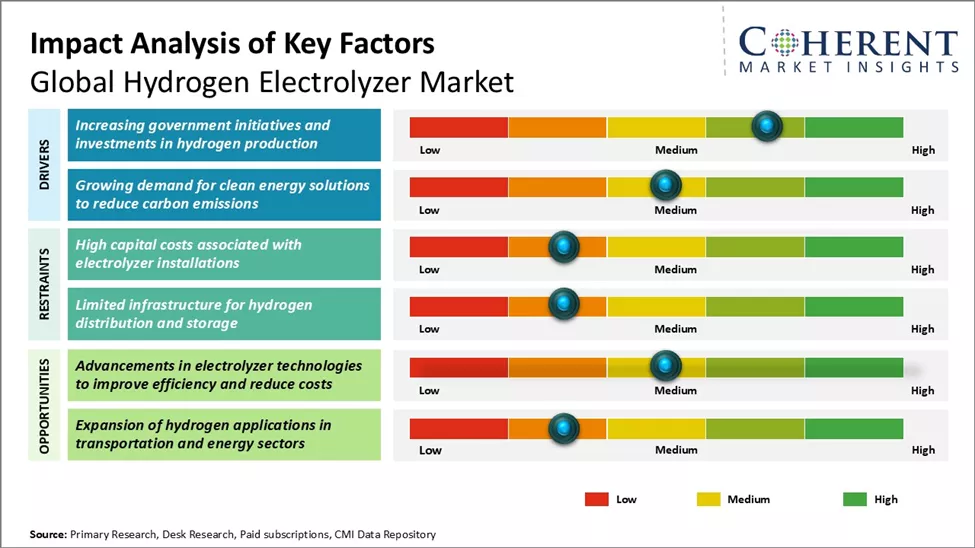
Electrolyzer Market Drivers and Restraints Analyzed
This chart is ideal for an ‘Investments’ section as it provides a nuanced overview of the market’s potential and risks, which are crucial considerations for any investment strategy.
(Source: Coherent Market Insights)
Table: Cummins’ Accelera Financial Events (2025-2026)
| Financial Event / Quarter | Time Frame | Details and Strategic Purpose | Source |
|---|---|---|---|
| Q4 2025 EBITDA Loss | Feb 5, 2026 | Accelera segment reported a $374 million EBITDA loss, which included $218 million in charges related to the strategic review of the electrolyzer unit. | Cummins Reports Strong Fourth Quarter and Full-Year 2025 Results … |
| Total 2025 Write-Down | Feb 5, 2026 | Cummins incurred total costs of $458 million in 2025 from its exit from the electrolyzer market, including a full goodwill impairment. | Major Blow to Hydrogen Sector as Cummins Stops Electrolyser Sales |
| Q3 2025 Charges & Loss | Nov 6, 2025 | Recorded $240 million in non-cash charges and a segment EBITDA loss of $336 million, prompting the launch of a full strategic review. | ‘Weaker prospects’ | Cummins to launch ‘strategic review’ of … |
| Former JV Stake Acquisition | Aug 13, 2025 | A Chinese firm agreed to invest $13.9 million for a 30% stake in an electrolyzer company formerly co-owned by Cummins, indicating shifting regional dynamics. | Chinese hydrogen firm to acquire 30% stake in electrolyser maker … |
| Full-Year 2024 Loss | Feb 4, 2025 | The Accelera unit reported a $764 million pre-tax loss for the 2024 fiscal year, showing historical unprofitability across its clean energy ventures. | Cummins’ hydrogen and battery unit, Accelera, files $764m loss for … |
Partnerships
Prior to its strategic shift, Cummins’ Accelera segment actively formed partnerships to embed its electrolyzer technology across key industries and geographies. A significant collaboration was established with Tyczka Hydrogen GmbH in September 2025 to supply a 5 MW electrolyzer system for a green hydrogen plant in Germany, targeting regional industrial clients. Earlier in the year, Accelera partnered with GAIL, India’s largest natural gas company, to advance green hydrogen production and support the country’s decarbonization goals. These alliances demonstrate a clear strategy to penetrate major industrial markets. A partnership with Isuzu to supply electric powertrain components further highlights Accelera’s broader ambitions in the zero-emissions vehicle space, a portfolio that continues beyond the electrolyzer exit.
Table: Cummins Accelera Key Partnerships (2025)
| Partner / Project | Time Frame | Details and Strategic Purpose | Source |
|---|---|---|---|
| Tyczka Hydrogen GmbH | Sep 26, 2025 | Supply of a 5 MW electrolyzer system for a green hydrogen production plant in Gersthofen, Germany, aimed at serving industrial customers. | Accelera by Cummins partners with Tyczka Hydrogen GmbH to … |
| Isuzu | Mar 27, 2025 | Agreement for Accelera to supply electric powertrain components, aimed at building a local supply chain for vehicle electrification. | Isuzu and Accelera by Cummins sign agreement to supply … |
| GAIL (India) Ltd. | Mar 3, 2025 | Partnership to advance large-scale green hydrogen production in India, aligning with the nation’s clean energy ambitions. | Accelera and GAIL Partner to Advance Green Hydrogen Production … |
$458M Write-Down, Cummins Signals Electrolyzer Market Volatility
The diversity of Cummins’ initial projects—from the massive 100 MW bp system in Lingen to the more modest 5 MW Tyczka Hydrogen plant—highlights the broad but fragmented nature of the electrolyzer market. While large-scale projects signaled industrial decarbonization potential, their long timelines and policy dependence created commercial uncertainty. Cummins’ strategic retreat and pivot to the 15-liter hydrogen internal combustion engine (H2-ICE) represents a calculated move toward a more unified and accessible market: heavy-duty transport. By focusing on an engine, Cummins leverages its core manufacturing expertise and targets a specific application with a clearer path to profitability and infrastructure compatibility, implying that a focused application strategy is more viable than a broad, multi-segment approach in the current climate.

Electrolyzer Market Forecasts Explosive Growth to 2030
This chart’s forecast of explosive market growth provides a powerful contrast to the section’s topic of a major financial write-down, highlighting that Cummins’ struggles are company-specific despite a booming market.
(Source: KBV Research)
Europe & Asia, Cummins’ Global Electrolyzer Strategy and Retreat
Cummins’ electrolyzer activities were heavily concentrated in Europe and Asia, reflecting a strategy to capitalize on regions with strong policy support for green hydrogen. The flagship 100 MW project with bp and the 5 MW supply agreement with Tyczka Hydrogen were both located in Germany, a leader in EU hydrogen policy. The establishment of a major electrolyzer production facility in Guadalajara, Spain, further cemented Cummins’ European focus. Simultaneously, the partnership with GAIL in India demonstrated an ambition to capture a share of Asia’s burgeoning clean energy market. The subsequent exit, citing shifting regulations and market deterioration, suggests that even in these leading regions, the gap between policy ambition and on-the-ground commercial reality became too wide to sustain profitability.

Green Hydrogen Projected to Dominate Post-2050
This chart illustrates the long-term strategic opportunity cost of Cummins’ retreat from the electrolyzer market, as green hydrogen (produced by electrolyzers) is projected to become the dominant energy source.
(Source: Natural Gas Intelligence)
Cummins Pivots from PEM to 15L H2-ICE Technology (2025-2026)
The contrast between Cummins’ PEM electrolyzer products and its new focus on H2-ICE reveals much about tech maturity versus market readiness. PEM electrolyzers like the Hylyzer 1000 (a 2.5 MW system) were commercially available and being deployed, but the market itself was not mature enough to support them profitably, suffering from oversupply and regulatory uncertainty. This indicates a technology that was viable but ahead of its economic time. In response, Cummins pivoted to its 15L H2-ICE, a technology built upon its century of engine manufacturing experience. An internal combustion engine represents a much more mature, scalable, and infrastructure-adjacent technology. This shift is a pragmatic recognition that a familiar technology with a clear application in heavy-duty trucking offers a faster and less risky path to commercialization than a novel technology dependent on an entirely new value chain.
Hydrogen Engines, Cummins’ New Focus After Electrolyzer Exit
Cummins’ withdrawal from new electrolyzer sales is not an exit from the hydrogen economy but a strategic realignment toward nearer-term opportunities. The substantial financial losses in 2025 forced a pragmatic decision to stem the bleeding from a business whose profitability horizon was too distant and uncertain. The key takeaway is a pivot from producing hydrogen (a capital-intensive, infrastructure-dependent market) to using hydrogen in a more familiar format. By focusing on its 15-liter H2-ICE and related turbocharger technologies, Cummins is leveraging its core competencies to provide a more immediate decarbonization solution for a key market segment. The industry will now watch two key things: first, whether Cummins can successfully deliver on its remaining electrolyzer commitments, like the 100 MW bp project, to maintain credibility. Second, how quickly it can scale its H2-ICE business to validate its new, more pragmatic hydrogen strategy.

Cummins Revenue Projected to Reach $50B by 2030
This chart connects the company’s new strategic focus on hydrogen engines to a positive overall financial outlook, suggesting the pivot is part of a successful long-term growth strategy.
(Source: TIKR.com)
Frequently Asked Questions
Why did Cummins stop selling new electrolyzers?
Cummins exited the new electrolyzer market due to significant financial losses and a reassessment of the market’s viability. In 2025, its Accelera business segment recorded a write-down of approximately $458 million, citing “weaker prospects” and a mismatch between the high cost of scaling production and the slow pace of market development. This prompted a strategic pivot to more mature technologies.
How much money did Cummins lose on its electrolyzer venture?
In the fiscal year 2025, Cummins incurred a total write-down of about $458 million from its decision to exit the electrolyzer market. This figure includes $240 million in non-cash charges in Q3 and an additional $218 million in charges in Q4.
What is Cummins’ new hydrogen strategy after this change?
Cummins is pivoting from hydrogen production (electrolyzers) to hydrogen utilization. The company’s new focus is on its 15-liter hydrogen internal combustion engine (H2-ICE). This strategy leverages its core expertise in engine manufacturing to provide a decarbonization solution for the heavy-duty transport market, which it views as having a clearer and faster path to profitability.
Is Cummins leaving the hydrogen business entirely?
No, Cummins is not exiting the hydrogen economy. It is strategically realigning its business from producing hydrogen via electrolyzers to using hydrogen as a fuel. The company is concentrating its efforts on developing and scaling its H2-ICE technology, representing a shift in focus rather than a complete withdrawal.
What will happen to the major electrolyzer projects Cummins had already committed to, like the one for bp?
The announcement specified that Cummins was ceasing *new* commercial activity and sales. The article suggests that the company is expected to deliver on its remaining commitments, such as the 100 MW PEM electrolyzer system for bp’s Lingen project, in order to maintain its credibility in the industry.
Want strategic insights like this on your target company or market?
Build clean tech reports in minutes — not days — with real data on partnerships, commercial activities, sustainability strategies, and emerging trends.
