

Siemens Energy and electrolyzers
Siemens Energy’s PEM Electrolysis Push, 200 MW Air Liquide JV, 140 MW OMV Deal, and 8 Projects (2025-2026)
Siemens Energy is carving out a definitive leadership role in the green hydrogen economy by strategically focusing on Proton Exchange Membrane (PEM) electrolysis. This technology is crucial for producing green hydrogen from intermittent renewable sources, and the company’s commitment is clear through its deep industrial partnerships and aggressive scaling of manufacturing. With the global electrolyzer market projected to surge from $2.08 billion in 2025 to potentially over $480 billion by 2034, Siemens Energy is positioning its technology not just as a component, but as the foundational engine for industrial decarbonization across Europe and beyond.
$1 Billion Annually, Siemens Energy’s R&D Investment Strategy
Siemens Energy’s market strategy is underpinned by substantial and consistent financial commitments aimed at accelerating technological leadership and manufacturing capacity. The company dedicates over $1 billion annually to Research and Development across its portfolio, a significant portion of which fuels innovation in its PEM electrolyzer product lines. This R&D is not just theoretical; it translates directly into tangible assets like the new Gigawatt-scale factory in Berlin, a strategic investment to mass-produce electrolyzer stacks and meet surging market demand. Further, Siemens Energy Ventures is actively investing to create market pull, partnering with and funding companies like GeoPura to pioneer new hydrogen-as-a-service business models and build demand from the ground up.
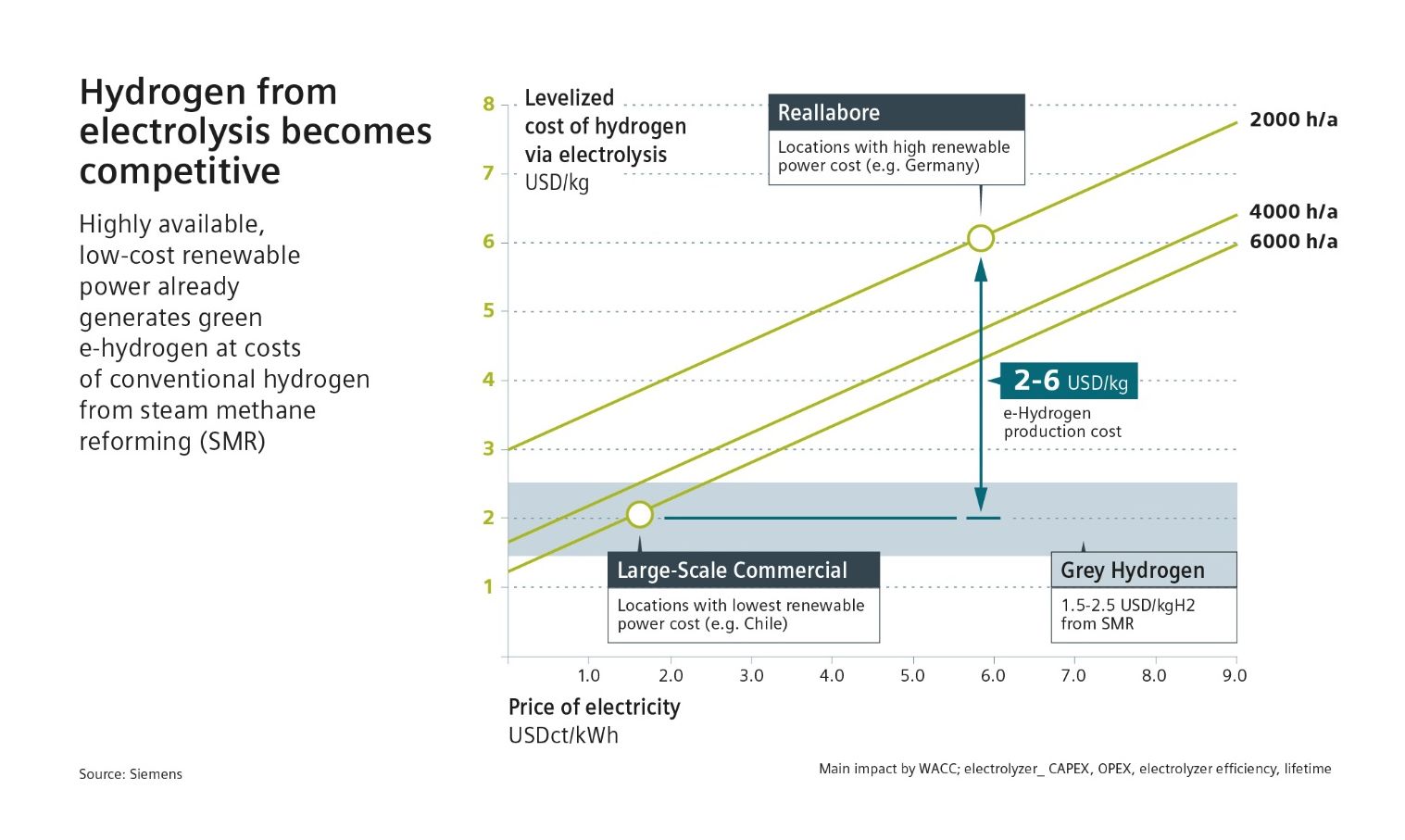
Green Hydrogen Nears Cost Parity with Fossil Fuels
This chart illustrates the critical technological and economic challenge that Siemens Energy’s R&D is tackling: achieving cost parity for green hydrogen. The $1 billion annual investment is directly aimed at closing this gap, making the chart a perfect illustration of the strategy’s primary goal.
(Source: POWER Magazine)
Siemens Energy: Strategic Investment Table
| Partner / Project | Time Frame | Details and Strategic Purpose | Source |
|---|---|---|---|
| Annual R&D Investment | December 3, 2025 | Over $1 billion invested annually in R&D to drive advancements in key decarbonization technologies, including the electrolyzer portfolio. | What is Growth Strategy and Future Prospects of Siemens Energy … |
| Gigafactory for Electrolyzer Production | October 30, 2025 | A strategic investment in a Gigawatt-scale factory in Berlin dedicated to producing electrolyzers at scale, aiming to secure market share and meet growing demand. | Modernizing and expanding the power grid for tomorrow’s energy |
| GeoPura Investment | April 15, 2025 | Investment via Siemens Energy Ventures to support GeoPura’s green hydrogen-based off-grid energy services, helping to kick-start the hydrogen economy by creating demand. | Geopura – Siemens Energy |

Electrolyzer Market to Exceed $400B by 2035
The chart’s staggering forecast of a $400B+ market provides the overarching strategic justification for the investments detailed in this section. It visualizes the massive potential reward that Siemens Energy is targeting with its capital allocation.
(Source: Precedence Research)
Siemens Energy’s 8 Key Partnerships Including Air Liquide and OMV (2025)
Collaboration is the cornerstone of Siemens Energy’s go-to-market strategy, embedding its technology directly into the operations of major industrial players. The joint venture with Air Liquide to create one of Europe’s largest PEM stack production facilities in Berlin is a prime example, providing the manufacturing muscle to supply massive undertakings like the 200 MW Normand’Hy project. This approach extends to critical sectors, including a collaboration with STRABAG to construct a 140 MW plant for Austrian oil and gas giant OMV. Beyond Europe, a key partnership with Guofu Hydrogen in China establishes Siemens Energy as a preferred technology supplier, opening a crucial channel into Asia’s rapidly growing hydrogen market. Through its financing arm, the company is also enabling market creation with partners like GeoPura to accelerate the deployment of off-grid hydrogen solutions.
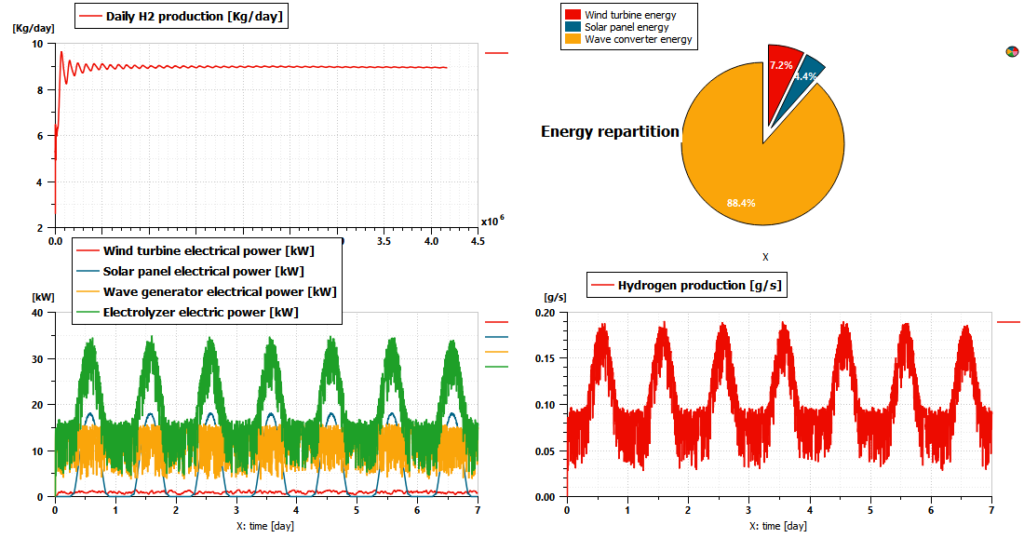
Simulation Shows Green Hydrogen Production Dynamics
Complex, large-scale hydrogen projects involving multiple partners like Air Liquide and OMV require sophisticated planning. This simulation chart exemplifies a key tool used by partners to model outcomes, align on technical specifications, and de-risk their joint investments.
Siemens Energy: Key Partnership Table
| Partner / Project | Time Frame | Details and Strategic Purpose | Source |
|---|---|---|---|
| STRABAG and OMV | September 29, 2025 | Collaborating to build a 140 MW electrolysis plant for OMV’s Schwechat refinery, aiming to produce 23,000 tons of green hydrogen annually for industrial decarbonization. | STRABAG and Siemens Energy build one of Europe’s largest … |
| Air Liquide | July 31, 2025 | A joint venture to operate a Gigawatt-scale electrolyzer factory in Berlin, producing PEM stacks for large-scale projects like the 200 MW Normand’Hy plant. | at the heart of the Air Liquide and Siemens Energy Electrolyzer … |
| GeoPura | March 10, 2025 | A financing deal through Siemens Financial Services to accelerate GeoPura’s deployment of green hydrogen for off-grid and temporary energy-as-a-service solutions. | GeoPura & Siemens Financial Services join forces to boost green … |
| Guofu Hydrogen | February 12, 2025 | Partnership to become the preferred technology supplier for Guofu’s electrolyzer production in China, accelerating development for the Asian market. | Siemens and Guofu Hydrogen partner to accelerate global green … |

Electrolyzer Market to Exceed $14B by 2031
This chart quantifies a specific, addressable market segment valued at over $14B. It provides the commercial context for the partnerships listed in the table, showing the tangible market opportunity these collaborations are designed to capture.
(Source: MarketsandMarkets)
Industrial Decarbonization, Siemens Energy’s 200 MW and 140 MW Projects
The application of Siemens Energy’s electrolyzer technology is notably diverse, signaling a strategy to penetrate multiple high-value industrial verticals. Rather than focusing on a single use case, projects range from producing industrial feedstock to creating next-generation e-fuels. For example, the 140 MW OMV project and the 54 MW BASF plant target the immediate need to displace grey hydrogen in refining and chemical production. Simultaneously, the partnership with Techint E&C on the Mexinol project aims to create one of the world’s largest hydrogen-to-methanol plants, a crucial step for the e-fuels market. This diversification demonstrates the versatility of PEM technology and allows Siemens Energy to build a broad base of adoption, proving its value across the entire industrial decarbonization landscape.

Electrolyzer Performance Monitored in Real-Time Dashboard
This chart provides a visual representation of how large-scale industrial projects, such as the 200 MW and 140 MW examples in the heading, are monitored post-completion. It illustrates the operational and data-driven aspect of Siemens Energy’s project delivery.
Europe Leads, Siemens Energy’s Focus on Germany, France, and Austria
A clear geographic pattern emerges from Siemens Energy’s project pipeline, with a heavy concentration in Europe’s industrial heartland. Germany (BASF, EWE, Hamburg), France (Air Liquide’s Normand’Hy), and Austria (OMV) host the company’s largest and most strategic projects. This focus is a direct response to the strong policy support and ambitious decarbonization targets set by the European Union, which create a stable and attractive market for green hydrogen technologies. The Berlin Gigafactory is geographically positioned to serve this core market efficiently. However, projects and partnerships in Croatia (INA), Japan (semiconductor plant), and China (Guofu) indicate a phased global rollout strategy, using the successful European deployments as a blueprint to expand into other regions as their hydrogen economies mature.

Europe Dominates Electrolyzer Market with PEM Tech a Key Segment
The chart directly supports the section’s headline. It visually confirms Europe’s leadership in the electrolyzer market, providing a data-driven rationale for Siemens Energy’s strategic focus on key European countries like Germany, France, and Austria.
(Source: IDTechEx)
100% Hydrogen, Siemens Energy’s SGT-400 Turbine and Digital Twins
Siemens Energy’s activities reveal a multi-layered approach to technology maturity. The core PEM electrolyzer technology is now clearly in a commercial scaling phase, evidenced by the move to gigawatt-scale manufacturing and deployments in the hundreds of megawatts. Innovations like the modular “skid” design are not about fundamental science but about industrialization—reducing costs and shortening installation timelines to facilitate mass adoption. Concurrently, the company is pushing the boundaries of integration and end-use. The successful test of an SGT-400 turbine on 100% green hydrogen is a landmark achievement, proving a viable pathway for decarbonizing power generation and creating a market for the hydrogen its electrolyzers produce. Digital tools like the Process Twin represent a further layer of maturity, focusing on optimizing the entire project lifecycle to lower long-term operational costs.

Siemens Turbines Show Varying Hydrogen Readiness
This chart is a perfect match, as it provides a comparative breakdown of Siemens’ own turbine portfolio and their capability to handle hydrogen. It directly visualizes the significance of the 100% H2-ready SGT-400 turbine mentioned in the section heading.
(Source: POWER Magazine)
Siemens Energy’s Future Direction with Gigafactory and Mexinol (2029)
The pattern of investments, partnerships, and projects signals a clear future direction for Siemens Energy. The company is executing an industrial-scale strategy centered on its PEM technology, leveraging the Berlin Gigafactory to meet exponential demand while embedding its systems within the operations of major partners like Air Liquide, OMV, and BASF. The key metric to watch will be the successful execution of its multi-hundred-megawatt projects, particularly the 280 MW system for EWE and the completion of the Normand’Hy plant. These will serve as critical proof points for the technology’s bankability at scale. Furthermore, the development of the Mexinol e-methanol plant, scheduled for operation by 2029, and the continued focus on enhancing electrolyzer lifecycles show a company looking beyond initial deployment towards building a sustainable, long-term, and economically viable green hydrogen ecosystem.

Electrolyzer Market Poised for Major Capacity Growth
The projected exponential growth in electrolyzer capacity provides the clear business case for Siemens Energy’s future-oriented investments like the new Gigafactory. The factory is being built precisely to meet the sharp increase in demand shown in this chart.
(Source: IDTechEx)
Frequently Asked Questions
What is Siemens Energy’s primary strategy in the green hydrogen market?
Siemens Energy’s strategy is to establish a leadership role by focusing on Proton Exchange Membrane (PEM) electrolysis technology. This involves scaling up manufacturing with its Berlin Gigafactory, forming deep industrial partnerships with major players like Air Liquide and OMV, and dedicating over $1 billion annually in R&D to advance its technology for industrial decarbonization.
What are some of Siemens Energy’s most significant hydrogen projects?
The article highlights several major projects, including a joint venture with Air Liquide for a 200 MW plant (Normand’Hy), a collaboration with STRABAG to build a 140 MW electrolysis plant for the OMV refinery in Austria, and a partnership for the Mexinol project, which aims to become one of the world’s largest hydrogen-to-methanol plants.
Why is the Berlin Gigafactory so important to Siemens Energy’s plans?
The Berlin Gigafactory is a strategic investment for the mass production of PEM electrolyzer stacks. It is central to Siemens Energy’s plan to meet surging market demand, secure market share, and efficiently supply its large-scale European projects, such as those in Germany, France, and Austria.
How is Siemens Energy working to create demand for green hydrogen?
Siemens Energy is actively creating market pull through its venture capital arm, Siemens Energy Ventures. For example, it has invested in and partnered with GeoPura to pioneer new “hydrogen-as-a-service” business models for off-grid energy. It is also proving hydrogen’s end-use viability, such as by successfully testing an SGT-400 turbine on 100% hydrogen, which helps create a market for the hydrogen its electrolyzers produce.
Which geographical region is the main focus for Siemens Energy’s hydrogen activities and why?
Europe, particularly its industrial heartland including Germany, France, and Austria, is the primary focus. The article states this is a direct response to the strong policy support and ambitious decarbonization targets set by the European Union, which create a stable and attractive market for green hydrogen technologies.
Want strategic insights like this on your target company or market?
Build clean tech reports in minutes — not days — with real data on partnerships, commercial activities, sustainability strategies, and emerging trends.

Hydrogen Electrolyzer Market to Exceed $7.5B by 2035
As this section is a call to action, the chart serves as a final piece of compelling data. It acts as a ‘teaser,’ showcasing another example of a specific market forecast to demonstrate the value of the strategic insights being offered to the reader.
(Source: Transparency Market Research)
