

Top 10 US Green Hydrogen Hubs, Exxon Mobil’s $1.2 B Hy Velocity Project, and $925 M ARCH 2 Resilience (2025-2026)
The U.S. hydrogen market is undergoing a fundamental recalibration, splitting into a two-tiered system where commercial viability, not federal subsidy, dictates project survival. The primary finding from recent market activity is that the withdrawal of over $2 billion in Department of Energy (DOE) H 2 Hubs grants has revealed which hubs possess resilient fundamentals versus those overly dependent on now-tenuous government support. For instance, the Appalachian Hydrogen Hub (ARCH 2) and the Gulf Coast Hydrogen Hub (Hy Velocity) continue to advance due to strong private-sector backing and inherent regional advantages. In stark contrast, the California (ARCHES) and Pacific Northwest (PNWH 2) hubs face significant jeopardy after their foundational federal funding was rescinded in late 2025. The dominant theme for 2025-2026 is a market-driven stress test, forcing a transition from subsidized development to a “survival of the fittest” environment where access to low-cost feedstock and inelastic industrial demand are paramount.
1. Appalachian Hydrogen Hub (ARCH 2)
Key Partners: EQT Corporation, Battelle, TC Energy
Installation Capacity: Up to $925 Million in DOE Funding
Applications: Blue hydrogen production leveraging existing natural gas infrastructure
Source: In Ohio, hydrogen industry presses on despite federal uncertainty
2. Gulf Coast Hydrogen Hub (Hy Velocity)
Key Partners: Exxon Mobil, Chevron, Air Liquide, Linde
Installation Capacity: Up to $1.2 Billion in DOE Funding
Applications: Serving industrial demand for refining and ammonia production
Source: Trump tax bill risks exodus of clean hydrogen investment | Reuters
3. Avina Hydrogen Project
Key Partners: Avina Clean Hydrogen
Installation Capacity: N/A (Privately Funded)
Applications: Large-scale hydrogen production and vehicle dispensing facility
Source: The energy source that could survive Trump’s attack on California’s …
4. Midwest Hydrogen Hub (Mach H 2)
Key Partners: Exelon, Cummins, Argonne National Laboratory
Installation Capacity: Up to $1 Billion in DOE Funding
Applications: Decarbonizing heavy industry, steel manufacturing, and transportation
Source: The most-read Hydrogen Insight articles by our subscribers in 2025
5. Heartland Hydrogen Hub
Key Partners: Xcel Energy, Marathon Petroleum, University of North Dakota
Installation Capacity: Up to $925 Million in DOE Funding
Applications: Green ammonia production for the agricultural sector
Source: Top US green hydrogen projects for 2026 and beyond – Airswift
6. Limestone Green Hydrogen Production Project
Key Partners: Green Hydrogen International (now Energy Abundance Development Corp.)
Installation Capacity: N/A (Privately Funded)
Applications: Green hydrogen production, with initial startup planned for 2026
Source: Limestone Green Hydrogen Production Project Final EA
7. St. Gabriel Green Hydrogen Plant
Key Partners: Unknown from sources
Installation Capacity: N/A (Privately Funded)
Applications: Green hydrogen production in Gulf Coast industrial corridor
Source: Top US green hydrogen projects for 2026 and beyond – Airswift
8. Mid-Atlantic Clean Hydrogen Hub (MACH 2)
Key Partners: Chemours, PSEG, University of Delaware
Installation Capacity: Up to $750 Million in DOE Funding
Applications: Decarbonization across industrial and transportation sectors
Source: Hydrogen-Fueled Medium- and Heavy-Duty Vehicles (MHDVs)
9. Pacific Northwest Hydrogen Hub (PNWH 2)
Key Partners: Fortescue, Pacifi Corp, Puget Sound Energy
Installation Capacity: Up to $1 Billion (Funding Cut)
Applications: Green hydrogen production and distribution
Source: Two Hydrogen Hubs Respond to Sudden Federal Funding Cuts – ENR
10. California Hydrogen Hub (ARCHES)
Key Partners: Sempra, Lawrence Berkeley National Laboratory, Port of Los Angeles
Installation Capacity: Up to $1.2 Billion (Funding Cut)
Applications: Decarbonization of ports, transportation, and power generation
Source: Two Hydrogen Hubs Respond to Sudden Federal Funding Cuts – ENR
Table: Top 10 US Hydrogen Hubs & Projects by Resilience (2025-2026)
| Key Partners | Installation Capacity | Applications | Source |
|---|---|---|---|
| EQT Corporation, Battelle, TC Energy | Up to $925 Million in DOE Funding | Blue hydrogen production leveraging existing natural gas infrastructure | In Ohio, hydrogen industry presses on despite federal uncertainty |
| Exxon Mobil, Chevron, Air Liquide, Linde | Up to $1.2 Billion in DOE Funding | Serving industrial demand for refining and ammonia production | Trump tax bill risks exodus of clean hydrogen investment | Reuters |
| Avina Clean Hydrogen | N/A (Privately Funded) | Large-scale hydrogen production and vehicle dispensing facility | The energy source that could survive Trump’s attack on California’s … |
| Exelon, Cummins, Argonne National Laboratory | Up to $1 Billion in DOE Funding | Decarbonizing heavy industry, steel manufacturing, and transportation | The most-read Hydrogen Insight articles by our subscribers in 2025 |
| Xcel Energy, Marathon Petroleum, University of North Dakota | Up to $925 Million in DOE Funding | Green ammonia production for the agricultural sector | Top US green hydrogen projects for 2026 and beyond – Airswift |
| Green Hydrogen International | N/A (Privately Funded) | Green hydrogen production, with initial startup planned for 2026 | Limestone Green Hydrogen Production Project Final EA |
| Unknown from sources | N/A (Privately Funded) | Green hydrogen production in Gulf Coast industrial corridor | Top US green hydrogen projects for 2026 and beyond – Airswift |
| Chemours, PSEG, University of Delaware | Up to $750 Million in DOE Funding | Decarbonization across industrial and transportation sectors | Hydrogen-Fueled Medium- and Heavy-Duty Vehicles (MHDVs) |
| Fortescue, Pacifi Corp, Puget Sound Energy | Up to $1 Billion (Funding Cut) | Green hydrogen production and distribution | Two Hydrogen Hubs Respond to Sudden Federal Funding Cuts – ENR |
| Sempra, Lawrence Berkeley National Laboratory, Port of Los Angeles | Up to $1.2 Billion (Funding Cut) | Decarbonization of ports, transportation, and power generation | Two Hydrogen Hubs Respond to Sudden Federal Funding Cuts – ENR |
Blue Hydrogen & Green Ammonia Adoption, ARCH 2 and Heartland Hubs Lead
The diversity of applications pursued by the more resilient hubs indicates where hydrogen adoption is most commercially viable. The ARCH 2 hub’s focus on blue hydrogen leverages the Appalachian region’s vast natural gas reserves and existing pipeline infrastructure, providing a cost-advantaged pathway to decarbonization that is less dependent on new technology breakthroughs. Similarly, the Heartland Hydrogen Hub is targeting a clear, non-discretionary market by planning to produce green ammonia for the agricultural sector. This strategy secures a reliable offtake market, enhancing its economic case. These targeted applications stand in contrast to the broader, more ambitious goals of hubs like ARCHES, whose multifaceted approach is proving more vulnerable in a tighter funding environment.
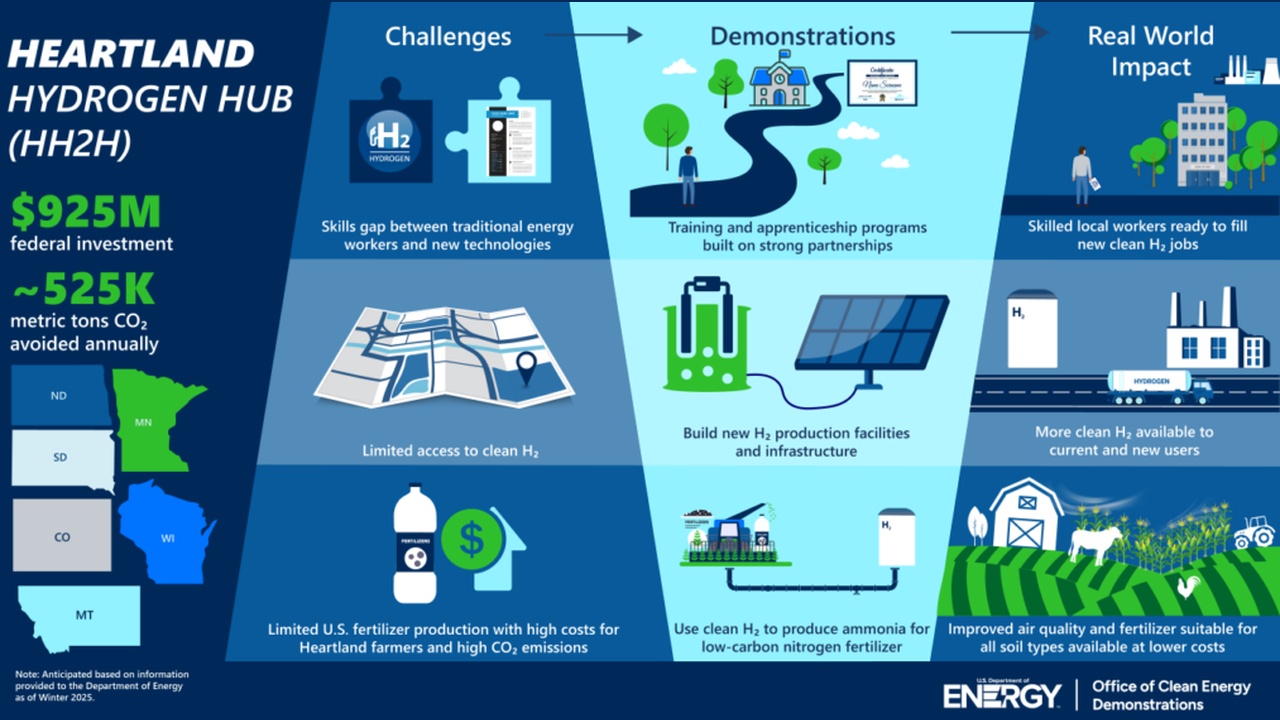
Heartland Hub Focuses on Green Ammonia
This infographic details the Heartland Hydrogen Hub’s $925M project to produce green ammonia for agriculture, which is a primary example used in this section.
(Source: Global Hydrogen Hub)
Appalachia and Gulf Coast Lead, California Hub Faces Funding Cuts
A distinct geographical pattern is emerging, with project resilience strongly correlated to regional industrial characteristics. The Appalachian and Gulf Coast regions are proving to be the most robust centers for hydrogen development. The Gulf Coast Hydrogen Hub (Hy Velocity), backed by energy giants like Exxon Mobil and Chevron, benefits from the world’s most extensive hydrogen pipeline network and massive industrial demand from refineries and chemical plants. Meanwhile, Ohio projects within the ARCH 2 hub are reportedly “chugging along anyway” despite federal uncertainty. Conversely, the West Coast hubs—PNWH 2 and ARCHES—have had their ambitious plans jeopardized by the DOE’s decision to rescind over $2 billion in grants, highlighting their critical dependence on federal capital.

Map Details Regional Strengths of Hydrogen Hubs
This map illustrates the geographic strengths of key hydrogen regions like the Gulf Coast and Appalachia, visually supporting the section’s point that these areas are leading development.
(Source: Ammonia Energy Association)
$1.2 Billion in Federal Cuts Test Hydrogen Hub Commercial Viability
These developments reveal a clear divergence in technological and commercial maturity. Projects that can leverage existing infrastructure, such as blue hydrogen production in Appalachia, demonstrate a more mature and immediately bankable model. In contrast, large-scale green hydrogen projects requiring significant new infrastructure and renewable energy build-out are proving more fragile. However, the emergence of privately-funded, commercially-driven projects like the Avina Hydrogen Project in California and the Limestone Green Hydrogen Project in Texas signals a new phase of maturity. These ventures are sized and located to serve specific, guaranteed offtakers, insulating them from federal policy shifts and proving that green hydrogen can be commercially viable when executed with a focused business case.

Table Details Funding Status of Hydrogen Hubs
This table illustrates the article’s theme of funding challenges by showing the status of each hub, including those that are ‘At Risk’ or have been ‘Canceled’.
(Source: RBN Energy)
Hy Velocity Hub’s $1.2 B Project Signals Future Private Investment Focus (2026)
The single most critical expectation for project developers in 2026 is the urgent need to secure private capital and bankable offtake agreements, treating federal funding as a potential accelerator rather than a foundational requirement. The market’s bifurcation will accelerate, forcing a clear distinction between projects with robust commercial underpinnings and those that cannot survive without subsidies.
- Signal Gaining Traction: Independent, private-sector projects are becoming the new benchmark for bankability. The Avina Hydrogen Project in California, set to open in Fall 2025, is a prime example of a large-scale facility moving forward without reliance on the H 2 Hubs program, indicating strong commercial drivers in the transportation sector.
- Signal Gaining Traction: Hubs anchored by existing industrial ecosystems and infrastructure are demonstrating the most resilience. Reports that Ohio’s hydrogen industry within ARCH 2 is pressing on despite federal uncertainty underscores the value of leveraging low-cost feedstock and established demand.
- Signal Losing Steam: Ambitious, multi-faceted greenfield hubs are facing severe headwinds. The DOE’s official funding cuts to the California (ARCHES) and Pacific Northwest (PNWH 2) hubs in late 2025 serve as a clear signal that projects without a clear, near-term path to profitability are at high risk of failure.

Gulf Coast Hub’s Plan to Lower Costs
This chart details the Gulf Coast Hub’s (HyVelocity) strategy to use its $1.2B in funding to lower costs, aligning with the section’s focus on future commercial viability.
(Source: Ammonia Energy Association)
The questions your competitors are already asking
This report covers one angle of the US hydrogen hub market’s recalibration following major shifts in federal policy and funding. The questions that matter most depend on your work.
- Which US hydrogen hubs are gaining or losing ground after the reversals in the DOE H2Hubs program?
- ARCH2 and HyVelocity investments and funding. Are the projects on track for deployment despite the federal policy shifts?
- What is the outlook for large-scale hydrogen deployment in the US by 2026, now that commercial viability is replacing federal subsidies as the primary driver?
This report does not answer these. Enki Brief Pro does.
Your question, your angle, your framework. SWOT, PESTL, scenario modelling. The same niche depth, built around the decision your work actually depends on.
