

Indian Oil Green Hydrogen, ₹2 Trillion Investment, 10, 000 Tonne L&T Plant, and 3 Major Projects (2021 to 2026)
Green Hydrogen Project Execution, Indian Oil Resolves Delays with 10, 000 Tonne L&T Plant
Indian Oil Corporation (IOCL) overcame significant early-stage project execution failures by shifting to a vertically integrated model anchored by a firm 25-year offtake agreement for its own refinery, demonstrating a resolution to the challenges that previously stalled its ambitions.
- The period from 2021 to 2024 was characterized by ambitious announcements, including plans for India’s first green hydrogen plant at the Mathura refinery, but was practically defined by execution hurdles. The flagship tender for a green hydrogen plant at the Panipat refinery was repeatedly cancelled in February 2024 and again in October 2024, signaling major difficulties in procurement and project management for new energy technologies.
- A decisive shift occurred in 2025 with the successful awarding of the Panipat project to L&T Energy Green Tech. This agreement locks in a 10, 000 tonnes per year supply for the refinery and establishes a de-risked commercial template that can be replicated across IOCL’s other facilities, contrasting with the stalled progress seen on projects globally, like BP’s exit from the Protium project.
- With its core project now underway, IOCL’s strategy has expanded to encompass the full value chain. This includes pilot-scale production at its Faridabad R&D center for technology validation and advanced plans for a green hydrogen fuel retail network to enter the mobility sector, a market where players like Plug Power are also highly active.
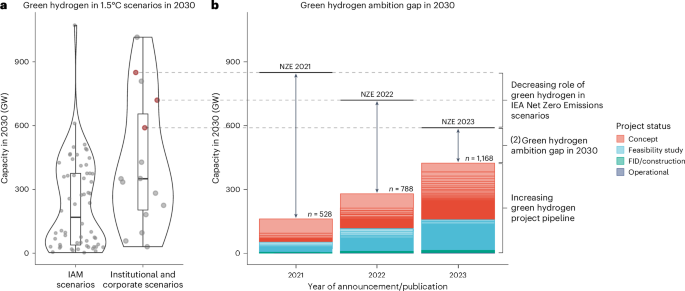
Green Hydrogen Ambition Gap Persists Despite Pipeline Growth
The section discusses the execution of a specific project and resolving delays. The chart provides the macro context, showing a persistent gap between green hydrogen ambitions and the actual project pipeline. This highlights that project delays and execution challenges, like those Indian Oil is resolving, are a widespread industry issue, making their progress noteworthy.
(Source: Nature)
₹2 Trillion in Capital, Indian Oil Corporation’s Green Hydrogen Investment Strategy
Indian Oil Corporation is a key participant in a coordinated ₹2 trillion (approximately $24 billion) investment initiative by India’s state-run refiners, designed to establish large-scale green hydrogen capacity and secure the nation’s energy transition.
- This overarching investment framework supports IOCL’s corporate goal of achieving net-zero operational emissions by 2046, with green hydrogen production positioned as a central pillar of its decarbonization strategy. The scale of this investment is globally significant, rivaling national programs like those seen in Egypt.
- Initial capital outlays between 2021 and 2024 were directed primarily towards planning and tenders. However, these faced considerable headwinds, culminating in the public cancellation of the Panipat green hydrogen plant tender twice, which stalled significant capital deployment.
- Beginning in 2025, the investment strategy has matured from allocation to execution. Capital is now flowing into tangible assets, including the development of the Panipat plant by L&T Energy Green Tech and the expansion of the Faridabad R&D center’s pilot facilities, marking a shift from strategic planning to physical infrastructure development.

India’s Green Hydrogen Demand to Surge 13-Fold
The section details Indian Oil’s massive ₹2 trillion investment strategy. The chart directly justifies this large-scale capital allocation by illustrating the projected 13-fold surge in India’s green hydrogen demand, demonstrating the significant market opportunity the company is targeting.
(Source: CEEW)
Table: Indian Oil Corporation Strategic Investments and Project Status
| Project / Initiative | Time Frame | Details and Strategic Purpose | Source |
|---|---|---|---|
| Panipat Green Hydrogen Plant | Jul 2025 | Awarded contract to L&T Energy Green Tech to build a 10, 000 tonnes/year plant. IOCL acts as its own anchor customer with a 25-year offtake agreement to decarbonize refinery operations. | Indian Chemical News |
| Collective State-Run Refiner Projects | Jun 2025 | IOCL is part of a collective ₹2 trillion (approx. $24 B) investment plan by state refiners to build green hydrogen capacity, with 42 KTPA tendered and an additional 128 KTPA planned. | Mint |
| Panipat Green Hydrogen Tender | Oct 2024 | (Cancelled) The relaunched tender for the Panipat green hydrogen plant was annulled for a second time, signaling persistent commercial or technical framework issues and causing significant project delays. | JMK Research |
| Net-Zero Emissions Roadmap | Feb 2023 | Announced a ₹2 lakh crore (~$24 Billion) investment plan to achieve net-zero operational emissions by 2046. The plan includes capital for green hydrogen plants at all its refineries. | The Times of India |

India’s Hydrogen Demand Projected to 2050
This section is a table detailing specific strategic investments and projects. The chart provides the overarching rationale for these investments by showing the long-term projection of total hydrogen demand in India through 2050. It acts as a backdrop explaining the market size these projects are designed to serve.
(Source: thyssenkrupp Uhde)
Indian Oil Corporation JV with L&T and Re New Power Signals Strategic Shift (2022 to 2025)
Indian Oil Corporation has strategically mitigated its internal execution risks and capability gaps by forming critical partnerships that integrate its own end-user demand with external engineering expertise and renewable energy supply.
- The April 2022 agreement to form a joint venture with engineering firm Larsen & Toubro and renewable energy producer Re New Power was a foundational move. This created a powerful consortium with specialized capabilities across the entire green hydrogen value chain, from clean power generation to project execution.
- This partnership strategy was operationalized with the awarding of the Panipat EPC contract in July 2025 to L&T Energy Green Tech. The decision demonstrates a successful transition from a high-level agreement to a concrete, project-level execution relationship.
- IOCL is also pursuing technology diversification through its research collaboration with the Indian Institute of Science (IISc) on biomass gasification, creating an alternative production pathway to electrolysis and hedging against renewable power intermittency. This multi-pronged approach is also being adopted by global players like Thyssen Krupp to manage technology risk.
- Beyond its commercial partnerships, IOCL’s participation as a key stakeholder in the India-EU Task Force on Green Hydrogen, operationalized in January 2026, signals a long-term interest in shaping international standards, accessing new technologies, and exploring future export opportunities.

Global Hydrogen Market to Exceed $226B by 2030
The section highlights a strategic shift and new joint ventures formed between 2022 and 2025. The chart, which projects the global market size to 2030, illustrates the significant near-term financial opportunity that is driving this strategic pivot and motivating companies like Indian Oil to form partnerships to capture market share.
(Source: MarketsandMarkets)
Table: Indian Oil Corporation Strategic Partnerships
| Partner / Project | Time Frame | Details and Strategic Purpose | Source |
|---|---|---|---|
| European Union | Jan 2026 | Operationalized the India-EU Task Force on Green Hydrogen. As a major state-owned entity, IOCL is a primary stakeholder, fostering cooperation on production, storage, and distribution. | MEA India |
| L&T Energy Green Tech | Jul 2025 | Awarded EPC contract to build India’s largest green hydrogen plant (10, 000 tonnes/year) at IOCL’s Panipat refinery, cementing a key execution partnership. | Indian Chemical News |
| Sembcorp & BPCL | Apr 2025 | IOCL’s peer, Bharat Petroleum (BPCL), entered a JV with Sembcorp to develop renewable energy and hydrogen projects, indicating a coordinated strategy among state-run refiners. | Offshore Energy |
| Larsen & Toubro / Re New Power | Apr 2022 | Formed a binding term sheet for a joint venture to develop the green hydrogen sector, combining IOCL’s end-use demand with L&T’s engineering and Re New’s renewable energy capacity. | Indian Oil |

India’s Path to Cheaper Green Hydrogen
This section is a table listing Indian Oil’s strategic partnerships. The chart illustrates the critical challenge of reducing the cost of green hydrogen in India. Strategic partnerships are a key method for achieving this goal by combining technology, expertise, and capital, making the chart a perfect illustration of the primary objective behind the partnerships listed in the table.
(Source: CEEW)
India-Centric Growth, Indian Oil Corporation Focuses on Domestic Refinery Decarbonization
Indian Oil Corporation’s green hydrogen strategy is fundamentally a domestic play, sharply focused on decarbonizing its own pan-India refining network to meet national energy security and climate objectives.
- Between 2021 and 2024, the initial geographic footprint of IOCL’s hydrogen ambitions centered on its refineries in Mathura (Uttar Pradesh) and Panipat (Haryana), where the first projects were announced.
- From 2025 onward, the strategy has consolidated, with Panipat emerging as the flagship execution project. Its 10, 000 tonnes per year capacity will serve as a critical blueprint for replication across IOCL’s vast network of refineries, which have a combined capacity of 80.75 MMTPA.
- The company’s geographic scope is also expanding beyond its core industrial assets. The announcement of a project at Kochi Airport in Kerala indicates a strategic intent to supply green hydrogen to new demand sectors, such as aviation and mobility.
- This domestic focus aligns directly with the goals of India’s National Green Hydrogen Mission, which targets 5 MMTPA of national production by 2030. IOCL’s own target of 350, 000 mt/y constitutes a significant portion of this national goal.

Hydrogen Demand in Indian Refineries to Nearly Double by 2050
The section focuses specifically on Indian Oil’s strategy to decarbonize its domestic refineries. The chart is a perfect match, as it quantifies the specific demand growth for hydrogen within the Indian refinery sector, directly supporting the section’s narrative and highlighting the core market for Indian Oil’s initial efforts.
(Source: thyssenkrupp Uhde)
PEM Electrolysis at Commercial Scale, Indian Oil Corporation De-risks with Proven Technology
Indian Oil Corporation is building its foundational green hydrogen ecosystem on commercially mature electrolysis technology while simultaneously developing next-generation alternatives like biomass gasification to hedge against future technology and feedstock risks.
- The initial strategy from 2021 to 2024 was centered on procuring established electrolysis technology for its refineries. However, the procurement process itself proved to be a major bottleneck, as evidenced by the repeated tender failures at Panipat.
- The successful contract award for the Panipat project in 2025 confirms IOCL’s commitment to deploying large-scale electrolysis as its primary commercial pathway for replacing grey hydrogen. This mirrors the global trend of major industrial players like Arcelor Mittal using green hydrogen for decarbonization.
- IOCL maintains a crucial technology-validation function through the pilot-scale green hydrogen production unit at its Faridabad R&D center. This facility allows the company to test and vet emerging electrolyzer and storage technologies before committing to large-scale capital expenditures.
- The ongoing research collaboration with the Indian Institute of Science (IISc) on biomass gasification is a strategic investment in a TRL 6-7 technology. If successful, it could provide a cost-stable, non-intermittent production route that leverages India’s abundant agricultural resources.

Green Hydrogen Market Ecosystem Explained
The section discusses the choice of a specific technology, PEM electrolysis, for commercial-scale production. The chart explains the entire market ecosystem, showing how production (where electrolysis fits) connects to storage, transport, and end-use. This provides essential context, illustrating how a proven production technology de-risks the entire value chain.
(Source: Earth5R)
SWOT Analysis, Indian Oil Corporation’s In-House Demand is Key Strength
Indian Oil Corporation’s greatest strategic strength is its massive in-house demand for hydrogen, which provides a guaranteed offtake that de-risks initial investments, though the company remains exposed to execution delays and competition from more agile private sector firms.
- The company’s ability to act as its own anchor customer for foundational projects like the Panipat plant solves the “chicken-and-egg” demand uncertainty that plagues green hydrogen project financing globally.
- However, the repeated cancellation of the Panipat tender between 2022 and 2024 exposed a significant weakness in its ability to manage procurement for complex, new-energy projects.
- As a large state-run entity, IOCL’s procurement scale presents an opportunity to shape the entire Indian hydrogen market and drive down costs, as demonstrated by tenders that successfully reduced green hydrogen prices to near $4/kg.
- The primary threat remains competition from private players like Reliance and Greenko, who may prove more nimble in project development and could capture market share if IOCL’s execution falters again.

Industry Leads as Top Hydrogen Consumer
The section identifies Indian Oil’s in-house demand as a key strength in its SWOT analysis. The chart strongly supports this point by showing that industry (which includes oil refining) is the largest consumer of hydrogen. This validates the strategic importance of having a large, built-in customer base for its own product.
(Source: Upstox)
Table: SWOT Analysis for Indian Oil Corporation’s Green Hydrogen Strategy
| SWOT Category | 2021 – 2024 | 2025 – 2026 | What Changed / Validated |
|---|---|---|---|
| Strengths | Massive internal hydrogen demand (2 MMT/year grey H 2) and existing infrastructure at refineries were identified as strategic assets. | Strategy shifted to actively leverage internal demand as guaranteed offtake for new projects, starting with a 25-year supply agreement for the Panipat plant. | IOCL validated that its internal demand could be used as a powerful de-risking tool to secure financing and execution for its first major green hydrogen project. |
| Weaknesses | Significant execution risk was demonstrated by the repeated cancellation of the Panipat green hydrogen plant tender, exposing a lack of experience in new energy project procurement. | Formed a JV with L&T and Re New Power and awarded the Panipat EPC contract to L&T Energy Green Tech, importing external execution expertise. | The company acknowledged its internal execution gaps and successfully used partnerships to mitigate them, resolving the primary weakness that had stalled its progress. |
| Opportunities | Alignment with India’s National Green Hydrogen Mission and its ₹19, 744 crore incentive scheme provided strong policy support for large-scale investment. | Began using its large-scale procurement power to drive down market prices, with tenders reducing green hydrogen costs from $5.5/kg to nearly $4/kg. | IOCL moved from being a beneficiary of government policy to an active market-maker, validating its ability to influence and accelerate the cost-down curve for the entire sector. |
| Threats | Project delays and execution failures created a risk of ceding market leadership in the Indian hydrogen economy to more agile private sector competitors like Reliance and Greenko. | With the Panipat project moving forward and a clear target of 350, 000 mt/y by 2030, IOCL re-established its position as a primary force in the market, though competition remains a key threat. | While the threat of competition is still present, IOCL has validated its ability to execute a large-scale project, mitigating the risk of being left behind. |

Global Hydrogen Market to Exceed $419B by 2035
This section is a table presenting a SWOT analysis. A key component of any SWOT analysis is ‘Opportunities’. The chart quantifies a major opportunity by projecting the massive growth of the global hydrogen market to over $419 billion by 2035, providing a compelling data point for the ‘O’ in the SWOT.
(Source: MarketsandMarkets)
What to Watch in 2026, Indian Oil Corporation’s Panipat FID and Retail Network Rollout
The key signal to watch for Indian Oil Corporation in the coming year is the translation of its successful Panipat project into a scalable, repeatable model across its other refineries, alongside the first tangible steps into the hydrogen mobility market.
- If Final Investment Decisions (FIDs) for new green hydrogen plants at other major IOCL refineries are announced, it would validate that the company has created a successful internal template and is on track for its 350, 000 mt/y by 2030 target.
- Watch for the first commercial launch of an IOCL-branded green hydrogen fueling station. This would confirm progress on its plans for a retail network and mark its official entry into the downstream mobility value chain, a key area of focus for the US hydrogen market as well.
- The price points achieved in any new hydrogen procurement tenders will be a critical indicator of whether IOCL’s scale continues to drive cost-competitiveness for the entire Indian market, pushing the industry closer to the critical milestone of parity with grey hydrogen.

Global Green Hydrogen Faces Major Implementation Gap
The section highlights the importance of the upcoming Final Investment Decision (FID) for the Panipat project. The chart explains why this is a critical milestone by visualizing the ‘implementation gap’ between announced projects and those that actually reach FID. It provides the global context for the challenge Indian Oil is overcoming, making the Panipat FID a key event to watch.
(Source: Nature)
The questions your competitors are already asking
This report covers one angle of Indian Oil’s green hydrogen strategy and project execution. The questions that matter most depend on your work.
- What is actually happening with Indian Oil’s Panipat green hydrogen project since the L&T contract was awarded?
- What is the outlook for green hydrogen deployment in Indian refineries by 2030?
- Who are Indian Oil’s key suppliers for its green hydrogen ecosystem build-out?
- Which Indian refinery operators are adopting green hydrogen?
This report does not answer these. Enki Brief Pro does.
Your question, your angle, your framework. SWOT, PESTL, scenario modelling. The same niche depth, built around the decision your work actually depends on.
