

AI Power Grid Crisis 2026: Why Meta’s Nuclear Deal Signals a New Energy Endgame
From PPA to Project Creation: How AI Is Forcing a 2026 Nuclear Procurement Shift
The dominant corporate energy procurement model has fundamentally shifted from signing passive Power Purchase Agreements (PPAs) for intermittent renewables to the active, strategic underwriting of new, firm power generation, a change driven by the immense energy needs of AI. Before 2025, the strategy centered on matching annual electricity consumption with renewable energy certificates. Now, as demonstrated by Meta’s landmark nuclear agreements in January 2026, the focus is on securing 24/7 baseload power to guarantee operational uptime for power-hungry AI infrastructure.
- Between 2021 and 2024, tech companies focused on large-volume solar and wind PPAs to achieve sustainability goals on an annualized basis. Meta, for example, saw its data center electricity consumption rise to 14, 975 GWh, a figure it aimed to offset with renewable purchases.
- The market changed in January 2026 with Meta’s announcement of agreements to secure up to 6.6 GW of nuclear power. This portfolio is not about offsetting carbon credits but about acquiring firm, reliable electricity through a sophisticated “barbell” strategy.
- This strategy combines low-risk execution with high-reward development. Meta is securing 2.6 GW from Vistra Corp’s existing nuclear plants for immediate needs while simultaneously providing development funding and offtake commitments to enable new advanced reactors from Terra Power LLC and Oklo Inc.
- This signals an industry-wide structural change, not an isolated move. In late 2024, Google partnered with Kairos Power for a 500 MW molten salt reactor fleet, and Amazon announced its own nuclear power deals, validating that securing baseload power is now a critical priority for all hyperscale AI players.
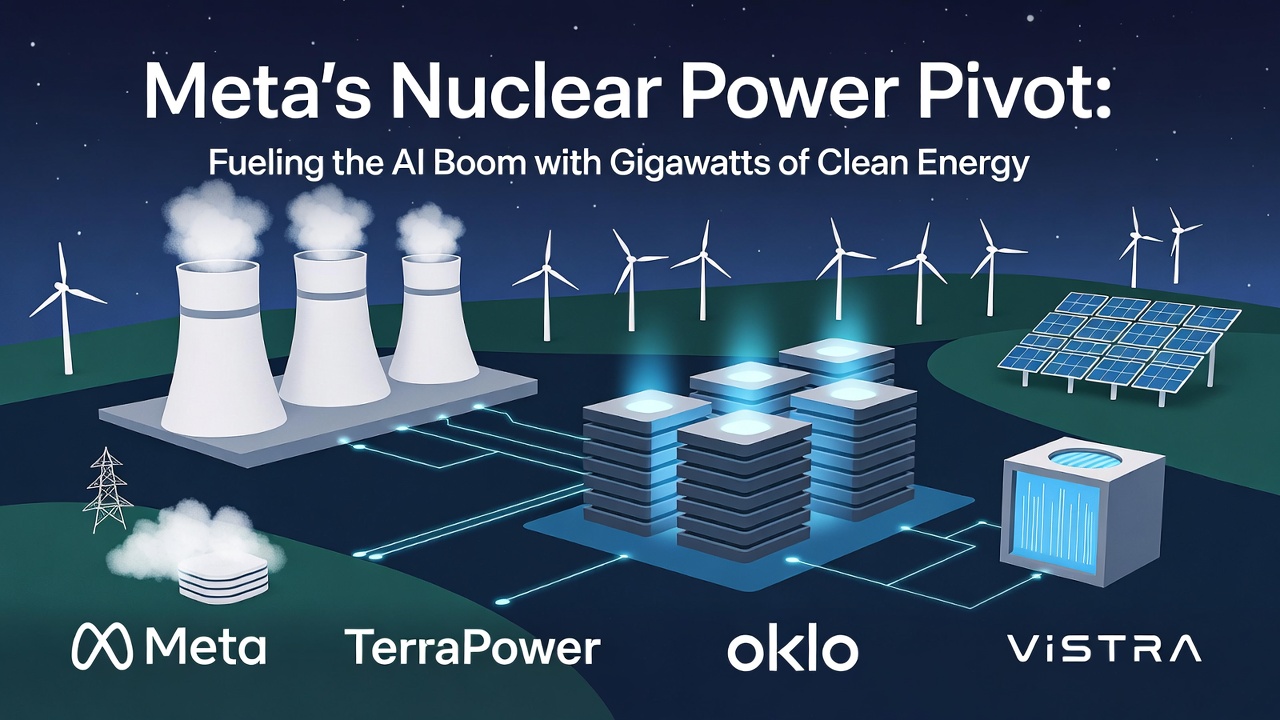
Meta Taps Nuclear to Fuel AI
This infographic directly illustrates the section’s core topic: Meta’s strategic 2026 pivot to nuclear power to satisfy the immense energy demands of artificial intelligence.
(Source: Quasa.io)
The Anchor Investment Model: De-Risking Billions in New Nuclear Capacity
Corporate financial commitments, structured as long-term offtake agreements, now function as powerful anchor investments that de-risk the massive capital requirements for first-of-a-kind (FOAK) advanced energy projects. Meta’s support for projects requiring an estimated $14 billion in new reactor investment provides the revenue certainty that has historically stalled new nuclear development, establishing a new public-private model for building next-generation energy infrastructure.
- The strategic purpose of these agreements is project enablement, not just simple procurement. By providing upfront funding and guaranteeing a multi-decade revenue stream, Meta gives developers like Terra Power and Oklo the bankability needed to secure billions in additional project finance and proceed with regulatory approvals.
- This investment model is timed to create synergy with government policy. The financial viability of these projects is significantly enhanced by U.S. policies like the Inflation Reduction Act’s (IRA) production and investment tax credits and the Department of Energy’s (DOE) Advanced Reactor Demonstration Program (ARDP).
- This approach transforms the role of the corporate buyer from a passive customer to an active market-maker. Unlike a venture investment for option value, Meta’s commitment is a full-scale execution play to build a captive energy supply chain and secure a primary input required for future growth.
Table: Key Commercial Agreements Driving the AI-Nuclear Nexus
| Partner / Project | Time Frame | Details and Strategic Purpose | Source |
|---|---|---|---|
| Meta / Vistra, Terra Power, Oklo | Jan 2026 | Portfolio of agreements for up to 6.6 GW of existing and new nuclear power. Secures baseload, 24/7 electricity for AI data centers via PPAs and direct development funding. | Reuters |
| Google / Kairos Power | Oct 2024 | Agreement to develop a 500 MW fleet of molten salt nuclear reactors to provide firm, clean power for Google’s data centers. | Power Magazine |
| Amazon / Next-Gen Nuclear Plant | Oct 2024 | Agreements to support a next-generation nuclear power plant in Washington state, securing clean energy for its data center operations. | Geek Wire |
| DOE / Terra Power | Pre-2024 | Initial $80 million in funding under the Advanced Reactor Demonstration Program (ARDP) to support the Natrium reactor demonstration project in Wyoming. | IN.gov |
US Heartland Emerges as 2026 AI Power Nexus Through Nuclear Revitalization
The geography of AI data center expansion is now determined by access to firm power, shifting development focus from renewable-rich areas to states like Ohio, Pennsylvania, and Wyoming that host existing nuclear assets or are primed for Small Modular Reactor (SMR) deployment at former fossil fuel sites.
- Prior to 2025, data center siting decisions were primarily driven by factors such as fiber connectivity, tax incentives, and proximity to large-scale solar or wind projects.
- The recent nuclear agreements reveal a new geographic logic. Meta’s Vistra PPA is tied directly to existing plants in Ohio and Pennsylvania. Its Oklo deal targets a new nuclear campus in Pike County, Ohio, while its Terra Power commitment follows the developer’s demonstration project in Kemmerer, Wyoming.
- This “brownfield-to-nuclear” strategy is highly strategic. Developing SMRs on the sites of former coal plants, a model actively explored by Vistra, leverages existing transmission infrastructure and a skilled local workforce, which helps accelerate project timelines and reduce costs.
- This dynamic is creating new economic hubs centered on energy availability. The future map of AI leadership will be drawn by regions with favorable nuclear policies and grid capacity, with areas like the Illinois AI data center market positioned for significant growth.
From Demonstration to Deployment: Meta’s Push to Commercialize Advanced Nuclear by 2030
Corporate offtake commitments are now the primary catalyst for pulling advanced reactor technologies across the commercial “valley of death, ” accelerating them from Technology Readiness Level (TRL) 6-7 (demonstration) to TRL 9 (full commercial operation) by the early 2030 s.
- Between 2021 and 2024, advanced reactors were largely confined to the R&D and demonstration stage, sustained by government funding like the DOE’s ARDP. Technologies from Terra Power and Oklo were at TRL 5-6, with the main barrier being the lack of a foundational customer to justify the expense of a commercial build.
- Meta’s 2026 agreements provide the crucial market signal to overcome this hurdle. The commitment enables Terra Power to advance from its Wyoming demonstration project to its first commercial units and allows Oklo to plan a multi-unit commercial campus.
- The technologies being accelerated offer unique capabilities for data centers. Terra Power’s Natrium® reactor, a sodium-cooled fast reactor, includes a molten salt energy storage system, allowing it to dispatch power flexibly to support the grid. Oklo’s Aurora powerhouse is a compact fast reactor suitable for on-site deployment.
- Significant risks remain in this transition from TRL 6 to TRL 9. Key challenges include navigating the U.S. Nuclear Regulatory Commission (NRC) licensing process for these novel designs and establishing a commercial supply chain for the High-Assay Low-Enriched Uranium (HALEU) fuel they require.
Forward Outlook: The 2026 Signals That Will Define the AI Energy Race
If hyperscale competitors replicate Meta’s strategy of underwriting new, firm power generation, watch for a rapid escalation in partnerships with nuclear, geothermal, and long-duration storage developers, signaling an industry-wide race to secure baseload capacity ahead of a looming grid-level constraint.
- What to Watch Next: The most critical leading indicators will be regulatory milestones from the NRC for Terra Power and Oklo. The successful issuance of construction permits and operating licenses for their first commercial reactors will be a major de-risking event and a strong positive signal for the entire sector.
- Monitor Project Economics: The Final Investment Decisions (FIDs) for the first SMRs backed by Meta will provide the first concrete data on all-in capital costs. This will validate or challenge the long-term economic model of using advanced nuclear to power AI.
- Track Competitor Responses: Monitor announcements from Amazon Web Services, Microsoft, and Google. Further large-scale commitments to firm power technologies beyond intermittent renewables would confirm that Meta’s move was not an outlier but the new standard for the industry.
- What Is Happening Now: The trend is solidifying. The smaller-scale nuclear deals from Google and Amazon in late 2024 served as precursors to Meta’s decisive, large-scale commitment in 2026, confirming the industry’s strategic direction. The primary bottleneck for AI growth is no longer compute, but power.
Frequently Asked Questions
Why are tech companies like Meta suddenly turning to nuclear power instead of just buying more solar and wind?
The shift is driven by the immense and constant power demands of AI infrastructure. While solar and wind are useful for meeting annual sustainability goals, they are intermittent. AI data centers require guaranteed 24/7 baseload power for operational uptime, a need that firm power sources like nuclear energy can meet. The strategy has moved from offsetting carbon credits to securing reliable electricity supply.
What is the ‘anchor investment’ model mentioned in the article?
The anchor investment model is where a large corporate buyer, like Meta, makes a long-term commitment to purchase power (an offtake agreement) from a new energy project that has not yet been built. This guaranteed revenue stream de-risks the project for developers, making it ‘bankable’ so they can secure the billions in additional financing needed for construction and regulatory approval. It effectively turns the corporate buyer into a project enabler.
What is Meta’s ‘barbell’ strategy for nuclear energy?
It’s a two-pronged approach to balance immediate needs with future growth. On one end (low-risk execution), Meta is buying 2.6 GW of power from Vistra Corp’s existing nuclear plants. On the other end (high-reward development), it is providing development funding and offtake commitments to help build new, advanced reactors from companies like Terra Power and Oklo, securing a long-term power supply.
Why is the US Heartland becoming a hub for AI and nuclear power?
The primary factor is access to firm power. States like Ohio and Pennsylvania have existing nuclear plants that can supply immediate energy. Additionally, these regions are ideal for deploying new Small Modular Reactors (SMRs) on the sites of former coal plants. This ‘brownfield-to-nuclear’ strategy leverages existing grid transmission infrastructure and a skilled local workforce, which can reduce costs and speed up project timelines.
What are the biggest challenges facing these new advanced nuclear projects backed by tech companies?
According to the article, two key risks are moving from demonstration to full commercial operation. The first is navigating the U.S. Nuclear Regulatory Commission (NRC) licensing process for novel reactor designs. The second major challenge is establishing a commercial supply chain for the High-Assay Low-Enriched Uranium (HALEU) fuel required by these advanced reactors.
