

Offshore Wind Pipeline, Ørsted Faces 2.6 GW Cancellation, Equinor & Total Energies Accept $1.7 B US Buyouts (2025-2026)
Offshore Wind Project Risks, Over 13 GW Canceled as Capital Costs and Political Risk Converge
The global offshore wind industry’s growth has stalled, caught between a global economic crisis of rising capital costs and a US-centric political crisis, leading to a wave of cancellations and delays that have removed at least 13 GW from the near-term pipeline. Before 2025, the sector was defined by ambitious expansion and falling costs. Now, developers face a dual threat: an economic model broken by inflation and an unstable policy environment that makes long-term, capital-intensive investments untenable.
- In the United States, the market reversed course abruptly in 2025 as the new administration began actively dismantling the project pipeline. This included unprecedented taxpayer-funded buyouts for developers like Invenergy and Total Energies, totaling nearly $1.7 billion, and issuing stop-work orders for projects already under construction, such as the 810 MW Empire Wind 1.
- In Europe, the crisis is economic rather than political. Offshore wind project costs surged by 30–50% in two years, forcing Ørsted to cancel its 2.6 GW Hornsea 4 project in the UK in May 2025. The developer cited high interest rates and supply chain challenges that made the project financially non-viable under its previously awarded contract.
- This instability has spread to emerging Asia-Pacific markets, signaling global contagion. Equinor systematically withdrew from the Australian market, abandoning over 2 GW of planned floating wind projects in 2025, while India’s inaugural 500 MW offshore wind tender failed in August 2025 due to a lack of developer interest.
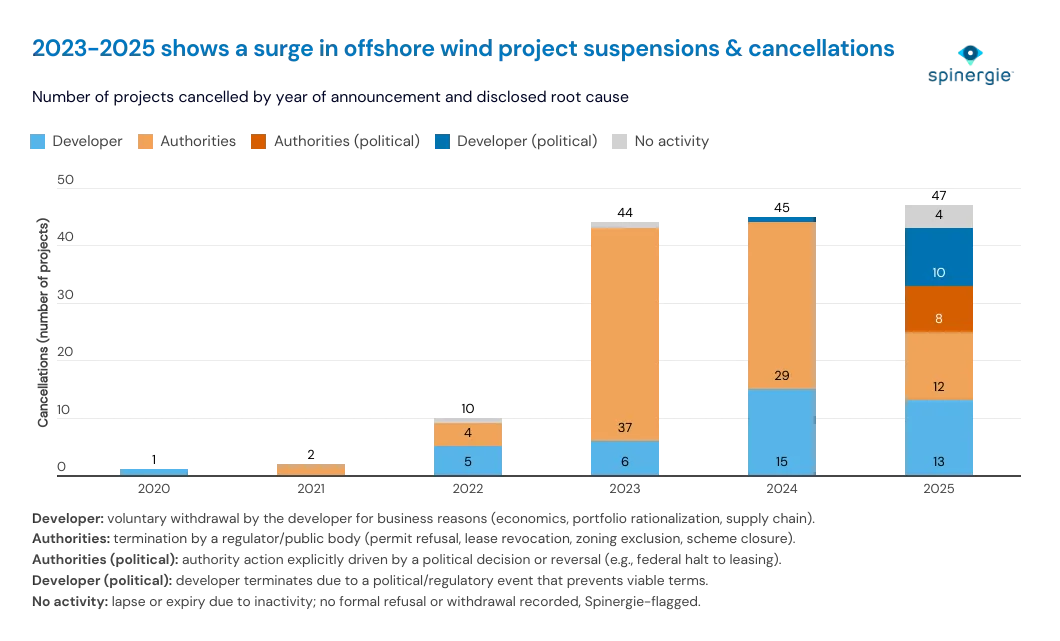
Offshore Wind Cancellations Surged from 2023-2025
The section heading explicitly mentions ‘Over 13 GW Canceled,’ and the chart’s headline, ‘Offshore Wind Cancellations Surged from 2023-2025,’ directly visualizes this trend, making it a perfect quantitative illustration for the section’s core topic of project risk and cancellations.
(Source: Spinergie)
$1.7 B+ in US Buyouts, Invenergy, Total Energies, and Golden State Wind Abandon Leases
Direct government intervention in the United States has become a primary driver of offshore wind cancellations, with over $1.7 billion in taxpayer-funded buyouts in 2026 alone systematically removing gigawatts of planned capacity from the West and East Coasts. These actions, driven by a policy shift away from renewables, create extreme uncertainty for any remaining projects and signal a hostile investment environment for the sector.
- In a landmark deal in March 2026, French energy giant Total Energies accepted a payment of $928 million to cancel its offshore wind leases off New York and North Carolina, announcing it would redirect the capital into US LNG and fossil fuel projects.
- The Department of the Interior paid Chicago-based Invenergy $765 million in June 2026 to abandon four of its early-stage offshore wind development leases in the New York Bight, Gulf of Maine, and off California, citing national security concerns.
- California’s nascent offshore wind ambitions were curtailed in June 2026 when the federal government paid $120 million to Golden State Wind, a joint venture of Ocean Winds and CPP Investments, to terminate its 2 GW floating wind project.
- These buyouts are compounded by stop-work orders issued in January 2026 that halted five large-scale projects already under construction, including Dominion Energy’s 2.6 GW Coastal Virginia Offshore Wind (CVOW) farm.
Table: Major Offshore Wind Cancellations and Halts (2025-2026)
| Project / Lease | Time Frame | Details and Strategic Purpose | Source |
|---|---|---|---|
| Invenergy US Leases | Jun 2026 | The U.S. administration paid $765 million to buy out four development leases amid a policy shift away from renewables. | The New York Times |
| Total Energies US Leases | Mar 2026 | Accepted a buyout of nearly $1 billion to abandon its offshore wind leases; the company redirected the capital to US fossil fuel projects. | Reuters |
| Mona & Morgan Projects (En BW) | Jan 2026 | German utility En BW canceled its UK Irish Sea projects, leading to a €1.2 billion impairment due to financial unviability. | En BW |
| Revolution Wind (Ørsted & Eversource) | Aug 2025 | The 704 MW project was halted by a federal stop-work order when it was 80% complete with $4 billion already invested. | Associated Press |
| Novocastrian Floating Wind (Equinor) | Aug 2025 | Equinor pulled out of the 2 GW Australian floating wind farm project after rejecting the government’s feasibility license. | offshorewind.biz |
| Atlantic Shores (Shell & EDF) | Jun 2025 | The developer terminated its OREC agreement for the 1, 510 MW New Jersey project, citing market uncertainty from federal policy. | Utility Dive |
| Hornsea 4 (Ørsted) | May 2025 | Ørsted discontinued its 2.6 GW UK project, citing adverse macroeconomic conditions, supply chain costs, and high interest rates. | Reuters |
US vs Europe, Ørsted Navigates Divergent Risks in Key Offshore Wind Markets
The drivers for offshore wind project cancellations have diverged sharply by region, with the United States market destabilized by targeted political risk while European projects crumble under severe economic pressure. This bifurcation of threats requires developers to adopt entirely different risk mitigation strategies for each market, complicating global investment decisions.
- United States: The market shifted from ambitious growth between 2021 and 2024 to active deconstruction from 2025 onward. Federal buyouts and project halts have directly targeted key developers like Ørsted and Equinor in states like New York, New Jersey, and Virginia, making political risk the primary barrier to investment.
- United Kingdom: Once the global leader, the UK market faces a crisis of confidence after the cancellation of Ørsted’s 2.6 GW Hornsea 4 and En BW’s Mona and Morgan projects. These events prove the country’s Contract for Difference (Cf D) auction model is not resilient to current levels of cost inflation.
- Germany: The German government acknowledged the untenable market conditions by proactively delaying 2.5 GW of offshore wind auctions, originally scheduled for 2026, until at least 2027. The move is intended to provide time to recalibrate auction designs to account for higher project costs.
- Asia-Pacific: The region is experiencing strategic retreats from European majors. Equinor’s abandonment of multiple Australian floating wind projects and a Mitsubishi-led consortium’s exit from projects in Japan indicate that high costs are making these emerging markets too risky without stronger local support.
Offshore Wind Commercial Viability Undermined by Cost Inflation and Policy Reversals
While the technology for both fixed-bottom and floating offshore wind is mature and proven at scale, its commercial viability has been severely undermined by macroeconomic and political shocks that have broken established financial models. The industry’s challenge is no longer technological but economic, as cost inflation has outpaced the revenue structures of existing power purchase agreements and auction frameworks.
- Between 2021 and 2024, the industry focused on scaling up proven fixed-bottom technology and advancing floating wind toward commercialization, benefiting from a steadily declining Levelized Cost of Energy (LCOE).
- From 2025, the narrative shifted from technological progress to economic survival. The LCOE for offshore wind spiked by 52% from its 2020 lows, erasing a decade of cost reductions and making new projects unbankable under legacy contract terms.
- The cancellation of the late-stage 2.6 GW Hornsea 4 project and the halting of the nearly complete 704 MW Revolution Wind project demonstrate that even technologically sound projects are not immune to financial and political headwinds.
- The failure of India’s first tender and Equinor’s exit from Australian floating wind projects suggest that next-generation technologies face a challenging path to commercial scale without stronger government support and financial de-risking mechanisms.
SWOT Analysis: Offshore Wind Sector Faces Economic and Political Headwinds
The offshore wind sector’s core strength in providing large-scale, carbon-free power is being directly challenged by severe weaknesses in its economic model and acute external threats from policy instability. This has created a high-risk environment where opportunities for recalibration exist but are contingent on urgent government and industry action.
Table: SWOT Analysis for the Offshore Wind Sector (2021-2026)
| SWOT Category | 2021 – 2024 | 2025 – 2026 | What Changed / Validated |
|---|---|---|---|
| Strengths | Proven technology for large-scale decarbonization; falling LCOE attracted significant investment. | Technology remains mature and capable of generating gigawatts of clean power with high capacity factors. | The technology’s capability was never in doubt, but its economic resilience was overestimated. |
| Weaknesses | Long project timelines and high CAPEX were seen as manageable risks in a low-interest-rate environment. | Vulnerability to supply chain inflation and interest rate hikes became critical flaws, making projects unprofitable. | The sector’s reliance on stable, low-cost financing and predictable supply chains was validated as a core weakness. |
| Opportunities | Expansion into new markets (Asia, US); developing green hydrogen offtake agreements. | Redesigning auctions with inflation indexation; repowering older sites; focus on politically stable markets. | The crisis created an urgent opportunity to fix flawed contract structures and prioritize resilient markets over pure growth. |
| Threats | Permitting delays and local opposition were the primary concerns for developers. | Hostile government policy (US buyouts), sustained high inflation, and competition from cheaper technologies like solar and BESS. | The threat landscape shifted from operational hurdles to existential political and economic risks. |
Ørsted and Equinor 2026 Scenario: Navigating a Market Reset in Offshore Wind
The critical path forward for offshore wind developers in 2026 involves a strategic retreat to core, de-risked markets and intense pressure on governments to reform contract structures to account for inflation and political risk. The era of speculative, large-scale expansion has ended, replaced by a focus on project-level economic resilience.
- If policy and cost pressures persist: Expect further project cancellations and a “flight to quality, ” with developers like RWE, Ørsted, and Equinor consolidating investments in a few select markets with the most favorable and stable regulatory regimes. This will lead to a more concentrated, less global, offshore wind industry.
- Watch for government response: The key signal for a potential recovery will be how governments in the UK and Europe redesign their 2026 and 2027 auction rounds. The inclusion of inflation indexation, supply chain development criteria, or other non-price factors will determine if private capital returns.
- This could be happening now: Developers are likely renegotiating supply chain contracts and indefinitely delaying Final Investment Decisions (FIDs) on projects in the “uncertain” category shown in market analyses. The large volume of capacity under review indicates widespread capital discipline and a pipeline that is shrinking, not growing.
The questions your competitors are already asking
This report covers one angle of the current downturn in the global offshore wind market. The questions that matter most depend on your work.
- Which US offshore wind projects are still viable
- UK offshore wind auction reform inflation indexation
- Orsted and Equinor new investment strategy after cancellations
- Offshore wind supply chain bottlenecks and new contracts
This report does not answer these. Enki Brief Pro does.
Your question, your angle, your framework. SWOT, PESTL, scenario modelling. The same niche depth, built around the decision your work actually depends on.
