

AWS Solar Strategy 2025-2026: From Mega-Consumer to Energy Asset Owner
Amazon Web Services (AWS) has fundamentally evolved its solar and clean energy strategy, moving from its established role as a passive, large-scale procurer to an active developer and direct owner of energy infrastructure. This strategic pivot is driven by the immense power requirements of cloud computing and artificial intelligence. The company is no longer just buying renewable energy credits; it is directly investing billions to build a green energy supply chain in parallel with its global data center expansion, ensuring that power availability does not constrain its growth.
AWS Commercial Adoption Shifts to Direct Infrastructure Investment 2026
AWS has shifted its industry adoption model from primarily securing its own power supply through third-party Power Purchase Agreements (PPAs) to directly shaping energy markets by co-locating generation with data centers and acquiring major energy assets.
- Between 2021 and 2024, AWS cemented its position as the world’s largest corporate buyer of renewable energy by accumulating a massive portfolio of over 500 projects, primarily through PPAs with partners like Brookfield and AES, reaching a total capacity exceeding 20 GW.
- The period from 2025 to 2026 marks a clear pivot toward direct infrastructure investment. This is evidenced by the $12 billion commitment to build data centers in Louisiana, a plan that includes AWS funding the development of 200 MW of new local solar projects to support the grid.
- A landmark event in January 2026 was AWS‘s acquisition of the Sunstone project in Oregon, a shovel-ready facility with a proposed capacity of 1.2 GW of solar and 1.2 GW of battery storage. This transaction signals a definitive move from being a tenant in the energy market to an asset owner.
- This evolution from procurement to ownership allows AWS to exert greater control over energy supply, de-risk project development timelines, and capture more value, creating a resilient energy backbone for its power-intensive AI and cloud operations.
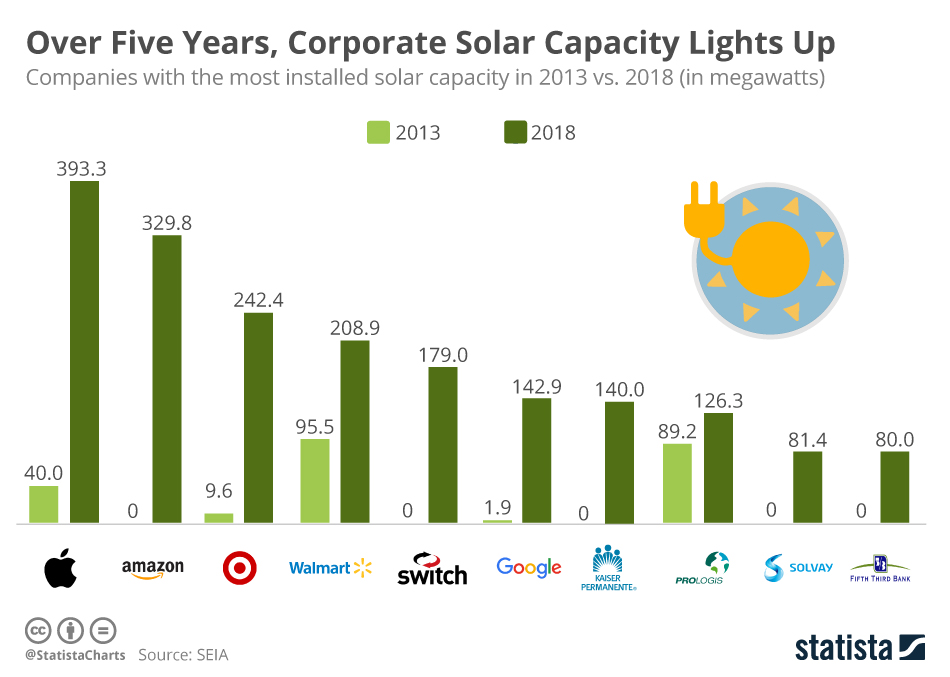
Amazon’s Rapid Rise in Corporate Solar
This chart illustrates Amazon’s significant growth in installed solar capacity between 2013 and 2018, providing historical context for its emergence as a major corporate buyer of renewable energy.
(Source: Statista)
AWS Energy Investment Strategy: Billions in Direct Capital Outlays
AWS‘s investment strategy has escalated from funding renewable projects via indirect PPAs to direct, multi-billion-dollar capital commitments for data centers explicitly tied to new energy generation and asset ownership.
- The 2025-2026 period is defined by massive, targeted capital outlays, including the $12 billion commitment in Louisiana and an AU$20 billion investment in Australia. Both initiatives directly link data center construction to the development of new, dedicated solar farms.
- This approach contrasts with the 2021-2024 period, which was characterized by broader portfolio growth (adding over 100 new projects in 2023 alone) and venture-style investments in climate tech startups through its $2 billion Climate Pledge Fund.
- The acquisition of the Sunstone project in January 2026 serves as the prime example of this strategic shift, moving capital from contractual agreements to direct control of physical energy infrastructure.
- Furthermore, the company diversified its energy investments beyond solar, committing over $500 million to support the development of Small Modular Reactors (SMRs) with X-energy in 2024, a strategy that intensified in 2025 with an $18 billion nuclear PPA with Talen Energy.
Table: Select AWS Clean Energy and Data Center Investments (2024-2026)
| Partner / Project | Time Frame | Details and Strategic Purpose | Source |
|---|---|---|---|
| Sunstone Project Acquisition | Jan 2026 | Direct acquisition of a 1.2 GW solar and 1.2 GW battery storage project in Oregon, marking a strategic shift to asset ownership. | Data Center Dynamics |
| Louisiana Data Centers | Feb 2026 (Announced) | $12 Billion investment in new data center campuses, supported by 200 MW of new solar projects funded by AWS to reinforce the local grid. | PYMNTS |
| Australian Data Infrastructure | Jun 2025 (Announced) | AU$20 Billion investment by 2029 to expand data centers, supported by the development of three new solar farms. | Taiyang News |
| Mississippi Solar Projects | May 2024 | Investment to support 650 MW of new solar projects to power new data centers in Mississippi. | Chain Store Age |
| Singapore Cloud Infrastructure | May 2024 | S$12 Billion (approx. $9 B USD) investment into Singapore cloud infrastructure, powered by renewable energy. | About Amazon |
AWS Partnerships Evolve into Symbiotic Technology Alliances
AWS‘s partnerships have evolved from transactional PPAs to deeper, symbiotic collaborations where it acts as both a major energy offtaker and a critical technology provider to the same energy companies, creating a powerful circular business model.
- This dual-role model was established between 2021 and 2024 through agreements with utilities like Duke Energy and energy majors like Repsol and Total Energies, where AWS exchanged cloud services for renewable power.
- From 2025 onwards, this strategy scaled dramatically. The strategic collaboration with RWE includes a 1.1 GW PPA in the U.S. and a new offshore wind deal in Germany, while AWS provides cloud technology to optimize RWE‘s energy trading and asset management.
- The partnership model now includes enabling new market structures, demonstrated by AWS serving as the anchor offtaker for South Africa’s first multi-buyer solar wheeling project with developer SOLA in October 2025.
- Significantly, AWS has diversified its energy mix through partnerships beyond solar. A landmark 17-year, $18 billion PPA with Talen Energy for 1, 920 MW of nuclear power, signed in June 2025, underscores its pursuit of 24/7 carbon-free baseload energy.
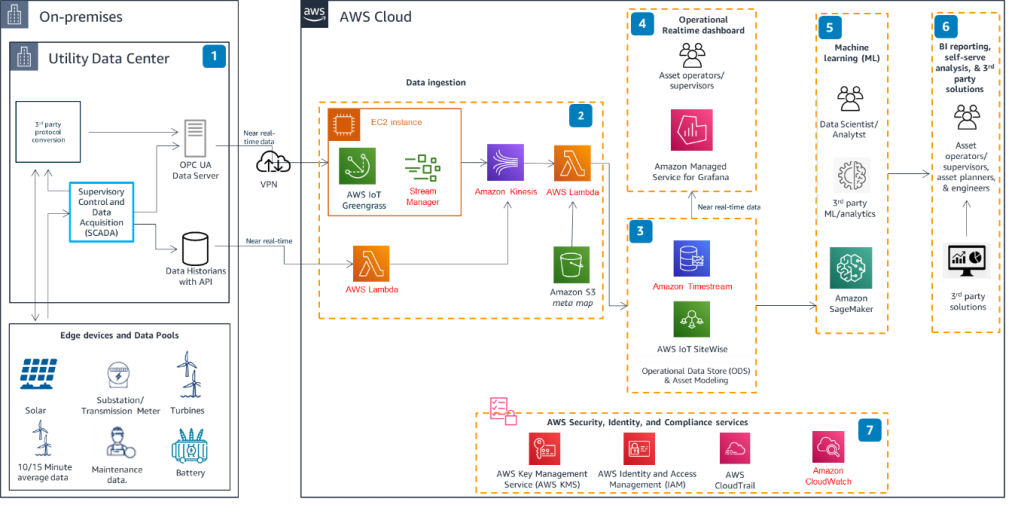
AWS’s Technology Stack for Energy Partners
This diagram details the AWS cloud services used for energy asset management, visually explaining the critical technology provider role AWS plays in its symbiotic partnerships with energy companies.
(Source: AWS)
Table: Select AWS Clean Energy Partnerships (2024-2026)
| Partner / Project | Time Frame | Details and Strategic Purpose | Source |
|---|---|---|---|
| JERA | Feb 2026 | Collaboration to integrate AWS digital technologies with JERA‘s renewable and low-carbon thermal assets to create a more efficient energy supply platform. | JERA |
| RWE | Jun 2025 – Feb 2026 | Strategic collaboration including 1.1 GW of PPAs in the U.S. and a 110 MW offshore wind PPA in Germany, while RWE uses AWS cloud for digital innovation. | RWE |
| Talen Energy | Jun 2025 | A 17-year, $18 billion PPA to secure 1, 920 MW of carbon-free nuclear power for reliable, 24/7 baseload energy for data centers. | Power Magazine |
| Bord na Móna | Apr 2025 | AWS became the first business to join the Eco-Energy Park in Ireland, creating a path to power data centers with co-located wind and solar. | Bord na Móna |
| Iberdrola | Feb 2025 | Expanded global partnership with 476 MW of new solar and wind PPAs in Spain and Portugal. | Iberdrola |
AWS Geographic Focus: North America and Australia Lead Mega-Project Development
While maintaining a global procurement strategy, AWS has concentrated its most significant recent energy infrastructure investments in North America and Australia to directly support massive new data center build-outs in those regions.
- The 2021-2024 period involved broad global diversification to build its initial 20 GW portfolio, with projects announced across the U.S., Canada, Spain, Sweden, the UK, India, and Japan to match its distributed operational footprint.
- From 2025, the focus has shifted to targeted, capital-intensive mega-projects in specific geographies. North America is the clear epicenter, with the 1.2 GW Sunstone project in Oregon, the $12 billion data center and solar plan in Louisiana, and a 450 MW solar deal in California.
- Australia has emerged as another key hub, with AWS committing AU$20 billion for data center expansion supported by three new solar farms in Victoria and Queensland.
- Europe remains a core market for procurement, evidenced by a 2026 offshore wind PPA in Germany with RWE and a 2025 agreement in Ireland with Bord na Móna, but the largest direct capital outlays for co-located generation are occurring elsewhere.
AWS Technology Maturity: AI-Driven Optimization and Nuclear Integration
AWS has advanced its solar strategy from procurement and basic integration to deploying and commercializing sophisticated AI-driven energy management systems, while also diversifying into firm, carbon-free power sources like nuclear to ensure 24/7 reliability.
- Between 2021 and 2024, AWS‘s technological focus was on scaling its portfolio and pioneering the integration of solar with battery storage, announcing projects like a 300 MW solar plus 150 MW storage facility in Arizona and beginning to apply machine learning.
- By 2025-2026, this approach matured significantly. AWS now deploys its own AI software at solar installations like Baldy Mesa, California, to analyze over 33 billion data points annually for performance optimization and grid stability.
- The company is now externalizing these capabilities, offering a grid modernization platform through “AWS for Energy” that positions it as a key technology vendor to the utility sector.
- The decisive move into nuclear energy, validated by the massive Talen Energy PPA and investments in SMRs, confirms that AWS recognizes intermittent solar and wind alone are insufficient to meet the 24/7 power demands of its AI-focused data centers.

AWS’s AI-Powered Energy Management Architecture
This architecture diagram is a direct visual representation of the section’s theme, showing how AWS uses AI and cloud services for sophisticated energy optimization and management.
(Source: AWS – Amazon.com)
AWS Solar Strategy SWOT Analysis
AWS successfully leveraged its massive scale to turn a potential weakness (extreme energy consumption) into a strategic strength (market-shaping procurement power), but now faces new operational complexities and financial risks associated with its pivot to direct asset ownership and a more diverse energy portfolio.
- Strengths have evolved from pure procurement scale to include in-house technological prowess in AI-driven energy management and direct control over key energy assets.
- Weaknesses related to reliance on intermittent renewables are being actively mitigated by massive investments in firm power sources like nuclear energy.
- Opportunities are expanding from securing its own power to commercializing its energy management technology and capturing greater financial value through direct asset ownership.
- Threats now include not just grid constraints but also the direct development, construction, and operational risks associated with owning some of the world’s largest energy projects.
Table: SWOT Analysis for AWS Solar and Clean Energy Strategy
| SWOT Category | 2021 – 2024 | 2025 – 2026 | What Changed / Validated |
|---|---|---|---|
| Strengths | Unmatched procurement scale as the world’s largest corporate buyer of renewables; strong financial position to sign large, long-term PPAs. | Direct control over key assets (Sunstone project); in-house AI for energy optimization; symbiotic tech partnerships (RWE, JERA). | The strategy shifted from leveraging buying power to leveraging operational and technological expertise, creating a more defensible market position. |
| Weaknesses | Extreme energy demand for data centers; reliance on intermittent solar and wind, creating potential for supply gaps. | Massive and growing power needs fueled by AI; increased capital exposure and operational complexity from direct asset ownership. | The core weakness of energy demand has intensified, but the reliance on intermittency is being directly addressed through nuclear and large-scale storage. |
| Opportunities | Securing long-term, fixed-price energy to hedge against volatile fossil fuel markets; building a green brand reputation. | Commercializing energy management AI as a service; capturing development profits from owned assets; shaping grid modernization policies. | Opportunities have matured from cost control and branding to creating new, high-margin revenue streams from its energy expertise. |
| Threats | Grid congestion and slow interconnection queues delaying projects; reputational risk from “greenwashing” accusations. | Project development and construction risks; direct exposure to energy market volatility for unhedged assets; increased regulatory scrutiny. | Threats have shifted from third-party project delays to the direct financial and execution risks inherent in becoming a major energy developer. |
Forward-Looking Insights: Executing on Asset Ownership and 24/7 Carbon-Free Power
For the remainder of 2026 and beyond, AWS‘s primary strategic focus will be on executing its direct development and asset ownership strategy while aggressively securing the firm, 24/7 carbon-free power required to ensure its AI expansion is not constrained by grid limitations.
- Expect AWS to pursue more direct acquisitions of shovel-ready solar and storage sites or enter into co-development partnerships, replicating the blueprint of the 1.2 GW Sunstone project to gain greater control over its energy supply chain.
- Watch for further major commitments in non-intermittent clean energy. The $18 billion nuclear PPA with Talen Energy is likely a precursor to more deals in nuclear, geothermal, or green hydrogen to complement its vast but intermittent solar and wind portfolio.
- Monitor the formal launch of new “AI-as-a-Service” products aimed at the energy sector. Having perfected its optimization algorithms on its own assets, AWS is positioned to monetize this technology by selling it to utilities and other large energy producers.
- Anticipate AWS taking a more vocal role in advocating for policies that accelerate grid modernization and streamline permitting. As a direct investor in grid infrastructure, its incentives are now fully aligned with utilities in overcoming these systemic bottlenecks.
Frequently Asked Questions
What is the biggest change in AWS’s energy strategy for 2025-2026?
The biggest change is a strategic pivot from being the world’s largest corporate buyer of renewable energy through third-party contracts (PPAs) to becoming a direct investor, developer, and owner of energy assets. This shift is highlighted by the acquisition of the 1.2 GW Sunstone solar and battery project.
Why is AWS investing billions to own its own power projects instead of just buying energy?
AWS is investing directly in energy infrastructure to secure the massive amount of power needed for its expanding data centers and AI operations. This ownership model gives AWS greater control over its energy supply, de-risks project development timelines, ensures power availability doesn’t constrain its growth, and allows it to capture more financial value.
Is AWS only investing in solar power?
No. While solar is a major part of the strategy, AWS recognizes that intermittent renewables alone cannot meet the 24/7 power demands of its data centers. The company is diversifying into firm, carbon-free power sources, evidenced by a landmark 17-year, $18 billion PPA for nuclear power with Talen Energy and investments in offshore wind.
What is a key example of AWS’s new direct investment strategy?
A key example is the acquisition of the Sunstone project in Oregon in January 2026. This is a shovel-ready facility with a proposed capacity of 1.2 GW of solar and 1.2 GW of battery storage. This transaction marks a definitive move from being a contractual buyer to a physical asset owner.
How is AWS using its own technology, like AI, in its energy strategy?
AWS is deploying its own AI and machine learning software at its solar installations to optimize performance and enhance grid stability, analyzing billions of data points to improve efficiency. It is also externalizing this capability, offering a grid modernization platform as a service to the broader energy sector, turning its internal solution into a commercial product.
Experience In-Depth, Real-Time Analysis
For just $200/year (not $200/hour). Stop wasting time with alternatives:
- Consultancies take weeks and cost thousands.
- ChatGPT and Perplexity lack depth.
- Googling wastes hours with scattered results.
Enki delivers fresh, evidence-based insights covering your market, your customers, and your competitors.
Trusted by Fortune 500 teams. Market-specific intelligence.
Explore Your Market →One-week free trial. Cancel anytime.
