

Automaker Pivot to Hybrids 2026: How Production Shifts Expose EV Market Risks
Industry Adoption: Automakers Pivot from BEV-Only Push to Hybrid Production Scale-Up
Major automakers are executing a significant strategic pivot away from aggressive, battery-electric-vehicle-only roadmaps to a more balanced approach that re-prioritizes hybrid vehicle production. This shift is a direct response to slowing BEV demand growth, consumer price sensitivity, and the superior profitability of mature hybrid platforms. The 2026 strategy now reflects a market correction, with legacy manufacturers emulating Toyota’s long-standing, profitable “multi-pathway” approach to meet immediate consumer needs while funding future electrification.
- Between 2021 and 2024, the dominant industry narrative focused on catching Tesla, leading legacy automakers like Ford and GM to announce massive capital allocations exclusively for BEV development and new EV-only plants. During this period, Toyota’s more cautious stance and continued investment in hybrids were often criticized as lagging.
- The period from 2025 to today has validated Toyota’s strategy, as the market realities of high BEV costs and charging infrastructure gaps became clear. Ford is now actively reinvesting in hybrid production after taking an $8.5 billion hit from canceled EV models, a clear signal of the broader industry course correction.
- Toyota is aggressively capitalizing on this trend by making its most popular models hybrid-exclusive. The 2025 Toyota Camry is now only available as a hybrid, and the top-selling 2026 Toyota RAV 4 will be offered solely as a hybrid or plug-in hybrid, directly aligning its highest-volume production with the strongest market demand.
- This hybrid boom is not merely a transitional phase but a core profit engine. In 2025, electrified vehicles, predominantly hybrids, accounted for over 50% of Toyota’s U.S. sales. This success is funding a planned 30% increase in hybrid and PHEV production from its 2026 target, aiming for 6.7 million units by 2028.
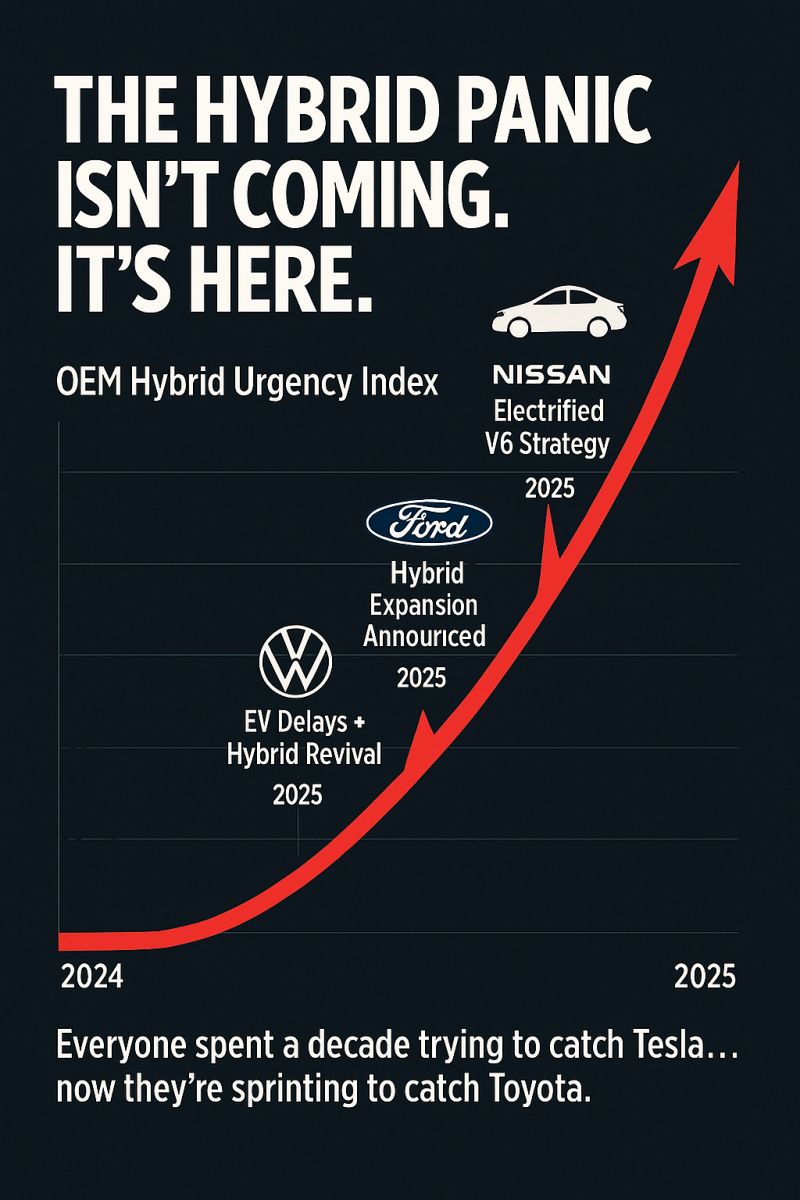
Automakers Urgently Pivot Towards Hybrid Vehicles
This chart’s ‘OEM Hybrid Urgency Index’ directly visualizes the strategic pivot away from BEV-only plans towards hybrids, which is the core topic of this section.
(Source: EnkiAI)
Investment and Cancellations: Capital Shifts from Pure-EV Bets to Profitable Hybrid Manufacturing
Capital allocation across the automotive sector is shifting decisively toward expanding hybrid production capacity, a move underscored by Toyota’s multi-billion-dollar investments in its North American manufacturing footprint. This contrasts sharply with the significant financial losses and project cancellations reported by competitors who over-invested in a BEV market that has not matured as quickly as anticipated. The data shows a clear trend of rewarding proven, profitable hybrid technology with new capital while pure-EV ventures face greater scrutiny and financial headwinds.
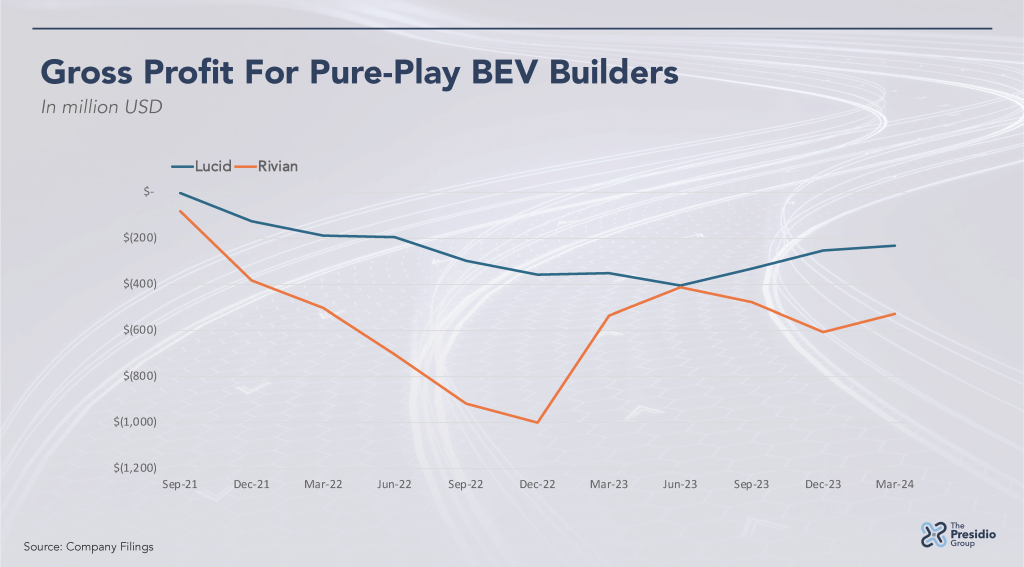
Pure-Play EV Makers Report Deep Financial Losses
This chart illustrates the ‘significant financial losses’ incurred by pure-play EV competitors, contrasting their performance with the profitable hybrid strategy mentioned in the text.
(Source: The Presidio Group |)
- Toyota’s recent investments are strategically targeted to boost hybrid component and vehicle assembly in North America, its most profitable market. A $1.1 billion retooling of its Ontario, Canada plants is dedicated to the all-hybrid 2026 Toyota RAV 4, while a separate $912 million investment announced in November 2025 expands advanced powertrain and hybrid vehicle assembly across five U.S. plants.
- This strategic capital deployment follows a period where competitors focused heavily on BEVs. The financial consequence of that earlier strategy is now apparent, with Ford reporting substantial losses on its EV division, validating the risk of a single-pathway approach to electrification.
- The scale of Toyota’s commitment is substantial, including a cumulative $13.9 billion investment in its North Carolina battery plant, which will supply batteries for both hybrids and its future BEVs. This facility underpins the entire “multi-pathway” strategy by securing a domestic supply chain for all forms of electrification.
Table: Toyota’s Strategic Investments in North American Hybrid Production
| Investment Value (USD) | Time Frame | Location & Project Details | Source |
|---|---|---|---|
| $1.1 Billion | Jan 2026 | Retooling plants in Ontario, Canada (TMMC) to produce the all-hybrid 2026 Toyota RAV 4. This modernizes and focuses one of its key North American facilities on its best-selling, highest-demand electrified model. | Reuters |
| $912 Million | Nov 2025 | Boosting advanced powertrain production and expanding hybrid assembly across five U.S. plants in West Virginia, Kentucky, Mississippi, Tennessee, and Missouri. This investment creates 252 jobs and strengthens the U.S. supply chain for hybrid components. | Toyota Pressroom |
| $71.4 Million | Nov 2025 | Expansion of the Jackson, TN plant to increase production of hybrid transaxle cases, housings, and engine blocks, directly supporting the broader hybrid vehicle production ramp-up. | Wards Auto |
| $8 Billion (Additional) | Oct 2023 | A massive expansion of the Liberty, North Carolina battery plant, bringing the total investment to $13.9 billion. This secures a large-scale domestic source of batteries for both HEVs and future BEVs, central to Toyota’s long-term strategy. | Toyota Pressroom |
Partnership Analysis: Toyota De-Risks Future Tech with Strategic Alliances
Toyota is leveraging a network of strategic partnerships to secure its leadership across its entire “multi-pathway” portfolio, mitigating risks in both current and future technologies. While competitors focused on vertical integration for BEVs, Toyota’s collaborative approach accelerates development, shares costs, and ensures access to critical technologies, from next-generation engines for hybrids to solid-state batteries and hydrogen fuel cells for its future zero-emission vehicles.
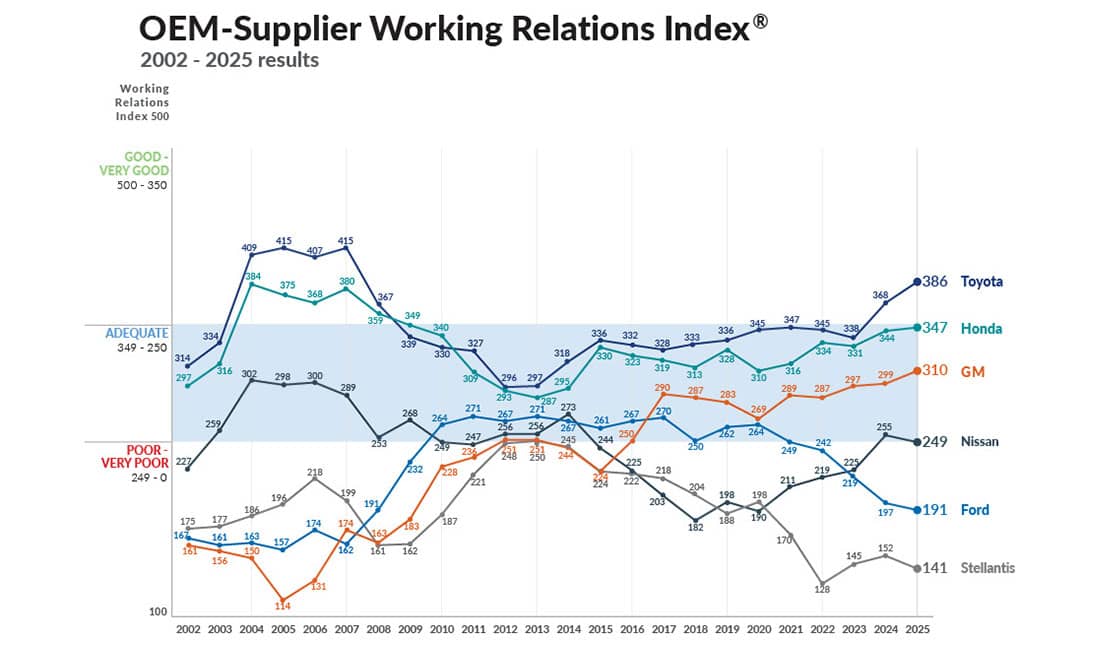
Toyota Consistently Leads Industry in Supplier Relations
This chart quantifies Toyota’s leadership in supplier and partner relations over two decades, directly supporting the section’s analysis of its strong strategic alliances.
(Source: EnkiAI)
- For its near-term hybrid and ICE strategy, Toyota announced in May 2024 a joint effort with Mazda and Subaru to develop new, more efficient engines optimized for hybrid powertrains and carbon-neutral fuels. This alliance ensures its core combustion technology remains competitive while it develops BEVs.
- To accelerate its BEV ambitions, Toyota is collaborating with Subaru to co-develop three new electric vehicle models by 2026. In China, it has formed alliances with tech giants like Huawei and Xiaomi to fast-track development of in-car AI and autonomous driving features, addressing a key competitive gap.
- In future-facing technologies, Toyota is strengthening its long-standing partnership with BMW Group on hydrogen fuel cell development, targeting heavy-duty transport. It is also a key investor in Joby Aviation, applying its manufacturing expertise to the production of electric vertical take-off and landing (e VTOL) aircraft.
- To build a circular battery economy, Toyota initiated a collaboration with Redwood Materials in June 2022. This partnership focuses on recycling end-of-life batteries from its hybrids and creating a closed-loop system to supply materials for new battery production, a critical component for long-term sustainability and cost control.
Table: Key Strategic Partnerships Supporting Toyota’s Multi-Pathway Strategy
| Partner / Project | Time Frame | Details and Strategic Purpose | Source |
|---|---|---|---|
| Huawei, Xiaomi, Momenta | Jun 2025 | Alliances with Chinese tech leaders to accelerate development of software, AI, and autonomous driving systems for the competitive Chinese market. This addresses Toyota’s need to catch up in software-defined vehicle technology. | Inside China Auto |
| Mazda, Subaru | May 2024 | Joint development of smaller, more efficient engines designed to be integrated with hybrid systems and compatible with carbon-neutral fuels. This allows for shared R&D costs and continued innovation in core powertrain technology. | Wards Auto |
| BMW Group | Sep 2024 | Strengthened collaboration to advance and commercialize hydrogen fuel cell electric vehicles (FCEVs). This partnership leverages BMW’s luxury market access and Toyota’s deep FCEV expertise to target future mobility segments. | Toyota Global Newsroom |
| Redwood Materials | Jun 2022 | Collaboration to create a closed-loop battery ecosystem. Redwood Materials will recycle batteries from Toyota’s first-generation hybrids to supply cathode and anode materials for new battery production at its North Carolina plant. | Toyota Pressroom |
Geography: North America Emerges as the Epicenter of the 2026 Hybrid Boom
North America has become the primary market where the strategic value of a hybrid-heavy portfolio is most evident, with consumer preferences and targeted investments confirming the region’s central role. While regulatory pressures for ZEVs exist globally, the U.S. and Canadian markets are demonstrating a powerful, consumer-driven demand for practical and affordable electrified options, making them the main battleground where Toyota’s strategy is generating significant market share and profits.
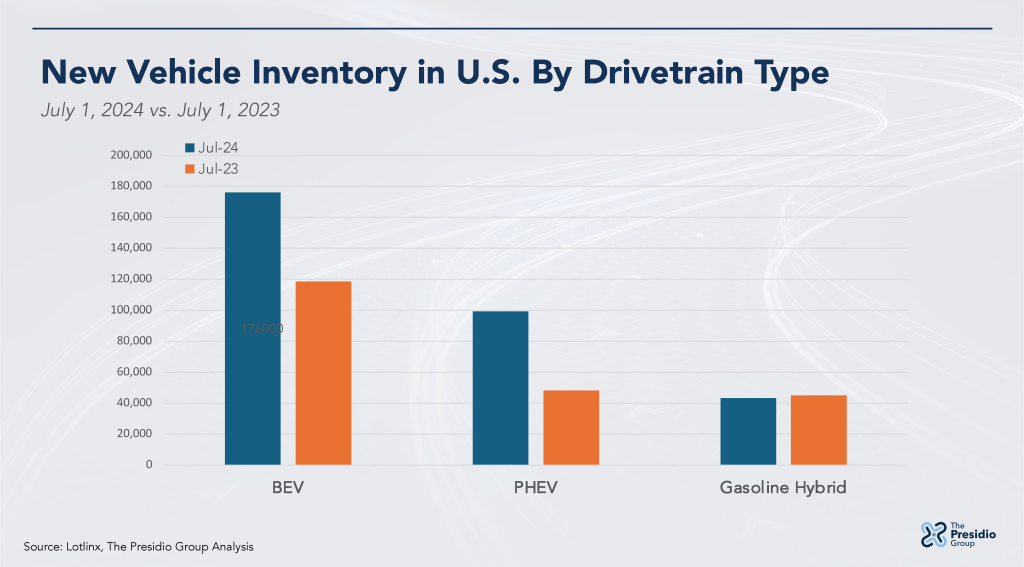
US BEV Inventories Surge Amidst Tight Hybrid Supply
This chart’s U.S. inventory data provides concrete evidence for the consumer demand dynamics in North America, confirming the region as the ‘epicenter’ of the hybrid boom.
(Source: EnkiAI)
- In the period from 2021-2024, much of the global focus was on Europe’s and China’s aggressive EV adoption policies. North America was seen as a key growth market for BEVs, but consumer adoption began to lag behind ambitious forecasts.
- Beginning in 2025, the trend reversed sharply. In Canada, full hybrid market share surged to 12.9%, overtaking the entire zero-emission vehicle (ZEV) segment for the first time. The launch of the Canadian-built, all-hybrid 2026 RAV 4 is expected to push partially electrified models to nearly 60% of Toyota’s sales in the country.
- In the U.S., the shift is equally dramatic. Hybrid sales for Toyota surged 66% year-over-year, and by late 2025, electrified models (mostly hybrids) constituted nearly half of the company’s U.S. sales. This demand is concentrated in the mainstream segments that competitors targeting only high-end BEVs have overlooked.
- Toyota’s investment strategy directly reflects this geographic focus. The $1.1 billion Canadian retooling and the $912 million investment across five U.S. states are squarely aimed at increasing North American production capacity for hybrids, ensuring supply can meet the surging regional demand.
Technology Maturity: TRL 9 Hybrids Outperform Developing BEV Ecosystems in Reliability and Cost
The current market validates the commercial superiority of mature, reliable technology over platforms that are still resolving fundamental cost, infrastructure, and reliability challenges. Toyota’s hybrid system, a Technology Readiness Level (TRL) 9 platform refined over two decades, offers proven reliability and affordability that the less mature TRL 7-8 BEV ecosystems of many competitors cannot yet match for the mass market, creating a clear performance and value gap in 2026.
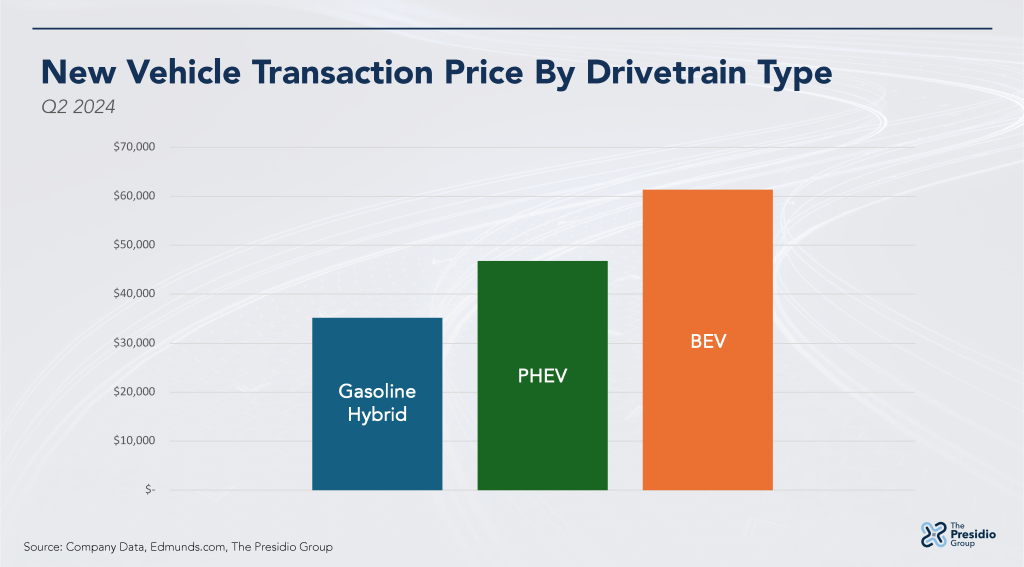
BEVs Priced Significantly Higher Than Hybrid Vehicles
This chart directly visualizes the ‘cost’ and ‘affordability’ gap between mature hybrid technology and developing BEV platforms, a central point of the section.
(Source: The Presidio Group |)
- Between 2021 and 2024, the industry narrative prioritized the potential of BEV technology, assuming rapid improvements in battery cost and charging infrastructure. However, real-world data revealed significant hurdles, including supply chain bottlenecks and slower-than-expected charging network build-outs.
- In contrast, Toyota’s hybrid powertrain, with over 10 million units sold, entered 2025 as a fully scaled, cost-optimized, and highly reliable system. A Consumer Reports survey highlighted this gap, showing hybrids have 15% fewer problems than gasoline cars, whereas EVs have approximately 80% more problems.
- The current hybrid boom is fueled by this reliability. The profits generated from this TRL 9 technology are funding R&D into next-generation technologies, including solid-state batteries (currently TRL 6-7), which Toyota aims to commercialize by 2028, effectively using its mature tech to leapfrog to the next frontier.
- While BEV technology is advancing, the total ecosystem, including public charging reliability and grid capacity, remains a significant barrier to mainstream adoption. Hybrids, requiring no new infrastructure, bypass this entire layer of complexity, providing a more seamless transition for the majority of consumers today.
SWOT Analysis: Toyota’s Hybrid Strategy
An analysis of Toyota’s position reveals that what was perceived as a weakness in the early 2020 s has become a decisive strength in the current market. The company’s strategic patience and focus on hybrid technology have allowed it to capitalize on the EV market’s slowdown, though long-term regulatory threats and future technological disruption remain key factors to monitor.
Table: SWOT Analysis for Toyota’s Hybrid-Centric Strategy
| SWOT Category | 2021 – 2023 Assessment | 2024 – 2026 Assessment | What Changed / Validated |
|---|---|---|---|
| Strengths | Manufacturing excellence (Kaizen), brand reputation for quality, established hybrid technology leadership (Prius). | Record profitability from hybrid sales, dominant market share, and a diverse portfolio meeting all consumer segments. The hybrid boom generates capital for future R&D. | The market validated that a significant consumer segment prefers hybrids, turning Toyota’s diverse portfolio from a perceived liability into a major profit center and competitive advantage. |
| Weaknesses | Perceived as a laggard in the BEV race, with limited pure-EV offerings and a cautious public stance on rapid electrification. | Continued low BEV sales volume relative to competitors like Tesla. Potential perception issues among investors focused solely on pure-play EV growth metrics. | While BEV volume is still low, the strategic rationale for delaying a massive BEV push has been validated by competitors’ financial losses and the robust hybrid market. The weakness is now framed as strategic patience. |
| Opportunities | Leverage hybrid expertise to offer a practical, affordable transition for consumers not ready for full BEV adoption. | Capture market share from competitors scaling back EV plans. Convert popular models (RAV 4, Camry) to hybrid-only to dominate mainstream segments. Use hybrid profits to fund a leapfrog to solid-state batteries. | The “EV slowdown” created the perfect market opportunity for Toyota’s existing strengths. Competitors are now trying to emulate this strategy, but Toyota has a significant head start in scale and cost. |
| Threats | Aggressive ZEV mandates (e.g., California) could render hybrids non-compliant. A breakthrough in battery cost could make BEVs price-competitive faster than expected. | Geopolitical tariff risks (as shown by a $9.5 billion profit forecast cut). Intensifying competition from Chinese automakers in both BEV and hybrid segments. Long-term risk of being leapfrogged if solid-state battery development stalls. | Regulatory and geopolitical risks have materialized and remain the primary threat. ZEV mandates are a future cliff, but near-term consumer demand and competitor pivots have delayed the immediate impact of this threat. |
Scenario Modelling and Summary
The most critical forward-looking indicator for the automotive sector’s electrification path is now the market performance of high-volume, mainstream hybrid models against their BEV alternatives. If sales data for the all-hybrid 2026 Toyota RAV 4 demonstrates sustained, high-margin success, it will confirm that the hybrid bridge is not only stable but wider and longer than previously anticipated, forcing more legacy automakers to divert capital from speculative BEV projects back into proven hybrid platforms.

Toyota’s Hybrid Sales Boom Validates Strategic Pivot
This chart’s depiction of a massive surge in Toyota’s hybrid sales provides direct evidence for the SWOT analysis’s conclusion that its strategy is a validated strength.
(Source: Sherwood News)
- If this happens: Watch for competitors like Ford, GM, and Stellantis to accelerate the re-introduction of hybrid options across their truck and SUV lineups, moving beyond niche offerings to electrifying their core profit centers. This will signal an industry-wide capitulation to a multi-pathway strategy for the remainder of the decade.
- Then you will see: A potential bifurcation in the investment market. Valuations may shift to reward automakers with strong, profitable hybrid sales, while pure-play EV companies and those with high BEV-related cash burn could face increased pressure from investors demanding a clearer path to profitability.
- Which could mean: The timeline for mass BEV adoption, particularly in North America, could be extended. This gives Toyota and other automakers a crucial window to perfect next-generation technologies, such as solid-state batteries, potentially allowing them to enter the mature BEV market with a technologically superior product rather than competing in the current price-sensitive environment. The key signal to monitor is any acceleration of Toyota’s 2028 solid-state battery launch timeline.