

IBM’s Data Center Solar Strategy 2025-2026: From Procurement to Powerhouse
International Business Machines Corporation (IBM) is executing a strategic pivot in its data center energy strategy, moving from a reliance on renewable energy procurement to a comprehensive model that integrates on-site solar generation, the commercialization of proprietary sustainability software, and aggressive hardware efficiency innovation. This multi-faceted approach is designed to meet the escalating power demands of AI workloads while positioning IBM as a critical technology enabler for the broader energy transition. The company has established a clear target of sourcing 90% of its global electricity from renewables by 2030, a significant increase from its 2025 goal of 75%.
IBM Commercial Projects Mark Shift to On-Site Generation 2026
IBM‘s commercial activity demonstrates a clear evolution from primarily securing renewable energy through Power Purchase Agreements (PPAs) between 2021 and 2024 to directly developing on-site solar generation and commercializing its internal efficiency tools in 2025 and 2026.
- In the earlier period, IBM‘s strategy centered on off-site procurement, exemplified by the 2021 PPA with Boralex to supply its data centers in France with wind power. This approach secured renewable energy supply but offered less direct operational control.
- A significant strategic shift occurred in 2025, with IBM initiating direct generation projects to power its facilities. The plan for a dedicated solar farm at its Hursley, UK campus in partnership with Clean Energy Capital and the completion of a 5.5 MW solar carport at its Yorktown Heights, NY research headquarters with Power Flex mark this new phase.
- Beyond powering its own operations, IBM is now commercializing its sustainability software. The adoption of the IBM Maximo Renewables platform by clients like KP Group to manage over 1.4 GW of assets and by Matrix Renewables underscores its new role as a technology vendor to the renewable energy industry.
- This is complemented by a deep focus on internal hardware efficiency. In July 2025, IBM launched new chips featuring a mode that reduces energy consumption by 28%, directly addressing the rising power demands of AI workloads at the source.
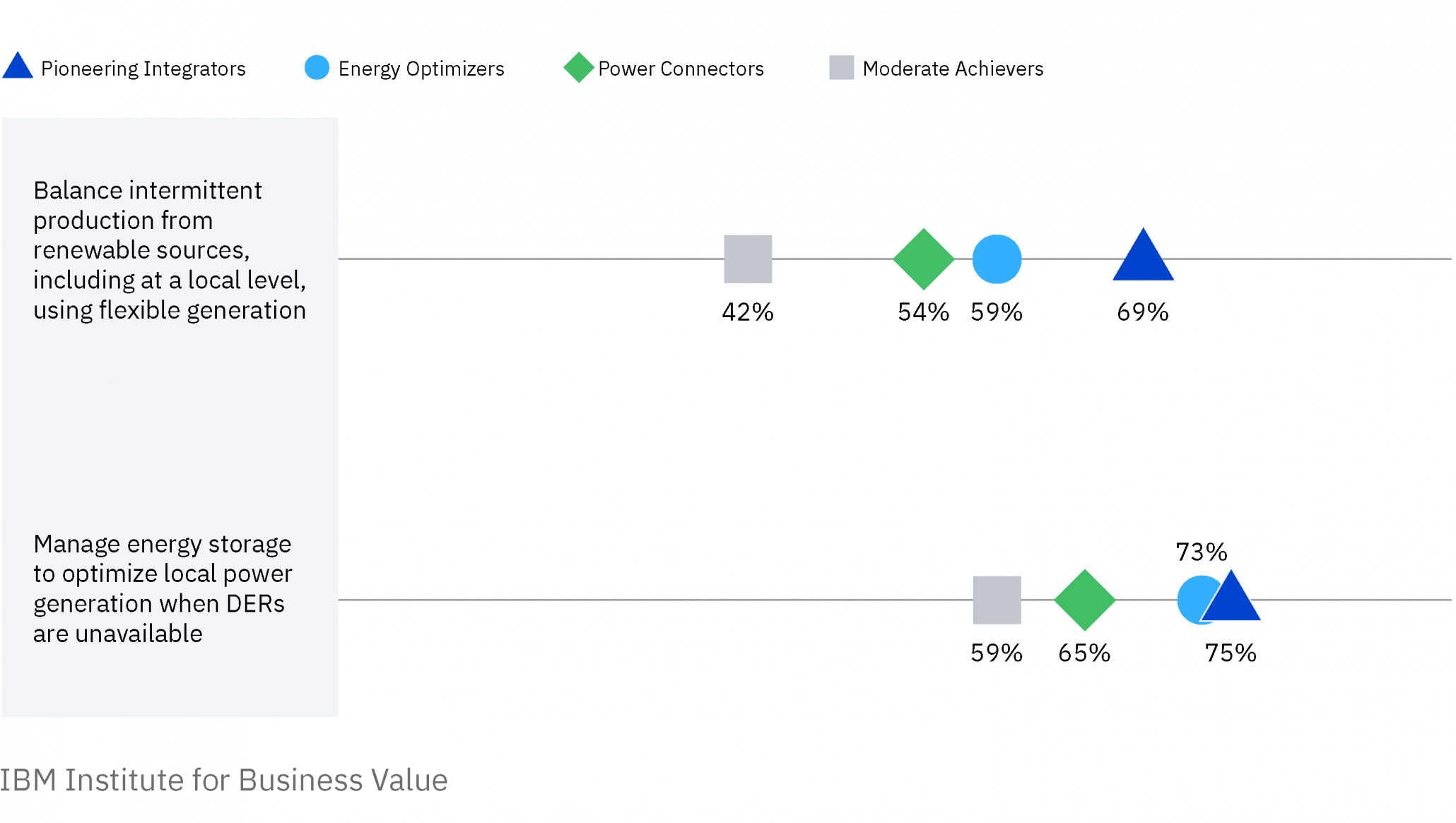
IBM Maps On-Site Generation Strategies
This chart illustrates the strategic importance of managing local power generation (DERs), which aligns with the section’s focus on IBM’s shift to on-site solar projects.
(Source: IBM)
IBM’s Strategic Investment in Sustainability Technology
IBM‘s investment strategy has matured from funding general green infrastructure to making targeted acquisitions and R&D commitments that directly enhance its portfolio of commercial sustainability technologies.
- A pivotal move was the October 2024 acquisition of Prescinto, an AI-powered asset performance management software provider for the renewable energy sector. This acquisition was explicitly aimed at strengthening the IBM Maximo Application Suite, turning a tool for internal efficiency into a robust commercial offering for solar and wind operators.
- In April 2025, IBM announced a plan to invest $150 billion in the United States over five years, with over $30 billion dedicated to R&D. This funding is focused on advancing energy-efficient technologies for mainframes and quantum computing, signaling a long-term commitment to solving the energy consumption challenge at the hardware level.
- This targeted approach follows earlier, foundational investments such as the $86 million “Big Green Data Center” project and the expansion of its data center in Boulder, Colorado, which was designated its “greenest data center in North America.”
- The company’s expansion into regions with abundant clean energy, such as the new Cloud Multizone Region in Montreal, Canada, which leverages Quebec’s hydroelectricity, further demonstrates a deliberate strategy to align its infrastructure growth with its sustainability goals.

Visualizing AI-Driven Asset Performance
This dashboard exemplifies the output of AI-powered asset management tools like Prescinto, which the section highlights as a key strategic acquisition for IBM.
(Source: ESG Today)
Table: IBM’s Key Investments in Sustainable Data Centers and Technology
| Partner / Project | Time Frame | Details and Strategic Purpose | Source |
|---|---|---|---|
| 5-Year US Investment Plan | April 2025 | A $150 billion total investment, with over $30 billion for R&D to advance energy-efficient mainframe and quantum computing. | Fox Business |
| Acquisition of Prescinto | October 2024 | Acquired a leading Saa S provider for renewable asset management to integrate into the IBM Maximo suite, commercializing its AI-driven efficiency tools. | IBM Newsroom |
| Quantum Data Center Expansion | October 2024 | Expanded its facility in Poughkeepsie, NY, to house the world’s largest fleet of utility-scale quantum processors, with a focus on sustainable operation. | Intelligent CIO |
| New Cloud Multizone Region | April 2024 | Established a new cloud region in Montreal, Canada, to leverage Quebec’s hydroelectric-powered grid for more sustainable cloud infrastructure. | RENX |
| “Big Green Data Center” | Recent | Invested $86 million in a new data center designed to showcase IBM‘s latest energy-efficient technologies as part of a larger $480 million initiative. | Data Center Knowledge |
IBM Forges Alliances for Grid Management and On-Site Power
IBM‘s partnerships have evolved from broad sustainability pacts to highly specific, technology-centric collaborations focused on grid management, direct renewable generation, and AI-powered analytics.
- Between 2021 and 2024, IBM‘s alliances were foundational, including an MOU with Worley and ABB to explore green hydrogen and a partnership with Borealis Data Center to offer green cloud services from Iceland.
- Starting in 2025, partnerships became more direct and operational. The collaboration with Power Flex to build a 5.5 MW solar carport at its Yorktown Heights campus is a prime example of implementing tangible, on-site renewable energy solutions.
- The partnership with Clean Energy Capital to plan a dedicated solar farm for its Hursley, UK data center further solidifies this strategic pivot toward direct power sourcing and operational autonomy.
- Simultaneously, IBM has pursued partnerships that position it as a technology leader. The collaboration with NASA to develop the “Surya” AI model for predicting solar weather demonstrates a strategy to apply its core competencies to solve industry-wide challenges in the renewable sector.
- The partnership with Andel Energi in Denmark to develop an AI-driven platform for grid flexibility shows IBM moving beyond its own four walls to provide critical solutions for integrating intermittent renewables into public energy systems.

IBM Charts Path to Grid Modernization
This chart from IBM outlines key strategies for grid modernization, directly supporting the section’s discussion of IBM’s technology-centric partnerships in grid management.
(Source: IBM)
Table: IBM’s Strategic Partnerships in Solar and Data Center Sustainability
| Partner / Project | Time Frame | Details and Strategic Purpose | Source |
|---|---|---|---|
| Power Flex | October 2025 | Partnered to construct a 5.5 MW solar carport and EV chargers at IBM’s Yorktown Heights research campus, serving as a clean energy hub. | Power Flex |
| NASA | August 2025 | Co-developed the “Surya” AI model to forecast solar weather, enhancing the resilience of power grids and digital infrastructure against solar events. | Computer Weekly |
| Clean Energy Capital | March 2025 | Initiated planning for a dedicated solar farm to directly power IBM’s Hursley, UK data center and campus, marking a key step in its decarbonization strategy. | Data Center Dynamics |
| Andel Energi | August 2024 | Collaborated to develop the IBM Utility Flexibility Platform, using AI to help balance Copenhagen’s energy grid by managing demand-side resources. | HFS Research |
| Borealis Data Center | December 2023 | Partnered to offer sustainable cloud services from Iceland, leveraging the country’s 100% renewable energy grid to provide green data center solutions. | Data Center Forum |
IBM’s Global Strategy Targets Renewable-Rich Regions
IBM is systematically expanding its sustainable data center operations in geographic regions with robust renewable energy infrastructure, primarily focusing on North America and Europe to align its growth with its decarbonization commitments.
- In North America, IBM has concentrated its efforts on tangible green projects. These include the 5.5 MW solar carport at the Thomas J. Watson Research Center in Yorktown Heights, NY, the “greenest data center” expansion in Boulder, CO, and the owned-and-operated IBM Gunbarrel Solar PV Park, which generates 9, 500 MWh annually. The establishment of a new Cloud Multizone Region in Montreal, Canada, was strategically chosen to leverage Quebec’s abundant hydroelectric power.
- In Europe, IBM is pursuing a similar strategy of co-locating with clean energy sources. The planned solar farm for its Hursley, UK data center, the PPA with Boralex for wind power in France, the partnership for sustainable cloud services from Iceland, and the new quantum data center in Ehningen, Germany all highlight this focus.
- This geographical strategy is not incidental. IBM has publicly stated that the availability of renewable energy is a significant factor in selecting locations for new data centers, explicitly identifying South-east Asia as a future region of interest, contingent on its clean energy development.

IBM’s Global Data Center Footprint
This map visualizes IBM’s global data center network, illustrating the geographic strategy of expanding in renewable-rich regions like North America and Europe as discussed in the text.
(Source: PR Newswire)
IBM’s Sustainability Tech Reaches Commercial Maturity
IBM has successfully transitioned its sustainability-focused technology from internal R&D and operational efficiency tools (2021-2024) to fully commercialized, revenue-generating software and hardware solutions in 2025 and 2026.
- The earlier period was characterized by foundational hardware improvements, such as the launch of the IBM POWER 10 processor in 2021, which offered up to 3 x greater energy efficiency. Software like IBM Turbonomic was also developed to optimize internal workload placement for resource savings.
- By 2025, these internal solutions evolved into market-facing products. The IBM Maximo Renewables suite is now a commercial offering used by major energy players like KP Group and Matrix Renewables to manage large-scale solar and wind portfolios.
- The launch of the Envizi Emissions API in September 2025 represents another step toward commercialization, allowing organizations to embed greenhouse gas emissions data directly into their enterprise systems.
- Breakthroughs in hardware R&D now have quantifiable commercial implications. The December 2024 announcement of its optical chip technology, which promises significant energy savings for AI model training, and a September 2025 patent for energy-efficient workload deployment demonstrate a focus on creating proprietary, high-value technology to address the industry’s power crisis.

IT and Cooling Drive Energy Use
This chart highlights that IT equipment and cooling are the primary energy consumers in data centers, providing essential context for why IBM’s efficiency-focused technologies are critical.
(Source: ScienceDirect.com)
SWOT Analysis of IBM’s Data Center and Solar Strategy
IBM is strategically leveraging its deep technological expertise to capitalize on the escalating demand for sustainable computing, but it faces significant competitive threats from hyperscalers engaged in massive spending and must prove the superior ROI of its more pragmatic, technology-first approach.
- Strengths: IBM‘s primary strength is its ability to develop and commercialize proprietary hardware and software (optical chips, Maximo, Envizi) that directly address energy efficiency, creating a defensible technology moat.
- Weaknesses: The company’s cautious stance on the profitability of gigawatt-scale data centers, as voiced by its CEO, may limit its ability to compete on sheer scale with rivals who are investing more aggressively in new capacity.
- Opportunities: The greatest opportunity lies in positioning IBM as the key technology enabler for the entire energy transition, selling its proven sustainability software and hardware to a market facing the same power and emissions challenges.
- Threats: The primary threat comes from hyperscalers like Google and Amazon, whose massive renewable energy PPAs and data center investments could marginalize IBM‘s market share if scale becomes the sole determinant of success.

Hyperscaler Market Growth Creates Competition
This forecast quantifies the massive growth of the hyperscale market, providing context for the significant competitive threat IBM faces from capital-intensive rivals, as noted in the SWOT analysis.
(Source: MarketsandMarkets)
Table: SWOT Analysis for IBM’s Data Center and Solar Strategy
| SWOT Category | 2021 – 2023 | 2024 – 2025 | What Changed / Resolved / Validated |
|---|---|---|---|
| Strengths | Established clear net-zero goals; developed efficiency-focused hardware like the POWER 10 processor. | Launched tangible on-site solar projects (Yorktown Heights); commercialized software suites (Maximo, Envizi); achieved R&D breakthroughs in optical chips. | The strategy shifted from setting goals to delivering tangible, revenue-generating products and direct generation projects that validate its technological capabilities. |
| Weaknesses | Primarily relied on procurement (PPAs) and leasing strategies, which offered less direct control over energy generation. | CEO publicly questioned the ROI of massive AI data center spending, suggesting a more cautious capital allocation strategy compared to rivals. | A potential weakness in the hyper-scale race was acknowledged, leading to a deliberate pivot toward a more ROI-focused, technology-driven strategy rather than a pure spending race. |
| Opportunities | Recognized the growing market demand for green cloud services and ESG reporting software. | Actively commercialized internal solutions (Envizi API, Maximo) and acquired Prescinto to become a key technology provider for the energy transition. | The opportunity evolved from simply participating in the green market to actively architecting and selling the enabling technology for it, creating new revenue streams. |
| Threats | Faced rising energy costs and the growing power demands of high-performance computing. | Confronted massive spending on renewable energy PPAs and data center construction by hyperscalers like Amazon and Google. | The competitive threat intensified from general market pressures to a direct, capital-intensive race for scale and renewable capacity, forcing IBM to find a different axis of competition. |
IBM’s 2026 Outlook: Commercializing Efficiency
The critical path for IBM in 2026 is to demonstrate the commercial success and profitability of its integrated sustainability strategy, proving that its technology-first approach can deliver superior returns compared to the capital-intensive build-outs of its hyperscaler rivals.
- The primary indicator to watch will be the market adoption and revenue generated by the IBM Maximo Renewables and Envizi software platforms. Customer wins and expanded deployments will be key to validating the strategy of turning internal solutions into external revenue.
- Progress on the proposed solar farm for the Hursley, UK campus will be a crucial milestone. Securing approval and beginning construction would serve as a powerful proof point for its on-site generation strategy in the competitive European market.
- The timeline for integrating the breakthrough optical chip technology into commercial products will be critical. A successful rollout could provide IBM with a significant competitive advantage in managing the energy consumption and operational costs of AI infrastructure.
- Finally, expect to see announcements of new, strategic Power Purchase Agreements or on-site generation projects as IBM works to close the gap between its current renewable energy usage and its ambitious 90% by 2030 target.
Frequently Asked Questions
What is the main change in IBM’s data center energy strategy for 2025-2026?
The main change is a pivot from primarily procuring renewable energy through off-site Power Purchase Agreements (PPAs) to a more integrated model. This new strategy focuses on developing on-site solar generation projects (like those in Yorktown Heights, NY, and Hursley, UK), commercializing its proprietary sustainability software (like IBM Maximo), and innovating in energy-efficient hardware to directly power its operations and create new revenue streams.
What are IBM’s specific renewable energy targets?
IBM has a target of sourcing 75% of its global electricity from renewable sources by 2025. The company has set a more ambitious goal of increasing this to 90% by 2030.
How is IBM using its own technology to support its sustainability goals?
IBM is leveraging its technology in two key ways. First, it is commercializing its internal software, such as the IBM Maximo Application Suite (strengthened by the acquisition of Prescinto) and the Envizi Emissions API, selling them to other companies in the renewable energy sector. Second, it is investing heavily in R&D to create more energy-efficient hardware, such as new chips that reduce consumption by 28% and advanced optical chip technology to lower the power required for AI workloads.
What are some key on-site solar projects IBM is developing?
Two key projects mark IBM’s shift to on-site generation. The first is a 5.5 MW solar carport at its research headquarters in Yorktown Heights, NY, developed with Power Flex. The second is a planned dedicated solar farm in partnership with Clean Energy Capital to directly power its campus and data center in Hursley, UK.
What is the primary threat to IBM’s sustainability strategy?
According to the SWOT analysis, the primary threat comes from hyperscale competitors like Google and Amazon. These companies are making massive capital investments in renewable energy PPAs and new data center construction, creating a competitive environment focused on sheer scale. IBM’s challenge is to prove that its more technology-focused, ROI-driven approach can be more effective than simply outspending rivals on capacity.
Experience In-Depth, Real-Time Analysis
For just $200/year (not $200/hour). Stop wasting time with alternatives:
- Consultancies take weeks and cost thousands.
- ChatGPT and Perplexity lack depth.
- Googling wastes hours with scattered results.
Enki delivers fresh, evidence-based insights covering your market, your customers, and your competitors.
Trusted by Fortune 500 teams. Market-specific intelligence.
Explore Your Market →One-week free trial. Cancel anytime.
