

Microsoft’s Solar Strategy 2025-2026: How 40 GW in PPAs Are Powering Global AI Data Centers
Microsoft’s energy procurement strategy has scaled aggressively to support its artificial intelligence and data center expansion. The company has moved from incremental renewable energy purchasing to executing multi-gigawatt, long-term power purchase agreements (PPAs) that directly fund new solar and wind project construction. This approach is designed to secure a vast, stable supply of clean power, mitigate exposure to volatile fossil fuel markets, and meet the company’s goal of matching 100% of its electricity consumption with zero-carbon energy purchases by 2030.
Microsoft’s Commercial Scale Projects Define Data Center Energy Procurement 2026
Microsoft has transitioned its renewable energy procurement from a series of individual projects to a programmatic, supply-chain-building model, securing tens of gigawatts to power its global data center fleet.
- Between 2021 and 2024, Microsoft focused on signing numerous individual PPAs, such as a 37 MW solar agreement with ATCO in Canada and a 366 MW wind and solar deal with Statkraft in Ireland. These agreements established its model of using its balance sheet to underwrite new renewable projects.
- Starting in 2025, the scale of these agreements increased dramatically. The company contracted a total of 40 GW of renewable capacity across 26 countries, an amount sufficient to match 100% of its global electricity consumption for 2025.
- The strategy’s cornerstone is a landmark framework agreement with Brookfield Asset Management to develop over 10.5 GW of new renewable capacity, backed by a Microsoft investment exceeding $10 billion. This single deal is approximately eight times larger than any previous corporate PPA.
- Solar energy forms the foundation of this strategy, highlighted by an eight-year strategic alliance with Qcells to deploy 12 GW of solar panels and related services, directly supporting the development of a U.S.-based solar supply chain.
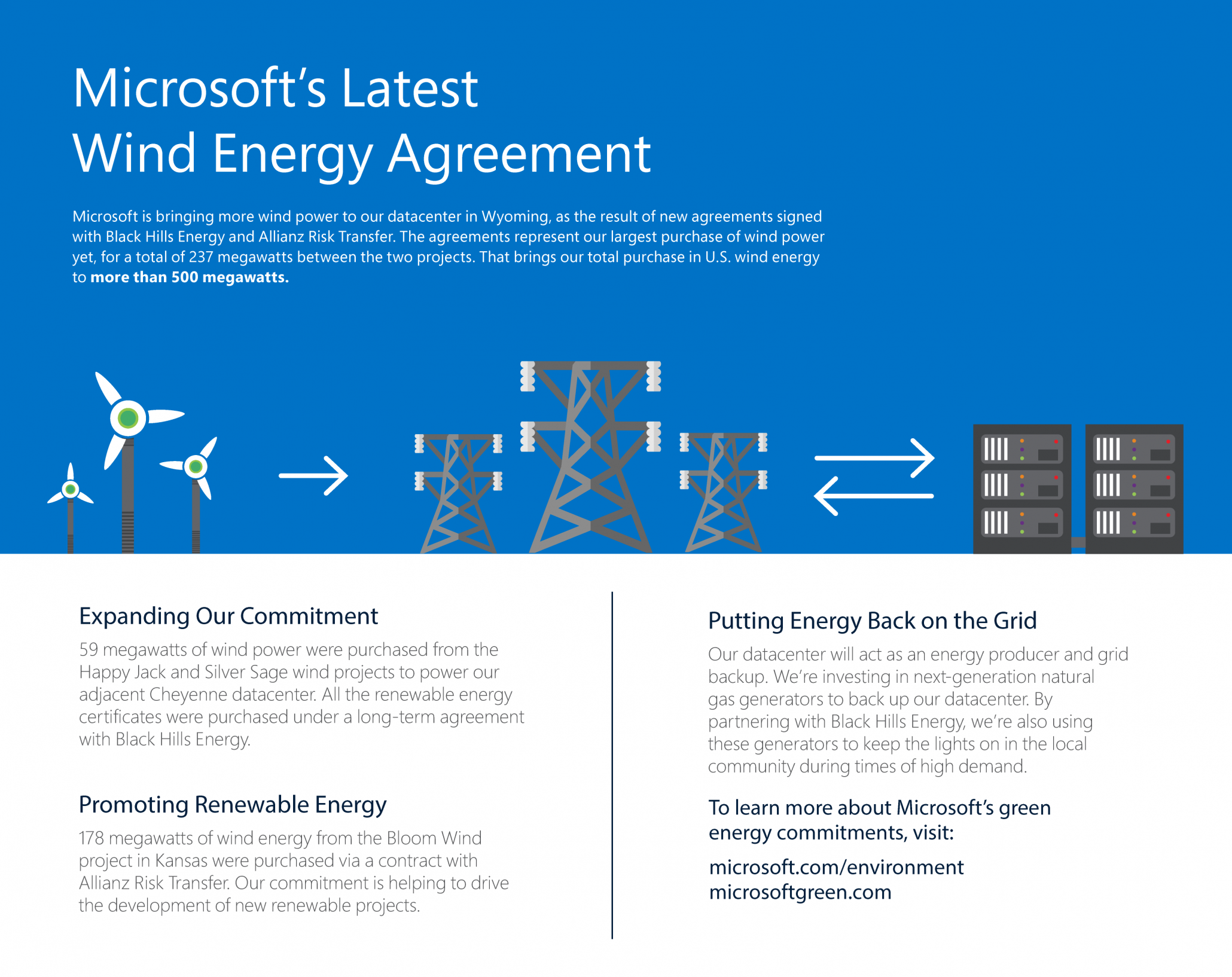
Microsoft Secures 237MW Wyoming Wind Power
This chart exemplifies the individual project-based Power Purchase Agreements (PPAs) that defined Microsoft’s procurement model in the 2021-2024 period, as detailed in the section.
(Source: Microsoft News)
Microsoft’s Investment Analysis: Over $100 Billion Directed to AI, Data Centers, and Clean Power
Microsoft is leveraging its significant financial resources to execute a multi-faceted investment strategy, committing tens of billions of dollars to secure the physical and energy infrastructure required for its AI ambitions.
- The company’s overarching capital plan includes an $80 billion global build-out of data center infrastructure, first announced in January 2025, with a core pledge that all facilities will be backed by 100% low-carbon energy PPAs.
- In February 2026, Microsoft committed $50 billion specifically for AI and data centers, directly linking the investment to its carbon negative and 100% renewable matching goals.
- To fund the necessary infrastructure, Microsoft co-launched the Global AI Infrastructure Investment Partnership (GAIIP) with Black Rock and others, targeting an initial $30 billion to invest in data centers and their supporting power systems.
- Specific regional investments are substantial, including a $19 billion commitment to expand AI and cloud infrastructure in Canada, a $15.2 billion data center expansion in the UAE, and over $7 billion for hyperscale AI data centers in Wisconsin.
Table: Microsoft’s Key Data Center and Clean Tech Investments 2025-2026
| Partner / Project | Time Frame | Details and Strategic Purpose | Source |
|---|---|---|---|
| General AI and Data Center Investment | Feb 2026 | A $50 billion commitment to support the company’s carbon negative goal and 100% renewable energy match amid rapid AI-driven expansion. | GBAF |
| AI & Cloud Infrastructure Expansion | Dec 2025 | A $19 billion investment to expand Azure data center regions in Canada, focusing on sustainable and scalable capabilities for AI and cloud services. | Microsoft |
| Data Center Expansion | Dec 2025 | A $15.2 billion commitment for a major expansion of data center capacity in the UAE, with a focus on renewable energy partnerships. | Forbes |
| Large-Scale AI Data Hub | Nov 2025 | An €8.6 billion (approximately $10 billion) investment to establish a major AI data hub in Portugal to serve the European market. | Capacity Media |
| Global AI Infrastructure Investment Partnership (GAIIP) | Sep 2024 | Co-founded a partnership with Black Rock and others targeting $30 billion to invest in data centers and supporting power infrastructure globally. | Microsoft |
| Renewable Energy Framework Agreement | May 2024 | An investment exceeding $10 billion to support a deal with Brookfield Asset Management to develop over 10.5 GW of new renewable energy capacity in the US and Europe. | CNBC |
Microsoft Partnership Strategy: Building a Global Green Grid for AI
Microsoft’s partnership strategy centers on long-term, large-volume agreements with energy producers and technology developers to create a diversified, global portfolio of clean energy sources.
- Between 2021 and 2024, partnerships were characterized by agreements with utilities and developers like AES Corporation for 24/7 renewable energy in Virginia and EDP Renewables for solar projects, establishing the model for direct procurement.
- Since 2025, the company has executed a series of massive framework agreements, including a landmark 10.5 GW deal with Brookfield and a 12 GW solar supply and EPC alliance with Qcells, shifting from project-by-project deals to programmatic, supply-chain-level engagements.
- The company is diversifying its technology mix beyond solar and wind. A partnership with G 42 in Kenya is developing a data center powered entirely by geothermal energy, while an agreement with Constellation Energy supports nuclear power for reliable, 24/7 carbon-free energy.
- Microsoft is also forming technology partnerships to address grid constraints, exemplified by its collaboration with grid operator MISO to use AI and cloud technology to modernize the U.S. power grid and improve the integration of renewables.
Table: Microsoft’s Strategic Renewable Energy Partnerships 2025-2026
| Partner / Project | Time Frame | Details and Strategic Purpose | Source |
|---|---|---|---|
| Sol Systems | Feb 2026 | An agreement to add over 500 MW of solar energy to the grid in Illinois, Ohio, and Texas to directly support Microsoft’s regional data centers. | Qazaq Green |
| Brookfield Asset Management | Feb 2026 | A framework agreement to develop 10.5 GW of new renewable energy capacity, focusing on projects in the U.S. and Europe to come online between 2026 and 2030. | Microsoft |
| MISO | Jan 2026 | A technology collaboration utilizing Microsoft’s AI and cloud platforms to modernize the U.S. power grid, improving efficiency and reliability. | Carbon Credits |
| Iberdrola | Dec 2025 | Two new long-term PPAs for 150 MW of solar and wind power in Spain, combined with the use of Microsoft’s AI solutions to enhance Iberdrola’s operations. | Iberdrola |
| Qcells | Jan 2024 | An eight-year strategic alliance to supply 12 GW of U.S.-made solar modules and EPC services, enough to power over 1.8 million homes. | Qcells |
Geographic Expansion: Microsoft’s Global Data Center and Renewable Energy Footprint
Microsoft’s geographic strategy aligns its massive data center construction with targeted, large-scale renewable energy procurement in key markets across North America, Europe, and Asia.
- Between 2021 and 2024, activity was concentrated in established markets like the U.S. (Virginia data centers powered by local PPAs) and Europe (Ireland data centers supported by wind projects), proving the co-location model.
- From 2025 onward, this strategy has globalized and scaled. North America remains central, with over $7 billion invested in new AI data centers in Wisconsin and $19 billion in Canada, supported by major solar PPAs in the U.S. Midwest and a 12 GW domestic solar supply deal with Qcells.
- Europe is a major growth theater, with an €8.6 billion AI data hub planned for Portugal and significant PPAs signed in Spain (with Iberdrola and Zelestra), Italy (with Enfinity), and Norway to secure renewable power for its expanding Azure cloud regions.
- The strategy is also expanding into new territories, including a $15.2 billion data center investment in the UAE and a partnership in Kenya to build a data center powered entirely by geothermal energy, demonstrating a flexible approach based on regional renewable resource availability.
Technology Maturity for Microsoft Data Centers: From Pilot to Commercial Scale
Microsoft is advancing data center sustainability on multiple fronts, moving beyond renewable energy procurement to commercialize innovations in cooling, construction, and grid integration.
- In the 2021-2024 period, Microsoft demonstrated key technologies at the pilot level, such as using the batteries at its Dublin data center to provide grid stabilization services and testing green hydrogen for backup power, validating their technical feasibility.
- Since 2025, the company has begun commercializing these innovations. It launched a new data center design that uses zero water for cooling, a critical development now planned for deployment in arid regions like Arizona, and began constructing its first data centers using cross-laminated timber to reduce embodied carbon.
- The company is applying its core software expertise to the energy sector, deploying AI-powered platforms in partnership with grid operator MISO to modernize grid management. This marks a shift from being a passive energy consumer to an active technology partner for the grid.
- To meet the 24/7 power demands of AI, Microsoft is moving beyond intermittent renewables and into baseload clean energy. Its project in Kenya represents the first commercial-scale deployment of a data center powered entirely by geothermal energy, a key step toward achieving true hourly carbon-free operations.
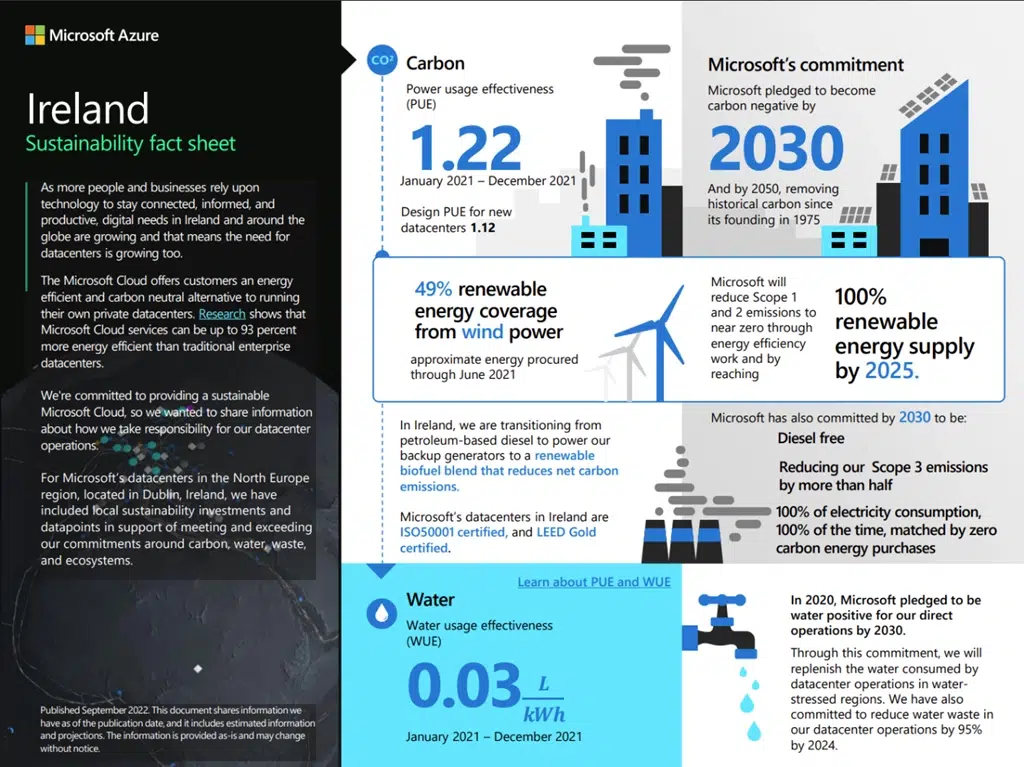
Microsoft’s Ireland Data Center Touts Efficiency
This chart supports the section’s focus on technology maturity by providing a key metric (PUE of 1.22) for data center efficiency in Ireland, a location noted for its technological innovations.
(Source: Microsoft Azure)
SWOT Analysis for Microsoft’s Data Center Energy Strategy
Microsoft’s aggressive procurement strategy creates significant market advantages but also exposes it to execution risks and public scrutiny related to its massive resource consumption.
- The strategy’s primary Strength is its unmatched scale in renewable procurement, which allows it to lock in long-term energy prices and de-risk its operations from fossil fuel volatility.
- Its main Weakness is the growing gap between its annual renewable energy matching claims and the reality of 24/7 carbon-free operations, evidenced by its reliance on gas turbines in grid-constrained markets like the UAE.
- The most significant Opportunity lies in setting a new industry standard with its “Community-First” policy, where it internalizes infrastructure costs, thereby securing its social license to operate and build.
- The most pressing Threat is the immense strain its own data center growth places on local grids, creating risks of instability and public backlash that could impede future expansion.

Microsoft’s Energy Consumption Rivals Entire Nations
This chart quantifies the massive scale of Microsoft’s energy consumption, which is central to the SWOT analysis, representing both a key strength and a significant risk.
(Source: Reddit)
Table: SWOT Analysis for Microsoft Data Centers
| SWOT Category | 2021 – 2024 | 2025 – 2026 | What Changed / Resolved / Validated |
|---|---|---|---|
| Strengths | Leveraging balance sheet for individual PPAs (e.g., with AES, ATCO). Early innovation in data center battery grid support in Ireland. | Unprecedented procurement scale (40 GW contracted). Landmark deals (10.5 GW with Brookfield) shape the entire market. Direct investment in U.S. solar supply chain (12 GW with Qcells). | The strategy shifted from incremental procurement to programmatic, market-making investments, validating that Microsoft’s financial power can reshape global clean energy supply chains. |
| Weaknesses | Focus on annual matching created a gap with hourly consumption. Water consumption for cooling was a growing concern. | Reliance on fossil fuel backup (gas turbines in UAE, Mexico) contradicts climate goals. The 600% projected surge in AI power demand makes the 24/7 carbon-free goal harder. | The scale of AI growth has magnified the weakness of the annual matching approach, forcing a strategic pivot toward 24/7 solutions but creating near-term contradictions. |
| Opportunities | Piloting new technologies like green hydrogen backup power. Early leadership in corporate renewable purchasing. | Setting industry precedent with “Community-First” policy to internalize infrastructure costs ($25 M in Virginia). Using AI for grid modernization (MISO partnership). Expanding into geothermal and nuclear. | Microsoft validated it can move beyond being a consumer to a technology partner for the grid and a responsible community stakeholder, creating a competitive advantage in securing permits and public support. |
| Threats | Growing scrutiny over data center energy and water use. Potential for grid strain in high-density regions like Virginia. | Massive data center load growth is a primary driver of grid instability. Political risk to clean energy policies like the Inflation Reduction Act. Water scarcity in key expansion zones. | The threat has evolved from being a reputational risk to a direct operational risk. Microsoft’s own success is now a primary source of strain on the public infrastructure it depends on. |
Forward-Looking Insights: The Pivot to 24/7 Carbon-Free Energy and Community Responsibility
Microsoft’s primary strategic challenge is to transition from annual renewable energy accounting to true 24/7 carbon-free operations while managing the immense community and grid impacts of its growth.
- Watch for increased investment in firm, baseload clean power sources to complement intermittent solar and wind. The geothermal project in Kenya and the nuclear-linked PPA with Constellation are early signals of a necessary pivot to technologies that can run 24/7 to power AI workloads.
- The execution of the “Community-First” pledge will be a critical indicator of Microsoft’s long-term strategy. The success of its commitment to cover full power and infrastructure costs, as seen in Virginia, will determine if this becomes a new, defensible industry standard or a selective policy.
- Scrutiny over resource consumption will intensify. The rollout of zero-water cooling designs and other efficiency innovations is no longer a “nice-to-have” but a critical requirement for securing permits and maintaining a social license to operate in water-scarce regions.
- The company’s ability to use its own technology, particularly AI, to help solve the grid integration challenges it creates will be a key differentiator. The MISO partnership is a template for how Microsoft can turn its greatest operational challenge into a new business opportunity.
Frequently Asked Questions
Why is Microsoft investing so heavily in renewable energy like solar?
Microsoft’s massive investment in renewable energy is driven by the explosive growth of its artificial intelligence (AI) and data center operations. According to the article, the company needs a vast, stable supply of clean power to run these facilities, reduce its dependence on volatile fossil fuel markets, and meet its corporate goal of matching 100% of its electricity use with zero-carbon energy purchases by 2030.
What is the single largest renewable energy deal Microsoft has signed?
The article identifies a landmark framework agreement with Brookfield Asset Management as its largest deal. Microsoft is investing over $10 billion to help Brookfield develop over 10.5 GW of new renewable energy capacity in the U.S. and Europe. This single agreement is noted to be approximately eight times larger than any previous corporate PPA.
How has Microsoft’s energy procurement strategy evolved from 2024 to 2025?
The strategy shifted from incremental, project-by-project deals to a programmatic, market-shaping approach. Between 2021-2024, Microsoft signed numerous individual PPAs. Starting in 2025, it began executing massive framework agreements, such as the 10.5 GW Brookfield deal and a 12 GW solar panel alliance with Qcells, to secure tens of gigawatts and build out entire clean energy supply chains.
Is Microsoft only using solar and wind power for its data centers?
No. While solar and wind are the foundation of its strategy, the article states Microsoft is diversifying to achieve 24/7 carbon-free power. It highlights a project in Kenya to build a data center powered entirely by geothermal energy and an agreement with Constellation Energy to use nuclear power, demonstrating a pivot toward baseload clean energy sources that can run continuously.
What are the main risks or challenges to Microsoft’s energy strategy?
The article’s SWOT analysis identifies two key challenges. First, there’s a growing gap between its ‘annual matching’ of renewable energy and achieving true 24/7 carbon-free operations, as it still relies on fossil fuels in some grids. Second, the immense power demand from its own data center growth is placing a significant strain on local power grids, creating risks of instability and public backlash that could hinder future expansion.
