

Bloom Energy SOFC Data Center Deals, 2.8 GW Oracle Agreement, and 35 Commercial Deployments (2021 to 2026)
$7.65 B in Data Center Deals Drive Bloom Energy SOFC Scale for Remote Use
The explosive power demand from AI data centers is accelerating the manufacturing scale and commercial viability of Solid Oxide Fuel Cells (SOFCs), which in turn reduces costs and de-risks the technology for off-grid applications in mining, telecom, and island microgrids. This dynamic shifts SOFCs from a niche, high-cost alternative to a scalable solution for reliable, remote power.
- Before 2025, SOFC adoption for remote power was characterized by smaller-scale pilots and a focus on incremental efficiency gains over diesel generators. The primary challenge was high capital cost and unproven bankability for large projects, limiting deployment to specialized applications.
- In 2026, the market shifted fundamentally. The massive power requirements for AI data centers created an anchor customer category, exemplified by Oracle‘s agreement for up to 2.8 GW of Bloom Energy‘s SOFC systems. This deal validates the technology’s scalability for 24/7 high-density loads and provides a clear path to manufacturing volume.
- This large-scale adoption is expected to drive down manufacturing costs, with companies like Ceres Power launching new platforms such as the Ceres Endura, which is designed to reduce system manufacturing costs by as much as one-third.
- The technical validation and cost-down curve from the data center boom directly benefits off-grid sectors. Projects such as MODEC‘s plan with Eld Energy for a 120-k W SOFC system on an FPSO vessel become more economically feasible as the underlying technology becomes more standardized and affordable.
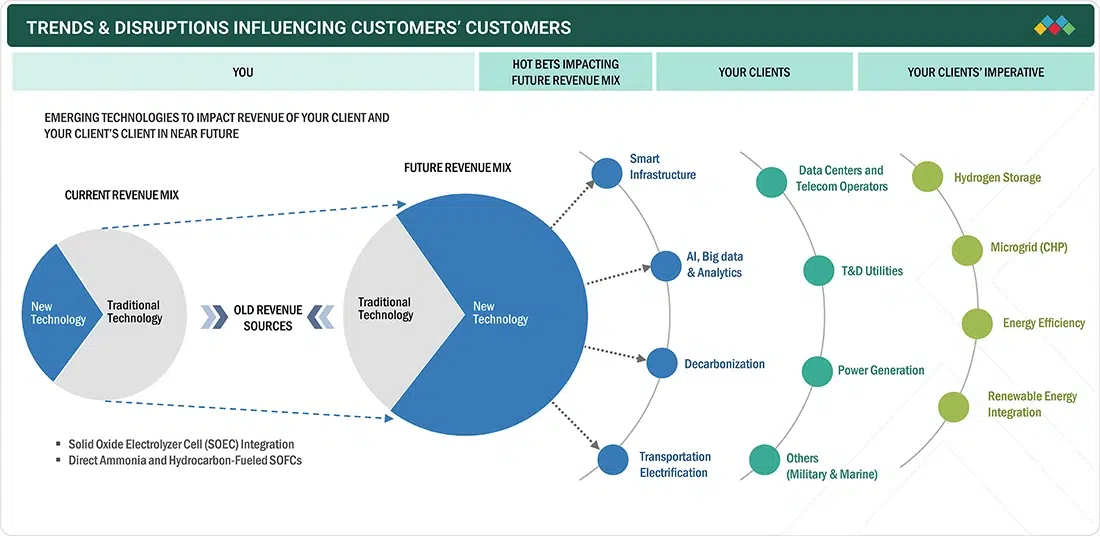
Data Centers Drive SOFC Technology Shift
This chart conceptually illustrates the section’s core argument: demand from AI and data centers is the primary macro trend driving the adoption of SOFC technology.
(Source: MarketsandMarkets)
Bloom Energy 2.8 GW Oracle Deal Anchors SOFC Investment Surge (2026)
Strategic partnerships and large-scale procurement agreements in 2026 have replaced speculative venture funding as the primary driver of capital into the SOFC sector. This signals a market shift from technology development to commercial deployment, with investment now following proven offtake agreements rather than technological promise alone.
- The master services agreement between Bloom Energy and Oracle for up to 2.8 GW of capacity represents a major capital commitment, securing a long-term revenue stream that underwrites manufacturing expansion and supply chain investment.
- Centrica‘s partnership with Ceres Power aims to deploy multi-gigawatts of SOFC power, providing industrial customers with a financed, on-site power solution to bypass grid delays and reduce carbon emissions.
- MODEC‘s joint development agreement with Eld Energy to scale an integrated SOFC and CO₂ capture system demonstrates investment in niche, high-value industrial applications, moving beyond simple stationary power.
- The inclusion of Proof Energy, which is commercializing a next-generation metallic SOFC, into the Halliburton Labs accelerator program shows continued investment in earlier-stage, disruptive SOFC technologies intended for industrial scale.
Table: SOFC Strategic Investments and Commitments (2026)
| Partner / Project | Time Frame | Details and Strategic Purpose | Source |
|---|---|---|---|
| Bloom Energy / Oracle | Apr 2026 | Master services agreement for up to 2.8 GW of SOFC systems to power AI infrastructure, validating the technology’s scalability and bankability for hyperscale data centers. | Data Center Dynamics |
| Ceres Power / Centrica | Mar 2026 | Strategic partnership to deploy multi-gigawatts of on-site SOFC power in the UK and Europe, specifically targeting industrial customers and data centers facing grid connection delays. | Reuters |
| Proof Energy / Halliburton Labs | Mar 2026 | Acceptance into accelerator program to scale up a next-generation metallic SOFC (M-SOFC) technology for industrial and energy applications. | Stock Titan |
| MODEC / Eld Energy | Feb 2026 | Joint development agreement to scale an integrated 120-k W SOFC and CO₂ capture system for Floating Production Storage and Offloading (FPSO) vessels. | Carbon Capture Magazine |
US vs. Asia, Bloom Energy and Doosan SOFC Market Leadership
While North America currently leads in large-scale SOFC commercial agreements driven by the data center boom, Asia, particularly South Korea and India, is emerging as a critical region for manufacturing and long-term market growth. This geographic diversification is essential for building resilient global supply chains and accessing new customer bases.

Asia-Pacific Leads SOFC Market Growth
This chart directly supports the section’s focus on geographic market leadership, showing the Asia-Pacific region as the largest and fastest-growing market for SOFCs.
(Source: MarketsandMarkets)
- North America, particularly the US, became the epicenter of SOFC deal-making in 2026. This was driven by the IRA’s tax credits and immense power demand from AI data centers, as seen in Bloom Energy‘s deal with Oracle.
- Europe is a key hub for technology development and strategic partnerships, highlighted by the UK-based alliance between Centrica and Ceres Power and Estonia-based Elcogen’s technology platform.
- South Korea stands out as a leader in SOFC deployment and manufacturing. Companies like Doosan are establishing production facilities for both domestic use and export, leveraging technology from partners like Ceres.
- Market expansion into the Asia-Pacific region is a strategic priority. This is evidenced by Elcogen appointing a business development director in January 2026 to specifically target the high-growth markets of India and the surrounding region.
60% Efficiency Validates Bloom Energy SOFC Commercial Scale
In 2026, SOFC technology has transitioned from a pilot-stage technology (TRL 7-8) to a commercially scalable platform (TRL 9). This maturity is evidenced by proven high efficiency, documented long-term reliability, and the launch of manufacturing-optimized commercial platforms by multiple industry players.

SOFCs Positioned for Continuous Data Center Power
This chart aligns with the section’s theme of commercial maturity by identifying SOFCs as a key technology for continuous power, which implies the high efficiency and reliability discussed.
(Source: IDTechEx)
- While the focus from 2021-2024 was on demonstrating durability, studies in 2026 confirm SOFCs consistently achieve over 60% electrical efficiency with low degradation rates of just 0.2% per 1, 000 hours. This performance makes the business case for continuous operation in remote sites compelling.
- The technology’s readiness for large-scale industrial use was validated by the launch of commercial products. These include Weichai’s metal-supported SOFC and Ceres Power‘s Ceres Endura platform, both of which are designed for mass manufacturing and cost reduction.
- While large-scale systems are now mature, research and development continues on next-generation and niche applications. A Japanese team developed a palm-sized SOFC microreactor with a 5-minute startup time, with field trials planned for late 2026, indicating future expansion into mobile and robotics markets.
- A key advancement is the development of dual-use platforms for both SOFC (power generation) and SOEC (hydrogen production). This transforms the technology into a versatile energy conversion asset, a strategy pursued by companies like Ceres and HD Hydrogen.
SWOT Analysis, Bloom Energy SOFC Strengths and Supply Chain Risks
SOFC technology’s primary strength lies in its high efficiency and fuel flexibility for baseload power, but its growth is constrained by high initial CAPEX and potential supply chain vulnerabilities for key materials like scandium. The massive demand from data centers presents both the greatest opportunity for scale and the most significant test of the supply chain’s resilience.
Table: SWOT Analysis for SOFC Off-Grid and Remote Power
| SWOT Category | 2021 – 2024 | 2025 – 2026 | What Changed / Validated |
|---|---|---|---|
| Strengths | High efficiency (>50%) in lab/pilot settings. Fuel flexibility demonstrated with natural gas and hydrogen. | Electrical efficiency validated at >60% in commercial systems. Low degradation (0.2%/1000 hrs) confirmed. Total CHP efficiency can exceed 80%. | The technology’s core value proposition of high efficiency and reliability has been proven at commercial scale, moving from theoretical advantage to a bankable metric. |
| Weaknesses | High CAPEX was the primary barrier to adoption. Long-term durability and stack life were key customer concerns. | CAPEX remains a challenge but is improving, with an LCOE of $0.139/k Wh in hybrid systems. New platforms target one-third cost reductions and five-year stack life. | While still high, CAPEX is now on a clear downward trajectory driven by manufacturing scale. The industry is directly addressing durability with new product generations. |
| Opportunities | Primary markets were industrial CHP and niche backup power. Remote power was an emerging but small-scale opportunity. | AI data centers have emerged as a multi-gigawatt anchor market. The 2.8 GW Oracle deal provides a blueprint for large-scale, non-grid power. | The emergence of a massive, non-subsidized anchor market (data centers) de-risks the entire industry and accelerates the cost curve for all other applications, including remote power. |
| Threats | Dependence on government subsidies. Competition from rapidly falling costs of solar and battery storage. | Policy risk remains (e.g., changes to the IRA). New threats include feedstock price volatility (natural gas) and supply chain constraints on materials like scandium. | While policy risk is constant, the primary threat has shifted from technological obsolescence to operational and supply chain risks associated with rapid, large-scale growth. |
Bloom Energy Bull Case, Data Center Scale Unlocks Remote SOFC Markets
The most critical strategic development for the off-grid SOFC market in the year ahead is the successful execution of gigawatt-scale data center contracts. This will validate the technology’s bankability and accelerate the cost-down curve for all other applications, including mining, telecom, and island microgrids.

SOFC Market to Skyrocket by 2035
This forecast chart visually represents the ‘bull case’ described in the section, illustrating the massive market growth potential if data center scale successfully unlocks remote markets.
(Source: Market Research Future)
- If this happens: If Bloom Energy successfully deploys the first few hundred megawatts for Oracle on schedule and on budget, it will trigger a wave of similar deals from other hyperscale cloud providers.
- Watch this: Monitor announcements from other major cloud providers like Amazon, Google, and Microsoft regarding their on-site power strategies. A follow-on deal of 500 MW or more before year-end would confirm the trend and cement SOFCs as a primary solution.
- This could be happening: The manufacturing scale and supply chain security achieved to fulfill these large orders will make SOFC systems cost-competitive with diesel generators for remote mining and telecom sites within the next 18-24 months.
- Watch this: The Levelized Cost of Electricity (LCOE) of hybrid renewable systems incorporating fuel cells, currently around $0.139/k Wh, should drop closer to the $0.10/k Wh mark as SOFC CAPEX decreases, making it the default choice for new off-grid microgrids.
The questions your competitors are already asking
This report covers one angle of how the AI data center boom is accelerating SOFC deployment for off-grid and remote power. The questions that matter most depend on your work.
- Which SOFC companies are best positioned to capture the remote power market now that data centers are driving manufacturing scale?
- What is the outlook for SOFC deployment in mining and island microgrids by 2028, considering the new cost-down curve?
- How does the total cost of ownership for SOFCs now compare to diesel generators for a 24/7 remote industrial load?
- Which mining and telecom operators are adopting SOFCs for remote power now that the technology is being de-risked at the gigawatt scale?
This report does not answer these. Enki Brief Pro does.
Your question, your angle, your framework. SWOT, PESTL, scenario modelling. The same niche depth, built around the decision your work actually depends on.
