

NVIDIA’s Data Center Power Strategy 2025: Architecting the AI-Energy Ecosystem
NVIDIA’s Commercial Projects: Shifting from Component Supplier to Data Center Energy Architect
NVIDIA has fundamentally shifted its commercial strategy from supplying power-intensive components to actively orchestrating the entire energy ecosystem required to support them.
- Between 2021 and 2024, NVIDIA‘s strategy focused on enabling large-scale AI infrastructure in new markets, where power was a known constraint. This period was defined by partnerships to build capacity, such as the $4.3 billion AI infrastructure project with YTL Power in Malaysia announced in December 2023 and the collaboration with Reliance Jio in September 2023 to build up to 2,000 MW of AI data center capacity in India.
- Starting in 2025, the strategy escalated from building individual data centers to architecting the grid itself. The launch of the “power-flexible AI factory” with Emerald AI in October 2025, designed to unlock 100 GW of grid capacity, marks a transition toward turning data centers into grid-interactive assets.
- This strategic pivot is further solidified by massive capital programs, including the $100 billion AI infrastructure program with Brookfield announced in November 2025 and the potential $100 billion investment in OpenAI to build 10 GW of new capacity. These initiatives demonstrate a move from influencing projects to directly financing and designing the energy systems that power them.
NVIDIA’s Strategic Investments: Billions Deployed to Secure AI’s Energy Future
The scale of investment in 2025 reveals a deliberate strategy to fund the entire data center and power value chain, ensuring that energy bottlenecks do not impede the growth of AI.
Table: NVIDIA-Linked Investments in Data Center and Power Infrastructure
| Partner / Project | Time Frame | Details and Strategic Purpose | Source |
|---|---|---|---|
| Brookfield | November 2025 | Launched a $100 billion AI infrastructure program to invest in physical assets including power and cooling, with NVIDIA as a key partner. | Nvidia Joins Forces with Brookfield… |
| Aligned Data Centers | October 2025 | An investor group including NVIDIA, BlackRock, and Microsoft acquired Aligned Data Centers for $40 billion, securing a massive footprint of nearly 80 data center facilities. | BlackRock, Nvidia-backed group strikes $40 billion AI data… |
| OpenAI | September 2025 | NVIDIA announced its intention to invest up to $100 billion in OpenAI to support the deployment of 10 GW of AI data centers using millions of NVIDIA GPUs. | Nvidia to invest up to $100 billion in OpenAI data center… |
| Intel | September 2025 | Announced a $5 billion investment in rival Intel to jointly develop custom data center hardware and AI infrastructure products. | NVIDIA and Intel to Develop AI Infrastructure… |
| Global AI Infrastructure Partnership (GAIIP) | September 2024 | NVIDIA serves as a technical advisor to a $30 billion fund launched by BlackRock, Microsoft, and others to invest in data centers and supporting power infrastructure. | BlackRock, Microsoft, Nvidia Launch $30 Billion AI Fund |
| YTL Power | December 2023 | Partnered to develop $4.3 billion in AI cloud and supercomputing infrastructure in Malaysia, hosted in the YTL Green Data Center Park. | Nvidia & YTL Power partner for $4.3bn AI data centers… |
NVIDIA’s Partnership Ecosystem: Building Alliances for Gigawatt-Scale AI
NVIDIA has constructed a complex web of partnerships spanning utilities, infrastructure providers, and finance to solve the AI power challenge at every level.
Table: NVIDIA’s Key Power and Data Center Partnerships
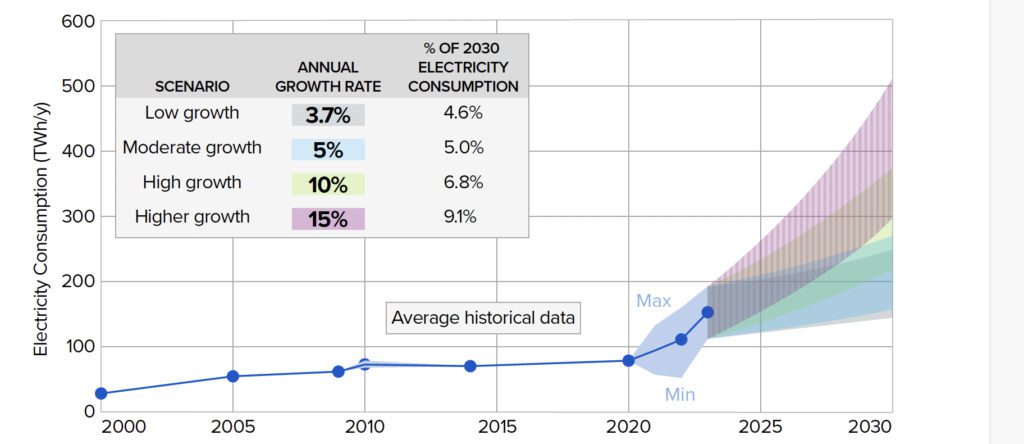
Power and Data Center Sectors Join Forces to Resolve …
(Source: POWER Magazine)
| Partner / Project | Time Frame | Details and Strategic Purpose | Source |
|---|---|---|---|
| Emerald AI, EPRI, Digital Realty, PJM | October 2025 | Developing the world’s first “power-flexible AI factory” in Virginia, creating a reference design to unlock 100 GW of capacity on the U.S. grid. | NVIDIA, Emerald AI, EPRI, PJM and Others to Develop… |
| U.S. Department of Energy (DOE), Oracle | October 2025 | Partnering to build two of the largest next-generation AI supercomputers for national security and energy research. | Energy Department Announces New Partnership with… |
| Vertiv | October 2025 | Co-developing flexible and rapidly deployable reference architectures for power and cooling in gigawatt-scale data centers, supporting NVIDIA‘s Omniverse DSX blueprint. | Delivering Flexibility at Gigawatt-Scale: Vertiv Announces… |
| ABB | October 2025 | Collaborating on next-generation power solutions, specifically for 800 VDC power systems, to enable high-efficiency power delivery for future AI workloads. | ABB to develop next-generation AI data centers with NVIDIA |
| National Grid, Emerald AI | September 2025 | A UK-based demonstration project to prove data centers can support grid stability and accelerate new connections to the electricity network. | National Grid and Emerald AI announce strategic… |
| Schneider Electric | June 2025 | Co-developing AI-ready power and cooling systems, including an 800 VDC sidecar capable of powering racks up to 1.2 MW. | Schneider Electric and NVIDIA Partner to Power… |
| EPRI DCFlex Initiative | October 2024 | Co-founded an initiative with EPRI, Google, and Meta to demonstrate how data centers can act as grid-support assets through load shifting and demand response. | EPRI launches data center flexibility initiative… |
NVIDIA’s Global Footprint: Expanding AI Data Center Power from the US to Asia
NVIDIA‘s geographic strategy has evolved from enabling AI capacity in new markets to driving massive, power-centric infrastructure build-outs in the U.S. and targeted grid-integration projects in Europe.
- Between 2021 and 2024, NVIDIA‘s international efforts focused on establishing a foothold in high-growth Asian markets. This was demonstrated by the $4.3 billion AI infrastructure project with YTL Power in Malaysia (December 2023) and partnerships with Reliance Jio and Tata Group in India (September 2023) to build gigawatt-scale AI capacity.
- From 2025 onward, the focus intensified on the United States as the epicenter of gigawatt-scale development, driven by the extreme power needs of its largest partners. Projects like the OpenAI “Stargate” (up to 5,000 MW), the 2,000 MW IREN Sweetwater AI Campus in Texas, and the 2,300 MW modular gas fleet for Oracle in Texas signify a concentration of activity in power-rich U.S. regions.
- Simultaneously, NVIDIA‘s European activities in 2025 became more focused on grid technology and sustainability. The partnership with National Grid in the UK to demonstrate power flexibility and the collaboration with Schneider Electric to develop sustainable infrastructure across Europe highlight a strategic effort to solve grid integration challenges in mature but constrained markets.
Technology Maturity: NVIDIA’s Push from Efficient Chips to Commercial Grid-Interactive AI Factories
NVIDIA‘s technological focus has matured from improving performance-per-watt at the chip level to commercially deploying system-level power management and grid-interactive data center architectures.
- In the 2021-2024 period, the core technological strategy was centered on hardware efficiency. The launch of the Blackwell B200 GPU in March 2024, promising a 25x energy reduction over the H100, and the development of the power-efficient Grace CPU Superchip were primary examples of addressing the power problem at the component level.
- By 2025, the technology moved to the system and ecosystem level, with a clear focus on commercial implementation. The “power-flexible AI factory” reference design with Emerald AI is a prime example, shifting from a concept to a live project in Virginia. This initiative aims to turn data centers into dispatchable grid assets.
- This shift is further validated by the industry-wide push for the 800V HVDC power architecture, which NVIDIA is driving for a 2027 rollout. Partnerships with infrastructure giants like ABB and Schneider Electric to develop compatible solutions confirm that this is no longer an R&D effort but a new commercial standard being actively built out to support future 1 MW-per-rack systems.
SWOT Analysis: NVIDIA’s Strategic Evolution in the AI-Energy Market
Table: NVIDIA’s SWOT in the AI-Energy Sector 2021-2025

Nvidia: Data Center Dominance Has Only Just Begun (NASDAQ …
(Source: Seeking Alpha)
| SWOT Category | 2021 – 2024 | 2025 – Today | What Changed / Validated |
|---|---|---|---|
| Strengths | Dominant market position in AI GPUs; ability to set de facto hardware standards due to market share. | Ecosystem leadership; ability to dictate power standards (800V HVDC) and attract massive capital ($100B with Brookfield) to solve its own bottlenecks. | The company’s strength evolved from technology leadership to comprehensive ecosystem control, influencing both capital allocation and infrastructure design. |
| Weaknesses | Extreme power consumption of its own products (e.g., H100) created a significant market challenge and potential growth ceiling. | Deep dependency on the successful execution of partnerships with utilities, power generation companies, and grid operators to realize future growth. | The core weakness (power draw) became the primary driver of its new corporate strategy, forcing it to enter the energy sector to secure its future. |
| Opportunities | Expand AI infrastructure into new global markets by forming alliances with local conglomerates like YTL Power (Malaysia) and Reliance Jio (India). | Create new revenue streams and markets by turning data centers into grid-interactive assets (Emerald AI partnership) and selling AI solutions to the utility sector (SCE collaboration). | The opportunity grew from selling more chips to selling and standardizing the entire AI factory ecosystem, including power management software and services. |
| Threats | Grid constraints, long interconnection queues, and insufficient power generation capacity were general risks that could slow data center deployment. | The sheer scale of demand (5,000 MW for OpenAI Stargate) creates an acute project-level threat that outstrips grid capacity, making projects non-viable without dedicated power. | The threat evolved from a systemic risk to a critical, immediate bottleneck, validating the strategy of securing multi-gigawatt, behind-the-meter power like the Oracle/VoltaGrid deal. |
Forward-Looking Insights: NVIDIA’s Next Move Toward Dedicated Power Generation
NVIDIA‘s next strategic phase will focus on directly enabling the co-location of AI data centers with dedicated, gigawatt-scale, carbon-free power sources to bypass grid limitations and secure its long-term growth.
- The current trend of securing behind-the-meter power is validated by the 2,300 MW modular natural gas fleet being deployed by VoltaGrid for Oracle‘s AI expansion. This model, which bypasses traditional grid interconnection queues, provides a blueprint for future deployments.
- NVIDIA‘s leadership has already signaled a long-term interest in nuclear energy, as seen when a company it backs explored building a data center near a nuclear plant in Japan in October 2024. This indicates a strategic push toward securing stable, 24/7 baseload power required for massive AI factories.
- The power requirements of next-generation projects, such as OpenAI‘s multi-phase 5,000 MW “Stargate” supercomputer, are too large for most existing grid infrastructure to handle. This makes on-site generation, such as Small Modular Reactors (SMRs), a logical and necessary next step.
- Financial vehicles like the $100 billion AI infrastructure program with Brookfield provide NVIDIA and its partners with the direct investment capability needed to fund these capital-intensive energy projects in tandem with data center construction, effectively de-risking the entire AI hardware-to-energy value chain.
Frequently Asked Questions
What is the main change in NVIDIA’s strategy regarding data center power?
NVIDIA has shifted its strategy from simply supplying power-intensive components (like GPUs) to actively architecting the entire energy ecosystem. Before 2025, it focused on partnerships to build capacity in new markets. Starting in 2025, it began designing grid-interactive data centers and directly financing the energy systems required to power them, becoming an ‘energy architect’ rather than just a component supplier.
Why is NVIDIA investing billions in data centers and power infrastructure?
NVIDIA’s high-performance GPUs create immense power demands, making energy availability a critical bottleneck for AI growth. To ensure that energy shortages do not limit the deployment of its hardware, NVIDIA is investing billions (e.g., the $100 billion programs with Brookfield and OpenAI) to fund the entire data center and power value chain, thereby securing its own future market.
What is a ‘power-flexible AI factory’ and why is it significant?
A ‘power-flexible AI factory,’ like the one being developed with Emerald AI and PJM, is a data center designed to be a grid-interactive asset. Instead of just consuming power, it can adjust its workload in response to grid conditions (demand response). This is significant because it helps stabilize the power grid and can unlock massive amounts of existing grid capacity, with the Virginia project aiming to create a reference design to unlock 100 GW.
How has NVIDIA’s geographic focus for AI infrastructure projects changed?
Between 2021 and 2024, NVIDIA’s focus was on establishing AI capacity in high-growth Asian markets like Malaysia (with YTL Power) and India (with Reliance Jio). From 2025 onward, the focus has intensified dramatically on the United States to support the gigawatt-scale power needs of its largest partners, with massive projects concentrated in power-rich regions like Texas.
According to the analysis, what is the next major step in NVIDIA’s power strategy?
The next strategic phase will focus on bypassing traditional grid limitations by directly co-locating AI data centers with dedicated, gigawatt-scale power generation. This is driven by the enormous power needs of projects like OpenAI’s ‘Stargate’ (up to 5,000 MW). The article suggests this will involve behind-the-meter natural gas plants and, in the long term, stable, carbon-free sources like Small Modular Reactors (SMRs).
Experience In-Depth, Real-Time Analysis
For just $200/year (not $200/hour). Stop wasting time with alternatives:
- Consultancies take weeks and cost thousands.
- ChatGPT and Perplexity lack depth.
- Googling wastes hours with scattered results.
Enki delivers fresh, evidence-based insights covering your market, your customers, and your competitors.
Trusted by Fortune 500 teams. Market-specific intelligence.
Explore Your Market →One-week free trial. Cancel anytime.
