

Offshore Wind Capital Shifts, Shell’s $1 B Sale, RWE’s $6.8 B Con Edison Buy, and 2 Major Divestitures (2022 to 2026)
Renewables Strategy Divergence, Shell’s $1 B Exit Signals Capital Discipline
A fundamental divergence in corporate strategy is splitting the energy sector, as oil majors re-evaluate their role in renewable power generation amid persistent market headwinds and pressure for higher returns. This strategic fragmentation sees companies like Shell retreat from capital-intensive renewables to fund core oil and gas operations, while specialized utilities and infrastructure funds opportunistically acquire these assets to build scale.
- Between 2021 and 2024, integrated energy majors broadly pursued diversification, with Shell investing over US$1 billion annually into solar and wind, accounting for 12%-15% of its capital expenditure. This period was marked by portfolio expansion as a primary strategy to participate in the energy transition.
- The period from 2025 to 2026 marks a sharp reversal, driven by deteriorating project economics. Shell initiated plans to divest its offshore wind portfolio for over $1 billion, a move to recycle capital back into higher-margin businesses like LNG and deepwater oil. This followed previous exits from European onshore projects and the shelving of new offshore wind investments.
- This retreat created acquisition opportunities for players with different financial structures. Pure-play renewable operators like RWE and infrastructure investors like Brookfield are positioned to acquire these portfolios, as their business models are built to accommodate the lower, more stable returns of long-life infrastructure assets.
- Policy instability, particularly in the U.S. following the passage of the One, Big, Beautiful Bill (OBBBA), accelerated this divergence. Changes to tax credit timelines and a federal pause on new project leases since late 2025 introduced significant uncertainty, punishing companies without a dedicated, long-term commitment to the sector. This policy shift contributed to the shelving of at least $8 billion in planned projects and a subsequent 36% drop in U.S. clean energy investment, according to data on Google’s energy procurement plans.
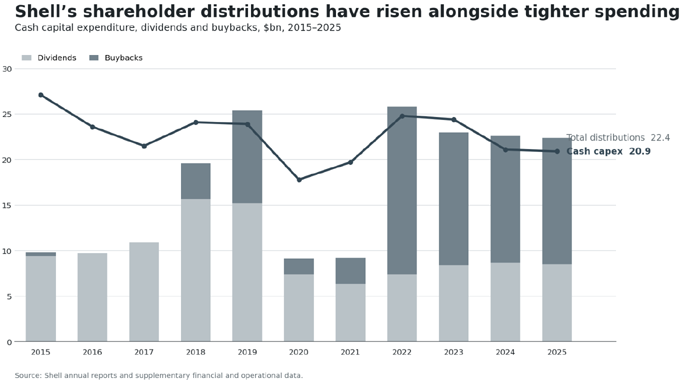
Shell Boosts Shareholder Payouts Amid Tighter Spending
This chart directly illustrates the ‘capital discipline’ mentioned in the section heading. It visually connects Shell’s strategic shift (tighter spending) with its financial outcome (increased shareholder payouts), which is a core theme of the company’s change in renewables strategy.
(Source: KeyfactsEnergy)
$6.8 B Acquisition, RWE Accelerates US Renewables Scale
Recent high-value transactions demonstrate that capital is not fleeing the renewables sector but is being reallocated from integrated energy companies to specialized operators and funds with a lower cost of capital and a dedicated focus on green infrastructure. This trend concentrates renewable assets in the hands of entities structured for long-term ownership, while oil majors recycle capital into ventures with higher and faster returns.
- Shell’s planned sale of its offshore wind assets for over $1 billion is a primary example of capital recycling. The divestment is intended to release funds for reinvestment into its core oil, gas, and LNG trading businesses, which offer more favorable return profiles.
- RWE’s $6.8 billion acquisition of Con Edison’s Clean Energy Businesses in 2022 serves as a direct parallel. RWE used the transaction to absorb a 3 GW operating portfolio and a 7 GW development pipeline, immediately establishing itself as the fourth-largest renewables operator in the U.S. market.
- In 2023, Duke Energy sold its commercial renewables business to Brookfield Renewable for $2.8 billion. This move was explicitly framed as a way to fund grid modernization and focus on its core regulated utility business, mirroring the rationale of both Shell and Con Edison.
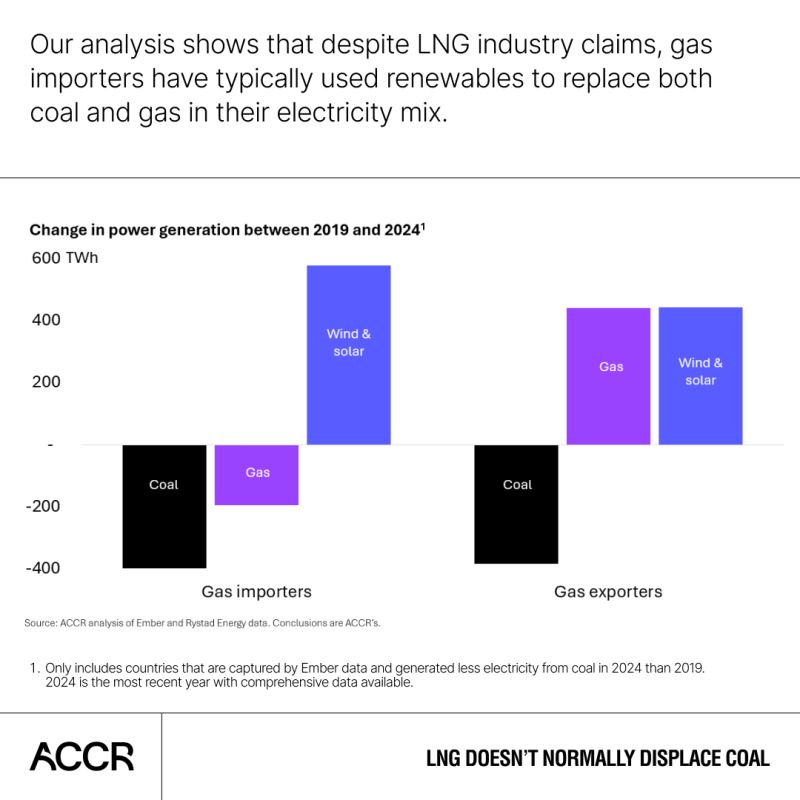
Renewables Displace Both Coal and Gas in Key Markets
This chart provides the macro-environmental context for RWE’s acquisition. It demonstrates the underlying market trend in the US (‘a key market’) that justifies a large-scale investment in renewables, showing why companies are accelerating their scale in the region.
(Source: LinkedIn)
Table: Strategic Divestitures in Renewable Energy
| Seller | Buyer | Asset Type / Size | Deal Value ($B) | Year | Stated Rationale for Seller | Source |
|---|---|---|---|---|---|---|
| Shell | TBD | Offshore Wind Portfolio | 1.0+ | 2026 (Planned) | Refocus on higher-return businesses (oil, gas, LNG); retreat from capital-intensive renewables. | Bloomberg |
| Con Edison | RWE | Clean Energy Businesses (3 GW operating, 7 GW pipeline) | 6.8 | 2022 | Refocus on core regulated utility business and grid investments. | Con Edison |
| Duke Energy | Brookfield Renewable | Commercial Renewables (3.4 GW) | 2.8 | 2023 | Capital recycling to fund grid modernization and focus on regulated utility growth. | Duke Energy |
| Ørsted | Stonepeak | 80% stake in 957 MW Onshore Wind Portfolio | 0.3 | 2024 | Capital recycling to fund new projects while retaining operational control. | Power Technology |

Shell Sells Wind Farms Amid Weak Renewables Value
The section is a table of divestitures. This chart’s headline serves as a perfect, concrete example of an entry that would appear in such a table, illustrating the ‘Strategic Divestitures in Renewable Energy’ theme with a specific case involving Shell.
(Source: LinkedIn)
US vs. Europe, Shell Navigates Divergent Policy Risk
Heightened policy and regulatory volatility in the United States, a key offshore wind growth market, has become a primary driver for strategic exits, contrasting with the more established, albeit still challenging, policy environment in Europe. This regional risk divergence forces companies to re-evaluate their geographic exposure, favoring markets with greater regulatory predictability.
- While the global offshore wind market maintained a strong growth trajectory through 2024, driven largely by deployments in China and Europe, the risk profile of the U.S. market deteriorated significantly in 2025. A federal pause on new offshore wind leases, coupled with altered tax credit qualifications, directly impacted project economics and investor confidence.
- These policy shifts contributed to over $34.8 billion in project cancellations and an 11% spike in the Levelized Cost of Energy (LCOE) for new builds, creating an unstable environment for developers. For an integrated major like Shell, this level of uncertainty makes long-term capital allocation difficult compared to its more predictable fossil fuel projects.
- In contrast, European players like Ørsted, which is progressing toward a 9 GW portfolio, and Equinor, despite facing their own challenges, operate within more mature regulatory frameworks. This stability allows them to underwrite long-term projects with greater confidence, making them natural owners of divested assets.
- Even with a more stable policy backdrop, European operators are not immune to market pressures. Total Energies, while targeting 30 GW of wind capacity, faces grid connection delays with partners like Tenne T in Germany, demonstrating that infrastructure constraints remain a universal challenge.

Global Commitments to Renewable and Net-Zero Targets
This chart is the best fit as it directly addresses the ‘Divergent Policy Risk’ between the US and Europe. It would visualize the differing levels of policy commitment and targets across regions, which is the source of the risk Shell must navigate.
Shell Exits TRL 9 Assets, Market Focus Shifts to LCOE (2025 to 2026)
The strategic challenge in offshore wind has decisively shifted from technological viability to economic execution, as the sector’s mature, commercial-scale technology (TRL 8-9) proves vulnerable to macroeconomic and policy-driven cost pressures. The core issue is no longer whether the turbines work but whether projects can be delivered on budget in an inflationary and uncertain environment.
- During the 2021-2024 period, the industry successfully commercialized multi-megawatt turbines on fixed-bottom foundations, proving the technology at scale. The focus was on securing leases and building a development pipeline based on the assumption of continuously falling costs.
- From 2025 onward, this assumption was broken by persistent inflation, supply chain disruptions, and rising interest rates. This changed the fundamental economics of projects, with data showing that a shift in the Weighted Average Cost of Capital (WACC) from 4% to 9% can double a project’s LCOE from approximately $74/MWh to $184/MWh.
- Shell’s portfolio consists of these mature assets, meaning the company is not divesting unproven technology. It is exiting de-risked projects because the financial returns no longer meet its internal thresholds when compared to its core oil and gas ventures.
- Consequently, the value proposition for acquirers is not in proprietary technology but in operational expertise, grid interconnection rights, and long-term offtake agreements. Buyers are purchasing de-risked steel in the water, and their ability to create value depends on managing operational costs and financial structures more efficiently than the seller.

Shell Financial Forecasts Amid Renewables Divestment
This chart aligns perfectly with the section’s forward-looking nature (2025-2026) and focus on divestment. It connects the strategic ‘exit’ from certain assets directly to the company’s financial ‘forecasts’, which is the logical focus after a major strategic shift.
(Source: Yahoo Finance)
$1 B Divestment, Shell’s Exit Creates a Buyer’s Market
Shell’s divestment, alongside similar strategic reviews by its peers, is set to accelerate market consolidation and create a buyer’s market where specialized renewable operators and infrastructure funds can acquire de-risked assets at more attractive valuations. The critical signal to watch is whether other oil majors follow Shell’s lead, and at what price these portfolios transact.
- If this happens: More integrated energy companies prioritize shareholder returns and de-prioritize capital-intensive renewable generation, creating a steady stream of M&A opportunities for well-capitalized buyers. This would confirm a structural shift in asset ownership across the sector.
- Watch this: The valuation multiples achieved in upcoming divestments. If portfolios trade at a discount compared to the highs of 2021-2022, it will confirm a transfer of value from motivated sellers to strategic buyers and validate the emergence of a buyer’s market.
- These could be happening: Increased deal activity led by pure-play renewables companies and infrastructure funds. Companies like Ørsted and RWE will likely act as consolidators, while oil majors with a continued renewables focus, such as Total Energies and Equinor, will become more selective, potentially targeting distressed assets or smaller, bolt-on acquisitions. The cancellation of over $8 billion in wind projects further pressures smaller developers, potentially making them acquisition targets.

Shell’s Renewables Unit Suffers Losses
This chart explains the fundamental reason behind Shell’s divestment creating a ‘buyer’s market’. The financial losses in the renewables unit provide the motivation for Shell to sell, making it a motivated seller and thus creating favorable conditions for buyers.
(Source: LinkedIn)
The questions your competitors are already asking
This report covers one angle of the strategic divergence in renewable energy investment. The questions that matter most depend on your work.
- Infrastructure funds buying renewable energy assets
- Offshore wind asset sale prices
- Other oil majors selling renewable projects
- Current status of US offshore wind leases
This report does not answer these. Enki Brief Pro does.
Your question, your angle, your framework. SWOT, PESTL, scenario modelling. The same niche depth, built around the decision your work actually depends on.
