

Xcel Energy BESS Strategy, $60 B Plan, 600 MW Sherco Project with Form Energy, and 5 Key Initiatives (2025)
BESS Adoption, Xcel Energy’s Dual Centralized and Distributed Model
In 2025, Xcel Energy executed a structural pivot in its grid strategy, advancing beyond supplemental storage pilots to a core, dual-pronged model that uses massive centralized batteries to replace fossil fuel capacity while pioneering a distributed network to manage grid-edge constraints.
- Prior to 2025, Xcel’s storage portfolio consisted of smaller-scale pilots, but this year saw the proposal for the 600 MW Sherco Energy Hub battery, a utility-scale project designed to directly replace the capacity of a retiring coal plant and become the largest of its kind in the Upper Midwest.
- The company introduced the ‘Capacity*Connect’ program in Minnesota, a first-of-its-kind plan to build a 200 MW distributed battery network by 2028, representing a new utility model for procuring grid services through a virtual power plant (VPP).
- Xcel diversified its technology approach beyond conventional lithium-ion by advancing a pilot with Form Energy to deploy a 10 MW / 1, 000 MWh iron-air battery, a long-duration storage asset intended to solve multi-day renewable intermittency.
- The strategy extends to the customer level with the Renewable Battery Connect Program in Colorado, which offers rebates for residential battery installations, creating a full-stack approach that integrates assets from utility-scale down to individual homes.
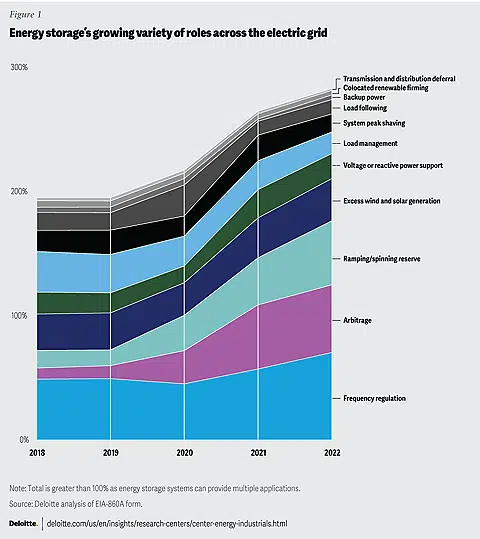
Grid Energy Storage Systems Take On More Roles
This chart complements the section’s discussion of Xcel’s dual centralized and distributed model by illustrating the expanding set of functions (roles) that a diverse BESS portfolio can provide to the grid, from frequency regulation to renewable energy integration.
(Source: Deloitte)
$60 B Capital Plan, Xcel Energy BESS and Grid Modernization
Xcel Energy is backing its ambitious storage strategy with a substantial, multi-billion-dollar capital injection, leveraging a combination of its own balance sheet, federal grants, and tax incentives to de-risk and accelerate its grid transformation.
- In October 2025, the company announced it was increasing its five-year capital plan to $60 billion, with significant funds earmarked for 7.5 GW of new renewable generation and energy storage capacity to meet rising electricity demand.
- The U.S. Department of Energy awarded Xcel a grant of up to $70 million to support its long-duration energy storage projects, providing federal validation and a significant cost reduction for its iron-air battery pilot with Form Energy.
- A proposed investment of $430 million is allocated for the ‘Capacity*Connect’ program, a material financial commitment to building out its distributed battery network and VPP capabilities across Minnesota.
- The financial viability of these projects is heavily dependent on federal incentives, with Xcel anticipating its 600 MW Sherco battery project will qualify for a 40% Investment Tax Credit offset under the Inflation Reduction Act (IRA).

Xcel Energy Details $45B Capital Forecast
The chart directly visualizes the capital commitment discussed in the section. While the headline mentions a $60B plan, this chart showing a $45B forecast provides specific, company-related financial data that substantiates Xcel’s significant investment in grid modernization and BESS.
(Source: LinkedIn)
Table: Xcel Energy 2025 Strategic Investments in Energy Storage
| Project / Investment | Time Frame | Details and Strategic Purpose | Source |
|---|---|---|---|
| Five-Year Capital Plan | 2025-2029 | $60 billion total plan to fund grid modernization, including 7.5 GW of new renewables and storage to enhance reliability. | Utility Dive |
| DOE Grant for LDES | October 2025 | Up to $70 million in federal funding to lower the cost of deploying long-duration storage technologies like the Form Energy iron-air battery. | Electric Perspectives |
| `Capacity*Connect` Program | November 2025 | $430 million proposed investment to build a 200 MW VPP by deploying utility-owned batteries at commercial sites across Minnesota. | Energy Central |

Energy Storage Market to Reach $47.7B by 2032
This chart provides financial context for the investment details in the table. By showing the significant projected value of the energy storage market, it underscores the rationale behind Xcel Energy’s strategic investments in this sector.
(Source: openPR.com)
Xcel Energy 3 Key 2025 Partnerships from Form Energy to Sparkfund
Xcel Energy’s 2025 strategy depends on critical alliances with technology pioneers and development specialists to execute its diverse storage portfolio, signaling a shift from a purely self-build model to one that incorporates external innovation and expertise.
- The partnership with Form Energy is central to Xcel’s long-term strategy, enabling the utility to pilot a 100-hour duration iron-air battery to address the future challenge of multi-day renewable shortfalls.
- Collaboration with Sparkfund is foundational to the proposed ‘Capacity*Connect’ program, leveraging Sparkfund’s capabilities to deploy and manage a distributed network of batteries at commercial and industrial sites.
- A 15-year tolling agreement with Panamint Capital LLC for a planned battery project demonstrates a strategy of using power purchase agreements with third-party developers to secure capacity without direct capital outlay.
- The market for these large-scale projects is attracting major suppliers, with companies like Sungrow becoming key players in the BESS supply chain.

Metal-Air Battery Market Shows Strong Growth
The section highlights a key partnership with Form Energy, a pioneer in iron-air battery technology. This chart is a direct match, as it shows the growth in the specific ‘metal-air’ battery market, justifying Xcel’s strategic interest in this emerging long-duration storage solution.
(Source: maximize market research)
Table: Xcel Energy 2025 Strategic Partnership Analysis
| Partner | Time Frame | Details and Strategic Purpose | Source |
|---|---|---|---|
| Sparkfund | October 2025 | Development partner for the ‘Capacity*Connect’ proposal, a distributed battery network intended to function as a 200 MW virtual power plant. | Power Magazine |
| Panamint Capital LLC | June 2025 | Signed a 15-year tolling agreement for a planned battery energy storage project, securing long-term capacity from a third-party asset. | Panamint Capital |
| Form Energy, Inc. | February 2025 | Technology deployment partner for a 10 MW / 1, 000 MWh iron-air battery system, piloting a solution for multi-day energy storage. | [PDF] Michigan Public Service Commission |

Renewable Storage Market to Reach $2.79B by 2033
This chart provides the market justification for the partnerships analyzed in the table. The projected growth of the ‘Renewable Storage’ market highlights the financial opportunity and strategic importance of forming alliances in this space.
(Source: openPR.com)
Minnesota Focus, Xcel Energy’s 935 MW in BESS Project Proposals
In 2025, Xcel Energy concentrated its most transformative battery storage initiatives in Minnesota, establishing the state as a national proving ground for both utility-scale coal-to-clean transitions and innovative distributed grid services.
- While pre-2025 activities were more geographically dispersed, this year saw a clear strategic focus on Minnesota, which hosts the company’s most ambitious proposals, including the 600 MW Sherco BESS, the 135.5 MW Blue Lake BESS, and the 200 MW statewide ‘Capacity*Connect’ program.
- Colorado remains a key secondary market, hosting another planned Form Energy pilot at the Comanche generating station and the customer-focused Renewable Battery Connect residential battery program.
- Future geographic expansion is signaled by plans to seek regulatory approval in Q 2 2025 for a new portfolio of generation projects in Texas and New Mexico to meet growing demand, which is expected to include additional storage assets.

U.S. Utility-Scale Battery Storage Booms in 2025
This chart provides the national context for the section’s focus on Minnesota. It shows that Xcel Energy’s 935 MW in local project proposals are part of a massive, nationwide boom in utility-scale battery storage, positioning the company as a key player in this trend.
(Source: Utility Dive)
BESS Technology, Xcel Energy Pilots LDES and Scales LFP
Xcel Energy’s 2025 initiatives reveal a two-track technology strategy: aggressively deploying commercially mature Lithium Iron Phosphate (LFP) batteries for bulk capacity while simultaneously piloting next-generation iron-air storage to de-risk future long-duration needs.
- The decision to use LFP technology for the 600 MW Sherco project confirms its status as the bankable, go-to chemistry for utility-scale applications, valued for its longer lifespan and improved safety profile over other lithium-ion variants.
- The Form Energy pilot moves iron-air technology from the lab toward commercial validation, addressing a critical grid requirement that 4-hour LFP batteries cannot: cost-effective, multi-day storage (100-hour duration).
- This dual approach mitigates technology risk by separating proven, large-scale deployment from the validation of emerging solutions, allowing Xcel to meet current reliability needs while preparing for a grid with even higher renewable penetration.
- The company is also exploring novel energy transport concepts, demonstrated by its participation in the Sun Train pilot in Denver, which tests the feasibility of moving stored electricity via rail.
Xcel Energy SWOT Analysis for BESS Strategy (2025)
Xcel Energy’s 2025 storage strategy leverages strong regulatory alignment and first-mover positioning in its core markets, but it also introduces significant execution risks associated with complex supply chains and the operational demands of its new distributed energy models.

Battery Storage Market to Surpass $170B
A SWOT analysis requires an understanding of external market opportunities. This chart’s forecast of a $170B+ market perfectly quantifies the significant ‘Opportunity’ available to Xcel Energy, framing the entire rationale for its BESS strategy.
(Source: openPR.com)
Table: SWOT Analysis for Xcel Energy’s 2025 BESS Initiatives
| SWOT Category | 2021 – 2024 | 2025 to Today | What Changed / Validated |
|---|---|---|---|
| Strengths | Strong balance sheet and experience with large capital projects. Established regulatory relationships in core states. | Secured a $60 billion, five-year capital plan. Gained initial approvals for its Upper Midwest Energy Plan, which includes storage. | Financial capacity and regulatory support were validated as key enablers for the aggressive 2025 push into large-scale storage. |
| Weaknesses | Limited operational experience with large-scale BESS and distributed VPP models. Exposure to technology risk in emerging storage types. | Proposing first-of-its-kind distributed network (`Capacity*Connect`) with high operational complexity. Heavy reliance on a few key technology partners. | The 2025 strategy amplifies exposure to execution risk by simultaneously pursuing massive centralized projects and a complex, novel distributed model. |
| Opportunities | Potential for federal funding (IRA). Growing need for grid reliability as renewables expand. | Secured a $70 million DOE grant. Aligned projects to capture a 40% ITC. Positioned itself as a market leader in coal-to-storage transitions. | Xcel successfully translated the potential of federal incentives into tangible financial benefits for its key projects, improving their economic viability. |
| Threats | Supply chain volatility for batteries and components. Potential for regulatory pushback on project costs. | Success of the $60 B plan is contingent on timely regulatory approvals. Major projects depend on managing complex global supply chains for LFP batteries. | The scale of the 2025 projects increases sensitivity to supply chain disruptions and regulatory timelines, making these the primary external threats to execution. |
2026 Outlook: Xcel Energy Regulatory Approvals and Project Execution
The viability of Xcel Energy’s ambitious 2025 strategy now hinges on securing timely regulatory approvals in 2026 for its cornerstone projects in Minnesota, with outcomes poised to either accelerate or delay its planned energy transition.
- The primary signal to watch is the Minnesota Public Utilities Commission’s decision on the 600 MW Sherco BESS. Approval would validate the utility-scale battery-for-coal replacement model and trigger the planned 2026 construction start.
- Equally critical is the regulatory verdict on the ‘Capacity*Connect’ proposal. Greenlighting the program would establish a new paradigm for how utilities can partner to build and operate VPPs, influencing strategies nationwide.
- Progress on the Form Energy pilot will be closely monitored. Any early performance or cost data released in 2026 will be a crucial indicator for the commercial future of long-duration iron-air technology across the industry.
- The results from the upcoming all-source Request for Proposals (RFP) in Texas and New Mexico will reveal the next wave of investments and confirm whether the aggressive solar-plus-storage procurement strategy will be replicated in other service territories.

Energy Storage and Renewables Projections to 2045
This section looks ahead to 2026 and beyond. A long-term projection chart is a perfect match, as it visualizes the future landscape of energy storage and renewables in which Xcel’s future projects and regulatory efforts will operate.
(Source: Energy and Environmental Economics)
The questions your competitors are already asking
This report covers one angle of Xcel Energy’s battery storage and grid modernization strategy. The questions that matter most depend on your work.
- Xcel Energy’s activities in long-duration storage. Is the Form Energy iron-air pilot progressing to full-scale deployment?
- What is the outlook for distributed battery (VPP) deployment in Xcel’s service territories by 2028?
- How does Form Energy’s iron-air technology compare to lithium-ion for replacing retiring coal plants?
- Who are Xcel Energy’s key suppliers for its utility-scale battery projects?
This report does not answer these. Enki Brief Pro does.
Your question, your angle, your framework. SWOT, PESTL, scenario modelling. The same niche depth, built around the decision your work actually depends on.
