

ADNOC DAC Strategy, $500 M Occidental Exploration, $3.8 B Project Lightning, and 6 Key Partnerships (2025)
Industry Adoption: ADNOC’s Dual-Pronged Energy Strategy
In 2025, Abu Dhabi National Oil Company (ADNOC) adopted a capital-intensive dual strategy, using profits from its hydrocarbon expansion to fund a parallel, pragmatic pivot into decarbonization and distributed energy. This marks a significant shift from the 2021-2024 period, which was characterized by incremental efficiency gains within its core business, to a new phase where large-scale clean energy projects are integrated with its long-term corporate objectives.
- Prior to 2025, ADNOC‘s sustainability efforts were substantial but largely focused on operational efficiency and planning. The period of 2025 to today has seen the execution of flagship projects that were previously in conceptual stages.
- A primary example of distributed energy adoption is the ADNOC Distribution partnership with Emerge to install solar photovoltaic panels at over 100 service stations, a tangible, consumer-facing application of renewable energy to decarbonize its retail footprint.
- On an industrial scale, the $3.8 billion ‘Project Lightning’ to electrify offshore production facilities represents a major commitment to decarbonizing core operations, aiming to cut emissions by connecting them to a cleaner mainland grid.
- ADNOC moved into emerging technology frontiers by exploring a joint venture with Occidental for a Direct Air Capture (DAC) hub in Texas, signaling an adoption strategy that spans from mature renewables to early-stage negative emissions technologies.
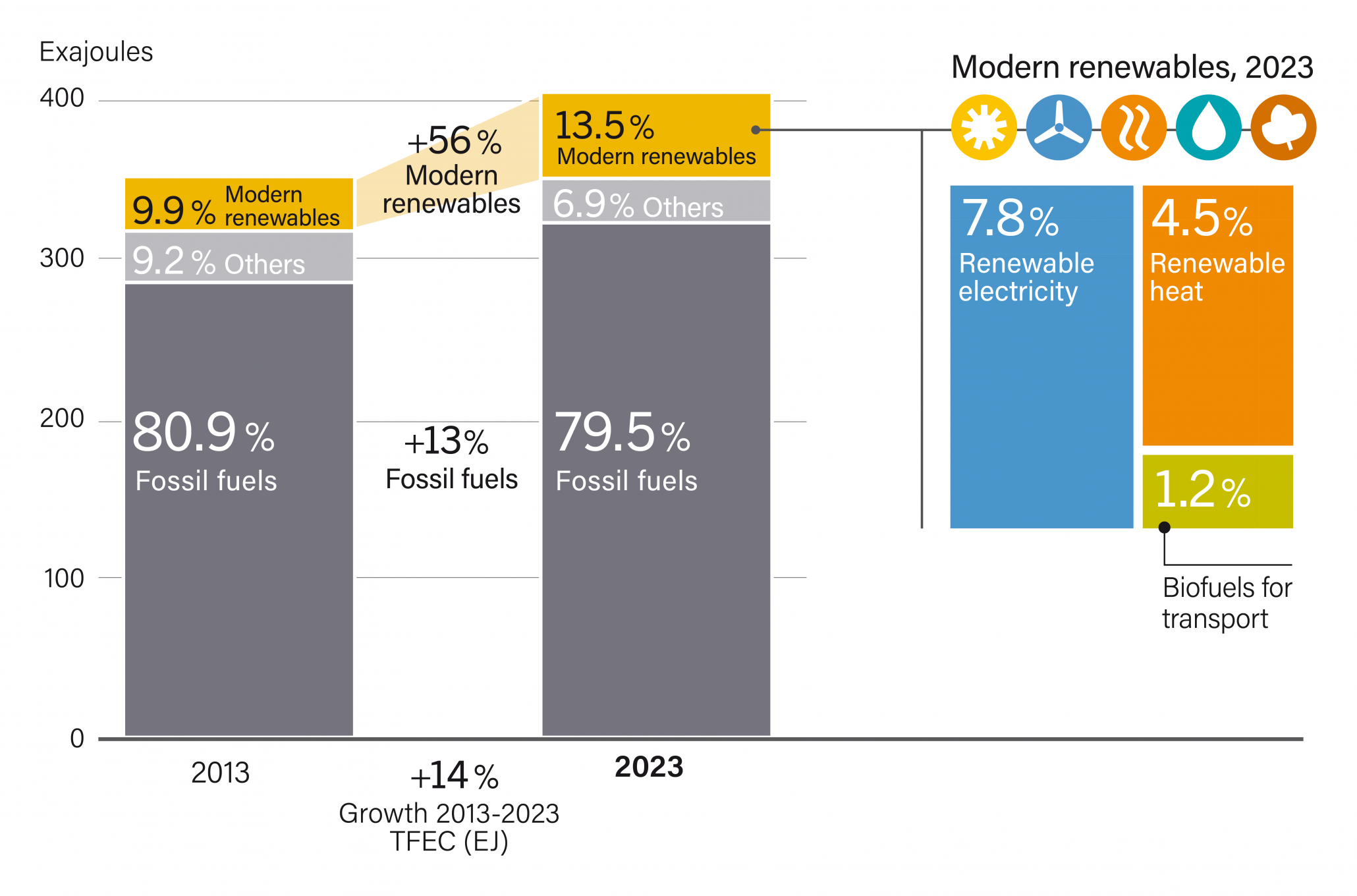
Renewables Grew 56% But Fossil Fuels Still Dominate
This chart illustrates the context for ADNOC’s ‘dual-pronged’ strategy. The significant growth in renewables justifies the transition effort, while the continued dominance of fossil fuels explains the ongoing investment in traditional energy sources.
(Source: REN21)
Investment: $47 B in Capital Commitments Signal ADNOC’s Transition Funding
ADNOC is leveraging its formidable financial strength from traditional energy sales to underwrite its expansion into new and decarbonized energy systems. The company has allocated tens of billions in 2025 towards a combination of shareholder returns, large-scale infrastructure decarbonization, and speculative investments in future technologies, demonstrating a clear capital-recycling strategy.
- The financial foundation for these investments is a core business targeting a production capacity of 5 million barrels per day by 2027 and a dividend distribution of $43 billion through 2030.
- A cornerstone decarbonization investment is the $3.8 billion ‘Project Lightning, ‘ a sub-sea transmission network designed to slash emissions from offshore operations by up to 50% by replacing fossil-fuel-based power generation.
- Signaling its ambition in next-generation climate technology, ADNOC, through its investment arm XRG, is exploring a potential $500 million investment with Occidental to develop a large-scale Direct Air Capture hub.
- To accelerate its broader energy strategy, ADNOC has established strategic agreements with U.S. majors that could facilitate up to $60 billion in investments across the gas, LNG, and specialty chemicals value chain over the projects’ lifespan.
Table: ADNOC Strategic Investments in 2025
| Project / Investment Focus | Time Frame | Details and Strategic Purpose | Source |
|---|---|---|---|
| Dividend Distribution Target | By 2030 | Targeting $43 billion (AED 158 billion) in dividends across listed companies, providing financial stability while funding growth. | Energy Connects |
| Project Lightning | Aug 2025 | A $3.8 billion investment in a sub-sea transmission network to connect offshore facilities to the onshore grid, reducing the carbon footprint of production. | Observer Research Foundation |
| Texas Direct Air Capture (DAC) Hub | May 2025 | Exploration of a joint venture with Occidental to build a DAC facility, representing a potential investment of $500 million. | Carbon Herald |
| US Energy Value Chain Investment | May 2025 | Agreements enabling a potential $60 billion in investments with US majors, focused on gas, LNG, and specialty chemicals. | ADNOC |
Partnership Data: ADNOC Accelerates Strategy with 6 Key Alliances
ADNOC‘s 2025 strategy relies heavily on forming strategic alliances with global and local leaders to acquire technology, share risk, and accelerate market entry into new energy sectors. This partnership-led approach, a shift from the more internally focused optimization of 2021-2024, acts as a force multiplier, enabling ADNOC to pursue multiple, diverse initiatives simultaneously from distributed solar to international carbon capture.
- For distributed generation, ADNOC partnered with Emerge, a joint venture of Masdar and EDF, to deliver a turnkey solar PV solution for its retail network, leveraging external expertise for financing, installation, and maintenance.
- To enter the negative emissions market, ADNOC signed an agreement with Occidental and its subsidiary 1 Point Five to explore a joint venture for a large-scale DAC hub, accessing established technology and project development experience.
- In technology, a collaboration with Microsoft is focused on integrating Artificial Intelligence to optimize energy consumption and enhance operational efficiency, a key enabler for its decarbonization goals.
- Strengthening its global position in carbon management, ADNOC entered a collaboration agreement with Petronas to explore opportunities in offshore CO₂ storage, expanding its technical expertise and international footprint in CCUS.
Table: ADNOC Key Strategic Partnerships in 2025
| Partner / Project | Time Frame | Details and Strategic Purpose | Source |
|---|---|---|---|
| Petronas | Oct 2025 | Agreement to explore opportunities in offshore Carbon Capture & Storage (CCS), building international capabilities. | Global CCS Institute |
| Occidental (via XRG) | May 2025 | Joint venture exploration for a DAC hub in Texas, marking a strategic entry into negative emissions technology. | Carbon Herald |
| US Energy Majors | May 2025 | Strategic agreements to facilitate up to $60 billion in US investments into UAE energy projects. | ADNOC |
| Emerge | Feb 2025 | Partnership to finance, design, and install solar PV panels at over 100 ADNOC Distribution service stations. | ADNOC Distribution |
Geography: From UAE Focus to Global Clean Energy Investment
While ADNOC‘s operational core remains centered in the UAE, its 2025 strategy for distributed and clean energy shows a marked geographic expansion, particularly into the United States. This contrasts with the 2021-2024 period, where international activity was dominated by traditional hydrocarbon sales and partnerships. The new strategy involves direct investment in clean energy assets and value chains abroad, establishing a global footprint in the energy transition.
- The most significant geographic development is the planned expansion into the US energy market. This includes the exploration of a $500 million investment in a Texas-based DAC hub with Occidental.
- Through its investment arm XRG, ADNOC is also pursuing investments in the US gas and LNG value chain, complementing its hydrocarbon business with assets in a key international market.
- The agreements signed with US energy majors, enabling a potential $60 billion in investments, create a two-way corridor for capital and technology between the UAE and the US.
- Domestically, ADNOC continues to deepen its investment in the UAE through its In-Country Value program, awarding $14.7 billion (AED 54 billion) in contracts to local suppliers in the second half of 2025 alone.

Renewable Project Pipeline Shows Strong Growth Post-2025
This chart supports the section’s theme of geographic expansion. A strong global pipeline of renewable projects provides the rationale for ADNOC to shift its investment focus from a domestic to a global scale.
(Source: Deloitte)
Technology Maturity: ADNOC Deploys a Portfolio Approach to Innovation
ADNOC‘s 2025 technology strategy has evolved from optimizing mature technologies in the 2021-2024 period to actively managing a portfolio of technologies at different maturity levels. The company is simultaneously deploying commercially proven solutions, scaling up infrastructure-level technologies, and investing in early-stage, high-potential innovations to secure a long-term competitive advantage.
- Commercial Scale Deployment: The rollout of solar PV systems at over 100 service stations with Emerge utilizes a mature, commercially viable technology to achieve immediate decarbonization wins and operational savings.
- Infrastructure Scale-Up: ‘Project Lightning’ represents the scaling of high-voltage direct current (HVDC) transmission technology in a novel sub-sea application, a complex engineering feat to decarbonize legacy assets.
- Early-Stage Exploration: The partnership with Occidental to explore a DAC hub is a strategic investment in a technology that is not yet commercial at scale but is considered critical for long-term net-zero goals, positioning ADNOC as an early mover.
- Digital Enablement: Underpinning this strategy is the use of Artificial Intelligence, developed with Microsoft, to optimize energy consumption and efficiency across all operations, from oil fields to solar installations.

Battery Storage Drives Global Energy Capacity Growth
This chart exemplifies a ‘portfolio approach to innovation.’ It highlights a specific, high-growth technology (battery storage) that is critical for the energy transition and would likely be a key component of ADNOC’s technology investment portfolio.
(Source: REN21)
SWOT Analysis for ADNOC’s Energy Transition Strategy
ADNOC’s strategic activities in 2025 have clarified both the strengths it can leverage and the inherent risks of its dual-pronged strategy. The company is capitalizing on its financial power to build new capabilities, but this pivot is tied to the continued success of its traditional hydrocarbon business.
- Strengths: Immense financial resources from its core oil and gas business provide the capital for large-scale, long-term investments in the energy transition without relying on external funding.
- Weaknesses: The company’s carbon footprint and revenue remain overwhelmingly tied to fossil fuels, creating a potential conflict with its net-zero ambitions and exposing it to transition risks.
- Opportunities: Leveraging its capital and engineering expertise to become a leader in emerging technologies like DAC and CCS, while building a significant renewable energy portfolio.
- Threats: Global policy shifts accelerating the decline of oil and gas demand could impact the revenue that funds the transition, while failure to execute on complex new technology projects presents a significant risk.
Table: SWOT Analysis for ADNOC Distributed Energy Initiatives for 2025: Key Projects, Strategies and Market Impact
| SWOT Category | 2021 – 2024 | 2025 – Today | What Changed / Validated |
|---|---|---|---|
| Strengths | Strong balance sheet and consistent hydrocarbon revenue. Established engineering capabilities. | Demonstrated willingness to deploy billions in capital ($3.8 B for Project Lightning, $500 M explored for DAC) for decarbonization projects. | Validated that ADNOC is using its financial strength not just for dividends but as a strategic tool to fund its energy transition. |
| Weaknesses | High dependency on hydrocarbon markets. Decarbonization efforts were less integrated with core strategy. | Dual strategy increases complexity. Still pursuing a 5 M bpd oil production target alongside Net Zero goals. | The inherent tension in the dual strategy is now explicit. The success of the transition is directly funded by the fossil fuel business. |
| Opportunities | Potential to leverage partnerships for new technology access. Growing global demand for low-carbon energy. | Formalized major partnerships (Occidental for DAC, US Majors for $60 B framework) and entered emerging tech markets. | The shift from potential to action. ADNOC is now actively building positions in DAC, CCS, and distributed solar through concrete partnerships. |
| Threats | Long-term oil demand uncertainty and global climate policy pressure. | Committing billions to new, sometimes unproven, technologies carries execution and financial risk. Increased scrutiny of O&G producers’ climate plans. | ADNOC is actively taking on technology and market risk (e.g., DAC) to mitigate the larger strategic threat of being left behind in the energy transition. |
Scenario Modelling: Texas DAC Decision is ADNOC’s Key 2026 Signal
The most critical strategic action to watch for ADNOC is the final investment decision (FID) on the Texas Direct Air Capture hub with Occidental. A positive decision to commit the potential $500 million would serve as the strongest validation of its commitment to becoming a leader in engineered carbon removal and would signal a tangible step beyond operational decarbonization towards addressing atmospheric CO₂.
- If ADNOC proceeds with the DAC investment, watch for follow-on announcements regarding offtake agreements for the captured carbon or plans for sequestration, which will indicate the commercial model they are pursuing.
- The deployment pace and performance data from the Emerge solar project at its service stations should be monitored. A successful, rapid rollout could lead ADNOC to expand the program to other assets or even offer similar energy-as-a-service solutions commercially.
- The strategic agreements with US majors, valued at a potential $60 billion, are currently a framework. The key signal will be the announcement of the first concrete, multi-billion-dollar project under this framework, which will clarify where ADNOC is placing its first major bets.

Diverse Scenarios for the 2050 Global Energy Mix
This chart is a perfect match, as its headline ‘Diverse Scenarios’ directly corresponds to the ‘Scenario Modelling’ theme of the section. It illustrates the concept of planning for multiple possible futures, which is central to the strategic decisions discussed.
(Source: RFF.org)
The questions your competitors are already asking
This report covers one angle of ADNOC’s execution of its dual-pronged energy strategy. The questions that matter most depend on your work.
- What is the status of ADNOC’s $3.8B ‘Project Lightning’ and is it on track to decarbonize its offshore production?
- ADNOC’s activities in negative emissions. Is the partnership with Occidental for a Direct Air Capture (DAC) hub progressing from exploration to a funded project?
- Which other national oil companies in the Middle East are adopting similar large-scale decarbonization strategies?
This report does not answer these. Enki Brief Pro does.
Your question, your angle, your framework. SWOT, PESTL, scenario modelling. The same niche depth, built around the decision your work actually depends on.
