

The 2026 Semiconductor Crisis: How AI Data Center Demand Disrupts Global Supply Chains
AI Data Center Dominance: How Semiconductor Supply Chains Are Being Reshaped in 2026
The explosive growth of artificial intelligence is causing a strategic reallocation of advanced semiconductor manufacturing capacity, prioritizing high-margin data center components and creating significant supply chain risks for other technology-dependent sectors.
- Between 2021 and 2024, the industry faced broad semiconductor shortages affecting multiple sectors due to pandemic-related disruptions. From 2025 to today, the constraint has become more specific, with chipmakers like Micron exiting consumer RAM segments to redirect capacity towards high-margin High-Bandwidth Memory (HBM) for AI servers.
- The automotive sector is now explicitly deprioritized by suppliers who favor AI data center customers. A S&P Global Mobility report warns this creates a new “semiconductor scarcity” that will directly impact automotive OEMs by 2026, threatening the production of vehicles with advanced driver-assistance systems.
- Hyperscale data center operators like Microsoft, Google, and Amazon are driving this shift, with AI infrastructure investments projected to approach $7 trillion. This demand has led to the entire near-term supply of high-end AI memory, such as HBM 3 e, being sold out, creating a hard ceiling on AI development capacity for those without massive purchasing power.
Geographic Hotspots: Analyzing the Global AI Infrastructure Buildout and Supply Constraints
The AI supply chain is geographically unbalanced, with massive infrastructure buildouts concentrated in North America while the production of critical components remains centered in Asia, creating systemic geopolitical and logistical risks.
- From 2021 to 2024, data center growth was widespread. Since 2025, the focus has shifted to massive “AI Factories” primarily in the United States, driven by hyperscalers like Meta, which is building a compute infrastructure equivalent to nearly 600, 000 NVIDIA H 100 GPUs.
- These AI data centers have immense power requirements, with rack densities reaching 50-150 k W, compared to 10-15 k W for traditional facilities. This secondary bottleneck concentrates viable locations in regions with abundant and stable energy, further narrowing the geographic scope of deployment.
- The supply side remains highly concentrated in Asia. Key memory producers like SK Hynix and Samsung, along with advanced packaging foundries like TSMC in Taiwan, control the supply of the most critical components (HBM, Co Wo S), making the entire global AI expansion dependent on this region’s manufacturing stability.
Technology Bottlenecks: Why HBM and Advanced Packaging Are the New Constraints for AI Growth
The maturity of large-scale AI models has outpaced the manufacturing capacity for the specialized memory and packaging technologies they require, shifting the primary industry bottleneck from raw processing power to component integration and data throughput.

AI Model Complexity Is Growing Exponentially
This chart explains the root cause of the technology bottleneck. It shows the exponential growth in AI model capability, which directly drives the demand for HBM and advanced packaging that has outpaced manufacturing.
(Source: 80000 Hours)
- Between 2021 and 2024, the main technological focus was on the processing power of GPUs like the NVIDIA A 100. Since 2025, the constraint has moved to enabling components, as seen with NVIDIA’s new Blackwell B 200 GPU, which is entirely dependent on the limited supply of HBM 3 e memory and advanced packaging.
- High-Bandwidth Memory (HBM) has become a critical chokepoint. The complex manufacturing process limits production volume, and leading suppliers have reported that their HBM supply is completely sold out for the near future, directly capping the number of advanced AI accelerators that can be produced.
- This technological dependency is creating a new tier of vulnerability. While custom chips from Google (TPU) and Amazon (Trainium) aim to reduce reliance on NVIDIA, they still compete for the same limited advanced node manufacturing and packaging capacity at foundries like TSMC, failing to solve the fundamental supply constraint.
SWOT Analysis: Navigating the 2026 AI Semiconductor Supply Chain Crisis
The current semiconductor market realignment offers immense leverage to hyperscalers and AI-focused chipmakers but introduces existential threats to lower-margin industries like automotive and consumer electronics, potentially stifling broader technological innovation.
- Strengths are concentrated among a few hyperscale buyers whose immense purchasing power allows them to secure the entire supply of next-generation components.
- Weaknesses are most acute in industries with long product cycles and lower margins, such as automotive, which are being deprioritized by suppliers.
- Opportunities exist for new memory and accelerator architectures to reduce reliance on HBM, though these remain in early stages and do not offer near-term relief.
- Threats include the potential for an “AI bust” if massive capital expenditures fail to generate returns, and the stagnation of innovation in critical areas like scientific research and vehicle automation due to resource starvation.
Table: SWOT Analysis for AI-Driven Semiconductor Supply Chain Disruption
| SWOT Category | 2021 – 2024 | 2025 – Today | What Changed / Validated |
|---|---|---|---|
| Strength | Broad demand for GPUs (e.g., NVIDIA A 100) from cloud and enterprise customers drove market expansion. | Concentrated purchasing power of hyperscalers (Microsoft, Google, Meta) secures the entire supply of HBM 3 e and next-gen GPUs like the Blackwell B 200. | Market power consolidated from a broad base of buyers to a select few hyperscale customers with the capital to lock in supply. |
| Weakness | Automotive and consumer electronics sectors faced general chip shortages from broad supply chain disruptions. | Automotive and consumer electronics firms are now systematically deprioritized by chipmakers reallocating capacity to high-margin AI, as confirmed by S&P Global and public warnings from Dell and HP. | The shortage evolved from a general crisis affecting all sectors to a strategic, margin-driven reallocation of supply that disadvantages specific industries. |
| Opportunity | Cloud providers like AWS and Google initiated investments in custom silicon (Trainium, TPU) to reduce reliance on third-party GPU suppliers. | Investment accelerates into new accelerator architectures (e.g., Tenstorrent using GDDR 6) and alternative memory technologies to design around the HBM bottleneck. | The focus of innovation shifted from simply replacing GPUs to engineering around the new, more acute constraints of memory and advanced packaging. |
| Threat | The primary risk was operational, centered on supply chain interruptions from geopolitical tensions and logistical bottlenecks. | The threat has become systemic, including a potential “AI bust” from unsustainable capex and resource starvation for non-hyperscale sectors like scientific research and autonomous driving. | The risk evolved from temporary operational disruptions to a structural market imbalance that threatens long-term innovation in critical public and commercial sectors. |
Forward Outlook: Key Signals for the 2026 AI Infrastructure Market
If semiconductor and memory constraints continue to worsen, watch for service degradation in real-time generative AI and production delays in the automotive sector, as these will be the first indicators of a deepening supply crisis.
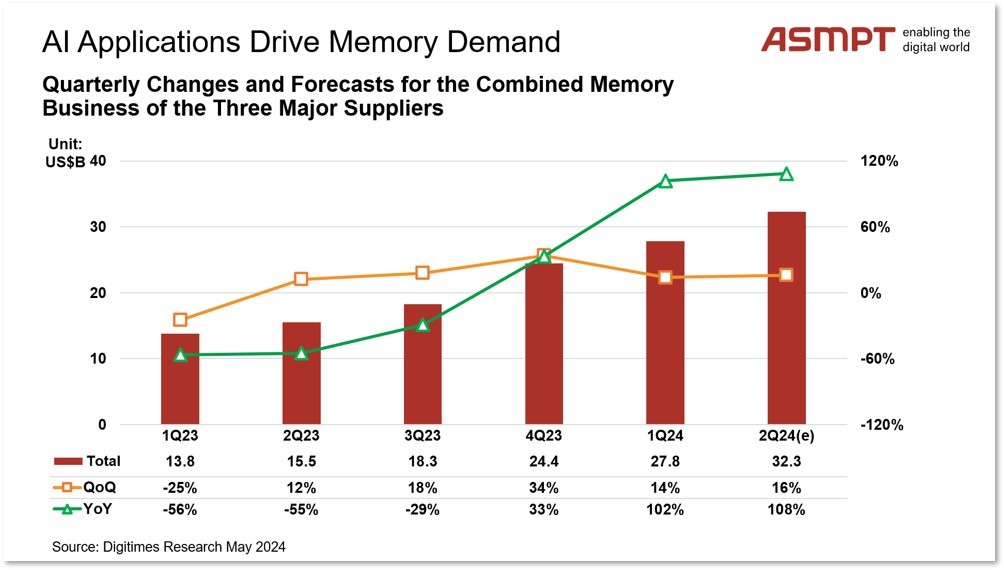
AI Sparks Explosive Growth in Memory Market
This chart quantifies a key signal mentioned in the forward outlook. It visualizes the dramatic market rebound and projected revenue growth for memory, confirming the squeeze on components that the section advises monitoring.
(Source: EnkiAI)
- Monitor prices for standard memory like DRAM and NAND. Projections show a steep price increase through 2026 as production capacity is diverted to HBM, a signal that will confirm the squeeze on consumer electronics and on-device AI.
- Observe automaker product announcements and production targets. Any scaling back of ADAS features, delays in rolling out Level 3 autonomy, or production halts will validate reports from S&P Global that the automotive sector is losing the tug-of-war for chips.
- Track the business models of generative AI startups. An increase in usage-based pricing, the introduction of consumer waitlists for high-demand services like video generation, or company failures citing high inference costs will signal that the economic model for AI-as-a-service is becoming unsustainable due to hardware expenses.
Frequently Asked Questions
Why is there a new semiconductor crisis in 2026 if the pandemic-related shortages are over?
The nature of the crisis has changed. It’s no longer a broad, general shortage. Instead, chipmakers are now strategically reallocating their manufacturing capacity away from lower-margin sectors like automotive and consumer electronics to prioritize high-margin components like High-Bandwidth Memory (HBM) for AI data centers. This creates a new, targeted scarcity for specific industries.
Which industries are most at risk from this AI-driven supply chain shift?
The automotive and consumer electronics sectors are most at risk. According to the S&P Global Mobility report mentioned, the automotive sector is being explicitly deprioritized by suppliers, which threatens the production of vehicles with advanced systems. Similarly, chipmakers like Micron are exiting consumer RAM segments to focus on HBM, putting pressure on consumer electronics.
I thought the main bottleneck for AI was a shortage of NVIDIA GPUs. What has changed?
While GPUs like NVIDIA’s are still critical, the primary bottleneck has shifted to the specialized components required to make them function at scale. Specifically, the limited manufacturing capacity for High-Bandwidth Memory (HBM) and advanced packaging technologies (like TSMC’s CoWoS) is the new constraint. The article notes that the entire near-term supply of HBM3e is sold out, which directly caps the number of advanced AI accelerators that can be produced.
Can’t companies like Google and Amazon solve this by building their own custom AI chips?
No, building custom chips like Google’s TPU or Amazon’s Trainium does not fully solve the problem. While it reduces reliance on NVIDIA for the chip design, these companies still have to compete for the same limited manufacturing and advanced packaging capacity at foundries like TSMC. They are still vying for the same scarce HBM and CoWoS supply, which is the fundamental bottleneck.
What are the early warning signs that this supply crisis is getting worse?
The article suggests watching three key indicators: 1) Steep price increases for standard memory like DRAM and NAND, which would confirm production is being diverted to HBM. 2) Automakers delaying production or scaling back on advanced features like ADAS. 3) Generative AI companies introducing waitlists, shifting to usage-based pricing, or failing due to unsustainable hardware costs.
