

Apple AI Infrastructure Strategy 2025: $600 Billion US Manufacturing Plan Signals Energy Sector Parallels
Apple’s AI Infrastructure Projects Signal Shift to Domestic Manufacturing in 2025
In 2025, Apple pivoted its AI strategy from internal development and software acquisitions to a massive, public commitment to domestic manufacturing and vertically integrated infrastructure, a model that mirrors large-scale energy project deployments.
- Before 2025, Apple’s AI investment was characterized by a five-year, $430 billion US investment plan announced in 2021 and the acquisition of 32 AI startups in 2023, focusing primarily on software and talent.
- This strategy changed in 2025 with a public plan to build a proprietary AI server and chip manufacturing base, increasing its domestic investment commitment from an initial $500 billion to $600 billion over four years.
- A key commercial application of this investment is the “Apple Intelligence” private cloud platform, which is supported by a new 250, 000-square-foot AI server manufacturing hub in Houston, Texas, that began shipping servers in October 2025.
- This adoption of in-house manufacturing for core infrastructure demonstrates a strategic decision to control the physical asset layer, reduce reliance on third-party suppliers, and secure the supply chain for its critical AI services.
Apple Investment Analysis: $600 Billion US Commitment Anchors AI Infrastructure Strategy
Apple’s capital deployment for AI is defined by a monumental $600 billion domestic investment plan that prioritizes long-term vertical integration and job creation over the short-term GPU acquisition race that its competitors are engaged in.
- The central investment is the four-year, $600 billion US commitment announced in August 2025, which focuses on US manufacturing and R&D and aims to create 20, 000 new jobs.
- This approach differs from competitors like Open AI, which announced a $500 billion AI supercomputer project, and the broader market trend where AI startups raised a record $150 billion in venture capital in 2025.
- Apple’s capital-disciplined strategy has allowed it to maintain a cash and marketable securities reserve of over $130 billion as of January 2026, showing a focus on owning long-term physical assets while leveraging partners for more capital-intensive model development.
- Analysts project this strategy could add an estimated $10 billion to $15 billion in annual revenue by 2027 if the integrated user experience drives hardware upgrades.
Table: AI Investment & Infrastructure Commitments (2025-2029)
| Company / Entity | Time Frame | Details and Strategic Purpose | Source |
|---|---|---|---|
| Apple | 2025-2029 | $600 Billion four-year plan for US manufacturing, R&D, and AI server production. Aims to create 20, 000 jobs and build a vertically integrated AI infrastructure. | Apple increases U.S. commitment to $600 billion … |
| Open AI & Partners | Announced 2025 | $500 Billion Stargate AI supercomputer project, a single, large-scale infrastructure initiative to advance model development. | Apple commits $500 B plan for U.S. investment, adding … |
| General AI Startups | 2025 | $150 Billion in total venture capital raised, indicating massive private sector investment in AI software and model development. | AI Startups Raise Record $150 B in 2025, Redefining … |
| Qatar Investment Authority & Brookfield | Announced 2025 | $20 Billion joint venture to build high-performance compute data centers, highlighting global investment in third-party AI infrastructure. | Qatar Launches $20 Billion AI Infrastructure Venture … |
Apple’s Supply Chain Partnerships Fortify US-Based AI Manufacturing 2025
Apple’s domestic infrastructure strategy is underpinned by critical partnerships with US-based semiconductor and materials suppliers, which are essential to securing the supply chain for its proprietary AI hardware.
- Between 2021 and 2024, Apple’s partnerships were less focused on manufacturing, highlighted by the acquisition of software-oriented firms like Darwin AI and discussions with model providers like Google and Meta.
- In 2025, the focus shifted to securing the physical supply chain through its Advanced Manufacturing Fund, establishing collaborations with US-based suppliers including Global Foundries, Corning, and Texas Instruments.
- These alliances are vital for developing the next-generation semiconductors and optics required for Apple’s custom AI servers and devices, directly supporting the goals of its $600 billion domestic investment.
- While partnering with Google for its Siri overhaul and Open AI for Chat GPT integration, Apple’s infrastructure-related partnerships are distinctly aimed at building its own hardware foundation.
Table: Apple’s Key AI-Related Partnerships
| Partner / Target | Time Frame | Details and Strategic Purpose | Source |
|---|---|---|---|
| Nov 2025 | $1 Billion deal to license Google’s Gemini model to power a revamped Siri, outsourcing a capital-intensive software layer. | EP 650: Apple and Google’s deal for AI-powered Siri … | |
| Open AI | Oct 2025 | A non-monetary partnership to integrate Chat GPT into i OS, leveraging Apple’s distribution to gain access to a leading AI model. | Apple opens door to multiple AI partners beyond Chat GPT |
| US-Based Suppliers (Global Foundries, Corning, etc.) | 2025-2029 | Partnerships through the Advanced Manufacturing Fund to develop next-generation components for AI hardware, securing the domestic supply chain. | Apple expands US investment to $600 billion with new … |
| Various AI Startups | 2025 | Acquisition of seven AI-related firms in 2025 to bolster talent and acquire specialized technology. | Apple loosens its grip on AI spending—and potential … |
Apple’s Geographical Focus: A Strategic Consolidation in US Manufacturing for AI
Apple’s AI infrastructure strategy marks a decisive geographical consolidation within the United States, shifting from a globally dispersed and less visible supply chain pre-2025 to a concentrated domestic manufacturing footprint.

Apple’s Global Revenue by Geographic Segment
This chart details Apple’s net sales by geographical region, providing crucial context for the strategic pivot to domestic US manufacturing. It highlights the established revenue streams from international markets prior to the new AI infrastructure focus.
(Source: Reddit)
- Prior to 2025, while Apple had a $430 billion US investment plan in place since 2021, its physical supply chain and manufacturing operations were predominantly associated with international partners.
- This changed in 2025 with the expansion of that commitment to $600 billion and the establishment of a 250, 000-square-foot AI server manufacturing hub in Houston, Texas.
- The Houston facility, which began shipping servers in October 2025, serves as the physical anchor for Apple’s US-centric strategy and its goal of creating 20, 000 new domestic jobs.
- This focus on the United States for its core AI server and chip manufacturing represents a strategic decision by Apple to enhance supply chain security and control, a trend that parallels reshoring efforts in the energy and industrial sectors.
Apple’s AI Infrastructure Technology Reaches Commercial Scale in 2025
In 2025, Apple’s AI infrastructure technology progressed from an R&D and acquisition phase to commercial-scale deployment with the operational launch of its proprietary server manufacturing capabilities.
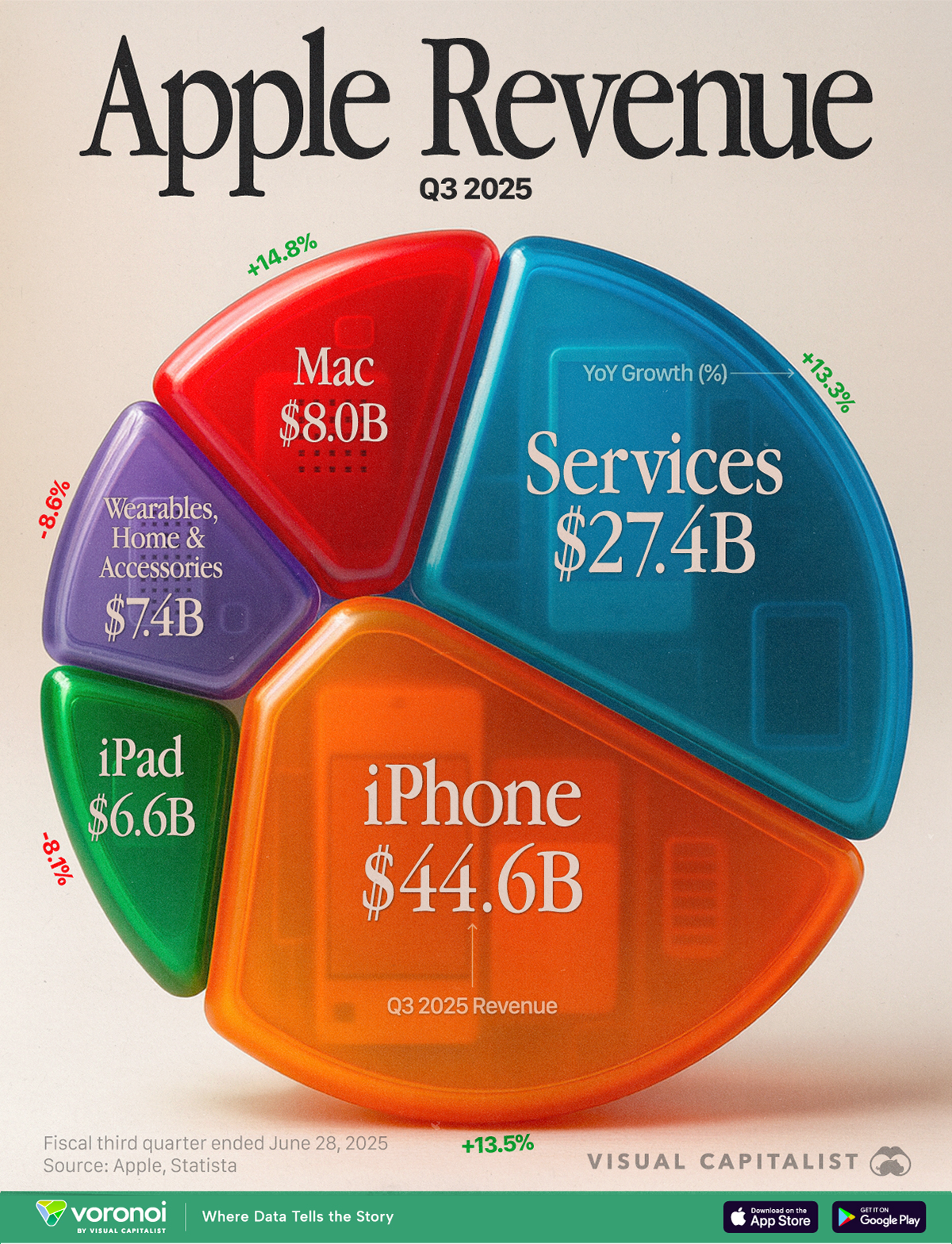
Visualizing Apple’s Revenue Breakdown in Q3 2025
This revenue chart from Q3 2025 illustrates the performance of Apple’s product lines as its AI infrastructure reaches commercial scale. It provides a financial snapshot of the company during this critical deployment phase.
(Source: Visual Capitalist)
- From 2021 to 2024, the technology was in an advanced development phase, evidenced by the acquisition of numerous AI startups and the creation of M-series chips for on-device processing.
- The technology reached commercial maturity in October 2025, when Apple started shipping its first custom-built AI servers from its Houston factory, internally designated as Project ACDC.
- These servers are not test units; they are commercial-grade hardware forming the backbone of the “Apple Intelligence” private cloud, a live platform designed to handle complex AI queries from its user base.
- This transition validates the maturity of Apple’s vertical integration model, as its custom Apple Silicon technology now powers not just consumer devices but also commercial-scale data center infrastructure.
SWOT Analysis: Apple’s AI Manufacturing and Infrastructure Strategy
Apple’s AI infrastructure strategy effectively leverages its immense financial strength and hardware expertise but faces external competitive pressures and internal execution risks associated with its massive capital deployment.
- Strengths are rooted in Apple’s vast financial resources, including a $130 billion cash reserve, and its vertically integrated model, which enable it to fund a $600 billion domestic manufacturing plan.
- Weaknesses include a later entry into the generative AI market, which necessitates reliance on partners like Google and Open AI to bridge immediate model capability gaps.
- Opportunities include driving a major hardware upgrade cycle among its user base and unlocking an estimated $10 billion to $15 billion in new annual revenue by 2027.
- Threats stem from the intense capital expenditure race with competitors and the execution risk that its integrated user experience fails to meet consumer expectations by its 2026 target.
Table: SWOT Analysis for Apple’s AI Infrastructure Strategy
| SWOT Category | 2021 – 2024 | 2025 – Today | What Changed / Validated |
|---|---|---|---|
| Strengths | Strong balance sheet and established expertise in custom silicon (A-series and M-series chips). | Leveraging $130 B+ in cash reserves to fund a $600 B domestic manufacturing plan without significant financial strain. | The strategy shifted from developing chips for devices to building a full-stack, vertically integrated AI hardware infrastructure from silicon to servers. |
| Weaknesses | Perceived as slow in the generative AI race; Siri’s capabilities lagged behind competitors. | Reliance on partners like Google ($1 B deal) and Open AI (integration) to provide state-of-the-art LLM capabilities. | The weakness in in-house LLMs was addressed by a pragmatic, hybrid strategy of partnering, which accelerated time-to-market. |
| Opportunities | Potential to integrate AI deeply into its existing ecosystem of over a billion users. | Driving a new hardware super-cycle and generating $10 B-$15 B in new annual revenue by 2027 through “Apple Intelligence” features. | The opportunity became a defined corporate strategy in 2025, with a clear roadmap and financial projections tied to the AI rollout. |
| Threats | Risk of falling further behind in the AI arms race as competitors like Microsoft invested heavily in partners. | Competitors’ massive capital outlays (e.g., Open AI’s $500 B project). The success of Apple’s strategy is contingent on delivering a seamless user experience by 2026. | The threat of competition intensified, forcing Apple to counter with a massive, but strategically different, investment in owned domestic infrastructure. |
Future Outlook: Apple’s Success Hinges on Seamless AI Integration by 2026
The ultimate return on Apple’s $600 billion infrastructure investment will be determined by its ability to deliver a seamless and truly intuitive “Apple Intelligence” user experience across its ecosystem by its 2026 target.
- The most critical near-term milestone is the planned 2026 launch of a fully overhauled Siri, which will be powered by Google’s Gemini model and serve as the primary consumer test of Apple’s hybrid AI strategy.
- The successful operation of its private cloud compute platform, running on servers from the new Houston factory, is vital for delivering on its core brand promise of processing sensitive data privately.
- The potential for a large-scale acquisition remains a key factor, with market speculation around targets like Groq (valued at $20 billion) or Perplexity (valued at $14 billion) suggesting that Apple is open to buying technology to accelerate its roadmap.
- Forward success will be measured by whether these integrated features are compelling enough to drive a new hardware upgrade cycle and realize the projected $10 billion to $15 billion in additional annual revenue by 2027.
Frequently Asked Questions
What was the major shift in Apple’s AI strategy in 2025?
In 2025, Apple pivoted its AI strategy from primarily focusing on software acquisitions and internal development to a massive commitment to domestic manufacturing and vertically integrated infrastructure. This was marked by an increase in its US investment plan from $500 billion to $600 billion over four years, with a new focus on building its own proprietary AI server and chip manufacturing base in the US.
How does Apple’s $600 billion AI investment differ from its competitors’ strategies?
Apple’s $600 billion plan prioritizes long-term vertical integration, job creation (20,000 new jobs), and owning the physical manufacturing and infrastructure layer. This contrasts with competitors like OpenAI, which announced a $500 billion supercomputer project focused on advancing model development, and the broader market trend of startups raising capital ($150 billion in 2025) for software and model development.
What is “Apple Intelligence” and what physical infrastructure supports it?
“Apple Intelligence” is the commercial name for Apple’s private cloud platform, designed to handle complex AI queries from its users while maintaining privacy. It is supported by a new 250,000-square-foot AI server manufacturing hub in Houston, Texas, which began shipping custom-built servers in October 2025 to form the hardware backbone of the platform.
If Apple is building its own AI hardware, why is it partnering with Google and OpenAI?
Apple is pursuing a hybrid strategy. It is building its own hardware (servers, chips) to control the physical infrastructure, ensure supply chain security, and deliver on its privacy promises. Simultaneously, it partners with companies like Google (for its Gemini model) and OpenAI (for ChatGPT integration) to leverage their advanced large language models, bridging an immediate software capability gap and accelerating the time-to-market for features like the revamped Siri.
What is the key milestone that will determine the success of Apple’s AI strategy?
The most critical near-term milestone is the planned 2026 launch of a fully overhauled Siri, powered by Google’s Gemini model. The success of this launch, and the overall user experience of “Apple Intelligence” features, will determine if the strategy is compelling enough to drive a new hardware upgrade cycle and achieve the projected $10 billion to $15 billion in additional annual revenue by 2027.
