

Are Fuel Cells Clean Energy? 2026 Analysis of Hydrogen Sourcing & Market Viability
Fuel Cell Projects & Commercial Scale: Adoption Hinges on Hydrogen Sourcing in 2026
The commercial adoption of fuel cells has bifurcated into two distinct tracks: one is rapidly scaling in stationary power for data centers and industrial use, leveraging fuel flexibility, while the other is fragmenting in transportation due to the unresolved economics and infrastructure of green hydrogen. This split demonstrates that the “clean energy” status of fuel cells is less about the technology itself and more about the pragmatism of its fuel supply chain in specific applications.
- Between 2021 and 2024, the industry focused on broad-based pilots across multiple sectors. A key example was the “Tri-gen” system launched by Fuel Cell Energy and Toyota, which proved the technology could produce electricity, hydrogen, and water from biogas, validating the hardware in a real-world, lower-carbon application.
- From 2025 to today, strategies have diverged sharply. For stationary power, major deployments are moving forward using available fuels. Fuel Cell Energy partnered with SDC to deploy up to 450 MW for data centers, and Bloom Energy secured a partnership with Brookfield for up to $5 billion to power AI infrastructure, both of which can utilize natural gas or directed biogas.
- In contrast, the light-duty vehicle sector is retreating due to the persistent challenges of the hydrogen supply chain. Stellantis announced the discontinuation of its hydrogen fuel cell program in July 2025, and Honda dissolved its fuel cell production joint venture with GM in early 2026. This signals that for passenger cars, the pathway to truly clean, cost-effective hydrogen is not seen as commercially viable in the near term compared to direct electrification.
Fuel Cell Investment Analysis: Corporate Capital Splits Between Stationary Power & Automotive Pullbacks
Investment in the fuel cell sector is becoming highly concentrated in stationary power generation, driven by the explosive energy demands of AI and data centers, while significant players are simultaneously cancelling programs and divesting from the light-duty vehicle market. This flow of capital confirms that investors see a clear, immediate return on fuel cells as a reliable, on-site power solution, but view the “clean” hydrogen mobility market as a longer-term, higher-risk objective.
- The most significant validation of the stationary power market is the October 2025 announcement of a strategic partnership between Brookfield Asset Management and Bloom Energy, involving an investment of up to $5 billion to deploy solid oxide fuel cells for AI and data center infrastructure.
- Commitment to specific geographic manufacturing hubs continues, as seen with Toyota‘s $139 million investment in July 2025 to establish a hydrogen fuel cell manufacturing plant in Chengdu, China. This localizes the supply chain for a market with strong government support.
- Conversely, major automakers are pulling back capital from hydrogen vehicle development. Stellantis confirmed in July 2025 that it would cease its hydrogen fuel cell technology program, and Honda announced the dissolution of its production joint venture with GM in January 2026, citing a strategic pivot to internal development amidst market challenges.
Table: Major Fuel Cell Investment and Divestment Signals (2025-2026)
| Partner / Project | Time Frame | Details and Strategic Purpose | Source |
|---|---|---|---|
| Honda / General Motors (GM) | Jan 2026 | Dissolution of a joint venture for fuel cell system production. Honda is ending its role in the JV, indicating a strategic retreat from collaborative mass production to focus on its own development path for specific applications. | Wards Auto |
| Bloom Energy / Brookfield Asset Management | Oct 2025 | Up to $5 billion strategic partnership to deploy Bloom Energy‘s solid oxide fuel cell technology. The investment is targeted at providing reliable, clean power for the rapidly growing AI and data center industries. | Bloom Energy |
| Stellantis | Jul 2025 | Discontinuation of its hydrogen fuel cell technology development program. This represents a significant divestment and strategic pivot away from hydrogen mobility by a major global automaker. | Stellantis |
| Toyota / Shudao Investment Group | Jul 2025 | $139 million investment to build a hydrogen fuel cell manufacturing base in Chengdu, China. This joint venture aims to create a localized supply chain to support the growth of hydrogen vehicles in the Chinese market. | Fuel Cells Works |
Strategic Partnerships in Clean Energy: Fuel Cell Alliances Pivot to Data Centers and Industrial Use
Recent partnerships signal a clear strategic pivot toward high-demand, centralized power generation for data centers and industrial decarbonization, where fuel sourcing can be managed at scale. This move away from distributed mobility applications suggests the industry is prioritizing markets where fuel cells offer an immediate solution for reliability and emissions reduction, even if they initially rely on natural gas or biogas rather than exclusively green hydrogen.

Fuel Cells Offer Reliable, On-Site Power
This diagram shows how fuel cells provide grid-independent power to industrial sites, perfectly illustrating the strategic pivot to data centers and industry that require high reliability.
(Source: FuelCell Energy)
- The January 2026 partnership between Fuel Cell Energy and Sustainable Development Capital (SDC) to deploy up to 450 MW of fuel cells for data centers globally exemplifies the focus on the high-growth digital infrastructure sector. This alliance provides a clear channel to a power-hungry market.
- The extension of the joint development agreement between Fuel Cell Energy and Exxon Mobil through 2026 highlights the continued focus on industrial applications. The collaboration aims to advance carbonate fuel cell technology for capturing CO 2 from industrial sources while co-producing electricity and hydrogen, aligning fuel cells with existing infrastructure.
- In the hard-to-abate aerospace sector, a June 2025 Memorandum of Understanding between Airbus and MTU Aero Engines shows continued R&D interest. However, its non-binding nature indicates a longer, more uncertain path to commercialization compared to the immediate deployments in stationary power.
- The automotive sector shows a consolidating partnership landscape. The ongoing joint development of a third-generation hydrogen powertrain by Toyota and BMW now represents the primary OEM alliance in the space, standing in stark contrast to the recently dissolved GM/Honda venture.
Table: Key Fuel Cell Strategic Partnerships (2024-2026)
| Partner / Project | Time Frame | Details and Strategic Purpose | Source |
|---|---|---|---|
| Fuel Cell Energy / SDC | Jan 2026 | Partnership to explore deploying up to 450 MW of fuel cells for data centers. This targets the critical need for reliable, on-site power for the rapidly growing digital infrastructure market. | Data Center Dynamics |
| Airbus / MTU Aero Engines | Jun 2025 | Memorandum of Understanding (Mo U) to collaborate on hydrogen fuel cell propulsion for aviation. This represents an early-stage R&D effort to decarbonize a hard-to-abate sector. | Airbus |
| Fuel Cell Energy / Diversified Energy & TESIAC | Mar 2025 | Collaboration to form a development company to use coal mine methane and natural gas for off-grid data center power. This strategy leverages existing, problematic fuel sources to provide an immediate power solution. | Fuel Cell Energy |
| Fuel Cell Energy / KHNP | Oct 2024 | Agreement to pursue clean hydrogen production projects in South Korea using Fuel Cell Energy‘s solid oxide electrolyzer platform, targeting a key international market with strong policy support for hydrogen. | Fuel Cell Energy |
Geographic Analysis: Where are Clean Energy Fuel Cell Projects Growing?
While North America leads in large-scale capital deployment for stationary power, driven by the AI boom and strong policy incentives, Asia is solidifying its role as a critical hub for manufacturing and supply chain development. This geographic specialization indicates that the path to making fuel cells a viable clean energy solution involves a globalized strategy, with U.S. and Canadian markets serving as primary deployment zones and China and South Korea becoming key hardware and technology sources.
- Between 2021 and 2024, North America laid the policy groundwork. The U.S. Bipartisan Infrastructure Law, allocating $8 billion for H 2 Hubs, and Canada’s Hydrogen Strategy created a strong pull for investment, attracting pilot projects like a $6.8 million carbon capture initiative for Fuel Cell Energy in Canada.
- From 2025 to today, this policy support has translated into massive capital commitments in the U.S., highlighted by the $5 billion Bloom Energy/Brookfield deal aimed squarely at domestic data center demand. This demonstrates that near-term growth is heavily concentrated in the U.S. stationary power market.
- Simultaneously, Asia is emerging as the center of manufacturing. Toyota’s $139 million investment to build a fuel cell plant in Chengdu, China, in July 2025 is a strategic move to build out the supply chain in a region with ambitious hydrogen goals. Likewise, Fuel Cell Energy‘s partnership with KHNP in South Korea targets clean hydrogen production, positioning for future growth in the Asian market.
Technology Maturity: Are Fuel Cells Ready for Commercial Scale?
Fuel cell hardware is commercially mature and proven for stationary power applications using existing fuels, but the complete “clean energy system”—inclusive of a green hydrogen supply chain—remains in a developmental stage. The recent market divergence confirms that high-efficiency fuel cells from companies like Bloom Energy and Fuel Cell Energy are ready for large-scale deployment now, while the full decarbonization potential of the technology is constrained by the immaturity of green hydrogen production and distribution infrastructure.
- The 2021–2024 period was marked by successful demonstrations that validated the technology’s operational capabilities. The Fuel Cell Energy and Toyota “Tri-gen” project at the Port of Long Beach proved that fuel cells could reliably generate power (2.3 MW), hydrogen (1, 200 kg/day), and water from a renewable fuel source like biogas.
- From 2025 to the present, a clear split in technological readiness has emerged. Solid oxide fuel cells (SOFC) and molten carbonate fuel cells (MCFC) for stationary power have achieved commercial scale. They offer high electrical efficiencies (over 60%) and are being deployed in multi-megawatt projects, as evidenced by the 450 MW data center plan from Fuel Cell Energy and SDC.
- In contrast, the system for “clean” mobility is not yet mature. The high carbon intensity of currently available grey hydrogen (9-12 kg CO 2 e/kg H 2) and the projected high cost of green hydrogen make fuel cell vehicles uncompetitive. This lack of a mature, low-cost clean fuel pathway is the primary factor behind the strategic pullbacks by Stellantis and Honda.
SWOT Analysis: Strengths and Weaknesses of Fuel Cells as a Clean Energy Solution
The primary strength of fuel cells is their clean, efficient, and reliable point-of-use operation, making them an ideal solution for improving local air quality and providing grid-independent power. However, this is critically undermined by their core weakness: a lifecycle carbon footprint entirely dependent on a nascent and expensive green hydrogen supply chain. This dichotomy has created a market of immense opportunity in specific sectors like data centers but also a significant threat from more mature, fully electrified alternatives.
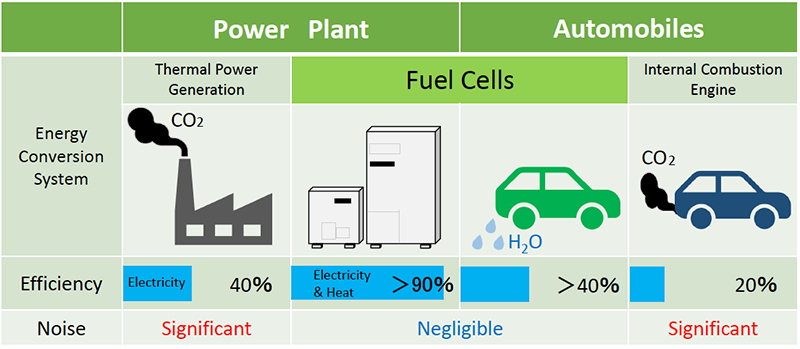
Fuel Cells Outperform in Efficiency
This chart visualizes a key strength mentioned in the SWOT analysis, showing the superior efficiency of fuel cells compared to traditional combustion technologies in power and auto applications.
(Source: www.fcgroup.yamanashi.ac.jp)
- Strengths: High efficiency and near-zero point-of-use emissions are the technology’s core value proposition.
- Weaknesses: The dependency on hydrogen production methods creates a “conditional” clean status that introduces market and investment risk.
- Opportunities: The soaring energy demand from AI and data centers has created an immediate, large-scale market for on-site power.
- Threats: Lower-cost renewable alternatives and the rapid maturation of battery electric vehicle technology pose significant competitive threats.
Table: SWOT Analysis for Fuel Cells as a Clean Energy Solution
| SWOT Category | 2021 – 2024 | 2025 – Today | What Changed / Resolved / Validated |
|---|---|---|---|
| Strengths | High electrical efficiency (40-60%) and zero harmful point-of-use emissions were established in pilots. CHP applications showed potential for over 85% total efficiency. | SOFCs for stationary power are achieving electrical efficiencies over 60%. Fuel cells reduce local smog-forming pollutants by over 99% compared to combustion. | The high efficiency and clean operation of stationary fuel cells from makers like Bloom Energy and Fuel Cell Energy have been validated at commercial scale, moving from pilot to deployment. |
| Weaknesses | Dependence on grey hydrogen from SMR was a known issue, creating a high lifecycle carbon footprint. The “well-to-wheel” efficiency gap with BEVs was a theoretical concern. | The “conditional” clean status is now causing market fragmentation. The carbon footprint of grey hydrogen (9-12 kg CO 2 e/kg H 2) and the cost of green hydrogen are forcing strategic withdrawals (Stellantis, Honda/GM). | The weakness is no longer theoretical; it is actively shaping corporate strategy. The market has validated that without cheap, abundant green hydrogen, fuel cells cannot compete with BEVs in light-duty transport. |
| Opportunities | Policy incentives like the U.S. Bipartisan Infrastructure Law ($8 B for H 2 Hubs) and Canada’s Hydrogen Strategy created a pathway for future growth. | The AI and data center boom has created an urgent, massive demand for reliable, on-site power. This is validated by the $5 B Bloom/Brookfield deal and the 450 MW FCE/SDC plan. | The primary market opportunity has shifted from a broad, policy-driven future to a specific, urgent commercial need. Data centers are now the key near-term growth driver, regardless of hydrogen color. |
| Threats | The falling cost of solar and wind, along with maturing battery technology, posed a significant competitive threat across all applications. | The low Levelized Cost of Electricity (LCOE) for new utility-scale solar PV (as low as $29/MWh) makes it a formidable competitor. BEV dominance in passenger transport is confirmed by automaker withdrawals. | The threat from alternatives has been validated. BEVs have effectively closed the door on mass-market fuel cell passenger cars for now, and low-cost renewables constrain fuel cells’ role in bulk grid power. |
2026 Forward Outlook: What to Watch in the Fuel Cell Market
If the AI-driven demand for reliable, grid-independent power continues to accelerate, watch for more large-scale, multi-billion-dollar partnerships between fuel cell manufacturers and data center developers or asset managers. This trend will solidify fuel cells’ role as a commercially viable, transitional power source that can operate on available fuels today while offering a future pathway to decarbonization with green hydrogen.
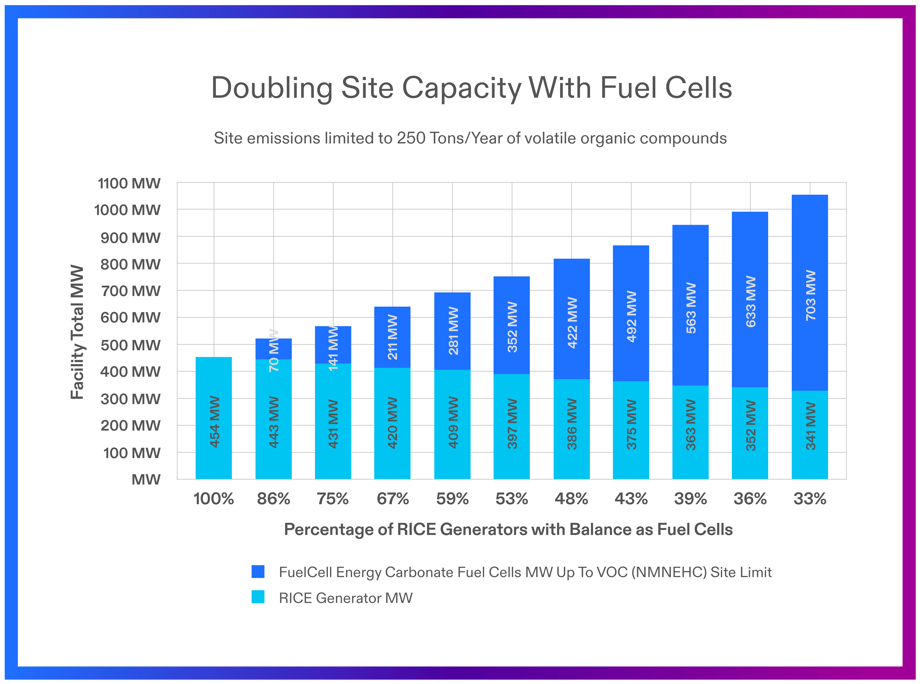
Fuel Cells Double Power Within Emission Caps
This chart directly supports the forward outlook on AI-driven demand by illustrating how fuel cells can double a data center’s power capacity while staying within fixed emission limits.
(Source: FuelCell Energy)
- If this happens: Another major asset manager or hyperscale data center operator announces a capital commitment on the scale of the Brookfield/Bloom Energy deal ($5 billion). This would confirm that the data center market is the primary driver of fuel cell industry growth for the foreseeable future.
- Watch this: An increase in announcements for “hydrogen-ready” fuel cell power plants that are designed to run on natural gas or biogas initially. Look for this specific language in press releases from Fuel Cell Energy and Bloom Energy, as it signals a pragmatic strategy to secure near-term revenue while preparing for a future hydrogen economy.
- These could be happening: A potential shakeout in the mobility sector, with companies focused purely on green hydrogen-dependent applications (like trucking) struggling to secure funding until the U.S. H 2 Hubs demonstrate tangible production volumes and cost reductions. Conversely, the success of stationary power specialists could trigger M&A activity as they look to acquire technologies or consolidate their market position.
Frequently Asked Questions
Why are fuel cells succeeding for data centers but failing in the passenger car market?
The fuel cell market is splitting. It’s succeeding in stationary power for data centers because they offer reliable, on-site power and are ‘fuel flexible,’ meaning they can run on available fuels like natural gas or biogas today. In contrast, the passenger car market is failing because it depends on a widespread, low-cost green hydrogen refueling infrastructure that does not yet exist, making it commercially unviable compared to battery electric vehicles.
Based on the 2026 analysis, are fuel cells really ‘clean energy’?
Their ‘clean energy’ status is conditional. The fuel cell itself produces power with near-zero harmful emissions at the point of use. However, its total carbon footprint depends on the fuel source. When using ‘grey’ hydrogen made from natural gas, the lifecycle emissions are high. The technology is only truly a clean energy solution when powered by ‘green’ hydrogen (made from renewables), which is currently expensive and not widely available.
What is the main driver behind the recent multi-billion dollar investments in fuel cells?
The primary driver is the explosive energy demand from the AI and data center boom. These facilities require massive amounts of reliable, grid-independent power. Stationary fuel cells meet this need, leading to major investments like the $5 billion partnership between Bloom Energy and Brookfield to power AI infrastructure.
Why are major automakers like Stellantis and Honda abandoning their hydrogen fuel cell programs?
They are pulling back due to the persistent economic and infrastructural challenges of the hydrogen supply chain for light-duty vehicles. The analysis shows they do not see a commercially viable path to delivering cost-effective, clean hydrogen to consumers in the near term, prompting a strategic shift away from fuel cell passenger cars.
What is the most important trend to watch in the fuel cell market going forward?
The key trend to watch is the continued growth of large-scale partnerships between fuel cell manufacturers (like Fuel Cell Energy and Bloom Energy) and data center developers or asset managers. The success of the industry now hinges on its ability to serve the immediate, high-demand stationary power market, often with ‘hydrogen-ready’ systems that run on natural gas initially.
