

BP’s 2025 Carbon Capture Overhaul: Why the Pivot from Green Ambition to Oil & Gas Focus Matters
BP’s CCUS Project Rollout in 2025: From Broad Ambition to Strategic Contraction
In 2025, BP’s Carbon Capture, Utilization, and Storage (CCUS) strategy is defined by a significant contraction, shifting from a broad green energy push to a narrow focus on “high-graded” projects that directly support its core oil and gas business.
- Between 2021 and 2024, BP pursued a wide range of CCUS applications, forming partnerships for blue hydrogen on the US Gulf Coast with Linde, exploring CCUS hubs in China with Petro China, and advancing hydrogen plans in the UK. This indicated an expansive, exploratory approach to decarbonization.
- The strategy sharply pivoted in 2025 with the cancellation of two major projects: the 1, 200 MW H 2 Teesside blue hydrogen project in the UK and the Indiana CCS project at its Whiting Refinery. These decisions, driven by land use conflicts, public opposition, and economic concerns, signal a much lower tolerance for projects with high uncertainty and long development timelines.
- Current activity is now concentrated on initiatives that preserve the value of existing fossil fuel assets. The Final Investment Decision (FID) for the $7 billion Tangguh UCC project in Indonesia enables Enhanced Gas Recovery (EGR), while the Northern Endurance Partnership in the UK focuses on decarbonizing industrial clusters tied to gas-fired power.
- This strategic shift demonstrates that CCUS is now being deployed by BP primarily as a pragmatic, defensive tool to extend the life and social license of its most profitable hydrocarbon operations, rather than as a vehicle for a widespread transition away from them.
BP’s 2025 Investment Pivot: Capital Reallocation from Low-Carbon to Core Hydrocarbons
BP‘s 2025 financial strategy confirms its strategic pivot, with a material reallocation of capital away from its broader low-carbon portfolio and back towards traditional fossil fuels, directly limiting the scope of its future CCUS investments.
- In a major strategic reset announced in February 2025, BP declared it would cut its annual low-carbon energy spending by over $5 billion, reducing it to a range of $1.5 billion to $2 billion per year.
- Concurrently, the company increased its planned annual investment in oil and gas to approximately $10 billion, underscoring a clear prioritization of its core hydrocarbon business over its energy transition ventures.
- This financial shift was further exemplified in September 2025 when BP ended its 25-year, $56 million funding partnership with Princeton University’s Carbon Mitigation Initiative. This move signaled a definitive turn away from broad, long-term research commitments.
- As a result of this capital reallocation, BP formalized its “high-grading” strategy by announcing a reduced target of investing in only five to seven select hydrogen and CCS projects by 2030, a significant reduction in ambition from prior years.
Table: BP’s Strategic Investments and Divestments in CCUS (2025)
| Partner / Project | Time Frame | Details and Strategic Purpose | Source |
|---|---|---|---|
| Tangguh UCC Project | December 2025 | Reached a $7 billion Final Investment Decision for Indonesia’s first at-scale CCUS project. The primary purpose is to unlock additional natural gas resources through Enhanced Gas Recovery (EGR), directly supporting the core LNG business. | bp and Partners Give Go-Ahead for Tangguh UCC Project … |
| H 2 Teesside Project | December 2025 | Cancelled the planned 1.2 GW blue hydrogen facility in the UK due to land use conflicts. This reflects a reduced appetite for complex, capital-intensive clean energy hubs that are not tied to existing core assets. | BP cancels its 1.2 GW H 2 Teesside blue hydrogen project … |
| Princeton Carbon Mitigation Initiative | September 2025 | Terminated a 25-year funding partnership that totaled $56 million since 2000. This signals a strategic shift away from broad, foundational climate research towards focused, commercial project execution. | BP & CCS | divestprinceton |
| Indiana CCS Project | June 2025 | Indefinitely halted a project to capture CO 2 from its Whiting Refinery due to public opposition and economic concerns. The decision avoids a potentially costly and controversial development, highlighting increased risk aversion. | BP Halts Indiana Carbon Capture Project Amid Safety and … |
| BP Corporate Strategy | February-April 2025 | Announced a major budget reallocation, cutting low-carbon spending by over $5 billion annually while increasing oil and gas spend to ~$10 billion. The company also reduced its target to just 5-7 CCS/hydrogen projects by 2030. | BP cuts renewable investment and boosts oil and gas in … |
BP’s Strategic Alliances in CCUS: A Shift to Project Execution in 2025
In 2025, BP‘s partnership strategy evolved from forming broad, exploratory alliances to engaging specialized contractors for the execution and commercialization of its few remaining large-scale CCUS projects.
- The 2021-2024 period was characterized by the formation of wide-ranging development agreements and Memorandums of Understanding. These included plans for a US Gulf Coast CCS hub with Linde, a CCUS cluster in China with Petro China, and a CCUS value chain in Indonesia with GE Vernova.
- By 2025, the focus shifted to execution-oriented partnerships for its “high-graded” projects. For the Northern Endurance Partnership, BP and its partners hired contractors Halliburton and SLB to provide critical subsurface monitoring and storage solutions.
- Similarly, for the $7 billion Tangguh UCC project, BP signed a four-year supply agreement with Tenaris for essential casing and tubing. This marks a move from strategic MOUs to tactical supply chain contracts.
- New collaborations in 2025 are more targeted and commercially driven. The partnership with Mitsubishi Research Institute aims to develop a CCUS methodology under Japan’s Joint Crediting Mechanism, a move designed to create a commercial pathway for generating carbon credits from the Tangguh project.
Table: BP’s Key CCUS Partnerships and Collaborations (2025)
| Partner / Project | Time Frame | Details and Strategic Purpose | Source |
|---|---|---|---|
| Mitsubishi Research Institute | October 2025 | Entered a feasibility study to develop a CCUS methodology under Japan’s Joint Crediting Mechanism. This is intended to create a pathway for generating carbon credits from CCUS projects like Tangguh. | Bp, Mitsubishi Research Institute join Japan’s METI … |
| Tenaris | September 2025 | Signed a four-year supply agreement for casing, tubing, and technical support for the Tangguh UCC project. This represents a shift to securing the project’s supply chain post-FID. | Tenaris signs four-year contract with bp to support … |
| Princeton University | September 2025 | Mutually agreed to end a 25-year funding partnership for the Carbon Mitigation Initiative. This marks a move away from broad academic research toward commercial deployment. | Princeton and BP agree to end 25-year funding for Carbon … |
| Northern Endurance Partnership (Equinor, Total Energies) | July-August 2025 | The joint venture hired specialist contractors Halliburton and SLB to provide subsurface monitoring and carbon storage solutions for the UK offshore CCS project, signaling a move into the detailed engineering and execution phase. | BP, Equinor and Total Energies hire Halliburton for carbon … |
BP’s CCUS Geographic Focus: Concentrating Efforts in Indonesia and the UK in 2025
In 2025, BP significantly narrowed its geographic focus for large-scale CCUS development to Indonesia and the UK, regions with clear regulatory support and direct alignment with its core assets, while retreating from less certain projects in the United States.

North America Dominates Global CCUS Market
North America holds the largest share of the CCUS market, providing context for BP’s strategic retreat from the crowded US market to focus on high-potential regions like Asia-Pacific.
(Source: SNS Insider)
- Between 2021 and 2024, BP pursued a broad geographic strategy, with major project plans in the US (Texas Gulf Coast with Linde), China (Hainan hub with Petro China), and the UK (Teesside and Humber clusters).
- This global footprint contracted sharply in 2025. The decision to halt the Indiana CCS project due to local opposition and economic factors marked a significant pullback from a key onshore US initiative.
- The UK remains a strategic region with the advancement of the Northern Endurance Partnership. However, the cancellation of the H 2 Teesside project demonstrates that even here, BP is applying a highly selective, “high-grading” approach.
- Indonesia has now emerged as BP‘s primary area of CCUS activity. The final investment decision on the $7 billion Tangguh UCC project confirms its importance, as the project directly supports the monetization of BP‘s major gas production assets in the country.
BP’s CCUS Technology Strategy 2025: Prioritizing Proven Applications Over Novel R&D
BP‘s technology strategy in 2025 prioritizes the integration of mature, commercially available CCUS solutions over the development or pioneering of novel technologies, aligning with its pivot to de-risk projects and support its core business.
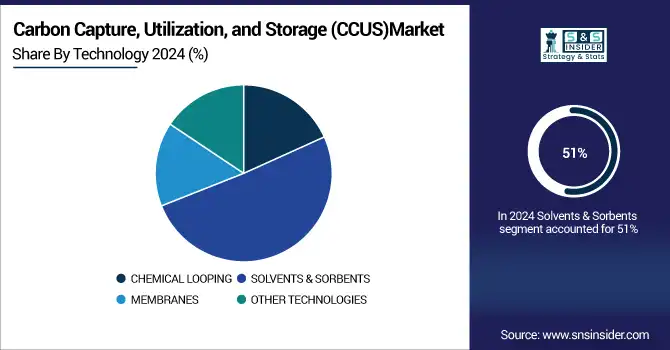
Post-Combustion Capture Leads CCUS Technology Adoption
Post-combustion technologies represent the largest segment of the CCUS market. This highlights the industry’s reliance on mature, commercially available solutions, mirroring BP’s 2025 strategy.
(Source: SNS Insider)
- During the 2021–2024 period, BP showed interest in a wider array of technologies. This included a collaboration with Carbon Free on its innovative Sky Cycle™ mineralization technology and a plan to use BASF‘s advanced OASE® capture solution for the now-cancelled H 2 Teesside project.
- By 2025, the focus has shifted entirely to applying proven technologies at scale. The Tangguh UCC project relies on established amine-based capture methods integrated with BP‘s extensive subsurface expertise in reservoir management for Enhanced Gas Recovery.
- The company is leveraging partners like Halliburton and SLB for the Northern Endurance Partnership, applying decades of oil and gas know-how in subsurface modeling and monitoring for CO 2 storage. This represents an application of existing corporate expertise, not a new technology launch.
- The cancellation of H 2 Teesside marks a strategic retreat from being an early, large-scale implementer of an integrated Autothermal Reforming (ATR) and CCUS model. This indicates a lower appetite for the technology integration risk associated with such complex clean energy hubs.
SWOT Analysis: BP’s Shifting CCUS Strategy in 2025
BP‘s 2025 CCUS strategy leverages its core operational strengths in regions with supportive policy but is constrained by a reduced budget and faces significant threats from public opposition and the reputational risk of linking decarbonization to fossil fuel expansion.
- The analysis highlights a clear shift from a broad, ambitious strategy to a defensive, focused one.
- Strengths in project execution are now being applied to fewer, more strategic assets.
- Weaknesses are centered on the reduced financial commitment to the energy transition and a business model that invites criticism.
- Opportunities remain in supportive markets, while threats from local opposition and competing land use have become tangible realities.
Table: SWOT Analysis for BP
| SWOT Category | 2021 – 2024 | 2025 – Today | What Changed / Resolved / Validated |
|---|---|---|---|
| Strengths | Broad global partnerships (Linde, Petro China) and extensive R&D exploration (Princeton partnership). | Proven large-project execution capabilities focused on core assets (Tangguh UCC) and key industrial clusters (Northern Endurance Partnership). | The company validated its core strength is in executing large, integrated engineering projects, not in broad-based R&D or pioneering multiple new ventures simultaneously. |
| Weaknesses | Ambition outpaced stated investment levels, creating a credibility gap. Strategy appeared scattered across multiple geographies and technologies. | A significantly reduced low-carbon budget (slashed by over $5 billion annually) and a shrunken project pipeline (target of 5-7 projects). Reputational risk from using CCUS for Enhanced Gas Recovery. | The 2025 strategy resolved the ambiguity in capital allocation by explicitly prioritizing oil and gas, but in doing so, it validated the weakness of its financial commitment to a broader energy transition. |
| Opportunities | Potential to lead in multiple emerging low-carbon markets like blue hydrogen and CCUS hubs globally. | Capitalizing on clear regulatory support and carbon pricing in the UK and Indonesia. Potential to generate new revenue from carbon credits via Japan’s JCM for the Tangguh project. | The opportunity has narrowed from global leadership to profitable execution in select, highly supportive markets. The focus shifted from market creation to capturing value where policy already exists. |
| Threats | Generic risks of policy uncertainty and economic viability for nascent CCUS projects. | Realized threats of public and political opposition leading to project cancellation (Indiana CCS). Direct competition for land and resources from other industries like AI data centers (H 2 Teesside). | Abstract threats became concrete business realities in 2025. The cancellation of two major projects validated that local opposition and competing economic interests are now primary risk factors. |
BP’s CCUS Outlook: Execution on Flagship Projects Defines the Path Forward
The success of BP‘s revised and narrowed CCUS strategy now depends entirely on the flawless and timely execution of its two remaining flagship projects: the Tangguh UCC project in Indonesia and the Northern Endurance Partnership in the UK.
- The primary focus for investors and competitors will be on the execution of the $7 billion Tangguh UCC project. Meeting construction timelines to achieve the first CO 2 injection, planned for as early as 2027, is critical to validating BP‘s selective CCUS strategy and its ability to deliver complex projects that support its core business.
- The industry will closely watch which projects BP chooses to sanction next to meet its stated goal of investing in only five to seven CCS and hydrogen projects by 2030. These future Final Investment Decisions will reveal the company’s true geographic and technological priorities within its constrained low-carbon budget.
- The long-term viability of BP‘s current CCUS projects remains heavily dependent on supportive government policies. Any changes to the UK’s carbon pricing mechanisms or Indonesia’s framework for cross-border CO 2 storage could significantly alter project economics and timelines.
- A new risk factor has emerged with the cancellation of H 2 Teesside in favor of an AI data center. This highlights a new dynamic where energy-intensive digital infrastructure competes directly for prime industrial land and grid connections, potentially affecting the feasibility of future industrial decarbonization sites.
Frequently Asked Questions
Why did BP change its carbon capture (CCUS) strategy in 2025?
BP’s CCUS strategy shifted in 2025 from a broad, exploratory approach to a narrow, defensive one. This pivot was driven by a lower tolerance for projects with high uncertainty, public opposition, and long development times. The new strategy focuses on ‘high-graded’ projects that directly support and extend the life of its core, profitable oil and gas assets.
Which major CCUS projects did BP cancel in 2025 and why?
BP cancelled two significant projects in 2025. The 1.2 GW H2 Teesside blue hydrogen project in the UK was cancelled due to land use conflicts, and the Indiana CCS project at its Whiting Refinery was halted due to strong public opposition and economic concerns.
What are BP’s main focus areas for CCUS now?
Following the strategic shift, BP is concentrating its efforts on two flagship projects: the $7 billion Tangguh UCC project in Indonesia, which uses CCUS for Enhanced Gas Recovery (EGR) to support its LNG business, and the Northern Endurance Partnership in the UK, which focuses on decarbonizing industrial clusters tied to gas power.
How did BP’s investment priorities change in 2025?
In 2025, BP announced a major financial pivot. It cut its annual low-carbon energy spending by over $5 billion (down to $1.5-$2 billion per year) while simultaneously increasing its planned annual investment in oil and gas to approximately $10 billion, signaling a clear prioritization of its traditional hydrocarbon business.
What does BP’s new CCUS strategy indicate about its commitment to the energy transition?
The 2025 strategy suggests that BP is using CCUS primarily as a pragmatic tool to decarbonize and preserve the value of its existing fossil fuel operations, rather than as a vehicle for a widespread transition away from them. This is supported by its reduced low-carbon budget and its shrunken target of investing in only five to seven select hydrogen and CCS projects by 2030.
Experience In-Depth, Real-Time Analysis
For just $200/year (not $200/hour). Stop wasting time with alternatives:
- Consultancies take weeks and cost thousands.
- ChatGPT and Perplexity lack depth.
- Googling wastes hours with scattered results.
Enki delivers fresh, evidence-based insights covering your market, your customers, and your competitors.
Trusted by Fortune 500 teams. Market-specific intelligence.
Explore Your Market →One-week free trial. Cancel anytime.
