

Top 10 DAC Projects: Occidental’s 1 MTPA Plant Amidst $3.5 B IRA Pause (2025-2026)
The Direct Air Capture (DAC) sector is bifurcating sharply in 2025-2026, creating a stark division between projects that can survive political headwinds and those that cannot. A new administration’s freeze on the Department of Energy’s $3.5 billion DAC Hubs program and a legislative proposal to slash the 45 Q tax credit from $180/ton to $36/ton have injected severe uncertainty into the US market. Amidst this turmoil, well-capitalized, vertically integrated players like Occidental Petroleum are demonstrating resilience by leveraging private funding and alternative revenue streams. This contrasts sharply with the precarious position of projects entirely dependent on the now-frozen federal grants. The dominant market theme for 2025 is a pivot from policy-driven exuberance to a harsh reality check defined by political risk, forcing a strategic split in the industry’s path forward.
1. STRATOS
Company: 1 Point Five (Occidental Petroleum), Carbon Engineering, Worley
Capacity: 1, 000, 000 tonnes per year
Application: Under construction for large-scale CO₂ sequestration and Enhanced Oil Recovery (EOR).
Source: 2025 Outlook Energy Sector – Gabelli Funds
2. Project Cypress
Company: Battelle, Climeworks, Heirloom Carbon Technologies
Capacity: Over 1, 000, 000 tonnes per year (planned)
Application: Paused. The project, selected for DOE Hub funding, is now at risk due to the administrative freeze.
Source: Carbon Removal Policy in Trump’s Second Term: What to Expect
3. Kern County DAC Hub (Project Bison)
Company: California Resources Corporation (CRC), Avnos
Capacity: Multi-megaton scale by 2030 (planned)
Application: Paused. Large-scale development is stalled pending the release of frozen DOE grant funding.
Source: [PDF] Annual Report – California Resources Corporation
4. Southern San Joaquin Valley DAC Hub
Company: Diverse DOE-supported consortium
Capacity: Not specified
Application: Paused. As a project under the DOE DAC Hubs program, it is subject to the funding freeze.
Source: [XLS] Dataset – Department of Energy
5. Tamarack Project
Company: True North Carbon (Headwater Exploration), Svante
Capacity: Demonstration scale
Application: Operational. Achieved first CO₂ capture in October 2025, marking a key milestone for DAC in Canada.
Source: Svante Market Intelligence – October 2025
6. Unnamed Geothermal-Powered DAC Facility
Company: Not specified
Capacity: Pilot/demonstration scale
Application: In development, utilizing geothermal energy to power DAC operations in Kenya.
Source: Unlocking Global Geothermal Energy: Pathways to Scaling …
7. Unnamed UAE DAC Project
Company: Not specified
Capacity: 1.5 million tonnes per year (planned)
Application: Under evaluation as part of the UAE’s national decarbonization strategy.
Source: [PDF] Decarbonization of Oil and Gas in the Gulf Cooperation Council [ En ]
8. Second Occidental US DAC Hub
Company: 1 Point Five (Occidental Petroleum)
Capacity: Approximately 1, 000, 000 tonnes per year
Application: Planned as part of Occidental’s strategy to build a network of DAC facilities.
Source: Occidental Petroleum (OXY/NYSE): Navigating the Energy …
9. Third Occidental US DAC Hub
Company: 1 Point Five (Occidental Petroleum)
Capacity: Approximately 1, 000, 000 tonnes per year
Application: Planned, representing the third hub in Occidental’s near-term development pipeline.
Source: Occidental Petroleum (OXY/NYSE): Navigating the Energy …
10. UK Large-Scale DACCS Deployment
Company: Portfolio of projects under UK government consideration
Capacity: Up to 5.6 GW of potential projects
Application: In feasibility and policy development stages as part of the UK’s net-zero strategy.
Source: [PDF] Assessing the feasibility for large-scale DACCS deployment in the UK
Table: Top 10 DAC Installations (2025-2026)
| Project | Company | Capacity | Application | Source |
|---|---|---|---|---|
| STRATOS | 1 Point Five (Occidental Petroleum), Carbon Engineering | 1 MTPA | Under Construction (Sequestration/EOR) | Gabelli Funds |
| Project Cypress | Battelle, Climeworks, Heirloom | >1 MTPA (Planned) | Paused (DOE Hub) | Carbon Future |
| Kern County DAC Hub | CRC, Avnos | Multi-megaton (Planned) | Paused (DOE Hub) | California Resources Corporation |
| S. San Joaquin Valley DAC Hub | DOE Consortium | Not Specified | Paused (DOE Hub) | Department of Energy |
| Tamarack Project | True North Carbon, Svante | Demonstration | Operational | Svante Inc. |
| Kenyan Geothermal DAC | Not Specified | Pilot Scale | In Development | Carnegie Endowment |
| UAE DAC Project | Not Specified | 1.5 MTPA (Planned) | Under Evaluation | Resource Governance |
| Second Occidental US DAC Hub | 1 Point Five (Occidental Petroleum) | ~1 MTPA | Planned | Financial Content |
| Third Occidental US DAC Hub | 1 Point Five (Occidental Petroleum) | ~1 MTPA | Planned | Financial Content |
| UK Large-Scale DACCS | UK Government | 5.6 GW Potential | Feasibility Study | The CCC UK |
$180/Ton IRA Credit Drives DAC Adoption Models
The current policy climate reveals a clear divergence in business models. The most resilient approach is vertical integration, exemplified by Occidental’s strategy with its STRATOS project. By using captured CO₂ for Enhanced Oil Recovery (EOR), it creates a revenue stream that hedges against potential reductions in the 45 Q tax credit for pure sequestration. This model contrasts with pure-play technology companies like Climeworks and Heirloom, whose participation in Project Cypress was heavily reliant on the now-frozen DOE funding and the high value of the sequestration tax credit. Their model is more vulnerable to policy shifts. A third approach is technology licensing, seen with Svante in Canada, which insulates the company from direct project execution risk but remains dependent on the overall health and stability of the carbon capture market.
US Leadership Wanes as Global DAC Projects Gain Ground
While the US remains the center of announced capacity, its leadership in Direct Air Capture is fracturing. The political uncertainty has stalled major federally-backed projects like Project Cypress in Louisiana and the California-based DAC hubs, effectively freezing development in key regions. In contrast, projects in jurisdictions with more stable policy frameworks are gaining momentum. Canada’s Tamarack project achieved its first capture in October 2025, benefiting from consistent federal and provincial support. Concurrently, the UK and UAE are advancing national-level strategies to build domestic DAC industries, signaling a move to attract investment that might otherwise have gone to the US. The emergence of a geothermal-powered DAC project in Kenya further highlights a new, decentralized development pathway, proving that DAC can be viable outside traditional energy centers by leveraging unique regional advantages.
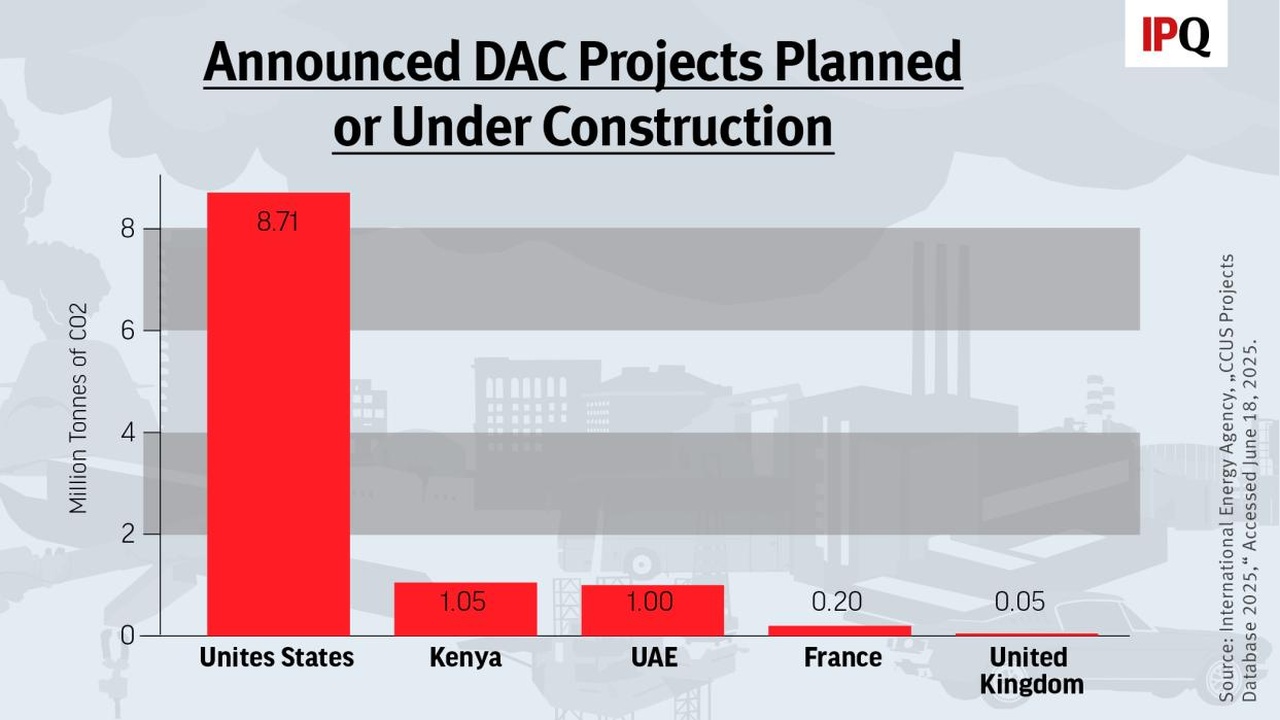
US Leads World in Announced DAC Capacity
The chart shows the United States leading the world in announced DAC capacity, providing context for the section’s argument that this leadership position is now fracturing due to project stalls.
(Source: Internationale Politik Quarterly)
Occidental’s 1 MTPA STRATOS Plant Signals DAC Scaling (2025)
The operational status of these top projects reveals distinct levels of technological maturity. Carbon Engineering’s liquid solvent technology, deployed by Occidental at the 1 MTPA STRATOS facility, has clearly reached commercial readiness for megaton-scale projects, provided it has robust corporate backing. Solid sorbent technologies from companies like Climeworks and Svante are also operational, but at a smaller scale. Svante’s Tamarack project is a successful demonstration, but the pause on the much larger Project Cypress shows the challenges this pathway faces in scaling without significant public investment. The policy freeze has been particularly damaging for novel approaches from companies like Heirloom (limestone-based) and Avnos (water co-capture). The DAC Hubs program was meant to be their proving ground to reach commercial scale, and its suspension delays the validation of these next-generation technologies.

Solid and Liquid DAC Markets to Boom
As the section contrasts the maturity of liquid-solvent (Occidental) and solid-sorbent (Climeworks) technologies, this chart forecasts the massive growth expected in both market segments through 2034.
(Source: Market.us)
DAC Viability, Occidental’s Hedge Against the 45 Q Credit Cut
The single most critical factor for the US DAC industry in 2026 is the resolution of the administrative freeze on IRA funds and the legislative threat to the 45 Q tax credit. The outcome will determine whether the US remains a leader or cedes its position to international competitors with more stable policies.
- Signal Losing Steam: Projects like Project Cypress and the Kern County Hub, which are almost entirely dependent on the frozen $3.5 billion in DOE grants, are in a state of paralysis. Their progress, or lack thereof, serves as a direct barometer of the political headwinds facing climate-related spending.
- Signal Gaining Traction: Occidental’s integrated model is proving its resilience. The ability to monetize captured CO₂ through EOR provides a crucial financial cushion against a potential cut to the $180/ton sequestration credit, making its projects the most likely to advance in the current environment.
- Signal to Watch: The international response. As policy in Canada, the UK, and the Middle East solidifies, watch for a potential shift in capital and talent away from the US. The success of projects like Tamarack could embolden investors to seek out more predictable regulatory landscapes.

Map Shows Federally-Funded DAC Hubs Now Stalled
This map pinpoints the major DAC Hubs, including Project Cypress, that are now stalled due to the administrative freeze on DOE funding mentioned in the text.
(Source: LinkedIn)
The questions your competitors are already asking
This report covers one angle of how political risk is splitting the commercial prospects of US Direct Air Capture projects. The questions that matter most depend on your work.
- Which companies are gaining or losing ground in the Direct Air Capture market due to the freeze on federal hub funding?
- What is the outlook for DAC deployment if the 45Q tax credit is cut from $180/ton to $36/ton?
- What is actually happening with the Department of Energy’s $3.5B DAC Hubs program, and which projects like Project Cypress are now paused?
- What is the actual cost per ton for a large-scale plant like Occidental’s STRATOS, and is it viable without federal hub funding?
This report does not answer these. Enki Brief Pro does.
Your question, your angle, your framework. SWOT, PESTL, scenario modelling. The same niche depth, built around the decision your work actually depends on.
