

Data Center Cooling 2026: How Panasonic is Building a Vertically Integrated Supply Chain for the AI Boom
Panasonic’s Market Pivot: From Consumer HVAC to AI-Driven Liquid Cooling Projects
Panasonic is executing a fundamental commercial shift, reorienting its vast manufacturing and thermal management expertise from traditional HVAC markets toward high-density liquid cooling for AI data centers. Prior to 2025, the company’s focus was on incremental upgrades to its air-cooling portfolio and general HVAC expansion. The period since has been defined by a decisive entry into the liquid cooling segment, validated by the launch of a dedicated business unit and a suite of commercial-ready, high-performance products specifically designed for the extreme thermal loads of generative AI.
- Between 2021 and 2024, Panasonic’s efforts centered on improving existing technologies, such as the 2022 launch of an upgraded server room air conditioner with a better SEER rating, and forming partnerships for building management systems. A 2024 project with Kyndryl to upgrade a Panasonic data center, which reduced CO 2 emissions by 180 tons, served as a key proof-of-concept for its efficiency-focused approach.
- The strategic pivot materialized in March 2026 with the formal launch of the Liquid Cooling Systems Business for Generative AI Data Centers in Europe. This move directly targets the most demanding segment of the data center market, moving beyond the capabilities of traditional air cooling.
- This new business is supported by a rapid product commercialization cycle. Key launches include a next-generation cooling water circulation pump, which began commercial production in March 2025, and a new range of high-performance Coolant Distribution Units (CDUs) introduced by its subsidiary Tecnair in March 2026.
- The company’s ambition is demonstrated by its product roadmap, which includes the development of next-generation CDUs with capacities of 1.2 MW and above. Order acceptance for these high-capacity units is scheduled for March 2026, signaling a direct challenge to established data center thermal management specialists.
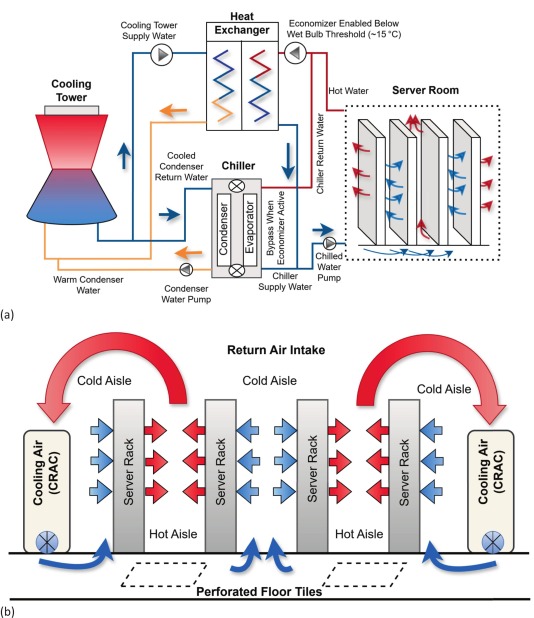
Comparing Data Center Cooling Technologies
This diagram illustrates the fundamental technology shift from traditional air cooling to the liquid cooling systems Panasonic is now focused on, visually explaining the company’s pivot.
(Source: ScienceDirect.com)
Capital Allocation: How Panasonic’s Strategic Investments Fuel Manufacturing Capacity
Panasonic is underwriting its data center strategy with significant and highly targeted capital investments designed to scale manufacturing capacity and vertically integrate its supply chain for critical AI-related components. The investment pattern shifted markedly after 2024, moving from general HVAC capacity expansion to specific, multi-hundred-million-dollar commitments in facilities and technologies essential for the AI infrastructure market. This financial backing provides the industrial foundation for its pivot to high-density liquid cooling.
- A cornerstone of this strategy is the €320 million ($348 million) investment announced in September 2025 to transform its factory in Pilsen, Czech Republic, into a major European manufacturing and R&D hub. While primarily focused on heat pumps, this facility establishes a critical industrial footprint for its broader European thermal management business.
- To secure its supply chain at the component level, Panasonic Industry announced a 7.5 billion yen (~$50.5 million) investment in March 2026 for a new production line for MEGTRON circuit board materials. These materials are essential for the high-speed servers powering AI, demonstrating a strategic move toward vertical integration.
- These recent investments build upon and accelerate earlier commitments. For example, a 2022 plan to invest €145 million in the Czech plant aimed to produce 500, 000 heat pump units by 2026. The new investments significantly expand the scale and strategic scope of its European manufacturing operations.
- The company’s $4 billion EV battery plant in Kansas, which began construction in 2022 and targets mass production by March 2025, provides a massive manufacturing and technological base in North America. This facility creates potential synergies for supplying energy storage systems, a critical component of the data center ecosystem.
Table: Panasonic’s Strategic Investments in AI Infrastructure and Manufacturing
| Company / Project | Time Frame | Details and Strategic Purpose | Source |
|---|---|---|---|
| Panasonic Industry | 2026-03-04 | Announced a 7.5 Billion JPY (~$50.5 M USD) investment for a new production line of MEGTRON circuit board materials to meet demand from AI servers. | Panasonic Industry Announces an Investment of 7.5 Billion yen for a … |
| Panasonic | 2025-09-01 | Invested €320 Million (~$348 M USD) to expand its heat pump factory in Pilsen, Czech Republic, establishing a European hub for its thermal management business. | Panasonic Expands European Heat Pump Production with $348 m … |
| Panasonic | 2023-03-14 | Announced a total investment program of 80 Billion JPY in its European Heating & Ventilation A/C Company to accelerate its growth strategy through fiscal year 2026. | Panasonic Accelerates Growth Strategy for Hydronic Systems … |
| Panasonic | 2023-03-02 | Began construction on a $4 Billion EV battery factory in De Soto, Kansas, to produce lithium-ion batteries for EVs and energy storage systems, targeting a 30 GWh initial capacity. | Turner-Yates JV wins $4 B Panasonic EV battery plant build |
| Panasonic | 2022-09-05 | Announced a €145 Million investment to expand its Czech heat pump plant, targeting a production capacity of 500, 000 units by the fiscal year ending March 2026. | Panasonic to invest €145 m in Czech heat pump plant… |
Ecosystem Build-Out: Strategic Alliances in HVAC and Software Integration
While direct partnerships with major data center operators have not yet been publicly disclosed, Panasonic is methodically building its ecosystem through distribution agreements in adjacent HVAC markets and technology alliances in software and energy management. This strategy aims to create a broad sales and service network while embedding intelligence into its thermal management systems, a key factor in reducing operational expenditures for data center clients. These moves lay the groundwork for a full-scale assault on the data center cooling market.
- In late 2025 and early 2026, Panasonic focused on expanding its channel reach through partnerships with established distributors. Key agreements include a strengthened partnership with Alessa in November 2025 to bolster sales in Saudi Arabia and a national distribution partnership with EMCO in March 2025 to cover the Canadian residential heat pump market.
- The company is integrating intelligence into its hardware through software partnerships. An alliance with German energy control company tado° in March 2024 focuses on developing smart management software, while a collaboration with J 2 Innovations, a Siemens company, in October 2024 leverages the FIN Framework for its smart controllers to enhance energy efficiency.
- In July 2024, Panasonic acquired Polish refrigeration equipment manufacturer Area Cooling Solutions to strengthen its capabilities in CO 2 and natural refrigerant technologies, signaling a commitment to sustainable cooling solutions that are increasingly demanded by the data center industry.
- A notable gap remains in the company’s public-facing strategy: the lack of announced collaborations with hyperscalers like AWS, Google, or Azure, or with major server OEMs. Securing such partnerships will be critical for accelerating market penetration and validating its technology at scale.
Table: Panasonic’s Key Partnerships and Acquisitions
| Partner / Project | Time Frame | Details and Strategic Purpose | Source |
|---|---|---|---|
| Alessa | 2025-11-20 | Strengthened strategic partnership to expand distribution and after-sales support for air conditioners and appliances in Saudi Arabia, building brand and service infrastructure. | Global Topic: Panasonic and Alessa strengthen strategic … |
| EMCO | 2025-03-06 | Strategic national partnership to distribute residential heat pump products across Canada, expanding its North American HVAC footprint. | Panasonic Canada and EMCO Announce National Partnership to … |
| J 2 Innovations (Siemens) | 2024-10-08 | Technology integration partnership to use the FIN Framework for Panasonic’s Smart Edge controller, enhancing energy efficiency in commercial building management. | J 2 Innovations and Panasonic HVAC Europe have partnered… |
| Area Cooling Solutions | 2024-07-09 | Acquisition of the Polish refrigeration equipment manufacturer to strengthen its portfolio of CO 2-based and natural refrigerant cooling solutions in Europe. | Panasonic to boost CO 2 interests with Area purchase -… |
| Kyndryl | 2024-06-24 | Service agreement to upgrade a Panasonic data center’s thermal environment, resulting in an annual CO 2 reduction of approximately 180 tons and serving as a key case study. | Kyndryl renews thermal environment of Panasonic Group’s… |
Geographic Focus: Establishing a European Manufacturing Hub for Global Ambition
Panasonic’s data center cooling strategy is geographically centered on establishing a dominant manufacturing and operational hub in Europe, which it is using as a launchpad for its global ambitions. This Europe-first approach, marked by major investments and acquisitions between 2024 and 2026, is complemented by a significant manufacturing presence in North America and a global R&D network, creating an integrated international operation.

Liquid Cooling Market by Region
This chart provides geographic context for Panasonic’s global strategy, highlighting the importance of the North American and European markets where the company is focusing its efforts.
(Source: Market Research Future)
- Europe is the clear epicenter of Panasonic’s new strategy. The €320 million expansion of its Czech factory, the acquisition of Poland-based Area Cooling Solutions in 2024, and the March 2026 launch of its dedicated European liquid cooling business all confirm this regional focus.
- In North America, the company is building a formidable presence with its $4 billion EV battery plant in Kansas. While not a cooling factory, it establishes a massive industrial footprint, supply chain expertise, and relationships in a key market for data centers, creating opportunities for its energy storage systems business.
- The company’s R&D efforts are global. A new R&D facility in Malaysia, which began operations in December 2023, is tasked with developing air conditioning equipment for both Asian and European markets, highlighting an integrated product development pipeline that feeds its key geographic targets.
Technology Commercialization: Rapid Progression from Components to Integrated Liquid Cooling Systems
Panasonic’s technology strategy has matured at an accelerated pace, progressing from developing foundational components between 2021 and 2024 to launching fully integrated, commercial-scale liquid cooling systems in 2025 and 2026. This rapid commercialization is designed to meet the immediate and escalating thermal challenges posed by AI and HPC infrastructure, moving the company from a component supplier to a systems provider.

AI Power Demand Fuels Need for Cooling
This projection shows the exponential growth in power demand from AI, which directly causes the ‘escalating thermal challenges’ that Panasonic’s new integrated liquid cooling systems are designed to solve.
(Source: Deloitte)
- The period from 2021 to 2024 was characterized by innovation at the component and material level. This included the development of a “High-Thermal Conductive Film R” in May 2023 for heat dissipation and incremental upgrades to its traditional air-cooling products.
- A significant shift occurred in 2025 with the start of commercial production of a specialized cooling water circulation pump designed specifically for data centers. This marked a transition from general-purpose technology to purpose-built data center hardware.
- In 2026, Panasonic took the final step to becoming a systems provider with the launch of a new range of high-performance CDUs through its subsidiary Tecnair. This was accompanied by the announcement of a development roadmap for even higher capacity 1.2 MW+ units.
- The company’s proposal of a “One-rack complete direct liquid cooling solution” in April 2025 further signals its strategic intent to offer fully integrated, turnkey systems, simplifying deployment for data center operators and competing directly with established solutions from firms like JCI and Trane.
SWOT Analysis: Evaluating Panasonic’s Entry into Data Center Cooling
Panasonic’s entry into the data center liquid cooling market is supported by formidable strengths in manufacturing and a timely strategic pivot, but its success is not guaranteed. The company must overcome the weakness of a limited track record in this specific niche and navigate intense competition from entrenched market leaders. Its ability to convert its industrial power into market credibility through partnerships and proven performance will determine its trajectory.

Liquid Cooling Market to Exceed $29B
This forecast quantifies the significant market opportunity in data center liquid cooling, which is a key ‘Opportunity’ in the SWOT analysis of Panasonic’s strategic market entry.
(Source: Market Research Reports & Consulting)
- Strengths: The company’s deep history in pump technology and large-scale manufacturing provides a strong foundation for producing reliable and cost-effective hardware. Its recent investments have added vertical integration in critical AI components like circuit board materials.
- Weaknesses: Despite its brand recognition in other sectors, Panasonic is a new entrant in the specialized data center liquid cooling market and lacks the established relationships and track record of its competitors.
- Opportunities: The explosive growth of AI is creating unprecedented demand for liquid cooling solutions, offering a prime market-entry opportunity. Additionally, the industry-wide push for sustainability and energy efficiency aligns perfectly with Panasonic’s “GREEN IMPACT” initiative and its expertise in heat pumps and natural refrigerants.
- Threats: The market is dominated by specialized and experienced competitors, including Vertiv, Schneider Electric, and n Vent, who have deep ties with hyperscalers and server OEMs. Panasonic must demonstrate a compelling total cost of ownership (TCO) and superior technology to displace them.
Table: SWOT Analysis for Panasonic’s Data Center Cooling Strategy
| SWOT Category | 2021 – 2024 | 2025 – 2026 | What Changed / Validated |
|---|---|---|---|
| Strengths | Long-standing expertise in HVAC and thermal management; strong global brand recognition; established manufacturing capabilities. | Leveraging 70-year pump expertise for new pumps; vertical integration with MEGTRON circuit boards; massive new manufacturing hubs in Europe and North America. | Panasonic validated its ability to translate historical expertise and capital into a concrete, vertically integrated manufacturing strategy for a new market. |
| Weaknesses | Limited brand presence in specialized data center liquid cooling; product portfolio focused on traditional air cooling and general HVAC. | Lack of publicly announced partnerships with major data center operators or server OEMs; new European business unit still needs to build a track record and sales channels. | The core weakness shifted from a lack of products to a lack of market penetration and key customer references for its newly launched portfolio. |
| Opportunities | Growing data center market; increasing focus on energy efficiency (PUE); early signs of AI creating higher thermal loads. | Explosive, confirmed demand for liquid cooling driven by generative AI; strong regulatory and market pressure for sustainable solutions and natural refrigerants. | The market opportunity became acute and urgent. The theoretical need for better cooling became a confirmed, immediate demand for high-capacity liquid cooling. |
| Threats | Established competition from specialists like Vertiv and STULZ in the broader data center cooling market. | Direct and intense competition in the liquid cooling niche from incumbents who are also launching new modular solutions (e.g., n Vent’s portfolio launch). | The competitive threat became more direct and focused. As Panasonic enters the liquid cooling niche, it now competes head-to-head on specific products like CDUs. |
2026 Outlook: Tracking Commercial Adoption and Competitive Response
The success of Panasonic’s data center cooling strategy in 2026 will be determined by its ability to translate its new manufacturing capacity and product portfolio into tangible commercial contracts. The primary signal to watch is the company’s progress in securing anchor customers among major data center operators, which would validate its technology and business model against established competitors.

Total Data Center Cooling Market Growth
This long-term forecast illustrates the massive scale of the total addressable market, framing the high stakes and competitive landscape detailed in the 2026 outlook for Panasonic.
(Source: Allied Market Research)
- If this happens: If Panasonic announces a significant offtake agreement or co-development partnership with a hyperscale operator for its new high-capacity CDUs or integrated rack solutions…
- Watch this: …then monitor financial reports for an upward revision in revenue forecasts for its industrial division and watch for competitive responses from incumbents, such as accelerated product launches or aggressive pricing strategies.
- These could be happening: Such a deal would confirm that Panasonic’s vertically integrated approach provides a compelling TCO and performance advantage. It would also signal that the company is successfully navigating the crucial process of securing server OEM certifications, which are a prerequisite for widespread adoption in the enterprise and hyperscale markets. The market reception following the March 2026 start of order acceptance for its 1.2 MW+ CDUs will be the first major indicator of traction.
Frequently Asked Questions
What is the primary shift in Panasonic’s data center strategy?
Panasonic is undertaking a fundamental pivot from its traditional focus on consumer HVAC and general air-cooling systems to developing and manufacturing high-density liquid cooling solutions specifically for AI data centers. This strategic change was solidified in March 2026 with the launch of a dedicated business unit for liquid cooling in Europe.
What new products has Panasonic launched for the AI cooling market?
Panasonic has rapidly commercialized a suite of new products, including a specialized cooling water circulation pump (production started March 2025) and a new range of high-performance Coolant Distribution Units (CDUs) launched in March 2026. The company is also developing next-generation CDUs with capacities of 1.2 MW and above.
How is Panasonic investing to build its AI infrastructure supply chain?
Panasonic is making significant, targeted investments to vertically integrate its supply chain. Key examples include a €320 million investment to turn its factory in Pilsen, Czech Republic, into a European manufacturing hub and a 7.5 billion yen (~$50.5M) investment for a new production line of MEGTRON circuit board materials, which are critical components for AI servers.
What is the biggest challenge or weakness for Panasonic in this new market?
According to the article’s SWOT analysis, Panasonic’s biggest weakness is its lack of an established track record and existing relationships in the specialized data center liquid cooling market. Despite its strong manufacturing capabilities, it is a new entrant competing against incumbents like Vertiv and Schneider Electric who have deep ties with major data center operators and server OEMs.
Has Panasonic announced any partnerships with major data center operators like AWS, Google, or Microsoft Azure?
No. The article explicitly notes that a significant gap in Panasonic’s public strategy is the lack of announced collaborations with hyperscalers like AWS, Google, or Azure. Securing such partnerships is identified as a critical step for accelerating its market penetration and validating its new technology at scale.
