

AI’s Energy Crisis: How Enterprise Software Is Solving the 2026 Data Center Cooling Problem
Enterprise AI Efficiency: The New Frontier in Energy Management
The enterprise software market has fundamentally repositioned its value proposition, shifting from treating AI’s energy consumption as a hardware problem to a software-managed efficiency opportunity. This strategic pivot, accelerating from 2025, uses the escalating energy and cooling demands of AI as a primary driver for cloud platform adoption. Companies are no longer just selling ERP systems; they are selling AI-driven operational efficiency as a core solution to mitigate the ballooning costs and carbon footprint of high-density computing.
- Before 2025, digital transformation projects focused on general operational improvements, such as the 2021 initiative where district cooling specialist Tabreed partnered with SAP and Deloitte to enhance data analytics. This represented a baseline effort to digitize existing infrastructure.
- A significant change is visible in the April 2024 agreement where Danfoss, a leader in cooling technologies, adopted RISE with SAP on HPE Green Lake. This project was not a generic cloud migration but a strategic move to run mission-critical workloads in its own energy-efficient modular data centers, creating a powerful, replicable model for sustainable IT.
- By 2025, the focus broadened to include the entire value chain. In November 2025, Italian manufacturer Facchini deployed the SAP Sustainability Control Tower to automate complex ESG reporting, a critical capability for any company, including data center operators, now required to manage and report on massive energy and water consumption.
- The strategy reached commercial scale in February 2026 with the launch of Germany’s “Industrial AI Cloud.” This collaboration between SAP, NVIDIA, and Deutsche Telekom integrates enterprise software directly with AI hardware and sovereign infrastructure, providing a packaged solution for industrial customers to manage AI workloads efficiently and securely.
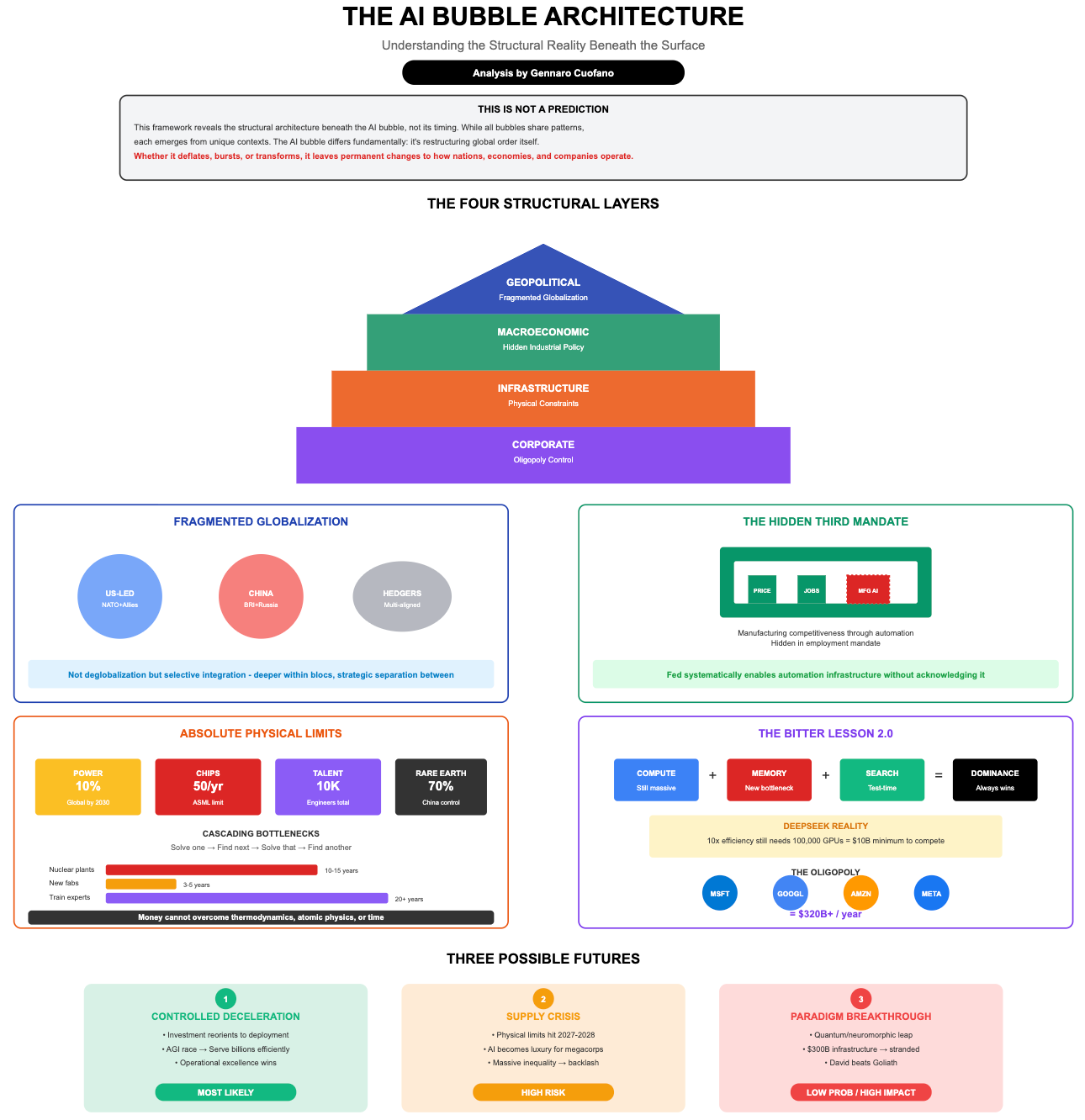
AI’s Physical Limits Drive Software Strategy
This framework shows how massive infrastructure costs and power constraints are the primary drivers forcing a strategic shift toward software-managed efficiency.
(Source: The Business Engineer)
Strategic Capital Deployment: Funding the AI Efficiency and Sovereignty Pivot
Major enterprise software investment has pivoted to a dual strategy: deploying massive capital into sovereign cloud infrastructure to address geopolitical and data residency requirements, while using strong financial performance to signal market confidence in an AI-driven growth model. This contrasts with the direct infrastructure spending by hyperscalers, positioning software as the intelligence layer that optimizes physical assets rather than simply owning them. This trend is a key part of the broader AI data center energy revolution.

Capital Investment Pours Into Data Center Construction
The AI boom has triggered an unprecedented surge in data center construction spending, directly visualizing the massive capital deployment into physical infrastructure.
(Source: AI Supremacy)
- In September 2025, SAP announced a landmark €20 billion investment plan to bolster Europe’s digital sovereignty. This long-term commitment includes building out Infrastructure-as-a-Service (Iaa S) capabilities and an on-premise sovereign cloud, directly enabling customers in regulated industries to adopt AI while maintaining data control.
- Following strong 2025 results, SAP announced a €10 billion share buyback program in January 2026. This move, funded by an annual free cash flow of €8.2 billion, was designed to return value to shareholders and project confidence in its AI-led strategy amid market anxieties.
- This software-centric investment model is distinct from the infrastructure commitments seen elsewhere. For instance, reports in January 2026 noted Open AI’s commitment to spend up to $60 billion annually on cloud facilities from providers like Oracle, highlighting the enormous hardware demand that SAP’s efficiency software aims to manage and reduce for its customers.
Table: Strategic Investments in AI Efficiency and Sovereign Cloud
| Company / Project | Time Frame | Details and Strategic Purpose | Source |
|---|---|---|---|
| SAP | Jan 2026 | Announced a €10 billion share buyback program to return value to shareholders, signaling confidence in its AI and cloud transformation strategy. | SAP 6-K Filing |
| Oracle / Open AI | Jan 2026 | Open AI committed to spend up to $60 billion per year on cloud computing facilities, with Oracle as a key infrastructure provider, underscoring the massive scale of AI hardware demand. | JP Morgan Asset Management |
| SAP | Sep 2025 | Announced a €20 billion investment initiative to strengthen Europe’s digital sovereignty and AI innovation, including Iaa S and on-premise cloud services. | The Fast Mode |
| SAP | FY 2023 | Reported €6.10 billion in R&D expenses, a significant portion of which was directed toward embedding Business AI and sustainability features into its core product suite to address energy efficiency. | SAP Integrated Report 2023 |
AI Ecosystem Convergence: Unlocking Cooling Efficiency Through Strategic Alliances
Since 2025, partnerships in the enterprise technology sector have matured from simple service agreements to deep, multi-layered collaborations. These alliances are now critical for delivering end-to-end solutions that manage AI’s energy footprint, integrating everything from silicon and cloud infrastructure to enterprise applications and cybersecurity frameworks. This integrated approach allows software providers to address the cooling crisis holistically, rather than as a standalone hardware issue.

Liquid Cooling Market Growth Fuels Alliances
The rapid expansion of the liquid cooling market underscores the significant commercial opportunity in solving AI’s heat problem, which in turn drives strategic ecosystem partnerships.
(Source: P&S Intelligence)

AI Network Spending Forecast to Skyrocket
The forecast for AI networking costs highlights the immense scale of infrastructure investment, providing critical context for the multi-billion dollar commitments by major tech players.
(Source: Deloitte)
- In the period before this shift, a typical partnership involved digital transformation projects, such as Tabreed’s 2021 engagement with Deloitte to implement SAP for operational improvements in its district cooling business.
- By 2025, the nature of these collaborations became far more strategic. The November 2025 partnership between SAP and Capgemini focused on accelerating sovereign, “agentic” AI-driven transformation, explicitly linking AI adoption with cybersecurity and data sovereignty.
- The most significant shift is the formation of integrated technology stacks. The February 2026 launch of the “Industrial AI Cloud” by SAP, NVIDIA, and Deutsche Telekom created a turnkey sovereign AI platform. This initiative directly embeds NVIDIA’s AI hardware within an enterprise software framework to manage industrial processes efficiently.
- This ecosystem strategy now extends to foundational AI models. The September 2025 partnership between SAP, Open AI, and Microsoft in Germany was established to build sovereign AI solutions, combining SAP’s cloud expertise with Open AI’s models to meet stringent European data residency and security standards.
Table: Key Strategic Partnerships for AI and Infrastructure Efficiency
| Partners | Time Frame | Details and Strategic Purpose | Source |
|---|---|---|---|
| SAP, Deutsche Telekom, NVIDIA, Siemens | Feb 2026 | Launched Germany’s “Industrial AI Cloud, ” a sovereign platform integrating hardware and software to provide scalable, efficient AI solutions for industrial clients. | Deutsche Telekom |
| SAP, Capgemini | Nov 2025 | Deepened their strategic partnership to focus on sovereign agentic AI transformation and cybersecurity, helping clients adopt AI securely. | PR Newswire |
| SAP, Open AI, Microsoft | Sep 2025 | Partnered to combine SAP’s sovereign cloud with Open AI’s AI models in Germany, ensuring data sovereignty for European customers. | Data Center Dynamics |
| Danfoss, HPE, SAP | Apr 2024 | Danfoss selected RISE with SAP on HPE Green Lake to run SAP workloads in its own energy-efficient modular data centers, showcasing a sustainable cloud model. | HPE Newsroom |
Europe Leads the Charge: The Proving Ground for Sovereign, Efficient AI in 2026
While the AI infrastructure boom is a global phenomenon, Europe, with Germany at its core, has become the strategic center for developing and deploying sovereign and energy-efficient AI ecosystems. This focus is driven by a combination of stringent data privacy regulations like GDPR, a strong industrial base demanding localized AI solutions, and a political will to establish digital sovereignty as a counterweight to US and Asian tech dominance.

Development Gap Highlights Need for New Partnerships
A widening gap between planned and developed data center capacity illustrates the execution challenges that the strategic infrastructure partnerships described in the section are formed to overcome.
(Source: LinkedIn)
- Germany is now the primary hub for this activity. The February 2026 launch of the “Industrial AI Cloud” by SAP, NVIDIA, and Deutsche Telekom in Germany established a flagship national platform for industrial AI. This was reinforced by HCLTech’s decision to open an innovation lab for SAP Business AI in Germany in December 2024.
- This national focus is part of a broader European strategy. SAP’s €20 billion investment commitment in September 2025 aims to build a pan-European sovereign cloud network, creating the necessary infrastructure for companies across the continent to run AI workloads efficiently and in compliance with local regulations.
- France is another key node in this network. The November 2025 alliance between SAP and Capgemini was explicitly framed as an effort to join forces with France’s AI ecosystem to power Europe’s sovereign digital future.
- This targeted European build-out from 2025 onward contrasts sharply with earlier, more globally dispersed projects. For example, a 2021 digital transformation project for cooling company Tabreed was based in the UAE and focused on regional operational goals, not continent-wide strategic infrastructure.
From Reporting to Action: The Evolution of Enterprise AI into Efficiency Engines
Enterprise AI technology has reached a critical maturity inflection point, evolving from passive tools for reporting and analytics to proactive, “agentic” systems that actively optimize business processes and resource consumption. This transition, which gained significant momentum in 2025, is central to the strategy of using software to manage the operational costs of the AI boom.

Enterprise AI Spending Accelerates Rapidly
The sharp rise in AI spending across all company sizes reflects the technology’s evolution from a niche tool to mature, actionable business engines as described in the section.
(Source: The Thesis by Leonis – Substack)
- In the 2021-2024 period, the primary application of AI in the sustainability context was for measurement and reporting. Products like the SAP Sustainability Control Tower and SAP Sustainability Footprint Management were designed to help companies calculate and track their carbon footprint.
- A definitive shift occurred in 2025 with the push toward agentic AI. At its November 2025 Tech Ed conference, SAP detailed its strategy to build systems around its AI copilot, Joule, that could automate complex workflows and unify data to drive tangible business outcomes, directly impacting operational efficiency and energy use.
- The technology stack deepened with the introduction of new AI models. In December 2025, SAP announced the “Enterprise Relational Foundation Model, ” a new class of AI designed specifically to predict business outcomes. This moves beyond generic generative AI to provide actionable insights for resource optimization.
- By early 2026, these technologies were integrated into commercially available platforms. The launch of the “Industrial AI Cloud” represents the packaging of these advanced AI software capabilities with high-performance hardware, signaling a move from standalone product features to fully integrated, commercial-scale solutions.
SWOT Analysis: SAP’s Strategy for the AI Cooling Crisis
An analysis of SAP’s strategic pivot reveals a calculated approach that leverages its market dominance and financial strength to turn the AI-driven energy crisis into a significant commercial opportunity. However, this software-first strategy is not without risks, as the company faces intense competition and market anxiety over the disruptive potential of AI itself.

SAP Stock Performance Validates AI Strategy
SAP’s significant stock outperformance signals strong market confidence in the company’s strategic pivot, directly reflecting the financial strength mentioned in the SWOT analysis.
(Source: Seeking Alpha)
- The core strength lies in SAP’s immense installed base and deep integration into the world’s most complex supply chains, providing a powerful distribution channel for its new AI and sustainability tools.
- The primary opportunity is the “cooling crisis” itself, which creates a compelling, C-suite-level business case for migrating from inefficient on-premise systems to SAP’s cloud offerings.
- A key weakness is the company’s dependency on partners like NVIDIA for the underlying hardware, which it seeks to mitigate by positioning itself as the indispensable “brain” that optimizes the physical “brawn.”
- The most significant threat comes from market perception and competition. The volatility in SAP’s market value in 2025-2026 reflects investor uncertainty about whether an incumbent can successfully navigate a paradigm shift driven by AI.
Table: SWOT Analysis of SAP’s AI and Sustainability Strategy
| SWOT Category | 2021 – 2024 | 2025 – 2026 | What Changed / Resolved / Validated |
|---|---|---|---|
| Strengths | Dominant ERP market share; strong customer relationships; early investments in cloud (RISE with SAP). | Deeply embedded “Business AI” and Joule copilot; strong financial position (€8.2 B free cash flow in 2025); vast partner ecosystem. | The company successfully translated its market incumbency and financial power into a credible AI and sustainability narrative, validated by major new investments and strong financial returns. |
| Weaknesses | Perception as a legacy on-premise software provider; slower cloud transition compared to hyperscalers. | Heavy reliance on hardware partners (NVIDIA, Intel); stock market volatility due to AI disruption fears; complexity of integrating a vast partner ecosystem. | The pivot to a software-first AI strategy exposed its dependence on a complex hardware ecosystem, and market anxiety about AI disruption became a tangible financial risk, as seen in market value fluctuations. |
| Opportunities | Growing demand for cloud ERP; increasing importance of ESG and sustainability reporting. | The “cooling crisis” as a catalyst for cloud adoption; rising energy costs making efficiency a C-suite priority; strong demand for sovereign cloud in Europe. | The energy and cooling crisis was successfully framed as a primary driver for cloud migration, transforming a technical problem into a strategic business imperative that SAP is positioned to solve. |
| Threats | Competition from cloud-native ERPs and best-of-breed Saa S solutions. | Custom-built AI ERPs by large enterprises; hyperscalers (AWS, Microsoft, Google) bundling their own AI-optimized solutions; investor skepticism about long-term defensibility. | The threat of AI disruption solidified from a theoretical risk into a direct market pressure, with reports of a $130 billion drop in SAP’s market value reflecting investor fears that AI could erode its core business. |
2026 AI Efficiency Imperative: Demonstrating ROI on AI-Powered Energy Savings
For 2026, the most critical strategic hurdle for enterprise software providers is to deliver quantifiable proof that their AI and sustainability tools generate tangible operational savings. As enterprises confront the soaring energy and infrastructure costs of AI, the purchasing decision will shift from adopting AI for innovation’s sake to deploying AI for measurable efficiency gains. The success of this entire strategic pivot hinges on demonstrating a clear and compelling return on investment.

Power Grid Strain Makes Efficiency ROI Critical
The overwhelming demand on power grids starkly illustrates the ‘soaring energy and infrastructure costs,’ making a clear return on investment for efficiency solutions non-negotiable.
(Source: SemiAnalysis)
- If this happens: If companies like SAP can publish credible case studies showing customers reducing data center energy costs by 15-20% or automating ESG reporting to save thousands of man-hours…
- Watch this: …then watch for a rapid acceleration in the adoption of platforms like RISE with SAP and the “Industrial AI Cloud.” The key indicator will be a shift in sales and marketing messaging from technology features to business outcomes, specifically cost savings and risk mitigation.
- This could be happening: We may see the emergence of new pricing models, where software vendors take a percentage of the energy savings they help generate. Furthermore, success will be validated if major industrial clients in Germany begin reporting significant efficiency gains from the Industrial AI Cloud by the end of 2026. Conversely, continued market skepticism and a failure to produce concrete ROI data will signal that the software-first strategy is not a sufficient defense against the broader forces of AI-driven disruption.
Frequently Asked Questions
What is the core problem enterprise software is trying to solve regarding AI?
The core problem is the “AI’s Energy Crisis,” specifically the escalating energy and cooling demands from the high-density computing required for AI workloads, which is projected to be a major issue by 2026. Enterprise software is shifting its focus to manage this as a software-driven efficiency opportunity, rather than just a hardware problem.
How has the role of enterprise software in managing energy consumption evolved?
Initially (before 2025), software like the SAP Sustainability Control Tower was used for passive reporting and tracking of a company’s carbon footprint. The technology has now matured into proactive, “agentic” AI systems that actively optimize business processes and resource consumption. This evolution is exemplified by the launch of integrated platforms like the “Industrial AI Cloud” that package efficiency software directly with AI hardware.
Why is Europe, and specifically Germany, a key focus area for these AI solutions?
Europe has become the strategic proving ground for sovereign and energy-efficient AI due to its strict data privacy laws (like GDPR), a strong industrial base, and a political goal to achieve digital sovereignty. Germany is a hub for this activity, hosting initiatives like the “Industrial AI Cloud” and major investments from companies like SAP to build a pan-European sovereign cloud infrastructure.
What is the difference between how software companies and hyperscalers are investing in the AI boom?
Software companies like SAP are pursuing a dual strategy: investing heavily in sovereign cloud infrastructure to meet data residency needs, while using their financial strength to project market confidence. They position their software as the “intelligence layer” that optimizes physical hardware. In contrast, hyperscalers and their partners, like Oracle and OpenAI, are engaged in massive direct spending on physical cloud facilities and hardware to meet the raw computational demand of AI.
What is the most critical challenge for this software-led strategy in 2026?
The most critical challenge for 2026 is to deliver quantifiable proof that these AI and sustainability tools generate a tangible return on investment (ROI). As businesses grapple with the high costs of AI, they will demand evidence of measurable efficiency gains, such as significant reductions in data center energy costs. The success of this strategy hinges on demonstrating clear business outcomes, not just technological features.
Experience In-Depth, Real-Time Analysis
For just $200/year (not $200/hour). Stop wasting time with alternatives:
- Consultancies take weeks and cost thousands.
- ChatGPT and Perplexity lack depth.
- Googling wastes hours with scattered results.
Enki delivers fresh, evidence-based insights covering your market, your customers, and your competitors.
Trusted by Fortune 500 teams. Market-specific intelligence.
Explore Your Market →One-week free trial. Cancel anytime.
