

Google Geothermal Data Centers, 150 MW Ormat PPA, 115 MW Fervo Energy Deal, and 3 Major PPAs (2025 to 2026)
10.4% CAGR, Geothermal Power Projects for AI Data Center Demand
Corporate power purchase agreements from technology companies are accelerating geothermal energy adoption from US-centric pilot projects to commercial-scale international deployments. This shift is driven by the urgent need for 24/7 carbon-free power to meet the immense energy demands of Artificial Intelligence (AI) infrastructure, a demand that intermittent renewables alone cannot satisfy.
- Between 2021 and 2024, the primary focus was on de-risking next-generation geothermal technologies within the United States. Google‘s initial 2021 partnership with Fervo Energy in Nevada was a foundational project designed to prove the commercial viability of Enhanced Geothermal Systems (EGS) for corporate offtake.
- The period from 2025 to 2026 marks a clear acceleration toward scalable procurement and geographic diversification. This is evidenced by Google‘s portfolio PPA with Ormat Technologies for up to 150 MW, one of the largest corporate geothermal agreements to date.
- The expansion into Asia with the 10 MW Baseload Capital PPA in Taiwan is the most significant strategic development. Although small in capacity, the deal is the first of its kind in Taiwan and effectively doubles the island’s commercial geothermal output, creating a replicable model for powering the region’s critical technology supply chain.
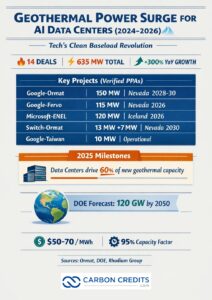
Geothermal PPAs Surge for AI Data Centers
This chart directly supports the section’s focus on the acceleration of geothermal power projects, like those from Google and Microsoft, to meet AI data center energy demand.
(Source: CarbonCredits.com)
Google 3 Geothermal PPAs, $17 B Market Growth Forecasts (2025 to 2033)
Large-scale corporate PPAs from hyperscalers provide the revenue certainty required to de-risk high-cost geothermal projects, fueling market growth and attracting long-term capital. While geothermal’s Levelized Cost of Energy (LCOE) is higher than solar, its value as a firm, dispatchable power source makes it a strategic investment for companies like Google that require constant, reliable electricity for their data centers. This demand signal is a primary driver behind projections that the global geothermal market will grow from approximately $9 billion in 2025 to over $17 billion by 2033.

Tech Giants Lead Geothermal Investment Strategy
The section discusses how large corporate PPAs, specifically from Google, are driving market growth. This chart details the investment strategies of Google and other tech giants, directly illustrating the section’s main point.
- The global geothermal market is projected to expand at a compound annual growth rate (CAGR) between 8.3% and 10.9% through the early 2030 s. Forecasts show installed capacity growing from 17.17 GW at the end of 2025 to 29.5 GW by 2031.
- Corporate PPAs are critical for project bankability. The high upfront capital cost of geothermal exploration and drilling is a major barrier, but long-term agreements from investment-grade offtakers like Google, Meta, and Microsoft provide the financial security for developers to move forward.
- The economic calculation for data centers prioritizes reliability. The LCOE for conventional geothermal ranges from $63–$74 per MWh for flash plants to $90–$110 per MWh for binary plants, compared to solar PPAs around $49-$61/MWh. However, geothermal’s 24/7 availability eliminates the need for expensive battery storage, making its total value proposition superior for baseload-critical operations.
Table: Global Geothermal Market Growth Forecasts
| Forecast Provider | Market Segment | 2025 Value | 2030/2031 Value | 2033 Value | Source |
|---|---|---|---|---|---|
| Mordor Intelligence | Installed Capacity (GW) | N/A | 29.5 GW (2031) | N/A | Mordor Intelligence |
| Straits Research | Market Size ($B) | $9.03 B | N/A | $17.09 B | Straits Research |
| The Business Research Company | Power Generation Market ($B) | $12.59 B | $21.18 B (2030) | N/A | The Business Research Company |
Geothermal Data Center PPAs, Google, Fervo, Ormat, and Baseload Capital
Google‘s geothermal procurement strategy is defined by a multi-partner, multi-technology approach designed to build a resilient and scalable clean energy portfolio. By engaging with an established industry leader, a next-generation technology pioneer, and a developer in a new strategic market, Google is systematically creating a diversified supply of 24/7 carbon-free energy for its global data center fleet.

Market Map of Key Geothermal Players
This section names Google’s specific partners (Fervo, Ormat, Baseload Capital). The market map chart provides crucial context by categorizing these companies and visualizing their position in the industry.
(Source: Montauk Capital – Substack)
- The partnership with Ormat Technologies in February 2026 for up to 150 MW of new capacity in Nevada represents a move to secure large-scale supply from a proven, conventional geothermal operator. This portfolio PPA provides a stable, long-term power source for its US data center operations.
- The agreement with Fervo Energy, which secured approval in May 2025 for 115 MW of EGS power, was a critical step in validating a next-generation technology. This project demonstrated that EGS could reliably deliver firm, carbon-free power for corporate customers, paving the way for broader adoption.
- The 10 MW deal with Baseload Capital in Taiwan announced in 2025 marks a strategic geographic expansion. It establishes a foothold in a key Asian technology hub, diversifies Google‘s geothermal sourcing beyond the US, and creates a replicable model for other corporations in the region, including Cyrus One and Switch.
Table: Google’s Strategic Geothermal Power Agreements
| Partner / Project | Time Frame | Details and Strategic Purpose | Source |
|---|---|---|---|
| Ormat Technologies | Feb 2026 | A portfolio PPA for up to 150 MW of new capacity in Nevada. This deal leverages an established geothermal leader for large-scale, reliable power for US data centers. | Ormat Technologies |
| Baseload Capital | May 2025 | A PPA for 10 MW of geothermal energy in Taiwan. This is the first corporate geothermal PPA in the country and serves as a blueprint for powering AI infrastructure in Asia. | Weekly news – Finance, Freedom, Fellows |
| Fervo Energy | May 2025 | Approval for a 115 MW power supply agreement in Nevada. This landmark project proved the commercial viability of Enhanced Geothermal Systems (EGS) for corporate offtake. | ENR |
US to Asia, Google’s Geothermal Expansion into Taiwan for AI
While the United States remains the center of gravity for corporate-driven geothermal development, Google’s PPA in Taiwan signals a strategic expansion into Asia. This move targets geologically favorable regions that are also critical hubs in the global technology supply chain, establishing a new frontier for powering AI infrastructure with firm, clean energy.

US Data Center Markets’ Geothermal Potential
The section discusses the concentration of geothermal development in the Western US before expanding to Asia. This chart visualizes the geothermal potential of key US markets, supporting the claim that the US is the ‘center of gravity’.
(Source: Rhodium Group)
- Between 2021 and 2024, geothermal activity for data centers was concentrated in the Western US, particularly Nevada, which offers a unique combination of vast data center infrastructure and accessible geothermal resources. This region served as the primary proving ground for the technology and procurement models.
- The 2025 deal in Taiwan represents a deliberate pivot. As the global epicenter of semiconductor manufacturing, Taiwan’s energy security is paramount. By initiating the first corporate geothermal PPA there, Google is not only securing its own power but also creating a pathway for decarbonizing a critical node in the AI supply chain.
- This expansion sets a precedent for other Asian nations with significant geothermal potential. Countries along the Pacific Ring of Fire, such as Indonesia (2, 432 MW installed capacity) and the Philippines (1, 937 MW), are now prime targets for similar corporate investments to power their own digital economies.
90% Cost Reduction Target, Enhanced Geothermal Systems (EGS) at Scale
Next-generation geothermal technologies, led by Enhanced Geothermal Systems (EGS), are transitioning from pilot phases to commercial-scale deployment. This maturation is validated by large corporate PPAs and driven by technological advancements adapted from the oil and gas industry, which are significantly reducing costs and expanding the geographic viability of geothermal power.
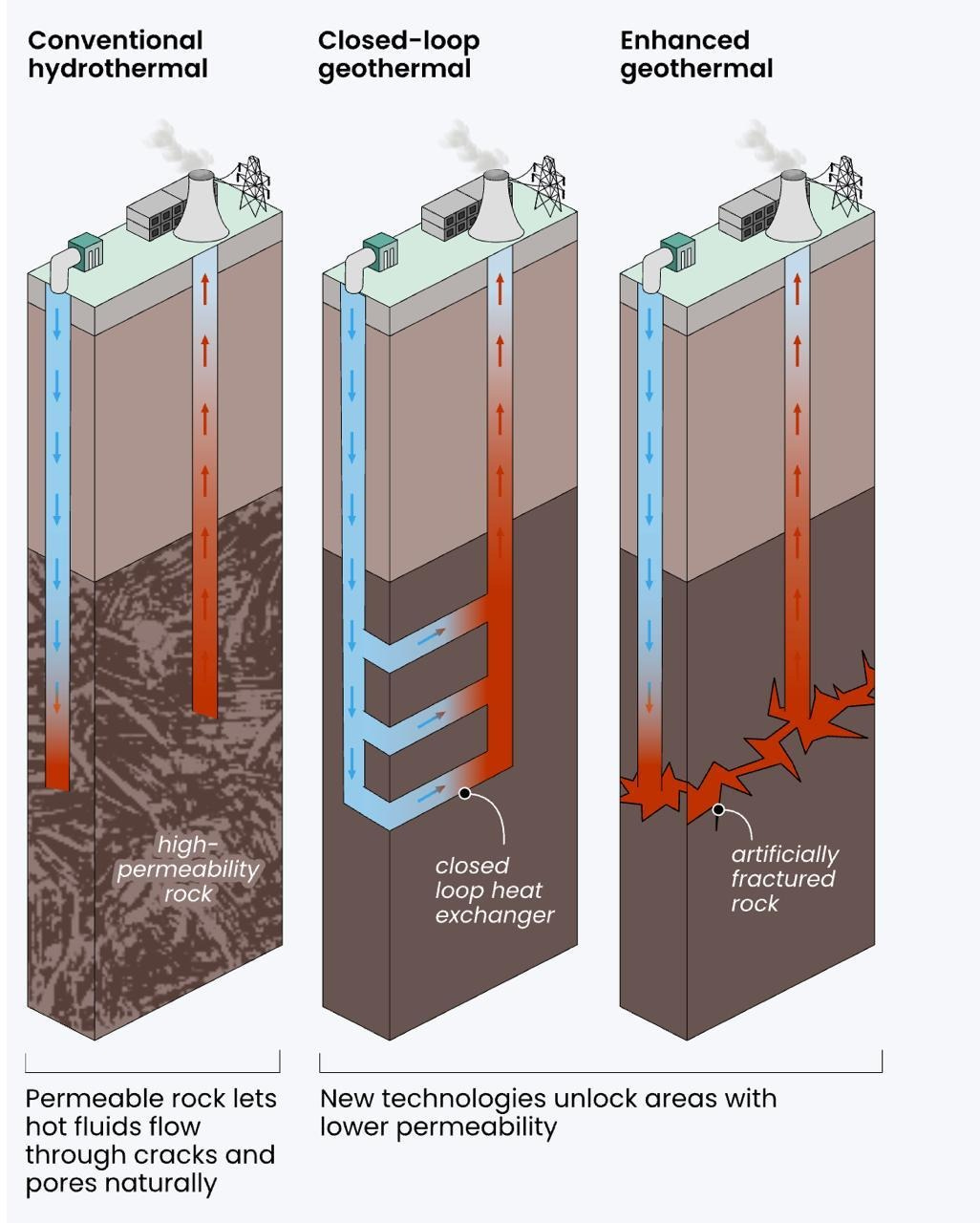
Explaining Next-Generation Geothermal Technologies
This section focuses on Enhanced Geothermal Systems (EGS) technology. The infographic is a perfect match as it explains and compares different geothermal technologies, including EGS.
(Source: Montauk Capital – Substack)
- From 2021 to 2024, EGS was largely considered a developing technology, with its viability dependent on successful pilot projects. Google‘s initial work with Fervo Energy was instrumental in providing a real-world test case for the technology’s ability to deliver reliable power.
- The period from 2025 to 2026 has seen EGS achieve commercial validation. Fervo Energy‘s report of a 65% reduction in drilling costs and timelines over just 14 wells demonstrates a rapid learning curve and path to economic competitiveness.
- The technology pipeline remains robust, supported by public and private sector initiatives. The US Department of Energy’s goal to reduce the cost of EGS by 90% to $45 per MWh by 2035, combined with research into superhot rock geothermal, indicates a strong commitment to making geothermal a mainstream global energy source.
Google SWOT Analysis, Strengths and Policy Risks in Geothermal Energy
Google’s geothermal strategy effectively leverages its market position to secure a first-mover advantage in 24/7 carbon-free energy, but its expansion is subject to external policy and infrastructure risks that could hinder deployment velocity. The company’s ability to navigate regulatory uncertainty and grid-level constraints will be critical to scaling its geothermal portfolio globally and meeting its ambitious clean energy goals for its nuclear-powered data center ambitions.
- Google‘s primary strength is its ability to sign large, long-term PPAs that de-risk new technologies and geographies for developers like Fervo Energy and Baseload Capital.
- The immense and growing energy demand from AI data centers creates a massive opportunity for geothermal, which is uniquely suited to provide the firm, clean power that hyperscalers require.
- A key threat is policy volatility, such as the One Big Beautiful Bill Act (OBBBA) in the US, which has created uncertainty around federal tax credits for clean energy projects.
- Weaknesses remain in the high upfront capital cost and long development timelines for geothermal projects, as well as the current bottleneck in grid interconnection queues.
Table: SWOT Analysis for Google’s Geothermal Data Center Strategy
| SWOT Category | 2021 – 2024 | 2025 – 2026 | What Changed / Validated |
|---|---|---|---|
| Strengths | Pioneered EGS offtake with a pilot-scale partnership (Fervo Energy). | Executing large-scale PPAs (150 MW Ormat) and expanding the model globally (Taiwan). | The procurement strategy shifted from proving a single technology to building a diversified, scalable, multi-partner portfolio. |
| Weaknesses | Dependence on a few innovative but unproven EGS developers; high perceived technology risk. | Higher LCOE ($65-$110/MWh) compared to intermittent renewables; long project lead times. | While partners diversified, the fundamental challenges of high capital costs and long development cycles remain a constraint on speed. |
| Opportunities | Leverage drilling advancements from the oil and gas sector to lower EGS costs. | Replicate the US PPA model in geologically rich Asian markets (Indonesia, Philippines) to power the AI supply chain. | The AI-driven energy demand surge validated the strategic value of firm, 24/7 power, making geothermal’s premium cost justifiable. |
| Threats | Lengthy permitting processes and high upfront exploration and drilling costs. | Increased policy uncertainty (US OBBBA Act) and severe grid interconnection bottlenecks delaying projects. | As projects moved from pilot to commercial scale, they encountered real-world systemic constraints related to policy and infrastructure. |
Geothermal Growth in Asia, Google and the Next Data Center PPA
The next decisive signal for geothermal’s role in the AI energy transition will be a second major corporate PPA in another strategic Asian market. Such a move would confirm that Google‘s Taiwan deal was a replicable blueprint, not a one-off project, likely triggering a regional investment cycle and prompting other hyperscalers like Meta, Microsoft, and Amazon to secure their own geothermal resources. Other firms focused on this space include Crusoe Energy and Vantage Data Centers, while some look to nuclear power as well.

AI Drives Surge in Data Center Power Demand
This section looks ahead to the next PPA in Asia, driven by AI’s energy needs. The chart quantifies the underlying driver by forecasting the massive surge in electricity demand from data centers.
(Source: Rhodium Group)
- If this happens: Another hyperscaler, or Google itself, announces a geothermal PPA of 20 MW or more in Indonesia, the Philippines, or Japan within the next 18 months.
- Watch this: Monitor policy shifts in those countries related to renewable energy permitting, foreign investment incentives, and standardized power purchase agreements, as these would be leading indicators of government support.
- These could be happening: Local and international energy developers will begin publicly announcing land acquisitions and feasibility studies for geothermal projects near planned data center hubs or industrial zones, anticipating the wave of corporate demand.
The questions your competitors are already asking
This report covers one angle of corporate PPAs driving global geothermal deployment for AI infrastructure. The questions that matter most depend on your work.
- Google’s activities in geothermal energy. Is the partnership model progressing from US-based pilots to international commercial deployment?
- What is the outlook for geothermal power deployment in the Asian AI data center sector by 2030?
- How does 24/7 geothermal power compare to intermittent renewables for powering AI data center infrastructure?
- What are the opportunities for geothermal developers in the Asian technology supply chain market following Google’s Taiwan PPA?
This report does not answer these. Enki Brief Pro does.
Your question, your angle, your framework. SWOT, PESTL, scenario modelling. The same niche depth, built around the decision your work actually depends on.
