

China AI Data Center Expansion, $295 B State Plan, 80% Domestic Chip Mandate, and 33% Market CAGR (2021 to 2026)
China AI Data Center Projects, $295 B State Plan Refutes Redundancy Claims
China’s national policy and massive investment plans directly contradict any notion of data center redundancy, revealing a clear strategy of state-driven expansion to establish a self-reliant and dominant AI ecosystem. The pursuit of efficiency is not a signal of contraction but a necessary enabler for this unprecedented infrastructure build-out.
- In June 2026, China announced a five-year plan to invest approximately $295 billion (2 trillion yuan) to construct a nationwide network of AI data centers. This move solidifies a long-term strategy of aggressive growth, directly refuting any theory that efficiency gains would make new facilities unnecessary.
- A key component of this national plan is a mandate that these new data centers must run on at least 80% domestic hardware. This policy creates a captive market for Chinese technology companies like Huawei and is designed to displace foreign suppliers like Nvidia, reinforcing the goal of sovereign compute capacity.
- Market forecasts validate this expansionary trajectory, with projections showing the China AI data center market growing at a compound annual growth rate (CAGR) of 33.1% to reach $336.20 billion by 2032. This rapid growth far outpaces the global average and is fundamentally incompatible with the concept of infrastructure redundancy.
- Capital expenditure from China’s internet giants, while historically smaller than their US peers, is set for significant growth. Bank of America estimated AI capex in China could reach $98 billion in 2025, signaling a sustained and large-scale investment cycle to support the national AI strategy.
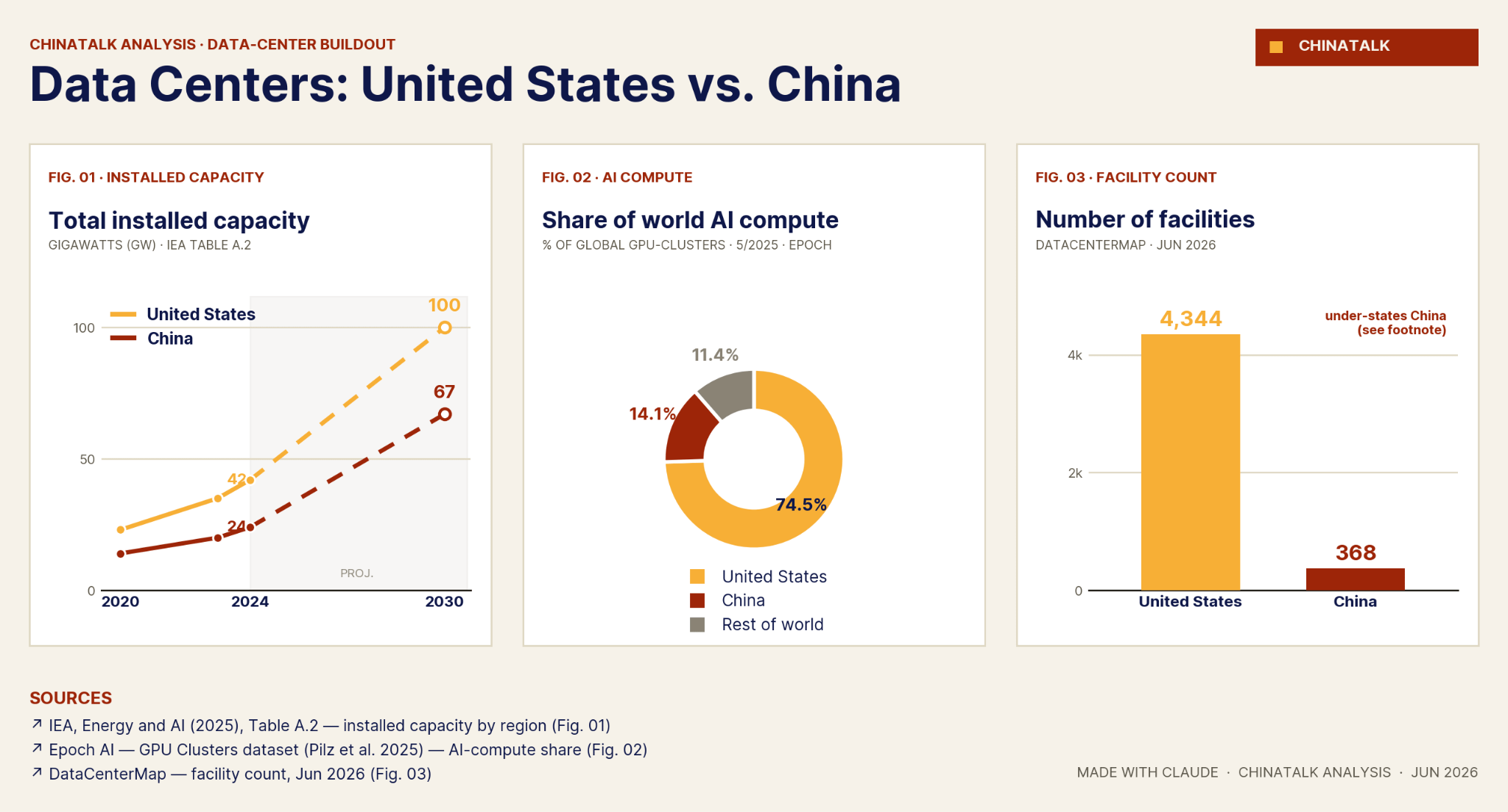
US Leads China in Data Center, AI Infrastructure
This chart provides essential context for the section by illustrating the existing gap between the US and China in AI infrastructure. The significant US lead rationalizes China’s massive $295 billion state plan as a necessary strategic investment to close this gap and compete globally.
(Source: ChinaTalk)
$295 Billion National Investment, China’s Plan for a Sovereign AI Grid
China is funneling hundreds of billions of dollars into a national AI infrastructure program to ensure technological self-reliance and meet the surging domestic demand for compute power. This state-directed investment is structured to build a vertically integrated domestic supply chain, from semiconductor fabrication to data center operation.
- The $295 billion national data center plan announced in June 2026 is the cornerstone of this strategy. It prioritizes the use of homegrown technology, aiming to build a national grid of computing infrastructure that is less vulnerable to foreign sanctions and supply chain disruptions.
- Local governments are providing direct operational subsidies to data centers that adopt Chinese-made AI chips. These incentives, which can reduce energy bills by up to 50%, create a powerful financial motivation for companies to align with the national goal of displacing foreign hardware.
- Chinese AI model developers are demonstrating extreme capital efficiency, which supports the economic case for wider deployment. For example, Deep Seek’s R 1 model was reportedly trained for less than $6 million, a fraction of the estimated $100 million or more required for leading US models like [Open AI]’s GPT-4.
- This focus on cost efficiency extends to construction, where data centers in China benefit from lower labor costs, locally sourced components, and government incentives. This structural advantage lowers the upfront capital required, further accelerating the build-out.

Data Center Costs Hinge on Domestic vs. Foreign Chips
The section discusses China’s plan for a ‘Sovereign AI Grid.’ This chart directly addresses a core challenge of that plan by highlighting the cost differences between using domestic versus foreign chips, a critical decision point for achieving technological sovereignty in AI.
(Source: ChinaTalk)
Table: Strategic Investments in China’s AI Data Center Ecosystem
| Partner / Project | Time Frame | Details and Strategic Purpose | Source |
|---|---|---|---|
| Nationwide AI Data Center Plan | 2026 – 2031 | China is preparing a five-year, $295 billion plan to build a national network of AI data centers. The plan mandates that at least 80% of the hardware be domestically produced, directly supporting companies like Huawei. | Reuters |
| AI Capital Expenditure Forecast | 2025 | Bank of America estimated that AI-related capital expenditure in China could reach $98 billion (700 billion yuan) in 2025, driven by demand from the country’s technology giants. | Reuters |
| Local Government Power Subsidies | 2025 – Ongoing | Local governments are offering electricity subsidies that can cut power bills by up to 50% for data centers that deploy Chinese-made AI processors, creating a direct financial incentive for domestic adoption. | Financial Times |
| China Data Center Market Growth | 2025 – 2029 | Technavio projects the data center market in China will grow by $274.39 billion between 2025 and 2029, progressing at a CAGR of 38.3%, indicating sustained, high-speed expansion. | Yahoo Finance |

China Faces Higher AI Hardware, Compute Costs
This chart aligns with the theme of ‘Strategic Investments’ by detailing a key problem those investments must solve. The higher hardware and compute costs faced by China underscore the need for targeted financial strategies to build a competitive and cost-effective data center ecosystem.
(Source: ChinaTalk)
East to West Relocation, China’s “Eastern Data, Western Computing” Strategy
To manage the immense energy requirements of its data center expansion, China is implementing a national geographic strategy, “Eastern Data and Western Computing, ” to optimize power consumption and lower operational costs. This proactive energy management is critical to sustaining the planned infrastructure growth, a challenge many Western nations are only beginning to confront with initiatives like [Smart Grid Software 2026, $52 B Market, FERC Rulemaking].
- The initiative relocates new data center projects from the power-constrained eastern demand centers to the country’s western regions. These areas offer abundant renewable energy sources, such as solar and wind, and cooler climates that naturally reduce cooling costs, a major operational expense.
- This strategy directly addresses the energy bottleneck that threatens to slow AI development globally. The International Energy Agency (IEA) projects that electricity consumption from AI workloads will grow by 30% annually, and China’s strategy is a direct attempt to build the power capacity needed to support this growth.
- The government has reinforced this initiative with strict efficiency mandates. A new action plan released in May 2026 requires that green electricity be a key component in the operation of new data center projects, and regulations set in 2025 require the average Power Usage Effectiveness (PUE) of data centers to be below 1.5.
- By proactively managing energy constraints and building out infrastructure in resource-rich regions, China is laying the groundwork to support a far larger AI ecosystem than would be possible if it remained concentrated in its eastern coastal hubs. This contrasts with the grid challenges facing [hyperscaler AI & data center energy 2026, $726 B Dell’Oro] expansion in other parts of the world.

China Data Center Personnel Costs 460% Cheaper
The ‘Eastern Data, Western Computing’ strategy is an economic and logistical plan. This chart explains a major economic driver for this relocation by showing a significant cost advantage in personnel, which can be maximized by moving data centers to less developed, lower-cost western regions.
(Source: ChinaTalk)
China’s AI Model Efficiency, Deep Seek Achieves 94% Lower Training Cost
Chinese firms are achieving commercial scale by focusing on AI model and hardware efficiency, enabling them to develop competitive technologies with significantly less compute and capital. This progress in algorithmic and hardware optimization is a strategic necessity driven by US export controls, and the resulting cost advantages are being reinvested to fuel wider infrastructure deployment, not reduce it.
- Between 2021 and 2024, the primary focus was on catching up to Western models, often requiring significant compute resources. However, by 2025, the strategy shifted dramatically toward capital efficiency. Chinese companies like Deep Seek demonstrated this by training their R 1 model for an estimated $6 million, approximately 94% less than the reported $100 million cost for Open AI’s GPT-4.
- This software-level efficiency is complemented by a push for more energy-efficient domestic hardware. Research from institutions like Tsinghua University on photonic chips, which demonstrated an energy efficiency of 160 TOPS/W, points to a long-term path for reducing the operational energy footprint of AI computations.
- In the near term, domestic champions like Huawei are filling the gap left by US sanctions. The company’s Ascend 910 B chip is gaining significant market share, with Huawei reportedly bracing for $12 billion in AI chip revenue in 2026, indicating strong domestic adoption and a viable alternative to more power-hungry foreign chips.
- These efficiency gains are crucial for survival and scale. By lowering the cost per inference and the energy per operation, China makes AI accessible to a broader range of industries, thereby increasing the total long-term demand for a larger, more cost-effective data center footprint, potentially powered by diverse sources from [Microsoft Nuclear 2026, 835 MW Constellation PPA] to traditional renewables.

China AI Compute Efficiency Trails US Hardware
While the section highlights a specific success in model efficiency (Deep Seek), this chart provides the broader, more critical context. It shows that overall hardware compute efficiency is a weakness for China, explaining the motivation for companies to find software and model-based efficiency gains.
(Source: ChinaTalk)
33% CAGR, China’s AI Data Center Expansion Scenario for 2026
The most critical trajectory for 2026 is China’s use of efficiency gains to accelerate, not curtail, its data center build-out, aiming to deploy massive compute capacity at a lower total cost of ownership than Western competitors. The assertion that efficiency makes data centers redundant is a fallacy; in a technology race, efficiency gains are immediately reinvested to expand scale and scope.
- If China continues to execute its $295 billion national AI plan, as detailed in June 2026, the primary signal to watch is the rate of domestic hardware adoption. An increase in the market share of Huawei’s Ascend chips over sanctioned Nvidia alternatives would validate the success of China’s self-reliance strategy.
- These developments could be happening alongside a growing divergence in the total cost of ownership for AI compute. With direct energy subsidies and lower construction costs, China is positioned to build and operate its data centers more cheaply, allowing it to support a larger AI economy with the same level of investment. The availability of reliable power, supported by solutions from traditional grids to innovative [Bloom Energy Fuel Cell 2025, $800 B AI Buildout & PG&E] deployments, will be a key differentiator.
- Watch for official progress reports on the “Eastern Data and Western Computing” initiative. Successful migration of data center capacity to western provinces will confirm that China is effectively managing its energy constraints, a critical enabler for sustaining its projected 33.1% market CAGR through 2032. This national-scale planning contrasts with the more fragmented, market-driven infrastructure development seen elsewhere.

China Data Center Market to Reach $63.81B
This section describes a 33% CAGR and future expansion. The chart provides a concrete data point for this growth trend, quantifying the projected size of China’s data center market and reinforcing the section’s narrative of rapid expansion.
(Source: Mordor Intelligence)
The questions your competitors are already asking
This report covers one angle of China’s state-driven AI infrastructure expansion. The questions that matter most depend on your work.
- Which companies like Huawei and Nvidia are gaining or losing ground in China’s AI data center market under the 80% domestic hardware mandate?
- What is the status of China’s $295B national AI data center plan, and is the build-out on track for its 2026 targets?
- How does domestic Chinese AI hardware compare to Nvidia’s for performance and efficiency in large-scale AI training?
- What opportunities remain for foreign suppliers in the 20% of China’s AI hardware market not covered by the domestic mandate?
This report does not answer these. Enki Brief Pro does.
Your question, your angle, your framework. SWOT, PESTL, scenario modelling. The same niche depth, built around the decision your work actually depends on.
