

The 2026 AI Power Wall: Why Grid Availability is the New Bottleneck for Chip Demand
AI Infrastructure Risks: How the Power Grid Became the Primary Constraint in 2026
The primary constraint for AI expansion has decisively shifted from semiconductor manufacturing to the availability of electrical power and infrastructure. While the industry previously focused on fabrication capacity, technology companies now possess stockpiles of advanced AI chips they cannot deploy because the grid infrastructure required to power and cool them is not ready. This creates a new, more intractable bottleneck that is redefining the timeline and geography of AI growth.
- Between 2021 and 2024, the central challenge was advanced manufacturing, specifically the limited capacity for TSMC’s Co Wo S advanced packaging and the supply of High-Bandwidth Memory (HBM). In 2025 and 2026, this has been superseded by the “power wall, ” where the deployment of built hardware is stalled by insufficient energy capacity, a problem highlighted by Gartner research as a material risk to global supply chains.
- The scale of energy demand is the core issue. Global net additional power demand from AI data centers in just the first quarter of 2024 was equivalent to the entire consumption of Sweden. A single Chat GPT query requires nearly 10 times the electricity of a standard Google search, illustrating the operational intensity that is now outpacing infrastructure development.
- This shift creates a clear divide between having chips and being able to use them. Reports from late 2025 confirm that technology firms have significant inventories of AI hardware sitting idle. This indicates that capital investment in chips has outpaced the much slower, more complex process of upgrading power substations, transmission lines, and cooling systems.
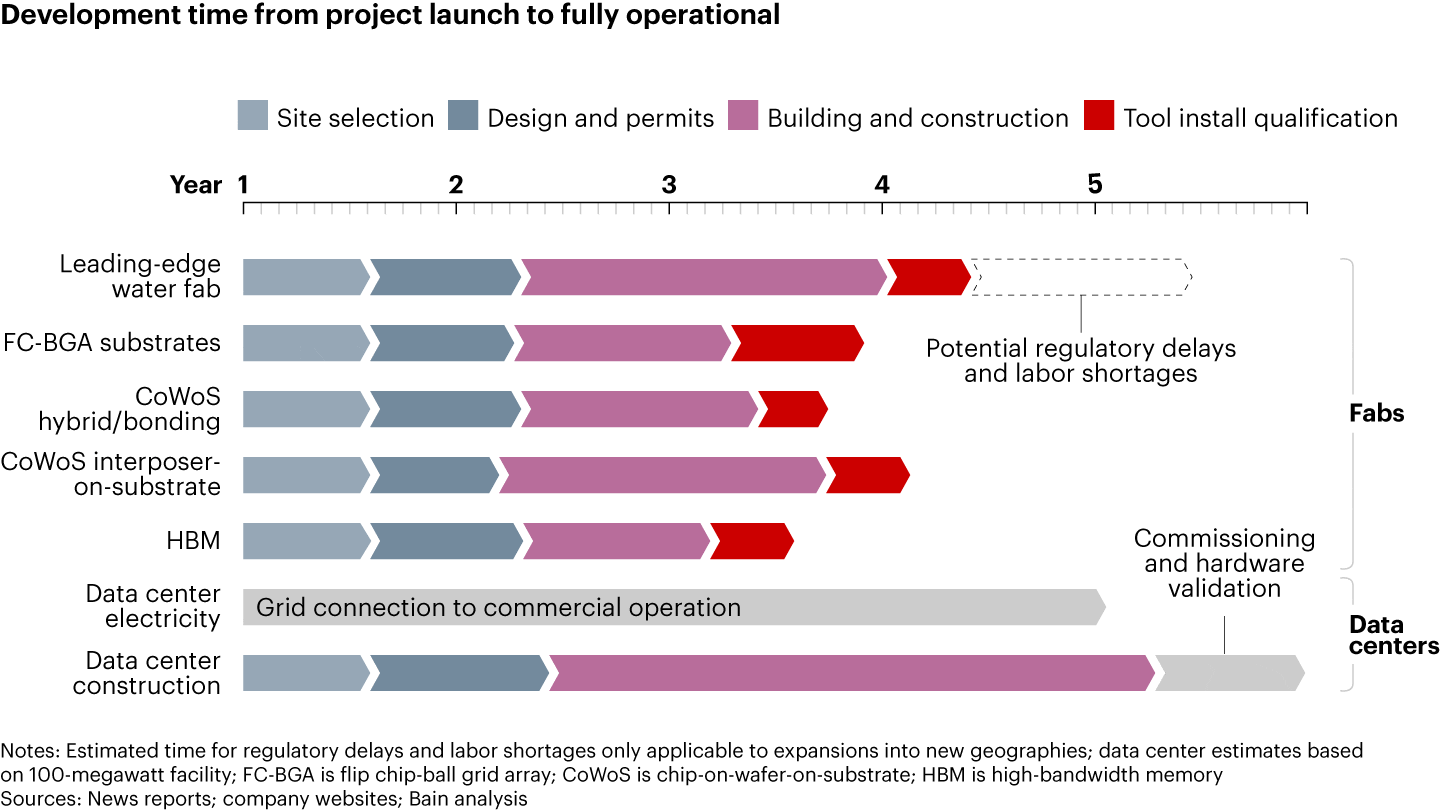
Power Grid Connection a Major Bottleneck
This chart perfectly illustrates the article’s core thesis that the power grid is the primary constraint, showing that establishing a grid connection can take over three years.
(Source: Bain & Company)
Investment Analysis: Capital Redirects to Powering the AI Arms Race
Massive capital expenditures are now being directed at the physical infrastructure required to power AI, signaling a market recognition that energy access is the key enabler for future growth. The historic wave of investment is no longer just for semiconductor fabs but for the entire energy and data center ecosystem, with hyperscalers funding a build-out that strains regional grids and resources.
- Big Tech companies like Google, Meta, and Amazon are driving a historic capital expenditure cycle, planning to spend between $364 billion and $400 billion on AI data centers and the specialized hardware they contain. This spending, evident in massive Cap Ex reports in Q 3 2025, directly translates into unprecedented demand for electricity.
- Investment is also flowing into the semiconductor supply chain to support this, but the focus reveals the interconnected challenges. Micron’s $24 billion investment in its Singapore plant, announced in January 2026, is a direct response to AI-driven memory demand, but the energy required to operate such facilities adds to the overall power burden.
- Government-led initiatives are injecting huge sums to build regional resilience, which includes securing the necessary infrastructure. The U.S. CHIPS Act has spurred over $630 billion in announced private investments across the domestic semiconductor supply chain, but the operational viability of these new fabs is contingent on securing sufficient local power and water.
Table: Strategic Investments in AI Infrastructure and Capacity
| Partner / Project | Time Frame | Details and Strategic Purpose | Source |
|---|---|---|---|
| Micron Plant Expansion | Jan 2026 | Announced a $24 billion investment to expand its Singapore memory production plant. The explicit goal is to meet AI-driven demand for components like HBM, directly contributing to the hardware build-out that requires more power. | MSN |
| Big Tech Hyperscalers | Q 3 2025 – 2026 | Alphabet, Amazon, Meta, and Microsoft are projected to spend $364 billion to $400 billion on AI data centers. This massive capital wave creates the core demand for power and grid infrastructure. | IEEE Com Soc Technology Blog |
| U.S. CHIPS Act Investments | Ongoing from 2025 | Legislation spurred over $630 billion in announced private investments for the U.S. semiconductor ecosystem. This regionalization effort’s success now depends on the ability to power these new domestic facilities. | Semiconductor Industry Association |
Partnership Analysis: Alliances Form to Secure the AI Energy Supply Chain
Strategic alliances are forming to address the systemic energy constraints created by the AI chip boom, moving beyond corporate-level deals to geopolitical and cross-industry collaborations. These partnerships recognize that securing the AI supply chain now requires coordinating not just semiconductors and minerals, but the underlying energy and power grid infrastructure.

Visualizing the AI Chip Supply Chain
This flowchart identifies the key corporate players in the AI supply chain, providing visual context for the cross-industry alliances and partnerships discussed in the section.
(Source: Medium)
- In December 2025, the U.S. government launched an eight-nation alliance explicitly designed to coordinate the development of resilient supply chains for AI. Critically, this initiative goes beyond chips to include critical minerals and energy, acknowledging that hardware dominance is impossible without securing the power to run it.
- Corporate collaborations are focused on improving the efficiency of the entire value chain. The partnership between Siemens and Global Foundries, announced in December 2025, aims to deploy AI-driven manufacturing techniques to make the supply chain more resilient and energy-efficient.
- The expanded partnership between Siemens and NVIDIA in January 2026 to build an industrial metaverse is another signal. The goal is to leverage AI and digital twins to optimize industrial value chains, including the energy-intensive process of manufacturing itself, thereby mitigating the impact on power resources.
Table: Key Partnerships Addressing AI Infrastructure and Power Constraints
| Partner / Project | Time Frame | Details and Strategic Purpose | Source |
|---|---|---|---|
| Siemens & NVIDIA | Jan 2026 | Expanded partnership to build an industrial metaverse. The initiative aims to use AI to reinvent industrial processes, including energy optimization in manufacturing and data center operations. | NVIDIA Newsroom |
| Open AI Domestic Manufacturing Initiative | Jan 2026 | Launched an initiative to enable domestic U.S. manufacturing. A key unstated goal is to co-locate future compute resources in areas with available and resilient power infrastructure, shortening the timeline from chip production to deployment. | Open AI |
| U.S. & Eight-Nation Alliance | Dec 2025 | A geopolitical alliance created to coordinate supply chains for semiconductors, critical minerals, and energy. This directly addresses the strategic need to secure power resources to support national and allied AI technology growth. | Trax Tech |
| Siemens & Global Foundries | Dec 2025 | Collaboration to deploy AI in manufacturing to improve efficiency. This addresses the energy consumption of chip fabrication itself, a significant contributor to the overall power strain. | Siemens Press |
Geographic Shifts: Power Availability Dictates AI Data Center Expansion
The geographic focus of AI infrastructure expansion is now dictated by regional power capacity, shifting the calculus of where to build data centers. While the 2021-2024 period saw concentration around existing tech hubs and fabrication sites, the 2025-2026 period is defined by a search for locations with stable, available, and affordable power, creating new winners and losers in the race to deploy AI.

AI Supply Chain Faces Critical Vulnerabilities
This chart details the critical supply chain vulnerabilities, such as geopolitical risk and high costs, that the partnerships mentioned in the section are designed to mitigate.
(Source: Medium)
- The massive investments under the U.S. CHIPS Act to build new fabs in states like Arizona and Indiana are now facing the second-order challenge of securing immense power and water resources. The success of these multi-billion dollar projects is contingent on local utility and grid readiness, a factor not fully priced into early strategies.
- Hyperscalers are actively scouting for regions with excess power capacity. This may lead to a decentralization of data centers away from traditional hubs like Northern Virginia and Silicon Valley toward areas with more robust energy infrastructure, potentially fragmenting the geographic footprint of AI compute.
- Asia remains a critical region, but for different reasons. While TSMC in Taiwan remains the leader in advanced fabrication, the concentration risk is now compounded by energy constraints. In contrast, Micron’s $24 billion expansion in Singapore highlights a move to diversify production, but this too will be gated by the island nation’s ability to provide the necessary power.
Technology Maturity: The AI Bottleneck Has Reached System-Level Scale
The AI supply chain constraint has matured from a component-level issue to a systemic infrastructure problem. The industry has effectively solved for near-term chip production bottlenecks only to collide with the much larger and slower-moving challenge of energy infrastructure, confirming that the problem is no longer just about making chips, but powering them.

AI Chip Market Dynamics and Restraints
This qualitative analysis of market drivers and restraints supports the section’s argument that the AI bottleneck has evolved into a complex, system-level problem.
(Source: Coherent Market Insights)
- Between 2021 and 2024, the key technological hurdles were at the micro level, such as increasing the production of Co Wo S packaging and HBM memory stacks. Companies like TSMC and SK Hynix focused on expanding capacity for these specific, highly technical manufacturing steps.
- From 2025 onward, the problem has scaled to the macro level. The binding constraint is no longer a specific packaging technology but the availability of megawatts at a substation and the cooling capacity of regional water systems. This is a far more complex engineering and regulatory challenge.
- The validation of this shift is the existence of idle AI hardware. The fact that companies have chips they cannot turn on is the clearest signal that the bottleneck has moved up the stack from manufacturing to deployment, making power and cooling the defining technological challenges for scalable AI in 2026.
SWOT Analysis: Power Constraints Reshaping the AI Chip Supply Chain
The AI-driven demand supercycle presents a dual-edged reality where immense growth is directly threatened by fundamental resource limits. The strategic landscape is now defined by the tension between unprecedented investment in AI hardware and the lagging development of the power infrastructure needed to support it.

AI Demand Pushes Chip Market to $1T
This chart highlights the massive market opportunity, illustrating the ‘Strength’ and ‘Opportunity’ aspects of the SWOT analysis by showing AI demand driving the entire semiconductor market.
(Source: Harding Loevner)
- Strengths are centered on massive capital deployment and accelerating innovation in chip efficiency.
- Weaknesses are exposed in the long lead times and regulatory hurdles associated with grid-scale energy projects.
- Opportunities arise for new energy technologies, grid modernization services, and regions with available power.
- Threats are materializing as grid instability, project delays, and geopolitical competition over energy resources.
Table: SWOT Analysis for the AI Power and Infrastructure Constraint
| SWOT Category | 2021 – 2024 | 2025 – 2026 | What Changed / Resolved / Validated |
|---|---|---|---|
| Strengths | Domination of advanced manufacturing by a few key players (TSMC, NVIDIA). Strong R&D pipeline for next-generation chips. | Unprecedented capital expenditure ($400 B) from hyperscalers. Massive government-led investments (U.S. CHIPS Act). Partnerships to improve efficiency (Siemens/NVIDIA). | The industry’s financial strength was validated and is now being deployed to address upstream infrastructure. The focus on efficiency has become a key strategic strength. |
| Weaknesses | Bottlenecks in advanced packaging (Co Wo S) and High-Bandwidth Memory (HBM) supply. High geographic concentration of manufacturing in Taiwan. | Power grid infrastructure cannot keep pace with AI data center deployment. Idle chip inventories due to lack of power. Long lead times for energy projects. | The primary weakness shifted from manufacturing capacity to infrastructure deployment. The 2025 revelation of idle hardware validated that energy is the new, more severe bottleneck. |
| Opportunities | Growth in the custom AI chip market (Google TPU, AWS Inferentia). Emerging alternative packaging suppliers. | Massive demand for grid modernization and new energy generation. Growth for companies in power management and cooling. New geographic hubs for data centers in power-rich regions. | The opportunity set expanded from semiconductors to the entire energy sector. The power constraint creates a multi-trillion dollar market for energy infrastructure and efficiency solutions. |
| Threats | Geopolitical tensions around Taiwan. Export controls on advanced semiconductor technology. | Grid instability and blackouts from data center load. Water scarcity impacting cooling. Regulatory delays in energy project approvals. Geopolitical alliances forming around energy security for AI. | The primary threat evolved from a potential supply chain disruption (e.g., a Taiwan conflict) to an active, ongoing constraint (power shortages) that is already limiting growth. |
2026 Scenario Model: The Race for Power Will Fragment AI Deployment
If hyperscalers cannot secure sufficient grid-scale power from traditional utilities in the next 12-18 months, watch for a strategic fragmentation of AI infrastructure deployment and an acceleration of investment in alternative, on-site power solutions. The primary signal to monitor is the location and type of new data center announcements, which will reveal whether the industry is solving the power problem through centralization or decentralization.
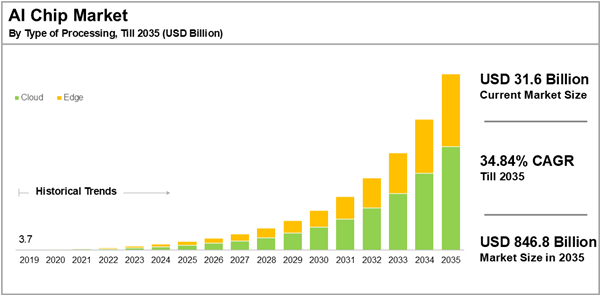
AI Chip Market Forecasted to Explode
This explosive growth forecast visually reinforces the SWOT analysis, justifying the unprecedented capital expenditures by hyperscalers listed as a key strength.
(Source: Yahoo Finance UK)
- If this happens: Major tech companies like Amazon, Google, and Meta will increasingly announce smaller data centers in unconventional, power-rich locations, moving away from mega-campuses in strained regions.
- Watch this: An increase in partnerships between tech firms and developers of small modular reactors (SMRs), geothermal energy, or long-duration energy storage. This would signal a strategic pivot toward creating independent, resilient power islands for AI compute.
- This could be happening: Early signals from 2025 already point to this trajectory. The explicit inclusion of “energy” in the U.S.-led eight-nation alliance and analyst warnings about idle hardware confirm that securing power is now a primary strategic objective, setting the stage for more direct investment in energy generation.
Frequently Asked Questions
What is the “AI Power Wall” mentioned in the article?
The “AI Power Wall” refers to the new primary bottleneck for AI expansion, where the lack of available electrical power and grid infrastructure has surpassed semiconductor manufacturing as the main constraint. It means that even though companies have enough AI chips, they cannot deploy them because there isn’t sufficient power to run and cool the data centers, a problem that became critical in 2025-2026.
Why is power a bigger problem now than it was a few years ago?
Between 2021 and 2024, the main challenge was manufacturing advanced chips and components like HBM and CoWoS packaging. The industry successfully increased production, creating a large supply of AI hardware. However, the process of upgrading power grids, substations, and transmission lines is much slower and more complex. This created a mismatch where the hardware is ready but the power infrastructure is not, leading to reports of idle chip inventories in late 2025.
How are big tech companies and governments trying to solve this power problem?
They are responding with massive capital investment and strategic alliances. Big Tech hyperscalers like Google, Amazon, and Meta are projected to spend up to $400 billion on data centers and related hardware. At the same time, governments are forming partnerships, such as the U.S.-led eight-nation alliance, to secure supply chains for energy and critical minerals, acknowledging that hardware is useless without power.
How does the energy demand of AI compare to traditional computing?
The energy demand for AI is significantly higher. The article highlights that a single ChatGPT query requires nearly 10 times the electricity of a standard Google search. On a macro scale, the net additional power demand from AI data centers in just the first quarter of 2024 was equivalent to the entire consumption of a country like Sweden, illustrating the immense strain AI is placing on global power grids.
How is this power shortage affecting where new data centers are being built?
The availability of power is now the main factor dictating the location of new AI data centers. This is causing a geographic shift away from traditional tech hubs like Northern Virginia and Silicon Valley, which have strained power grids. Companies are now actively scouting for regions with excess, stable, and affordable power, leading to a decentralization of AI compute infrastructure to new, power-rich locations.
Experience In-Depth, Real-Time Analysis
For just $200/year (not $200/hour). Stop wasting time with alternatives:
- Consultancies take weeks and cost thousands.
- ChatGPT and Perplexity lack depth.
- Googling wastes hours with scattered results.
Enki delivers fresh, evidence-based insights covering your market, your customers, and your competitors.
Trusted by Fortune 500 teams. Market-specific intelligence.
Explore Your Market →One-week free trial. Cancel anytime.
