

Xcel Energy’s AI Grid Strategy: Dominating Data Center Demand in 2025 and 2026
Xcel Energy is aggressively transforming its business model from a regulated utility into a critical infrastructure provider for the artificial intelligence economy. This strategic pivot is driven by the exponential growth in electricity demand from AI data centers, a market the company is positioning itself to both serve and leverage. Through a series of high-value partnerships and massive capital investments, Xcel is integrating AI into its core operations to manage the grid, mitigate risks, and secure its role as a primary enabler of the digital energy transition.
Xcel Energy’s AI Projects Signal a Shift to Commercial Scale in 2026
Xcel Energy’s adoption of artificial intelligence has matured from targeted operational pilots to a core component of its strategic growth, directly addressing both grid resilience and the explosive energy demands of the AI sector.
- Between 2021 and 2024, Xcel’s AI initiatives were focused on internal optimization and risk mitigation, including pilot programs with Pano AI for wildfire detection in Colorado, the use of the AVEVA PI System for wind forecasting, and the initial development of an internal chatbot with Databricks.
- Starting in 2025, the strategy accelerated dramatically towards commercial enablement of the AI economy, marked by a doubled data center capacity target of 6 GW by 2027 and major partnerships with Next Era Energy and GE Vernova to build new generation specifically for this market.
- This shift is further validated by a power supply agreement to provide up to 200 MW to Fermi America’s AI campus in Texas starting in January 2026, demonstrating a clear move from internal AI application to powering external AI infrastructure.
- The application of AI has also scaled, with the Pano AI wildfire detection system expanding from Colorado to over 57 stations in Texas and 38 planned for Minnesota, moving from a localized solution to a multi-state operational standard.
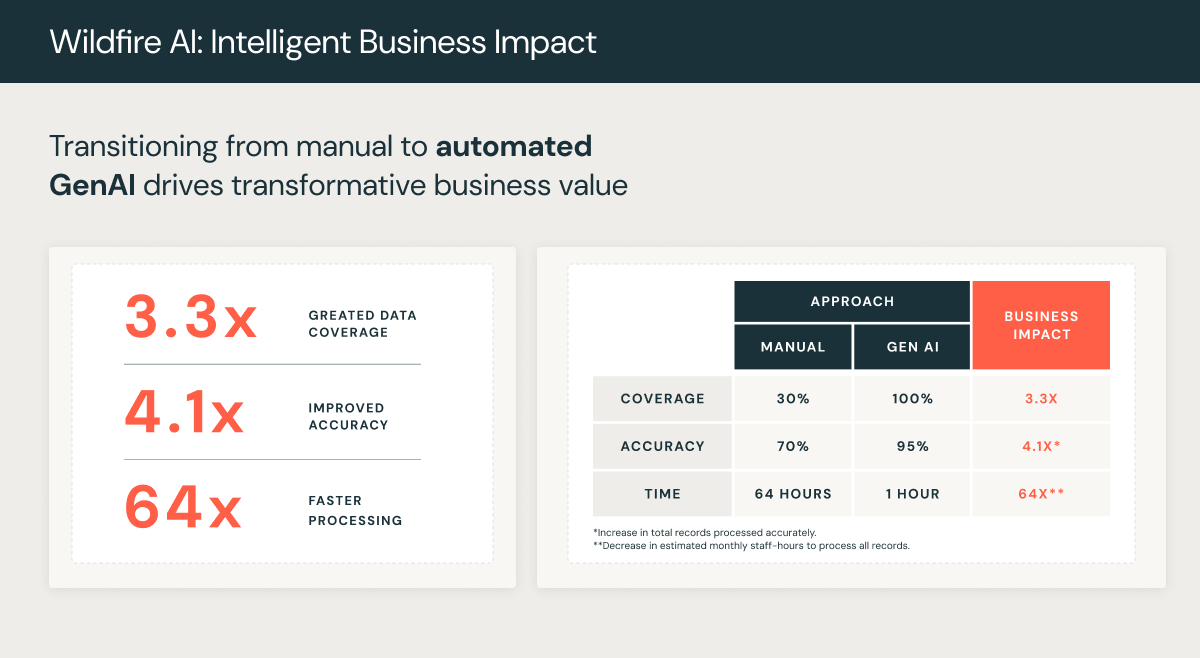
GenAI Improves Wildfire Management
This chart quantifies the operational improvements from using AI for wildfire management, directly illustrating the value of the Pano AI pilot mentioned in the section.
(Source: Databricks)
Xcel Energy’s AI Investment Strategy to Meet Data Center Demand
Xcel Energy has committed to a massive capital expenditure program, directly linking its financial strategy to the infrastructure requirements of the AI industry and the modernization of its grid.
- The company’s investment focus has intensified, increasing its five-year capital plan from $45 billion in late 2024 to over $60 billion by early 2026 to support the build-out of new generation and transmission.
- This spending is highly targeted, with a reported $22 billion estimated for Colorado grid upgrades alone to handle the demand from new data centers, illustrating the scale of investment required in key markets.
- Xcel is also investing in next-generation grid technologies to support this growth, including contracts for two 1, 000 MWh multi-day battery storage systems from Form Energy, announced in February 2026.
- Federal support has validated this strategy, with a $100 million grant from the U.S. Department of Energy in late 2023 specifically allocated to boost grid resilience and wildfire mitigation efforts that utilize AI technologies.
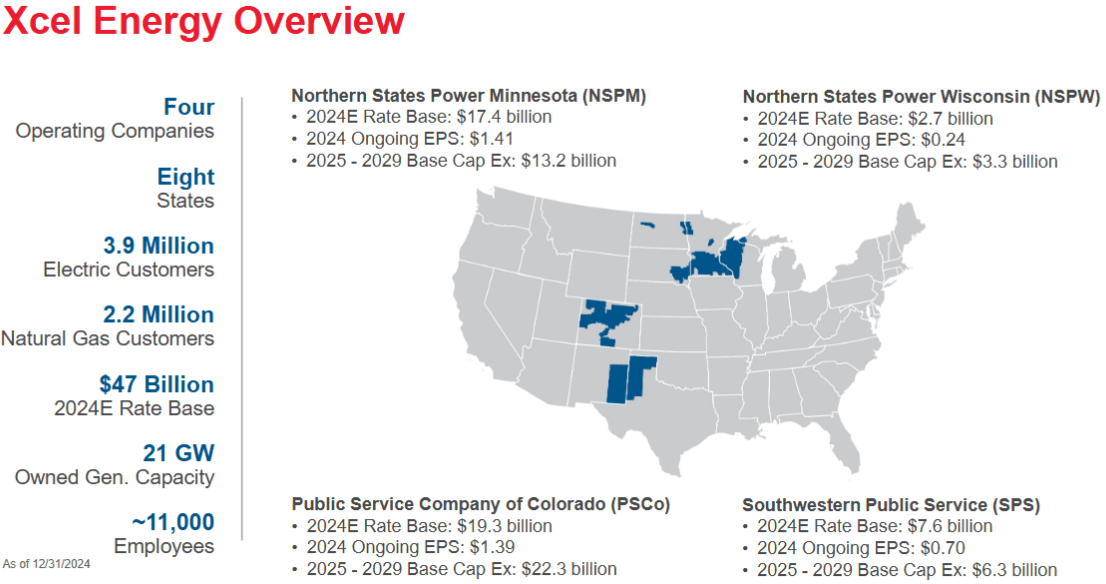
Xcel Energy Details Capital Spending by Region
This infographic is a perfect match, detailing Xcel’s capital expenditure plans and specifically highlighting the $22.3 billion for Colorado, a figure mentioned in the text.
(Source: Seeking Alpha)
Table: Xcel Energy’s Key AI and Grid Modernization Investments
| Partner / Project | Time Frame | Details and Strategic Purpose | Source |
|---|---|---|---|
| 5-Year Capital Investment Plan | 2026 | Raised five-year spending plan to over $60 billion to expand the grid and add 10.5 GW of new generation to support data centers and electrification. | Market Beat |
| Form Energy Long-Duration Batteries | 2026 | Contracted for two 10 MW / 1, 000 MWh iron-air battery systems in Colorado and Minnesota to enhance grid reliability with high renewable penetration. | Renewable Energy World |
| Colorado Data Center Grid Expansion | 2025 | An estimated $22 billion in investment is required in Colorado’s grid to meet the projected demand from new AI data centers. | Reddit / Denver Post |
| Wildfire Mitigation Plan | 2024 | Proposed a $1.82 billion plan for 2025-2027 in Colorado, including AI cameras and hundreds of weather stations to mitigate fire risk. | Xcel Energy |
| DOE Grid Resilience Grant | 2023 | Received a $100 million grant to enhance grid resilience and wildfire mitigation, partly through the use of AI-aided drones for inspections. | Xcel Energy |
Xcel Energy’s Strategic Alliances for AI Grid Integration
Xcel Energy’s partnership strategy has evolved from technology-specific pilots to large-scale alliances with energy and technology giants, reflecting its dual role as both a consumer and enabler of AI.
- In February 2026, Xcel formed critical alliances with Next Era Energy and GE Vernova to co-develop generation and grid technology, a strategic shift from earlier, smaller-scale collaborations to partnerships designed to meet gigawatt-scale data center demand.
- The partnership with Pano AI for wildfire detection, initiated as a pilot in Colorado, has scaled into a multi-state commercial deployment across Texas and Minnesota by 2025, becoming a core operational tool.
- During 2021-2024, partnerships with companies like Nokia for private LTE networks and Databricks for internal chatbots established the foundational technology stack for AI integration.
- By 2025, new partnerships with Oracle for its AI-powered Opower customer platform and with Itron and Tesla for a Virtual Power Plant (VPP) in Colorado demonstrate a focus on managing the grid impacts of new, high-density loads.
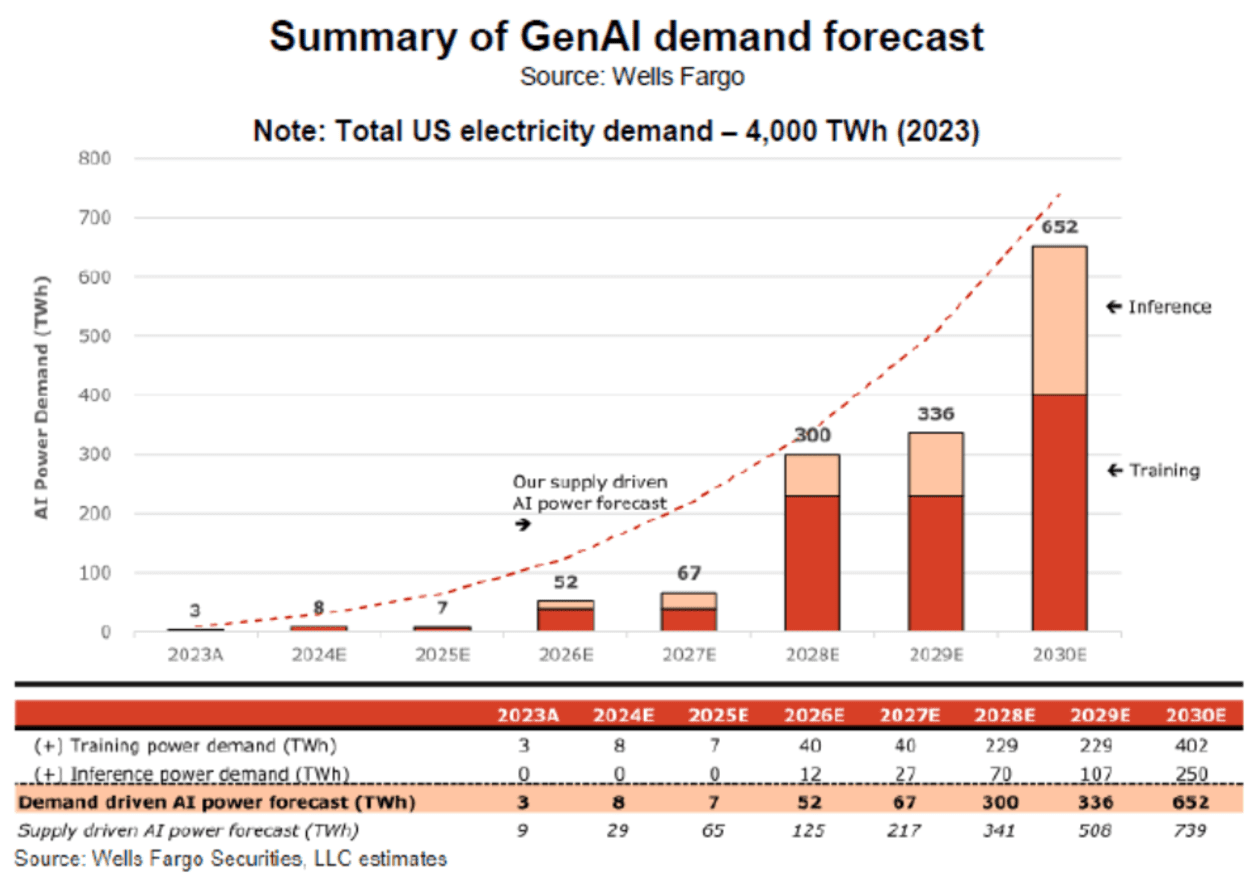
AI Power Demand Forecast to Skyrocket
This chart illustrates the massive growth in AI-driven electricity demand, providing essential context for why Xcel Energy is forming large-scale strategic alliances to meet future needs.
(Source: MarketWatch)
Table: Xcel Energy’s Key AI and Technology Partnerships
| Partner / Project | Time Frame | Details and Strategic Purpose | Source |
|---|---|---|---|
| Next Era Energy | 2026 | Signed an Mo U to co-develop generation and transmission solutions specifically targeting the electricity demand from AI data centers. | Yahoo Finance |
| GE Vernova | 2026 | Formed a strategic alliance to collaborate on AI innovations, grid modernization, and joint R&D to enhance grid reliability. | NA-Biz |
| Fermi America | 2025 | Executed a power supply agreement to provide up to 200 MW to Fermi’s Project Matador AI campus in Texas, starting in January 2026. | Stock Titan |
| Pano AI | 2023-2025 | Expanded an initial pilot to a multi-state deployment of AI cameras for early wildfire detection in Colorado, Texas, and Minnesota. | KCBD |
| Databricks | 2024-2025 | Utilized Databricks’ platform to develop a RAG-based chatbot for internal operations and for geospatial AI analysis for disaster mitigation. | Databricks |
Xcel Energy’s AI Strategy Concentrates on High-Growth US Regions
Xcel Energy’s geographic focus for AI and grid modernization is concentrated in states with significant data center growth and high climate-related risks, primarily Colorado, Minnesota, and Texas.
- Between 2021 and 2024, Colorado was the primary proving ground for AI-driven wildfire mitigation, with the initial deployment and expansion of the Pano AI camera network.
- From 2025 onwards, this geographic focus has expanded significantly, with Texas becoming a key market for both wildfire detection technology and large-scale power supply for AI campuses like Fermi America’s Project Matador.
- Minnesota has emerged as a critical hub for data center development, with Xcel securing agreements to power a new $800 million Meta facility and selling land to Microsoft for another data center, both driven by AI workloads.
- Colorado remains a central focus for grid investment, with an estimated $22 billion needed to meet data center demand and the deployment of advanced technologies like the Itron/Tesla VPP to manage grid strain.
Xcel Energy’s AI Technology Moves from Pilot to Commercial Dependency
The maturity of AI technology within Xcel Energy has rapidly progressed from isolated, proof-of-concept applications to commercially scaled systems that are now fundamental to the company’s risk management and growth strategy.
- In the 2021-2024 period, AI was in an early adoption phase, characterized by pilot projects such as the initial Pano AI camera deployment and the use of machine learning for wind forecasting with AVEVA.
- By 2025-2026, these technologies have reached commercial maturity and are being integrated at scale. The Pano AI system is now an operational standard across multiple states, and the company is developing an enterprise-wide “Xcel Data Fabric” to support dozens of high-value AI applications.
- The strategic dependency on AI is now explicit; Xcel’s ability to meet its 6 GW data center target and manage the associated grid stress relies on the successful implementation of AI for demand forecasting, VPP management, and predictive asset maintenance.
- Technologies like digital twins and physics-verified AI risk modeling, discussed at industry events in 2026, represent the next frontier, moving beyond simple data analysis to creating virtual models of the entire grid for complex simulations and decision-making.

AI Workflow for Wildfire Risk Mitigation
This flowchart visualizes a mature, systematic AI process, perfectly representing the section’s theme of AI technology moving from a simple pilot to a commercially dependent workflow.
(Source: Databricks)
SWOT Analysis of Xcel Energy’s AI Grid Strategy
Xcel Energy’s aggressive AI strategy creates significant opportunities for growth but also introduces substantial execution and financial risks that must be carefully managed.
- The company’s key strength lies in its proactive approach to capturing the AI data center market, while its main weakness is the immense capital dependency required to execute this strategy.

Xcel Projects Strong Financials Amid Investment
This table directly addresses the ‘financial risks’ and ‘capital dependency’ mentioned in the SWOT analysis by showing Xcel’s projected debt ratios and credit ratings through 2029.
(Source: Seeking Alpha)
Table: SWOT Analysis for Xcel Energy’s AI Initiatives
| SWOT Category | 2021 – 2024 | 2025 – 2026 | What Changed / Resolved / Validated |
|---|---|---|---|
| Strengths | Early adoption of AI for specific operational needs like wind forecasting (AVEVA) and wildfire pilots (Pano AI). Strong position in key markets. | Established strategic partnerships with energy majors (Next Era, GE) and tech leaders (Oracle, Tesla). A clear, articulated strategy to capture data center load growth. | The strategy shifted from reactive, problem-solving AI pilots to a proactive, market-capturing commercial strategy validated by major customer agreements (Fermi America) and capacity targets (6 GW). |
| Weaknesses | Reliance on pilot programs to prove AI value. Initial capital plans were large but not yet explicitly tied to the scale of the AI boom. | Extreme capital dependency, with a $60 billion five-year plan that requires significant regulatory approval for rate recovery. Execution risk on massive infrastructure projects. | The scale of the AI opportunity has forced a massive increase in capital expenditure, exposing the company to greater financial and execution risk than in the earlier pilot phase. |
| Opportunities | Pipeline of data center requests (6.7 GW) began to form. Federal grants for grid resilience ($100 M DOE grant) became available. | The AI data center boom is now a “once-in-a-generation” growth driver. Opportunity to become a leading utility for the AI economy and deploy next-gen tech (Form Energy storage). | The data center pipeline has transformed from a potential opportunity into the central pillar of Xcel’s growth strategy, justifying a multi-billion-dollar investment cycle. |
| Threats | Wildfire risk in Colorado was a major liability and operational threat. Regulatory uncertainty around large capital projects. | Balancing massive investments and potential rate increases with customer affordability. Intense competition from other utilities for data center projects. Physical climate risks remain. | While wildfire risk is now being managed with AI, the primary threat has shifted to financial and regulatory execution. Failure to get rate recovery for the $60 B plan could impact financial targets. |
Forward-Looking Insights: Execution of 6 GW Target is the Key Metric for 2026
The central focus for Xcel Energy moving forward is the successful execution of its ambitious plan to contract 6 GW of data center capacity by the end of 2027 while deploying its $60 billion capital plan on time and on budget.
- Progress toward the 6 GW target will be the most critical indicator of success. Watch for announcements of new large-scale power agreements with hyperscalers, similar to the Fermi America deal, as these will validate the demand forecast and investment thesis.
- The deployment of the two 1, 000 MWh Form Energy long-duration storage systems in Colorado and Minnesota will be a key milestone. The operational performance of these projects will serve as a proof point for managing a grid with high renewable penetration and massive, concentrated loads.
- Regulatory outcomes will be paramount. Monitor rate case filings related to the $60 billion capital plan, as their approval will determine the financial impact on customers and Xcel’s ability to maintain its long-term earnings growth targets.
- The return on investment from deployed AI technologies, such as quantified reductions in wildfire-related costs from the Pano AI system or peak demand reduction from the Oracle Opower platform, will signal the operational effectiveness of the strategy.
Frequently Asked Questions
What is the primary driver behind Xcel Energy’s new AI grid strategy?
The primary driver is the exponential growth in electricity demand from AI data centers. Xcel Energy is repositioning itself to capture this “once-in-a-generation” growth opportunity by becoming a critical infrastructure provider for the AI economy, with a stated goal of serving 6 GW of data center capacity by 2027.
How is Xcel Energy using AI in its own operations?
Xcel Energy is using AI for risk mitigation and grid optimization. Key examples include deploying the Pano AI camera system for early wildfire detection in Colorado, Texas, and Minnesota; using the AVEVA PI System for advanced wind forecasting; and partnering with Databricks to develop internal AI tools for geospatial analysis and disaster mitigation.
How much is Xcel Energy investing to meet this new demand?
Xcel Energy has committed to a massive capital expenditure program, raising its five-year plan to over $60 billion by 2026. This investment is targeted at building new generation (10.5 GW) and upgrading transmission infrastructure, with an estimated $22 billion required for grid upgrades in Colorado alone to support new data centers.
Who are Xcel Energy’s most important new partners in its AI strategy?
Starting in 2026, Xcel formed critical alliances with major energy and technology companies. These include Next Era Energy to co-develop generation for data centers, GE Vernova for grid modernization and AI innovation, and a power supply agreement with Fermi America to provide up to 200 MW for its AI campus in Texas.
What is the biggest risk to Xcel Energy’s strategy?
The greatest risk is the extreme capital dependency and the associated regulatory hurdles. The success of the $60 billion investment plan depends on getting approval from regulators for rate increases to recover the costs, which could face opposition. There is also significant execution risk in delivering such massive infrastructure projects on time and on budget.
